Claude Launches 'Invisible Watermark' Amid Criticism: New Model Fully Embedded, Tagging All Text

marsbitОпубліковано о 2026-08-11Востаннє оновлено о 2026-08-11

Анотація

Amidst user backlash, Anthropic announces that its latest Claude models will embed invisible watermarks directly into generated text, a move driven by compliance with the EU's AI Act. This "invisible ink," part of the text itself, is designed to persist through copying, pasting, and even some editing. The measure applies globally to all new models from August 2, 2026, with efforts underway to retroactively apply it to existing models. The system also adds signed metadata to supported image files. The watermarking technique, while not detailed by Anthropic, is speculated to potentially use invisible Unicode characters—a method the company has allegedly used before in Claude Code to discreetly tag content. The company is developing detection tools but acknowledges limitations: a watermark only indicates Claude processed the content, not authorship, and its absence doesn't guarantee human origin. Reactions are largely negative, with users criticizing the "unremovable" nature of the watermark and expressing concerns about potential impacts on output quality. In response, ideas for third-party tools to remove watermarks are already emerging, with some suggesting alternative AI models like Kimi as immediate workarounds.

Another questionable move from Company A has sparked widespread outrage online.

Just now, Anthropic announced: The new Claude will embed invisible watermarks in generated text.

Yes, not just metadata—these "ink marks" will become part of the text itself.

They will be copied and pasted along with the text to other places, and may still remain even after some degree of editing.

It's like a stubborn sticker that just won't come off...
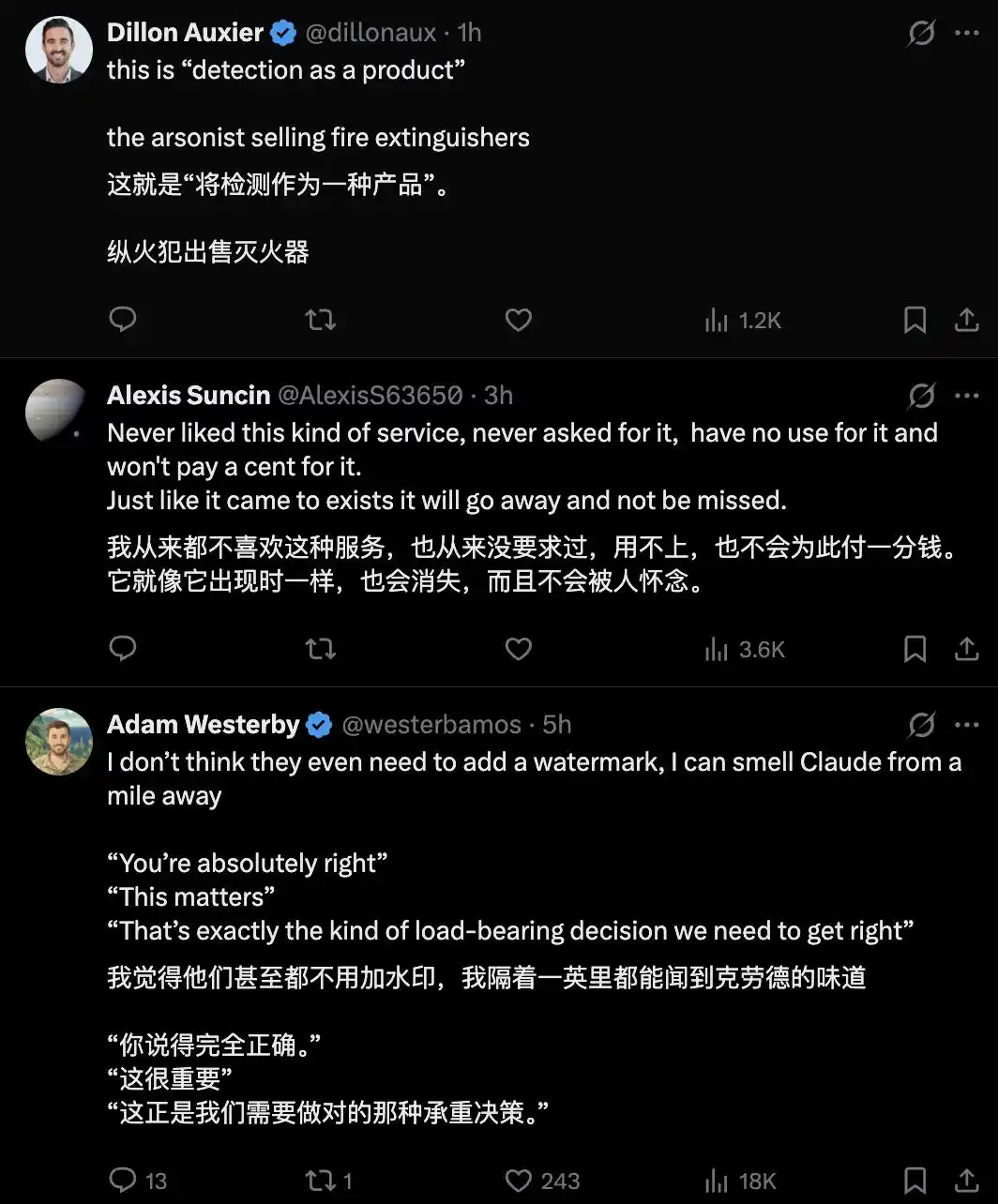
Netizens have already started voicing their anger collectively.
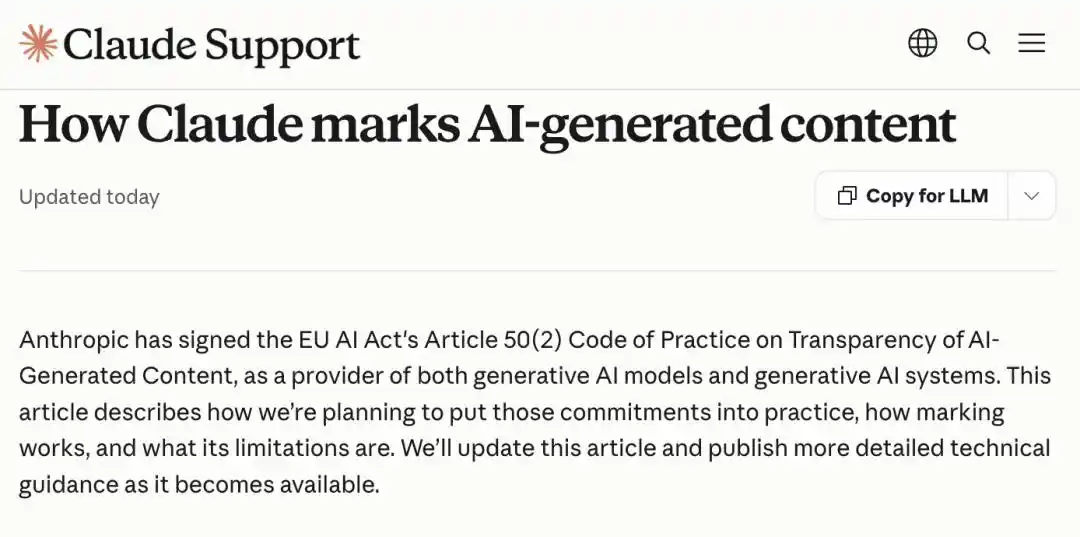
The direct driver of this move is the EU's AI Act, which Anthropic has signed. This mechanism will apply to all models released on or after August 2, 2026.

For Claude models already online, Anthropic is also researching how to add this watermarking mechanism retroactively.

Oh, and one more thing—

This measure will be implemented globally, not limited to the EU.

The great "Watermark Era" is here.

Text Gets Watermarks Too

Recently, Anthropic signed the EU AI Act's Transparency Code of Conduct for AI-Generated Content.

This code was drafted by independent experts, evaluated by the European Commission and the AI Office, and has been signed by about 190 institutions, including Google, Meta, Microsoft, OpenAI, and others.

For Claude, this translates into two specific things.

First, text watermarking.

Supported Claude models will weave a kind of invisible marker directly into the text when generating content.

Yes, completely invisible. You can't see it, and it doesn't change the meaning, quality, or readability of the response.

What's even scarier is that it's hard to get rid of.

The watermark is part of the text, copying and pasting will carry it along, and even edited versions might not be safe.

Second, signed metadata.

When Claude generates supported file types like .svg, .png, .jpg, it will attach digitally signed provenance metadata.

This metadata follows the C2PA open standard, promoted by Adobe, OpenAI, Google, and others. It can indicate the file was processed by Claude and also detect if the file has been tampered with.

The coverage is across the entire product line. API, Claude, Claude Code, Claude Cowork, Claude Tag are all included.

Cloud customers accessing Claude via AWS, Google Cloud, Microsoft Foundry will also be subject to this.

And there are no regional exceptions; it's uniformly implemented worldwide.

Meanwhile, Anthropic stated it is developing detection tools, allowing users and third parties to check whether a piece of text or a file carries the Claude marker.

Detailed technical documentation will be released by the company later.

However, Anthropic also explicitly noted the limitations of this mechanism.

Detecting a mark only indicates the content was processed by Claude, it does not confirm Claude as the original author.

After all, users often use Claude for proofreading, translation, summarization, format conversion—the core ideas and data may come from humans; marked content could also be modified, excerpted, or mixed with other materials afterward.

Conversely, not detecting a mark doesn't mean the content definitely wasn't AI-generated.

It might come from an older model, be heavily edited or rewritten, the paragraph might be too short to identify, or metadata might be stripped due to format conversion or screenshots...

Basically, everyone is under suspicion now...

As of now, Anthropic has not disclosed details of the watermarking algorithm.

In other words, no one knows what the "invisible ink" looks like, or what else Company A might be able to do with it.

Company A's Labeling Tactics

So, is there really such magic that makes watermarks in text completely invisible?

Yes.

And the tricks might be more numerous than you think.

The most famous is something called Unicode.

You can think of it as issuing ID cards to almost every character and symbol in the world: 'A' corresponds to one Unicode number, '中' (Chinese) corresponds to one Unicode number, even '🙂' corresponds to one Unicode number.

But beyond that, there exists a set of characters that are basically invisible to the human eye but distinguishable by computers.

For example, the simplest "Hello"—underneath, one might be H-e-l-l-o, and another might be H-e-invisible character-l-l-o.

They look completely identical to the human eye, but when a program reads the Unicode code points, it can find that the second string has an extra special character.

Amazing.

I wonder if everyone remembers, Company A had already "gracefully followed the trend" and used the Unicode trick before.

On June 30th, a Reddit user discovered a shocking truth after reverse-engineering Claude Code—

Claude Code's packaged files contained a set of Trojan-like code. If it detected you were a Chinese user, it would add two strokes of invisible ink to your system prompt—'Today's date is 2026-06-30'.

1. Changing the date format hyphens to slashes, marking a hit for the Chinese timezone.

2. The single quote in 'Today's' was quietly replaced with three characters that have different Unicode code points but are visually identical.

The result? In any editor, any terminal, this line looks exactly the same as the normal version. But in the program, you are already tagged.

Yes, Company A has been using Unicode to secretly tag users in Claude Code.

The company has not revealed whether the new Claude watermark uses this approach.
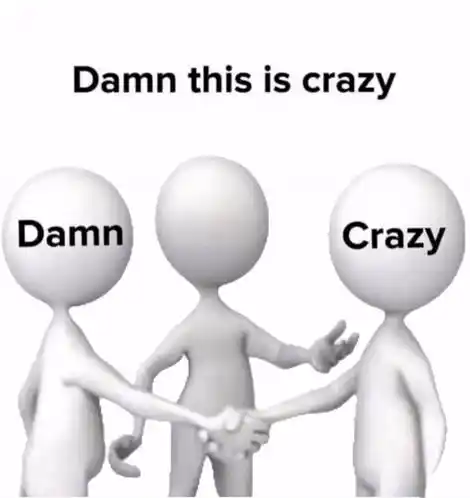
Looking at it this way, text watermarks might not be so bad, right? At least you won't get your account banned...

Moreover, various AI detection tools are of mixed quality, often charging dozens per detection and giving an AI-generated probability number with no logical basis. Having an official labeling channel could at least save a lot of wasted money.

The main reason for everyone's anger is Company A's history of similar actions.

But thinking carefully, AIGC content does need a reliable detection system, just like OpenAI adding C2PA metadata and SynthID watermarks to images.

However, does embedding watermarks by restricting the model's sampling distribution really not affect generation quality?

Company A's statement is—

No, it doesn't.

I remain skeptical.

After all, since version 4.6, Claude has been increasingly incomprehensible.

One More Thing

Regardless, the "Avengers Alliance" against Anthropic has already begun to act!

YC founder Paul Graham has already hatched a new startup idea, just waiting for aspiring individuals to join!

Create a third-party regeneration function, rephrase the text, preserving the original meaning while removing the watermark.
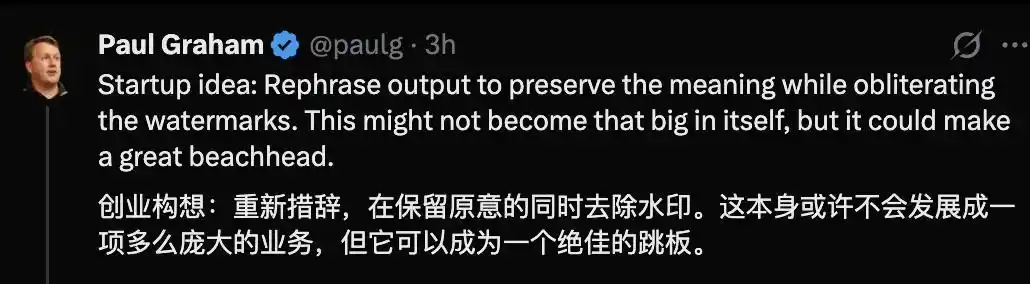
Of course, a more lightweight solution, usable by everyone right now, has also emerged—

Kimi, remove that invisible watermark.

Reference Links:

[1]https://support.claude.com/en/articles/16266773-how-claude-marks-ai-generated-content

[2]https://x.com/atharvabuilds/status/2086920300441268579?s=20

This article is from the WeChat public account "QbitAI", author: Jay

Трендові криптовалюти

Пов'язані питання

QWhat is the main content of the EU's AI Act that Anthropic has signed, as mentioned in the article?

AThe main content is the 'AI-Generated Content Transparency Code of Conduct,' which requires the embedding of invisible watermarks into generated text and adding signed metadata to supported file types like .svg, .png, and .jpg, in compliance with the C2PA open standard.

QAccording to the article, what are the two specific measures Claude will implement regarding content marking?

AThe two measures are: 1) Embedding invisible, non-removable watermarks directly into the generated text itself. 2) Adding digitally signed provenance metadata to supported file types such as .svg, .png, and .jpg.

QWhat is one limitation of the watermarking and metadata system as acknowledged by Anthropic?

AA key limitation is that detecting a mark only proves the content was processed by Claude, but does not confirm Claude as the original author. Conversely, the absence of a mark does not guarantee the content is human-generated, as it could come from an older model, be heavily edited, or have metadata stripped during format conversion.

QWhat technique from the article's past example did Anthropic allegedly use to covertly mark content for Chinese users?

AIt allegedly used Unicode characters—specifically, changing date format hyphens to slashes and replacing a standard apostrophe in "Today's" with three visually identical but different Unicode code points—to invisibly tag content generated for users in the China timezone.

QWhat are two potential user reactions or solutions mentioned in the article regarding the new watermarking policy?

ATwo reactions/solutions mentioned are: 1) A startup idea from YC founder Paul Graham to create a third-party service that rephrases content to remove watermarks while preserving meaning. 2) A suggested immediate workaround of using another AI (like Kimi) with the prompt 'Remove that invisible watermark.'

Пов'язані матеріали

Fed Research: Crypto Investors Driven by Beliefs, Returns Change Their Decisions

A new working paper from the Federal Reserve Bank of Cleveland provides a novel explanation for cryptocurrency's divergence from traditional financial assets. It finds that American crypto investors are distinguished not by demographics or risk tolerance alone, but by their radically different beliefs about future returns. This divergence in expectations better explains who owns crypto than factors like age or income, a reversal of the pattern seen with stocks or bonds. The research, based on surveys of up to 25,000 US households, shows crypto owners expected an average 22% annual return, compared to just 7% for non-owners. A one-percentage-point increase in an individual's expected return was linked to a 0.8-point rise in ownership likelihood. A randomized experiment revealed that simply showing information about Bitcoin's past 12-month performance increased respondents' desired crypto portfolio share by about 47% and spurred subsequent purchases, primarily among those who previously felt uninformed. The study suggests this dynamic—where past gains attract new buyers, pushing prices higher and reinforcing bullish beliefs—could fuel speculative bubbles. It also indicates crypto wealth gains are treated more like "gambling winnings" than permanent income, boosting purchases of durable goods but not everyday spending. The broader conclusion is that crypto volatility stems partly from investor disagreement and learning, not just market fundamentals. With widespread misunderstanding and shifting expectations driven by performance data, price swings are likely to remain a defining feature of the asset class. Future retail demand may depend not just on Bitcoin's price, but on what information investors receive about its past performance.

cryptonews.ru4 год тому

Fed Research: Crypto Investors Driven by Beliefs, Returns Change Their Decisions

cryptonews.ru4 год тому

Торгівля

Спот

Популярні статті

Як купити MOVE

Ласкаво просимо до HTX.com! Ми зробили покупку Movement (MOVE) простою та зручною. Дотримуйтесь нашої покрокової інструкції, щоб розпочати свою криптовалютну подорож.Крок 1: Створіть обліковий запис на HTXВикористовуйте свою електронну пошту або номер телефону, щоб зареєструвати обліковий запис на HTX безплатно. Пройдіть безпроблемну реєстрацію й отримайте доступ до всіх функцій.ЗареєструватисьКрок 2: Перейдіть до розділу Купити крипту і виберіть спосіб оплатиКредитна/дебетова картка: використовуйте вашу картку Visa або Mastercard, щоб миттєво купити Movement (MOVE).Баланс: використовуйте кошти з балансу вашого рахунку HTX для безперешкодної торгівлі.Треті особи: ми додали популярні способи оплати, такі як Google Pay та Apple Pay, щоб підвищити зручність.P2P: Торгуйте безпосередньо з іншими користувачами на HTX.Позабіржова торгівля (OTC): ми пропонуємо індивідуальні послуги та конкурентні обмінні курси для трейдерів.Крок 3: Зберігайте свої Movement (MOVE)Після придбання Movement (MOVE) збережіть його у своєму обліковому записі на HTX. Крім того, ви можете відправити його в інше місце за допомогою блокчейн-переказу або використовувати його для торгівлі іншими криптовалютами.Крок 4: Торгівля Movement (MOVE)Легко торгуйте Movement (MOVE) на спотовому ринку HTX. Просто увійдіть до свого облікового запису, виберіть торгову пару, укладайте угоди та спостерігайте за ними в режимі реального часу. Ми пропонуємо зручний досвід як для початківців, так і для досвідчених трейдерів.

486 переглядів усьогоОпубліковано 2024.12.13Оновлено 2026.08.21

Як купити MOVE

Обговорення

Ласкаво просимо до спільноти HTX. Тут ви можете бути в курсі останніх подій розвитку платформи та отримати доступ до професійної ринкової інформації. Нижче представлені думки користувачів щодо ціни MOVE (MOVE).

活动图片