Claude Code's Father's Night Shift AI Army, Fable 5 Built with Two Commands

marsbitОпубліковано о 2026-07-20Востаннє оновлено о 2026-07-20

Анотація

For the past year, Boris Cherny, creator of Claude Code, hasn't written a single line of code himself. He manages hundreds, even thousands, of AI agents that run day and night, autonomously handling tasks from writing and submitting code to fixing CI tests and gathering user feedback. His secret lies in a "loop" system, where tasks are defined and set to run repeatedly, combined with a critical "/goal" command that provides a clear, verifiable objective and a "supervisor" model to check progress. This approach transforms the programmer's role from a coder to a system designer and reviewer. At Anthropic, AI agents even collaborate in Slack channels to divide work. The recently released Fable 5 model is built for such long-term autonomous operation, featuring self-verification and the ability to understand complex charts. Effective use requires the "/goal" command for targeted tasks and "/loop" for recurring ones. To maximize efficiency, a local context system can be set up in 20 minutes, providing the AI with persistent memory of your projects, preferences, and procedures. The key takeaway is that the future lies not in prompting AI for each step, but in building autonomous systems driven by clear, verifiable goals.

For the past year, he hasn't written a single line of code by hand.

He submits dozens of PRs every day, and one day hit 150, setting a personal record.

What's even more outrageous is that he has hundreds of AI agents running simultaneously on his side, and thousands more work the night shift for him.

This was personally stated by Boris Cherny, the father of Claude Code, during a recent public discussion with developers.
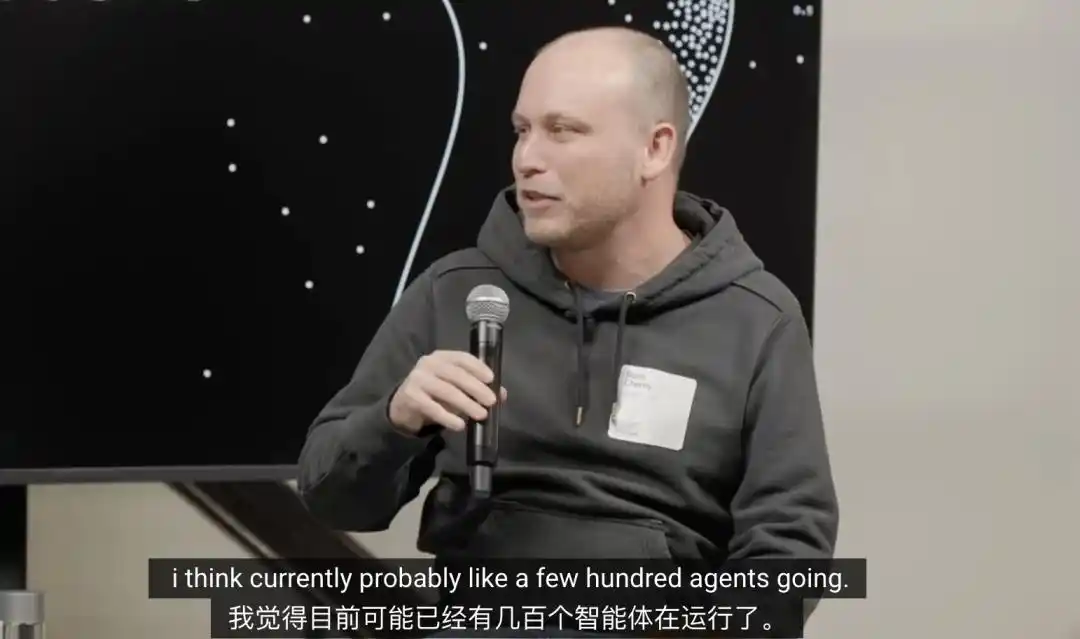

He has the Claude app open on his phone, with a small code tab on the left, containing 5 to 10 concurrent sessions.

Under each session is a cluster of agents, hundreds running during the day, and once night falls, thousands start doing deeper work.

The models write all the code, he doesn't touch a single line.

For him, the task of programming has been solved.

How Can One Person Manage Thousands of Agents?

One person manages thousands of agents, having them all modify code in the same repository simultaneously, without losing control, fighting each other, or creating piles of garbage.

Boris's secret lies behind one word: Loop.

He says a Loop is the simplest yet most useful thing he's seen; Loops are the future.

The essence of a Loop is letting Claude schedule a repeatable task using a cron job—every minute, every five minutes, daily, as you set it. Once it's running, it basically requires no management.

He has dozens of Loops running perpetually:

One specifically monitors his PRs, automatically fixing continuous integration (CI) and rebasing;

One is responsible for keeping CI healthy, fixing any unstable tests itself;

And another scrapes user feedback from X every 30 minutes, clusters and organizes it, then submits it to him.

More crucially, later on, even the step of initiating a Loop rarely requires Boris to speak up.

Once he just asked the model to run a data query, and the model replied: "I noticed this data keeps changing, so I'll start a Loop and give you a report every 30 minutes."

He said okay, just send it to my Slack. The model then handled the matter.

Not long ago, Boris also mentioned he no longer writes prompts, only loops.

Soon, he might not even need to write loops.

Agents

Are Redefining "Getting Work Done"

Behind this, "getting work done" itself is changing.

In the past, it was you writing a line, AI answering, you writing the next line; now, it's you building a small system that can find work, do it, and submit it on its own, then you walk away.

Anthropic recently launched Routines, moving the same mechanism to the server side. Close your laptop, and it still runs.

The role of "engineer" is also being rewritten in Boris's case:

The model writes the code, he's responsible for building the system and acceptance testing. Dozens to hundreds of PRs emerge daily from the agents. His real job is deciding which can be merged and which need to be sent back.

In his words, this is not "AI replacing engineers," but humans transitioning from operators and executors to designers of automated systems: the focus shifts from "writing this line of code correctly" to "building a system that can write code correctly on its own."

He even predicts that in another year, security steps like prompt injection protection, command validation, and manual approval will become less important because models will become increasingly conscientious about doing the right thing.

And this approach is no longer just his personal play.

According to Boris, there's hardly any manual coding left in the company; even SQL is written by models. It's hard to find a few lines of code still typed by a human in the entire company.

Even more surreal is another scene. When his Claude agents are writing code in a Loop, they'll go to Slack themselves, chat with colleagues' Claude agents, aligning on things no one has figured out yet.

A group of AIs holding meetings in a Slack channel, dividing up the work, and going back to do it—this is daily routine at Anthropic.

Even more intense is the team composition: engineering managers, product managers, designers, data scientists, finance, user researchers—everyone is writing code.

The functions remain, but everyone has gained an extra layer of general capability: "orchestrating AI to get work done," becoming cross-disciplinary generalists.

From Writing Prompts to Writing Loops

The Gap Lies in a Step Called Acceptance

How can an AI that works autonomously infinitely not be a machine producing bugs at high speed?

The answer lies in a step most people overlook: acceptance.

A Loop can run autonomously without going off the rails, relying on a "goal-driven" mechanism, corresponding to the /goal command in Claude Code.

You give it a goal, like "All unit tests under /tests/ pass, linting clean." After each step, a separate, smaller model judges: Is it done? If not, keep going; if yes, stop.

This "supervising model" responsible for scoring is not the one doing the work.

This simple design is precisely the heart of the entire loop.

Without it, a Loop running all night could very well be a machine that's asleep yet still bulk-submitting garbage code, and doing so righteously.

Boris verified this long ago.

When sharing his workflow previously, he gave this piece of advice: the most important step to squeeze the utmost out of Claude Code is to give it a way to verify its own work.
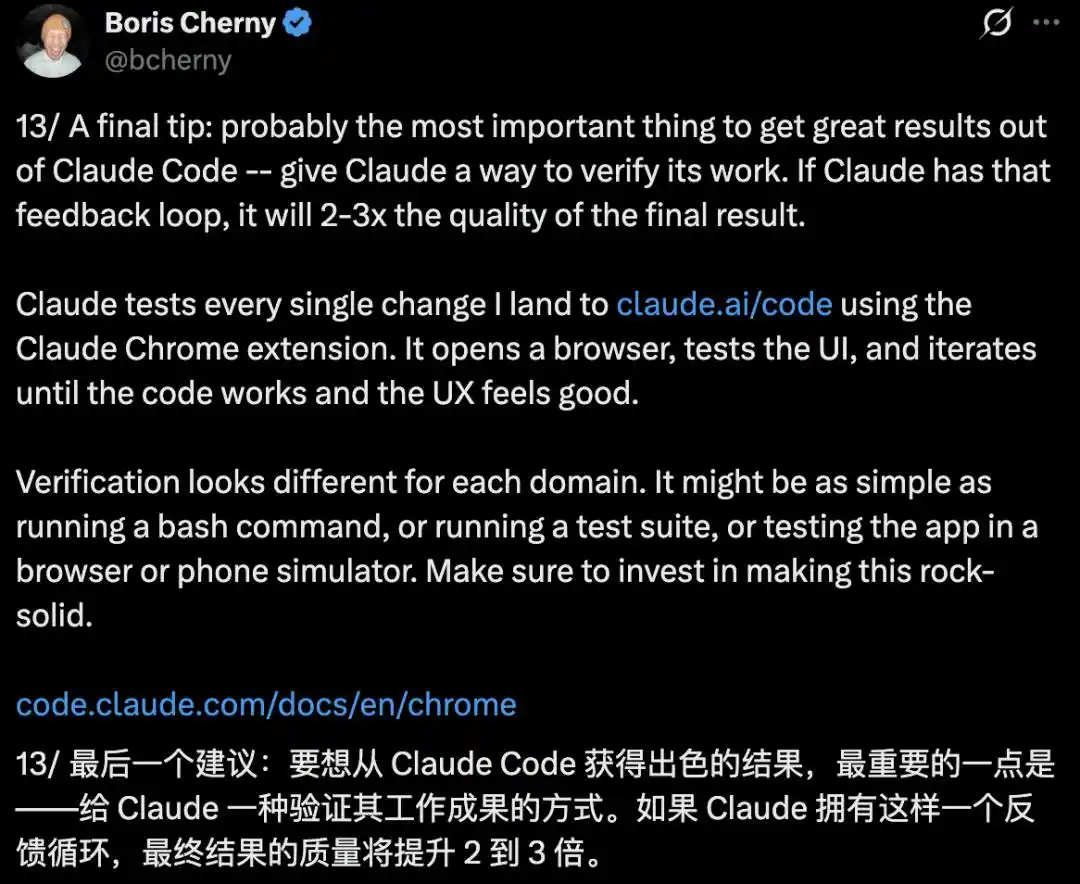
Once this feedback loop is established, output quality typically improves by 2 to 3 times.

A single action of "making AI check itself" is equivalent to upgrading a generation of models.

This Cycle is Usable by Ordinary People Too

The aforementioned cycle has been turned into a product; ordinary people can use it just the same.

After the release of Fable 5, a widely circulated tutorial on X stated, after three weeks of hands-on testing by the author: Most people use Fable 5 like they use ordinary Claude, which is a complete waste of what truly makes it worth paying for.

The author first points out three capabilities that distinguish Fable 5 from all previous Claude models.
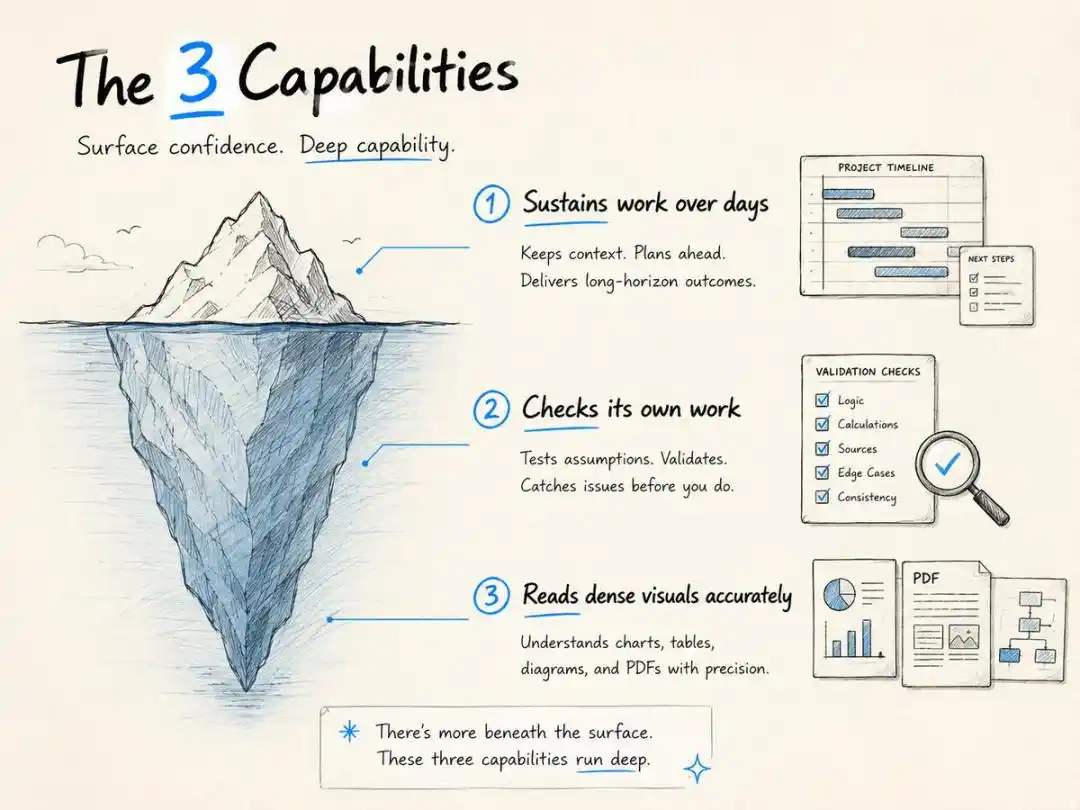
The three major capabilities of Fable 5 summarized in the tutorial: Long-term autonomous work, self-verification, understanding dense charts.

First, it can work continuously for days, not minutes.

Previous models were sprinters; Fable 5 is the first model built for "long-term autonomous work."

In Claude Code, you can give it an entire multi-day project; it plans in phases itself, dispatches sub-agents, and keeps working until the goal is met.

Second, it checks its own work. After finishing a task, it doesn't rush to deliver; it first writes tests, runs them, catches errors, fixes them, and only then says "done."

Third, the ability to understand dense charts.

According to the author's tests, for tables in financial reports, charts embedded in PDFs, architecture diagrams, dashboard screenshots—areas where Opus 4.8 occasionally misidentified columns or confused axes—Fable 5 can read them accurately and consistently.

And to truly utilize these capabilities, it relies on two commands: /goal and /loop.

Without them, you're paying double the price for a chatbot; with them, you're buying an autonomous working employee.
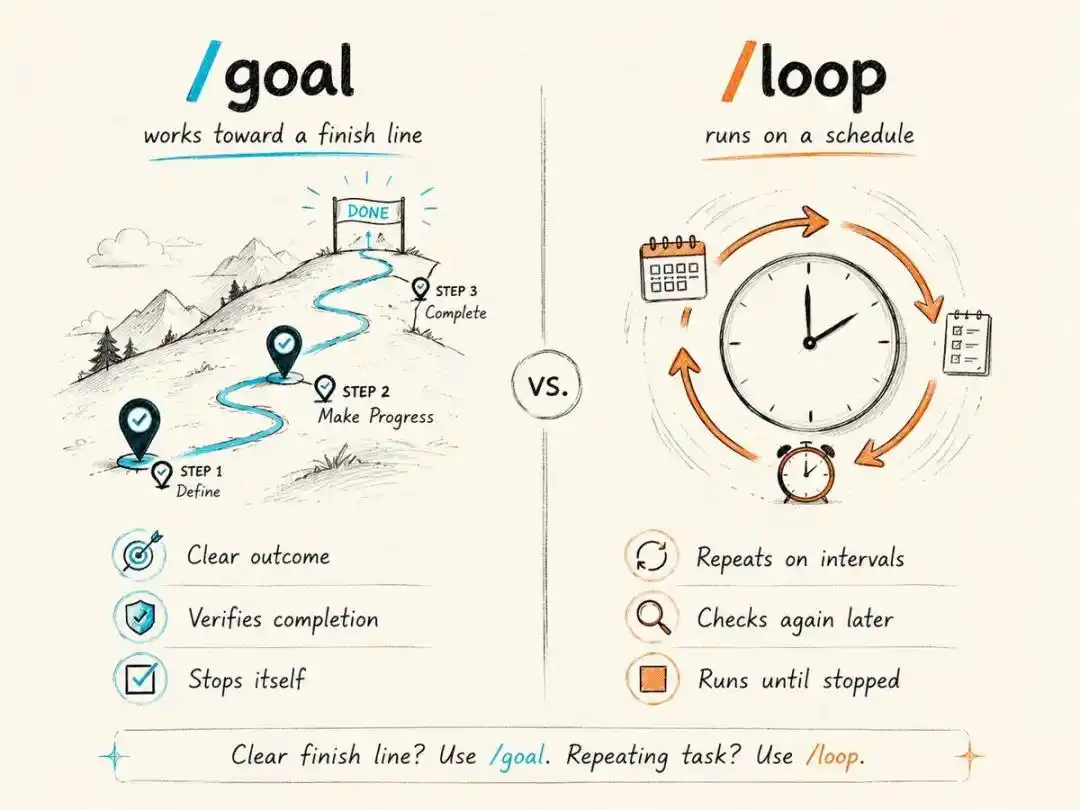
/goal runs towards the finish line and stops itself when reached; /loop runs repeatedly on schedule until you tell it to stop.

The mechanism of /goal is: you define the result, it's responsible for iteration. Whether it runs well follows an ironclad rule: write the "completion criteria" concretely, and must include an exit strategy for failure.

For example, "Improve this piece of code" is a bad goal because it's unverifiable; "All tests under /tests/ pass, only files in /src are allowed to be modified, stop and report if still failing after 3 fixes" is a good goal because each point can be verified.

/loop doesn't target a specific endpoint; it runs repeatedly on schedule until you stop it.

For example, check error logs every 30 minutes, pick out severity-level ones and report them in plain language; or scan the inbox every hour, summarize new emails, and draft replies for those needing responses.

The division of labor mantra is three sentences: For a clear endpoint, use /goal; for periodic repetition, use /loop; to keep running until a condition is met, combine both.

Before letting go, there's one more piece of very practical advice: set the spending limit first. An uncapped /goal hitting a difficult problem can burn through tokens frighteningly fast.

Making It Remember You: 20 Minutes of Local Configuration

The tutorial also mentions a step most guides skip, which is precisely the most crucial.

Fable 5 won't remember you. Every new session, it knows nothing about your business, writing style, clients, or preferences, starting from zero each time.

The solution is to set up a local context system on your own machine, which takes only 20 minutes.
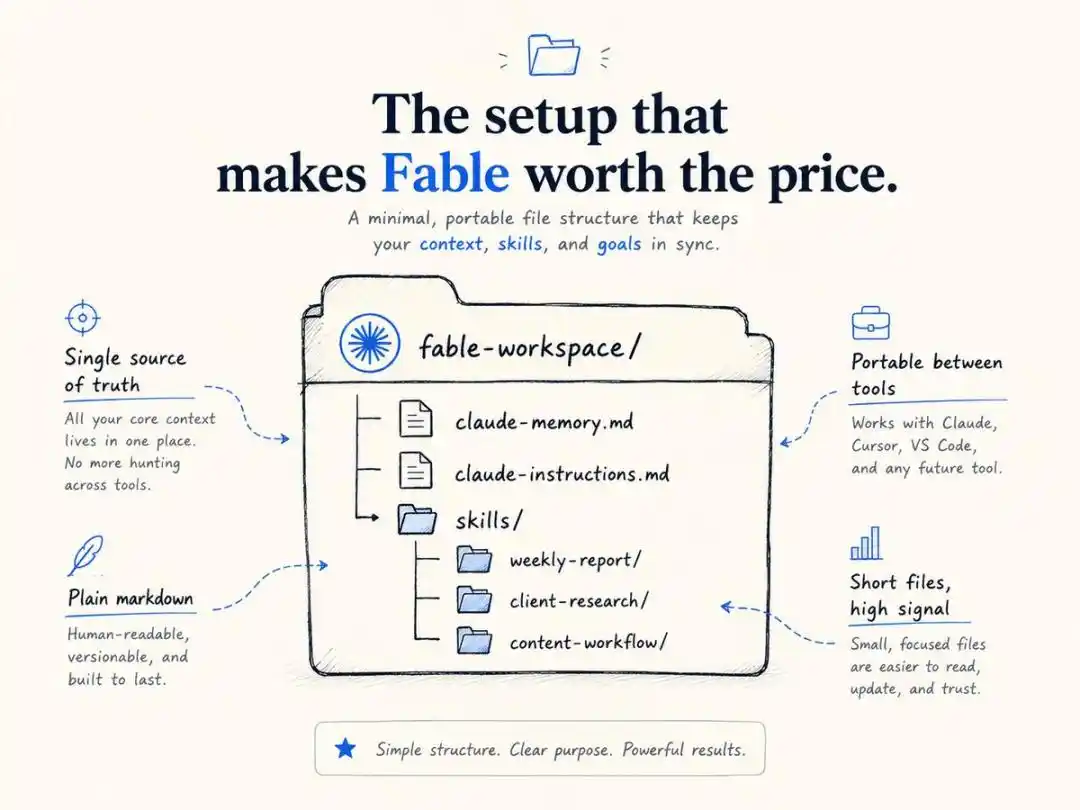
One folder, two markdown files, and a set of skills—that's all the configuration needed for Fable 5 to "know you."

It's done in four steps.

Step one, create a context folder, e.g., named `fable-workspace`, serving as the "single source of truth" it must read before starting any work.

The folder can contain items like: a one-page summary of business and priorities, standard operating procedures for frequent tasks, key information for ongoing projects, often-referenced strategic documents, plus a decision log.

Keep each file to one page; too much content eats up the context window.

Step two, create a memory file `claude-memory.md`, and leave an instruction: Whenever I mention important information about business, preferences, or situation, update the key points into it, keep it brief, and date it.

From then on, it updates itself. Mention a new client once, and it already knows in the next session.

Step three, create an instruction file `claude-instructions.md`, clearly stating behavioral rules for each session: read the memory file before starting work, check past decisions before giving advice, ask if unsure—don't guess, proactively report after finishing work and mark areas needing human review.

Step four, in Claude Code, use `/add` to point to this folder, or write into CLAUDE.md. Once connected, at the start of every session, it already comes loaded with your full context.

This configuration has another benefit: if you switch to another AI tool someday, you can directly package and take your context with you.

Regarding saving money, there's an 80/20 approach: only use Fable 5 for that 20% of tasks that truly leverage its strengths.

In Claude Code, Fable can also dispatch cheaper sub-agents to do rough work: it comes up with the plan, Sonnet, Haiku, etc., execute it, and finally, it returns to validate.

At this point, you'll realize Boris's "Night Shift AI Army" breaks down to just three things:

A model that works autonomously, a set of standards defining "done," and a cycle that runs on schedule.

The model and the cycle are already in place.

What's truly scarce is the person who can clearly explain to the model "what a finished task looks like."

References:

https://safe.ai/blog/significant-increase-in-digital-labor-automation

https://x.com/free_ai_guides/status/2073050543027638443

https://youtu.be/SlGRN8jh2RI

https://x.com/bcherny/status/2007179861115511237

This article is from WeChat public account "Xinzhiyuan", edited by: Yuanyu

Трендові криптовалюти

Пов'язані питання

QWhat is the core concept that allows Claude Code's creator to manage thousands of AI agents simultaneously without chaos?

AThe core concept is the 'Loop'. It involves setting up timed, automated tasks (like code fixes, CI health checks, or user feedback collection) that run periodically (e.g., every minute, 5 minutes, or daily) with minimal human oversight. This enables continuous, self-directed work by AI agents.

QAccording to the article, how is the role of an 'engineer' being redefined in Boris's workflow?

AThe role is shifting from being a hands-on coder to a designer and manager of automated systems. The engineer sets up the systems (like Loops), defines goals, and acts as a reviewer/approver for the code (PRs) generated by AI agents, rather than writing the code line-by-line themselves.

QWhat is the critical component that prevents an autonomous AI loop from becoming a machine that generates bugs?

AThe critical component is a 'verification' or 'acceptance' mechanism, specifically the '/goal' command in Claude Code. A separate 'supervisor' model independently checks if the AI's work meets the predefined, concrete completion criteria after each step, creating a feedback loop that ensures quality and stops the process when the goal is achieved.

QWhat are the two key commands in Fable 5 that users must utilize to unlock its potential for autonomous work?

AThe two key commands are '/goal' and '/loop'. '/goal' is for tasks with a clear end state, where the AI iterates until the goal is met. '/loop' is for recurring, periodic tasks that run until manually stopped. Using them transforms Fable 5 from a chatbot into an autonomous worker.

QWhat practical setup does the article suggest to make Fable 5 'remember' a user's context across different sessions?

AIt suggests creating a local context system with a dedicated folder (e.g., 'fable-workspace'). This folder should contain concise Markdown files summarizing the business, priorities, operating procedures, and active projects. A 'claude-memory.md' file is used for the AI to self-update with important user information, and a 'claude-instructions.md' file defines session behavior rules. This folder is then linked to Claude Code via the '/add' command or a CLAUDE.md file.

Пов'язані матеріали

Dialogue with Jia Hang | Looking Back at Two Decades of Chinese Payment Going Global

**Summary: A Conversation with Jia Hang on Two Decades of China's Payment Globalization** Jia Hang, a veteran with over twenty years in payments, reflects on China's attempts to build a global payment network through three key phases: UnionPay (card networks), Alipay+ (digital wallets), and now, stablecoins. His journey began at UnionPay International, aiming to establish China's card network abroad. While successful in following Chinese tourists ("where Chinese go, UnionPay goes"), it struggled to achieve true global scale. The core lesson: card networks like Visa/Mastercard's unassailable advantage isn't just technical standards, but their deeply entrenched **governance and profit-sharing models** that create powerful network effects. Competing as the "same species" is nearly impossible. At Ant Group, he led Alipay+, a strategy to bypass card networks by interconnecting local e-wallets worldwide. While innovative, it faced a similar ceiling. Mobile QR payments and card swipes were essentially **the same species competing for the same pie**, lacking a disruptive value proposition for users or a sustainable new incentive model to replace the card networks' established flywheel. Today, at Singapore's DCS, Jia focuses on stablecoin-based payments. He argues stablecoins represent a fundamental shift. They are not competing with Visa for consumer payments but challenging the **traditional banking and account system for value movement**. Products like "U Cards" (stablecoin-linked payment cards) are transitional, leveraging existing card networks for acceptance while building new rails. The real potential lies in stablecoins enabling seamless, low-cost global value transfer, potentially reorganizing the financial infrastructure around **accounts rather than cards**. Jia believes stablecoin adoption for local retail payments, cross-border transactions, and as high-yield savings vehicles is becoming irreversible. This could gradually reduce reliance on traditional fiat channels, especially in regions with weak currencies or capital controls. The quest for the "next global payment network" continues, now centered on whether stablecoins can successfully bridge Web2 and Web3, establish new governance, and create compelling user value beyond mere cost reduction.

marsbit11 хв тому

Dialogue with Jia Hang | Looking Back at Two Decades of Chinese Payment Going Global

marsbit11 хв тому

Circle's Stock Price Plunges 76%, Hong Kong Dollar Stablecoin Set to Launch Within Two Weeks

Circle's stock price has plunged approximately 76% from its 2023 peak, reflecting a major market revaluation. Despite this, Circle President Heath Tarbert emphasized the company's focus on long-term execution and its dominant position with USDC's $73 billion circulation across 34 blockchains. The competitive landscape is intensifying. A new consortium-backed stablecoin, Open USD, is attempting to challenge incumbents by sharing reserve yields with partners. More significantly, Visa's new stablecoin platform, initially supporting Open USD while also being compatible with USDC, could erode Circle's network effects. In response, Circle is expanding into real-world payments through partnerships like the one with Japan's JCB. Separately, Tether (USDT) faces a two-year compliance window under new U.S. regulations, requiring it to adjust its reserve composition away from assets like Bitcoin and loans towards cash and U.S. Treasuries. Meanwhile, in Hong Kong, Standard Chartered-backed fintech firm Dian Dian is poised to launch a licensed HKD-pegged stablecoin (HKDAP), moving the industry into a phase where the real test is integrating licensed stablecoins into actual payment flows and corporate treasury systems. The sharp decline in Circle's stock underscores a broader shift: the stablecoin market is moving from a winner-takes-all dynamic to a multi-player competitive arena where execution, compliance, and real-world utility are becoming paramount.

marsbit12 хв тому

Circle's Stock Price Plunges 76%, Hong Kong Dollar Stablecoin Set to Launch Within Two Weeks

marsbit12 хв тому

Amidst Capital's Encirclement, Decentralization is the Sole Defense for Public Blockchains

In a landscape dominated by power and profit motives, the author argues that decentralization is not merely one desirable feature among many in blockchain design—it is the singular, non-negotiable defense against corporate and capital capture. The article adopts a Machiavellian, realist perspective on human institutions, positing that businesses will inevitably attempt to co-opt any valuable network to protect their profits and dominance. While external attacks like 51% forks are often discussed, the greater existential risk is internal capture—the gradual erosion of a protocol’s neutrality by vested interests, as seen historically with platforms like Visa and Google. The piece critiques permissioned chains, highly centralized “permissionless” layer-1s, and layer-2s without sufficient decentralization (e.g., single sequencers) as inherently vulnerable. These compromised systems, promoted by established financial players, are framed as delaying tactics to stifle truly open networks that threaten existing high-fee, inefficient business models. Real-world examples, such as closed enterprise consortiums that exclude competitors, illustrate how such systems cement oligopolies rather than foster innovation. The author concludes that while decentralized protocols like Ethereum are imperfect and costly to operate, they represent the only viable long-term equilibrium. In a market where value naturally flows to the most secure and neutral settlement layer, only maximally decentralized public blockchains can resist being subsumed by capital and powerful incumbents.

Foresight News22 хв тому

Amidst Capital's Encirclement, Decentralization is the Sole Defense for Public Blockchains

Foresight News22 хв тому

Who Decides the Rules of Bitcoin? BIP-110 Ignites Governance Debate

Bitcoin's governance is once again at the center of a heated debate, this time ignited by BIP-110, the "Reduced Data Temporary Softfork." This proposal aims to curb non-monetary data (like inscriptions and Runes) by introducing seven new consensus-layer restrictions over a year, such as limiting new output scripts to 34 bytes and restoring the OP_RETURN cap to 83 bytes. The controversy stems from BIP-110's fundamental shift: it moves the battle against "spam" from node relay and miner policies to the consensus layer, rendering currently valid transactions invalid. Supporters, arguing that default policy governance has failed (highlighted by Bitcoin Core v30's relaxation of OP_RETURN limits), see this as necessary to protect node resources and Bitcoin's monetary focus. Opponents, led by figures like Michael Saylor and Adam Back, warn it dangerously centralizes governance. Saylor listed 110 reasons against it, criticizing its low 55% miner activation threshold and potential for chain splits. Back emphasized Bitcoin's "permissionless" ethos, arguing no single group should impose value judgments via consensus rules. Further complicating matters, technical critiques suggest BIP-110 may be technically circumventable, and a "BlockSlop" vulnerability in its upgrade path poses a consensus risk. The debate has drawn in diverse stakeholders: miners (with pools like Ocean signaling support and Foundry polling clients), node operators (like Bitcoin Knots), and new players like corporate treasury holder MicroStrategy (Saylor), whose market influence adds a novel dimension. Ultimately, BIP-110 acts as a governance stress test, exposing the unresolved question: who decides Bitcoin's rules? It pits the authority of miners, node operators, developers, and capital holders against each other, with each side claiming to defend Bitcoin's core principles of neutrality and security.

marsbit39 хв тому

Who Decides the Rules of Bitcoin? BIP-110 Ignites Governance Debate

marsbit39 хв тому

Торгівля

Спот

Популярні статті

Що таке $S$

Розуміння SPERO: Комплексний огляд Вступ до SPERO Оскільки ландшафт інновацій продовжує еволюціонувати, виникнення технологій web3 та криптовалютних проектів відіграє ключову роль у формуванні цифрового майбутнього. Один з проектів, який привернув увагу в цій динамічній сфері, — це SPERO, позначений як SPERO,$$s$. Ця стаття має на меті зібрати та представити детальну інформацію про SPERO, щоб допомогти ентузіастам та інвесторам зрозуміти його основи, цілі та інновації в рамках web3 та крипто-сектору. Що таке SPERO,$$s$? SPERO,$$s$ — це унікальний проект у криптопросторі, який прагне використати принципи децентралізації та технології блокчейн для створення екосистеми, що сприяє залученню, корисності та фінансовій інклюзії. Проект розроблений для полегшення взаємодії між користувачами новими способами, надаючи їм інноваційні фінансові рішення та послуги. У своїй основі SPERO,$$s$ прагне надати можливості індивідам, забезпечуючи інструменти та платформи, які покращують користувацький досвід у криптовалютному просторі. Це включає в себе можливість більш гнучких методів транзакцій, сприяння ініціативам, що підтримуються спільнотою, та створення шляхів для фінансових можливостей через децентралізовані додатки (dApps). Основна концепція SPERO,$$s$ обертається навколо інклюзивності, прагнучи зменшити розриви в традиційній фінансовій системі, використовуючи переваги технології блокчейн. Хто є творцем SPERO,$$s$? Особистість творця SPERO,$$s$ залишається дещо невідомою, оскільки є обмежені публічно доступні ресурси, що надають детальну інформацію про його засновників. Ця відсутність прозорості може бути наслідком зобов'язання проекту до децентралізації — етики, яку багато проектів web3 поділяють, ставлячи колективні внески вище за індивідуальне визнання. Зосереджуючи обговорення навколо спільноти та її колективних цілей, SPERO,$$s$ втілює суть наділення без виділення конкретних осіб. Таким чином, розуміння етики та місії SPERO є більш важливим, ніж ідентифікація єдиного творця. Хто є інвесторами SPERO,$$s$? SPERO,$$s$ підтримується різноманітними інвесторами, починаючи від венчурних капіталістів до ангельських інвесторів, які прагнуть сприяти інноваціям у крипто-секторі. Зосередження цих інвесторів зазвичай узгоджується з місією SPERO — пріоритет надається проектам, які обіцяють технологічний прогрес у суспільстві, фінансову інклюзію та децентралізоване управління. Ці інвесторські фонди зазвичай зацікавлені в проектах, які не лише пропонують інноваційні продукти, але й позитивно впливають на спільноту блокчейн та її екосистеми. Підтримка з боку цих інвесторів підкріплює SPERO,$$s$ як значного конкурента в швидко змінюваній сфері крипто-проектів. Як працює SPERO,$$s$? SPERO,$$s$ використовує багатогранну структуру, яка відрізняє його від традиційних криптовалютних проектів. Ось деякі ключові особливості, які підкреслюють його унікальність та інноваційність: Децентралізоване управління: SPERO,$$s$ інтегрує моделі децентралізованого управління, надаючи користувачам можливість активно брати участь у процесах прийняття рішень щодо майбутнього проекту. Цей підхід сприяє відчуттю власності та відповідальності серед членів спільноти. Корисність токена: SPERO,$$s$ використовує свій власний криптовалютний токен, розроблений для виконання різних функцій в екосистемі. Ці токени дозволяють здійснювати транзакції, отримувати винагороди та полегшувати послуги, що пропонуються на платформі, підвищуючи загальну залученість та корисність. Шарова архітектура: Технічна архітектура SPERO,$$s$ підтримує модульність та масштабованість, що дозволяє безперешкодно інтегрувати додаткові функції та додатки в міру розвитку проекту. Ця адаптивність є надзвичайно важливою для збереження актуальності в постійно змінюваному крипто-ландшафті. Залучення спільноти: Проект підкреслює ініціативи, що підтримуються спільнотою, використовуючи механізми, які стимулюють співпрацю та зворотний зв'язок. Підтримуючи сильну спільноту, SPERO,$$s$ може краще задовольняти потреби користувачів та адаптуватися до ринкових тенденцій. Фокус на інклюзію: Пропонуючи низькі комісії за транзакції та зручні інтерфейси, SPERO,$$s$ прагне залучити різноманітну базу користувачів, включаючи осіб, які раніше не брали участі в крипто-просторі. Це зобов'язання до інклюзії узгоджується з його загальною місією наділення через доступність. Хронологія SPERO,$$s$ Розуміння історії проекту надає важливі уявлення про його розвиток та етапи. Нижче наведено пропоновану хронологію, що відображає значні події в еволюції SPERO,$$s$: Етап концептуалізації та ідеації: Початкові ідеї, що стали основою SPERO,$$s$, були сформовані, тісно пов'язані з принципами децентралізації та фокусом на спільноті в індустрії блокчейн. Запуск білого паперу проекту: Після концептуального етапу був випущений комплексний білий папір, що детально описує бачення, цілі та технологічну інфраструктуру SPERO,$$s$, щоб залучити інтерес та зворотний зв'язок від спільноти. Створення спільноти та ранні залучення: Активні зусилля були спрямовані на створення спільноти ранніх прихильників та потенційних інвесторів, що полегшило обговорення цілей проекту та отримання підтримки. Подія генерації токенів: SPERO,$$s$ провів подію генерації токенів (TGE) для розподілу своїх рідних токенів серед ранніх прихильників та встановлення початкової ліквідності в екосистемі. Запуск початкового dApp: Перший децентралізований додаток (dApp), пов'язаний з SPERO,$$s$, став доступним, дозволяючи користувачам взаємодіяти з основними функціями платформи. Постійний розвиток та партнерства: Безперервні оновлення та вдосконалення пропозицій проекту, включаючи стратегічні партнерства з іншими учасниками блокчейн-простору, сформували SPERO,$$s$ у конкурентоспроможного та еволюціонуючого гравця на крипто-ринку. Висновок SPERO,$$s$ є свідченням потенціалу web3 та криптовалют для революціонізації фінансових систем та наділення індивідів. Завдяки зобов'язанню до децентралізованого управління, залучення спільноти та інноваційно спроектованих функцій, він прокладає шлях до більш інклюзивного фінансового ландшафту. Як і з будь-якими інвестиціями в швидко змінюваному крипто-просторі, потенційним інвесторам та користувачам рекомендується ретельно досліджувати та обдумано взаємодіяти з поточними подіями в SPERO,$$s$. Проект демонструє інноваційний дух крипто-індустрії, запрошуючи до подальшого дослідження його численних можливостей. Хоча подорож SPERO,$$s$ ще триває, його основні принципи можуть справді вплинути на майбутнє того, як ми взаємодіємо з технологією, фінансами та один з одним у взаємопов'язаних цифрових екосистемах.

136 переглядів усьогоОпубліковано 2024.12.17Оновлено 2024.12.17

Що таке $S$

Що таке AGENT S

Агент S: Майбутнє автономної взаємодії в Web3 Вступ У постійно змінюваному ландшафті Web3 та криптовалюти інновації постійно переосмислюють, як люди взаємодіють з цифровими платформами. Один з таких новаторських проектів, Агент S, обіцяє революціонізувати взаємодію людини з комп'ютером через свою відкриту агентну структуру. Прокладаючи шлях для автономних взаємодій, Агент S прагне спростити складні завдання, пропонуючи трансформаційні застосування в штучному інтелекті (ШІ). Це детальне дослідження заглиблюється в складності проекту, його унікальні особливості та наслідки для сфери криптовалюти. Що таке Агент S? Агент S є революційною відкритою агентною структурою, спеціально розробленою для вирішення трьох основних викликів в автоматизації комп'ютерних завдань: Набуття специфічних знань у галузі: Структура інтелектуально навчається з різних зовнішніх джерел знань та внутрішнього досвіду. Цей подвійний підхід дозволяє їй створити багатий репозиторій специфічних знань у галузі, покращуючи її продуктивність у виконанні завдань. Планування на довгих горизонтах завдань: Агент S використовує планування з підкріпленням досвіду, стратегічний підхід, який полегшує ефективний розподіл та виконання складних завдань. Ця функція значно підвищує її здатність ефективно та результативно управляти кількома підзавданнями. Обробка динамічних, неоднорідних інтерфейсів: Проект представляє Інтерфейс Агент-Комп'ютер (ACI), інноваційне рішення, яке покращує взаємодію між агентами та користувачами. Використовуючи багатомодальні великі мовні моделі (MLLMs), Агент S може безперешкодно орієнтуватися та маніпулювати різноманітними графічними інтерфейсами користувача. Завдяки цим новаторським функціям Агент S надає надійну структуру, яка вирішує складнощі, пов'язані з автоматизацією людської взаємодії з машинами, прокладаючи шлях для численних застосувань у ШІ та за його межами. Хто є творцем Агент S? Хоча концепція Агент S є фундаментально новаторською, конкретна інформація про його творця залишається невідомою. Творець наразі невідомий, що підкреслює або початкову стадію проекту, або стратегічний вибір зберегти засновників у таємниці. Незважаючи на анонімність, акцент залишається на можливостях та потенціалі структури. Хто є інвесторами Агент S? Оскільки Агент S є відносно новим у криптографічній екосистемі, детальна інформація про його інвесторів та фінансових спонсорів не задокументована. Відсутність публічно доступних відомостей про інвестиційні фонди або організації, що підтримують проект, викликає питання щодо його фінансової структури та дорожньої карти розвитку. Розуміння підтримки є критично важливим для оцінки стійкості проекту та потенційного впливу на ринок. Як працює Агент S? В основі Агент S лежить передова технологія, яка дозволяє йому ефективно функціонувати в різних умовах. Його операційна модель побудована навколо кількох ключових функцій: Взаємодія з комп'ютером, подібна до людської: Структура пропонує розширене планування ШІ, прагнучи зробити взаємодії з комп'ютерами більш інтуїтивними. Імітуючи людську поведінку при виконанні завдань, вона обіцяє підвищити досвід користувачів. Наративна пам'ять: Використовується для використання високорівневого досвіду, Агент S використовує наративну пам'ять для відстеження історій завдань, тим самим покращуючи свої процеси прийняття рішень. Епізодична пам'ять: Ця функція надає користувачам покрокові інструкції, дозволяючи структурі пропонувати контекстуальну підтримку в міру виконання завдань. Підтримка OpenACI: Завдяки можливості працювати локально, Агент S дозволяє користувачам зберігати контроль над своїми взаємодіями та робочими процесами, узгоджуючи з децентралізованою етикою Web3. Легка інтеграція з зовнішніми API: Його універсальність і сумісність з різними платформами ШІ забезпечують те, що Агент S може безперешкодно вписатися в існуючі технологічні екосистеми, роблячи його привабливим вибором для розробників та організацій. Ці функціональні можливості колективно сприяють унікальному положенню Агент S у крипто-просторі, оскільки він автоматизує складні, багатоступеневі завдання з мінімальним втручанням людини. У міру розвитку проекту його потенційні застосування в Web3 можуть переосмислити, як відбуваються цифрові взаємодії. Хронологія Агент S Розробка та етапи Агент S можуть бути узагальнені в хронології, яка підкреслює його значні події: 27 вересня 2024 року: Концепція Агент S була представлена в комплексній науковій статті під назвою “Відкрита агентна структура, яка використовує комп'ютери як людина”, що демонструє основи проекту. 10 жовтня 2024 року: Наукова стаття була опублікована на arXiv, пропонуючи детальне дослідження структури та її оцінки продуктивності на основі бенчмарку OSWorld. 12 жовтня 2024 року: Було випущено відеопрезентацію, що надає візуальне уявлення про можливості та особливості Агент S, ще більше залучаючи потенційних користувачів та інвесторів. Ці маркери в хронології не лише ілюструють прогрес Агент S, але й вказують на його прихильність до прозорості та залучення громади. Ключові моменти про Агент S У міру розвитку структури Агент S кілька ключових характеристик виділяються, підкреслюючи її новаторський характер та потенціал: Інноваційна структура: Розроблена для забезпечення інтуїтивного використання комп'ютерів, подібного до людської взаємодії, Агент S пропонує новий підхід до автоматизації завдань. Автономна взаємодія: Здатність автономно взаємодіяти з комп'ютерами через GUI означає стрибок до більш інтелектуальних та ефективних обчислювальних рішень. Автоматизація складних завдань: Завдяки своїй надійній методології він може автоматизувати складні, багатоступеневі завдання, роблячи процеси швидшими та менш схильними до помилок. Безперервне вдосконалення: Механізми навчання дозволяють Агенту S покращуватися на основі минулого досвіду, постійно підвищуючи свою продуктивність та ефективність. Універсальність: Його адаптивність до різних операційних середовищ, таких як OSWorld та WindowsAgentArena, забезпечує його здатність служити широкому спектру застосувань. Оскільки Агент S займає своє місце в ландшафті Web3 та криптовалюти, його потенціал покращити можливості взаємодії та автоматизувати процеси означає значний прогрес у технологіях ШІ. Завдяки своїй інноваційній структурі Агент S є прикладом майбутнього цифрових взаємодій, обіцяючи більш безперешкодний та ефективний досвід для користувачів у різних галузях. Висновок Агент S представляє собою сміливий крок вперед у поєднанні ШІ та Web3, з можливістю переосмислити, як ми взаємодіємо з технологією. Хоча проект все ще на ранніх стадіях, можливості для його застосування є величезними та переконливими. Завдяки своїй комплексній структурі, що вирішує критичні виклики, Агент S прагне вивести автономні взаємодії на передній план цифрового досвіду. У міру того, як ми заглиблюємося в сфери криптовалюти та децентралізації, проекти, подібні до Агент S, безсумнівно, відіграватимуть ключову роль у формуванні майбутнього технологій та співпраці людини з комп'ютером.

757 переглядів усьогоОпубліковано 2025.01.14Оновлено 2025.01.14

Що таке AGENT S

Як купити S

Ласкаво просимо до HTX.com! Ми зробили покупку Sonic (S) простою та зручною. Дотримуйтесь нашої покрокової інструкції, щоб розпочати свою криптовалютну подорож.Крок 1: Створіть обліковий запис на HTXВикористовуйте свою електронну пошту або номер телефону, щоб зареєструвати обліковий запис на HTX безплатно. Пройдіть безпроблемну реєстрацію й отримайте доступ до всіх функцій.ЗареєструватисьКрок 2: Перейдіть до розділу Купити крипту і виберіть спосіб оплатиКредитна/дебетова картка: використовуйте вашу картку Visa або Mastercard, щоб миттєво купити Sonic (S).Баланс: використовуйте кошти з балансу вашого рахунку HTX для безперешкодної торгівлі.Треті особи: ми додали популярні способи оплати, такі як Google Pay та Apple Pay, щоб підвищити зручність.P2P: Торгуйте безпосередньо з іншими користувачами на HTX.Позабіржова торгівля (OTC): ми пропонуємо індивідуальні послуги та конкурентні обмінні курси для трейдерів.Крок 3: Зберігайте свої Sonic (S)Після придбання Sonic (S) збережіть його у своєму обліковому записі на HTX. Крім того, ви можете відправити його в інше місце за допомогою блокчейн-переказу або використовувати його для торгівлі іншими криптовалютами.Крок 4: Торгівля Sonic (S)Легко торгуйте Sonic (S) на спотовому ринку HTX. Просто увійдіть до свого облікового запису, виберіть торгову пару, укладайте угоди та спостерігайте за ними в режимі реального часу. Ми пропонуємо зручний досвід як для початківців, так і для досвідчених трейдерів.

1.7k переглядів усьогоОпубліковано 2025.01.15Оновлено 2026.06.02

Як купити S

Обговорення

Ласкаво просимо до спільноти HTX. Тут ви можете бути в курсі останніх подій розвитку платформи та отримати доступ до професійної ринкової інформації. Нижче представлені думки користувачів щодо ціни S (S).

活动图片