Clash Over Stablecoin Legislation: Big Banks Vs. The Crypto Industry

bitcoinistОпубліковано о 2026-01-14Востаннє оновлено о 2026-01-14

Анотація

The Senate Banking Committee's updated crypto market structure bill (CLARITY Act) has sparked a new battle over the GENIUS Act, which focuses on stablecoin regulation. Blockchain Association CEO Summer Mersinger claims the "Big Bank lobby" is pressuring Congress to revisit settled stablecoin reward legislation to suppress competition, not due to emerging risks. She argues that big banks, controlling assets equivalent to 60% of US GDP, offer low savings yields (0.39%) compared to the Federal Funds rate (3.50%-3.75%), and lobby against technologies providing better consumer returns by invoking "systemic risk" claims. Expert Omid Malekan criticized the notion that stablecoin holders shouldn't earn yields, advocating that interest from Treasury bills should benefit average Americans rather than bank executives. He cited JPMorgan's $25 billion net interest income as evidence of banks profiting from low saver returns, dismissing concerns that interest-paying stablecoins would harm lending. Both advocate for policies prioritizing consumer choice and fair returns.

As the Senate Banking Committee unveiled the updated draft of the crypto market structure bill, known as the CLARITY Act, another critical battle is unfolding surrounding the GENIUS Act, which focuses on stablecoin regulations. The banking lobby is pressing for significant changes, particularly regarding stablecoin rewards.

Are Big Banks Disrupting Stablecoin Competition?

Summer Mersinger, CEO of the Blockchain Association and a prominent advocate for the crypto industry in Congress negotiations, took to social media platform X (formerly Twitter) to highlight the current state of discussions following the bipartisan passage of the GENIUS Act.

She claimed that the “Big Bank lobby” is pushing Congress to revisit settled legislation concerning stablecoin rewards, not due to emerging risks but rather to suppress competition that benefits consumers.

Mersinger stated, “When Big Banks face competition, they don’t improve services. They lobby to handicap alternatives. And the consumer suffers.”

The firm’s CEO pointed out that the average American savings account currently yields only 0.39%, while checking accounts offer an even lower rate of 0.07%. In contrast, the Federal Funds rate hovers between 3.50% and 3.75%.

She argued that this discrepancy is not merely a product of market forces but stems from a substantial barrier that the major banks have constructed, preventing customers from accessing better returns.

Mersinger emphasized that the dominance of the six largest US banks, which control assets equivalent to 60% of the country’s Gross Domestic Product (GDP), only reinforces this trend.

She further stressed that when new technologies arise that can provide consumers with superior returns, the banks’ immediate response is to invoke claims of “systemic risk” while lobbying against these advancements.

Ultimately, Mersinger and her colleagues are advocating for policies that prioritize consumer options. “We urge Congress to listen,” she implored, signaling the importance of the ongoing debate between the two sectors.

Expert Advocates For Fair Returns

Market expert Omid Malekan also weighed in, criticizing the notion that stablecoin holders should not earn yields, arguing that the interest revenue generated from taxpayer-backed Treasury bills should be directed to average Americans rather than lining the pockets of bank executives and shareholders.

Malekan called for a broader discussion on capping credit card interest rates and swipe fees, along with the implementation of a windfall profit tax on the net interest margins of banks. He asserted, “An industry this anti-competition and consumer choice should suffer the consequences.”

Support for Malekan’s view was reinforced by recent earnings reports from major banks. This morning, JPMorgan Chase announced $25 billion in net interest income, illustrating the profits generated by not providing higher returns to savers. Malekan dismissed claims that stablecoins paying interest would harm lending as unfounded.

The daily chart shows the surge in the total crypto market cap on Tuesday. Source: TOTAL on TradingView.com

Featured image from DALL-E, chart from TradingView.com

Пов'язані питання

QWhat is the main conflict described in the article regarding the GENIUS Act?

AThe main conflict is between the big bank lobby and the crypto industry. The banking lobby is pushing Congress to revisit settled legislation on stablecoin rewards, which the crypto industry argues is an attempt to suppress competition rather than address any emerging risks.

QAccording to Summer Mersinger, what is the average yield on a US savings account and how does it compare to the Federal Funds rate?

AAccording to Summer Mersinger, the average US savings account yields 0.39% and the average checking account yields 0.07%. This is in stark contrast to the Federal Funds rate, which is between 3.50% and 3.75%.

QWhat argument does Omid Malekan make about who should benefit from the interest revenue generated by Treasury bills?

AOmid Malekan argues that the interest revenue generated from taxpayer-backed Treasury bills should be directed to average Americans, rather than going to bank executives and shareholders.

QWhat recent financial report was used to support the argument that banks are profiting from not providing higher returns to savers?

AA recent earnings report from JPMorgan Chase, which announced $25 billion in net interest income, was used to support the argument that banks are profiting from not providing higher returns to savers.

QWhat does Summer Mersinger claim is the typical response from big banks when new technologies offer consumers better returns?

ASummer Mersinger claims that when new technologies arise that can provide consumers with superior returns, the big banks' immediate response is to invoke claims of 'systemic risk' while lobbying against these advancements.

Пов'язані матеріали

Conversation with Blockchain Capital Partners: The Next Bull Market May Be Right in Front of Us

In a recent Bankless podcast, Blockchain Capital partners Aleks Larsen and Spencer Bogart discussed the crypto market's evolution from infrastructure to applications. They noted that widespread stablecoin adoption has built significant on-chain liquidity, boosting revenues for lending and trading protocols. The partners defended the "buyback and burn" token model, explaining its current effectiveness in aligning incentives and establishing credibility with holders, despite past debates on capital efficiency. Addressing the sentiment divide in crypto, they highlighted positive catalysts like regulatory clarity and institutional entry, even during the bear market. Aleks compared the industry's current state to the 2003-2004 internet era—post-"broadband transition" with cheap block space, awaiting mainstream adoption through applications like stablecoins and prediction markets. They observed a shift from "fat protocol" to "fat application," where value now accrues more at the application layer than the base infrastructure, a sign of a maturing ecosystem. Drawing parallels to AI, they noted similarities in early hype cycles but emphasized crypto's transparent, token-driven market corrections versus AI's private market adjustments. On Real World Assets (RWA), Spencer projected stablecoin market cap to reach trillions by 2030, detailing its multiplier effect on on-chain economic activity. For stock tokenization, he outlined two approaches: permissionless but legally indirect models and compliant, direct ownership channels, suggesting they can coexist in "sidecar" models alongside pure DeFi. The conversation concluded that while the industry's ethos evolves with institutional adoption, crypto's core promise of upgrading global financial infrastructure for greater efficiency remains intact and is steadily progressing.

marsbit1 год тому

Conversation with Blockchain Capital Partners: The Next Bull Market May Be Right in Front of Us

marsbit1 год тому

Bitcoin's ECX Hard Fork to Introduce Three New Versions Throughout October

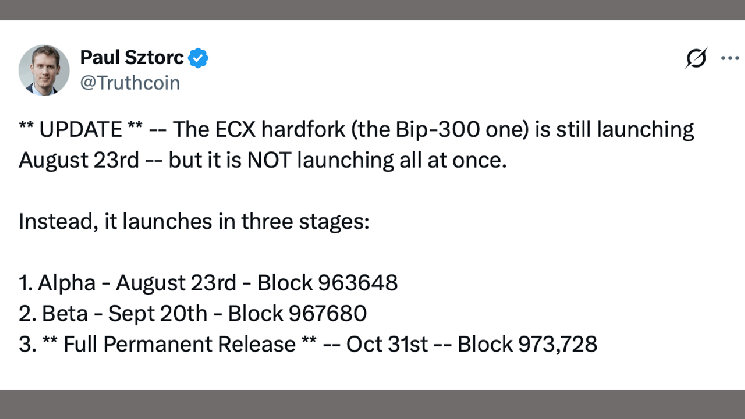
Bitcoin developer Paul Stortz, behind the Drivechain and BIP 300 proposals, has announced a hardfork for a new blockchain called ECX. Scheduled for October 31st (the 18th anniversary of the Bitcoin whitepaper), ECX will copy Bitcoin's full transaction history at a specific block height, crediting nearly all Bitcoin holders with an equal amount of ECX coins without altering the Bitcoin network itself. The launch will be executed in three phases. An "alpha" version is set for August 23rd (block 963,648), followed by a "beta" version on September 20th (block 967,680). The final mainnet launch is planned for October 31st (block 973,728). Coins accumulated during the alpha and beta phases can later be burned or swapped for real ECX. Stortz cites several reasons for the phased rollout: to address potential software bugs (including those possibly found by AI), allow an early market price to form for ECX before mining difficulty stabilizes, and let traders test and speculate. He described it as a "safety net" to manage any major issues and to demonstrate the chain's functionality. A key detail is that replay protection—a mechanism to prevent a transaction from being valid on both the Bitcoin and ECX chains—will remain optional, not automatic. The official ECX wallet software will apply this protection and warn users; Stortz warned that transactions ignoring this warning will be replayed on ECX, effectively tracking a user's spent bitcoins to their new owner unless a deliberate split is made. Stortz has given holders and exchanges 12 weeks from the alpha launch to prepare, during which they must decide on practical matters like running the wallet software to split their BTC and ECX holdings and how exchanges will credit the new asset to clients. The announcement comes as Bitcoin also faces another potential fork related to BIP-110.

cryptonews.ru5 год тому

Bitcoin's ECX Hard Fork to Introduce Three New Versions Throughout October

cryptonews.ru5 год тому

Торгівля

Спот
活动图片