‘Clarity once and for all’ – White House reviews SEC’s new crypto framework

ambcryptoОпубліковано о 2026-03-24Востаннє оновлено о 2026-03-24

Анотація

The U.S. SEC is shifting its approach to crypto regulation by moving away from enforcement actions toward creating clear rules. On March 20, it submitted two proposals to the White House, one aimed at classifying digital assets to determine which should be considered securities. If approved, many cryptocurrencies may no longer be classified as securities, reducing regulatory confusion. An "innovation exemption" may ease compliance for crypto firms, encouraging innovation in the U.S. The CFTC chair emphasized the need for clarity. The SEC-CFTC collaboration suggests most digital assets should not be automatically treated as securities. Despite recent market gains, investor sentiment remains fearful. The new framework seeks to balance oversight and growth while awaiting potential congressional legislation.

The U.S. Securities and Exchange Commission (SEC) is starting to change how it handles crypto regulation. Instead of relying mainly on lawsuits and enforcement actions, it is now working toward creating clear and structured rules.

On the 20th of March, the SEC quietly sent two important proposals to the White House. One focuses on making hedge funds and private equity firms more transparent.

Meanwhile, the second proposal was a more significant one for crypto. The latter aims to create a clear system to classify digital assets.

White House reviews crypto interpretation

If approved, many cryptocurrencies may no longer be classified as securities, reducing confusion and giving the industry clearer rules to follow. Instead of relying on lawsuits, the SEC is shifting toward setting clear guidelines, as reported by Bloomberg.

The proposed “innovation exemption” highlights this change. Rather than strict enforcement, the SEC is offering a more supportive environment where crypto firms can operate with fewer restrictions. This means new companies may not need to immediately meet complex registration requirements, making it easier for them to build and grow in the U.S.

Remarking on the same, Michael S. Selig, Chair of the Commodity Futures Trading Commission (CFTC), said,

Chairman Atkins and I now have developed a new interpretation that will provide clarity once and for all as to what’s a security and what’s not

Citing the reason behind this shift, Selig explains that earlier, the SEC, under Chair Gary Gensler, companies were often left guessing what was allowed and what wasn’t. This confusion pushed many crypto businesses to move outside the U.S.

In fact, because of this unclear environment, many developers became hesitant and stopped taking risks. Now, the new SEC proposals are trying to fix that by bringing more clarity and encouraging innovation to return to the U.S.

Private fund space also gets a breather

A similar shift is happening in the private fund space. The SEC has delayed some reporting rules (Form PF) until the 1st of October and is rethinking the strict data requirements introduced under Gary Gensler.

This revives an important debate. Following the Archegos collapse, regulators pushed for greater transparency to mitigate risk. Now, however, the SEC is shifting focus toward easing compliance burdens for firms, aiming to strike a balance between market safety and regulatory simplicity.

Notably, this change comes at a time when there is a significant disconnect between price movements and investor sentiment.

Market scenes are full of question marks

In the last 24 hours, the total crypto market value has gone up by about 3.26% at press time. But even with this rise, investor confidence is still very low.

The Crypto Fear & Greed Index is stuck in the “Extreme Fear” zone, showing that people are still uncertain and cautious.
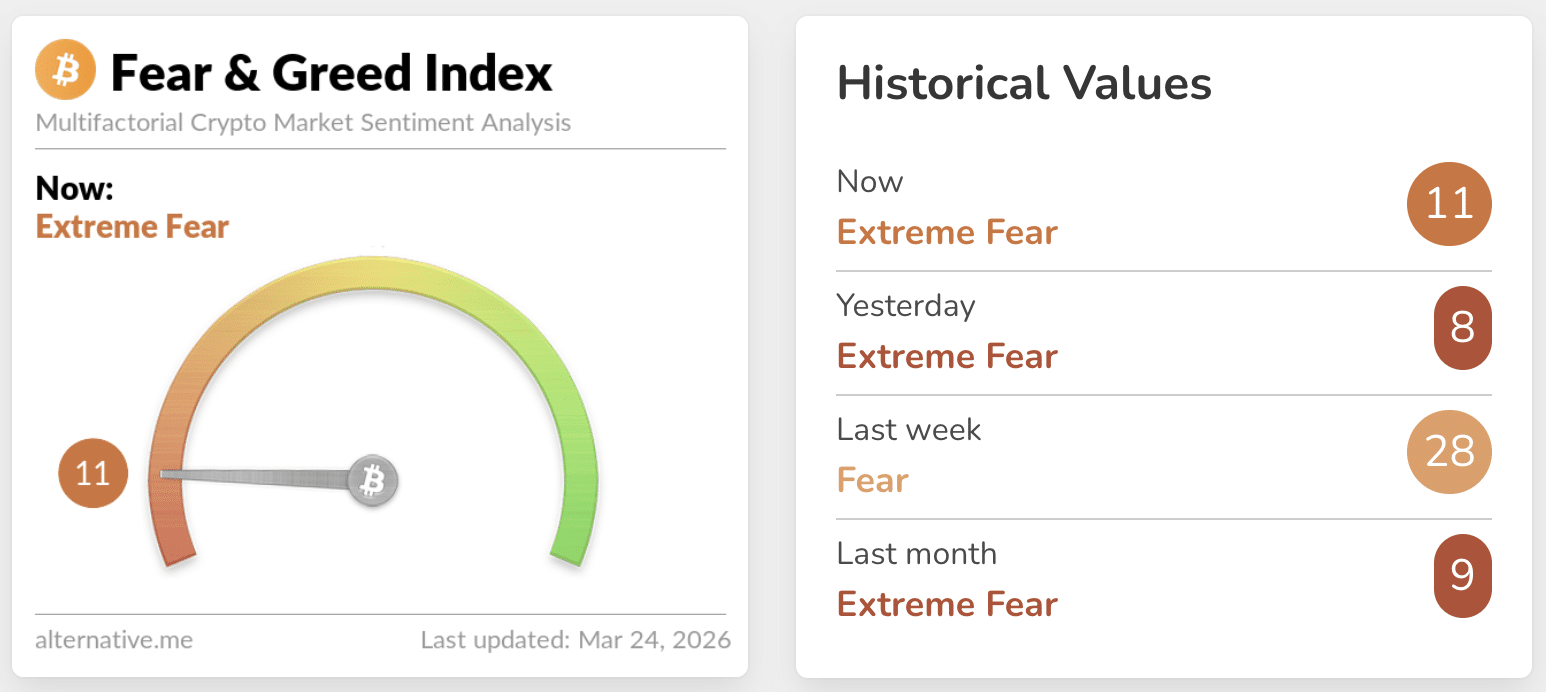
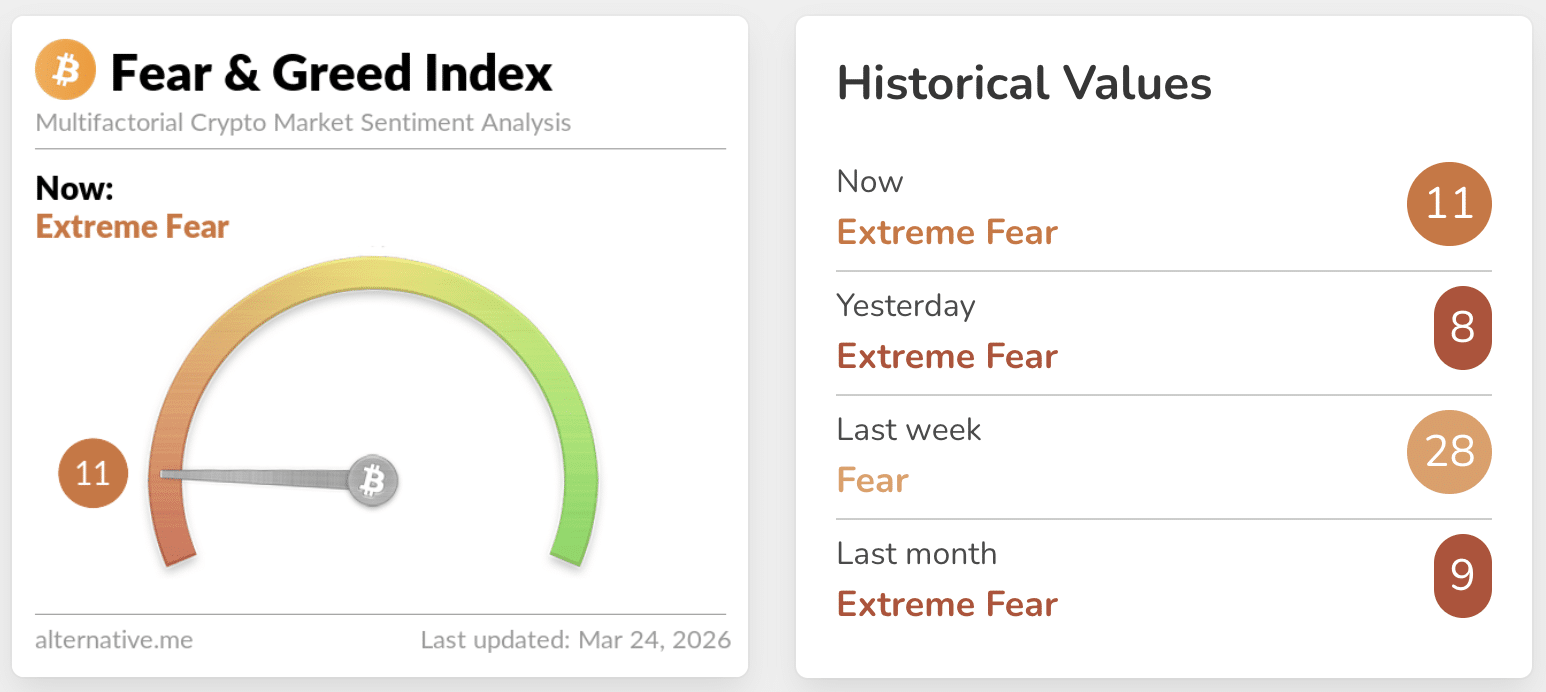
Source: Alternative

However, with all these developments, the SEC is trying to build a bridge between its old approach and future laws like the CLARITY Act, which aim to provide clearer legal clarity.

Needless to say, the SEC is also working closely with the CFTC. In a recent interpretation on the 17th of March, they suggested that most digital assets should not be treated as securities automatically. This helps reduce risk and uncertainty for crypto companies in the U.S.

It’s still unclear whether these new rules will be temporary until Congress passes full legislation or if they will become a long-term framework. But one thing is clear: under Chairman Paul Atkins, the SEC is trying to end the confusion.


Final Summary

  • Collaboration between the SEC and CFTC is a key step toward unified oversight, reducing regulatory overlap and uncertainty.
  • Clear classification of digital assets could finally remove the grey zone that has stalled crypto innovation.


Пов'язані питання

QWhat is the main shift in the SEC's approach to crypto regulation as described in the article?

AThe SEC is shifting from relying mainly on lawsuits and enforcement actions to creating clear and structured rules for the crypto industry.

QWhat is the purpose of the proposed 'innovation exemption' mentioned in the article?

AThe 'innovation exemption' aims to create a more supportive environment where crypto firms can operate with fewer restrictions, allowing new companies to build and grow without immediately meeting complex registration requirements.

QAccording to the article, what problem did the previous regulatory environment cause for crypto businesses?

AThe previous unclear regulatory environment, under Chair Gary Gensler, caused confusion that pushed many crypto businesses to move outside the U.S. and made developers hesitant to take risks.

QWhat does the current 'Crypto Fear & Greed Index' indicate about investor sentiment, despite recent market gains?

ADespite a recent rise in the total crypto market value, the Crypto Fear & Greed Index is stuck in the 'Extreme Fear' zone, indicating that investor confidence is still very low and people remain uncertain and cautious.

QHow are the SEC and CFTC collaborating to provide clarity, according to the recent interpretation on March 17th?

AIn their recent interpretation, the SEC and CFTC suggested that most digital assets should not be automatically treated as securities, which helps reduce risk and uncertainty for crypto companies in the U.S.

Пов'язані матеріали

After 50x Storage Surge, Justin Sun Always Looks to the Next Decade

Sun Yuchen, known for his controversial stunts like a $30 million lunch with Warren Buffett (canceled due to a kidney stone) and eating a $6.2 million duct-taped banana, is often overshadowed by a significant fact: his decade-long track record of spotting major investment trends. In 2016, he famously advised young people to invest in Bitcoin, Nvidia, Tesla, and Tencent instead of buying property. A hypothetical $20,000 investment in Nvidia and Tesla from that list would now be worth over 50 million RMB. His latest major call was on November 6, 2025, predicting a "50x storage opportunity" tied to the AI boom, which materialized with Sandisk's stock surging nearly 50-fold by 2026. Looking ahead, Sun now focuses on the next frontier: Physical AI. He identifies four key areas: 1. **Embodied AI/Robotics**: He sees this reaching its "iPhone moment," with companies like UBTech and Galaxy General leading in commercialization. 2. **Drones**: Viewed as the first commercially viable form of Physical AI, revolutionizing sectors from warfare (e.g., AeroVironment's Switchblade) to logistics. 3. **Spatial Computing**: Beyond VR, it's about AI understanding physical space, a foundational technology for robotics and autonomous systems, exemplified by Apple's Vision Pro. 4. **Space Exploration**: After a 2025 suborbital flight with Blue Origin, Sun advocates for space as the ultimate frontier, discussing blockchain's potential role in space asset management and data transactions. His investment philosophy involves betting on entire, inevitable trends rather than single companies. For robotics, he sees Tesla (the body/manufacturer) and Nvidia (the brain/AI platform) as complementary plays. In defense drones, he highlights companies making tanks obsolete (AeroVironment) and those augmenting fighter jets (Kratos). For space, he participated in Blue Origin's flight and anticipates SpaceX's potential IPO to redefine the sector's valuation. Sun Yuchen's vision frames the next two decades not as a revolution in information flow (like the internet), but in the fundamental operation of the physical world through AI-powered robots, autonomous systems, and spatial intelligence, ultimately extending human and AI activity into space. While many still focus on conventional assets, he continues to look toward the next technological horizon.

marsbit13 хв тому

After 50x Storage Surge, Justin Sun Always Looks to the Next Decade

marsbit13 хв тому

The Billionaires Behind the Most Expensive Midterm Election in History

"The Most Expensive Midterm Elections and Their Billionaire Backers" This analysis details the unprecedented scale of spending in the 2026 midterm elections, highlighting the key billionaire donors shaping the political landscape. Jeff Yass, founder of Susquehanna International Group, has contributed over $81 million, ranking third among individual donors behind George Soros ($102.6M) and Elon Musk ($84.8M). Yass is a major donor to Trump's MAGA Inc. and supports school choice and various candidates. Overall, federal committees have raised over $4.7 billion this cycle, with political ad spending projected to reach $10.8 billion. Republican-aligned groups are significantly out-raising their Democratic counterparts. "Dark money" from undisclosed sources continues to grow. The core stakes involve control of Congress and policy direction for Trump's final term. Donors are also motivated by specific issues: Sergey Brin and Chris Larsen are funding opposition to a proposed California wealth tax and supporting crypto-friendly policies. Other top donors include OpenAI's Greg Brockman and his wife Anna ($50M total to MAGA Inc. and an AI-focused PAC), Richard Uihlein ($45.3M to conservative causes), venture capitalists Marc Andreessen and Ben Horowitz (each over $44M to crypto/AI PACs and MAGA Inc.), Miriam Adelson ($42.6M to GOP leadership PACs), Paul Singer ($33.9M), and Diane Hendricks ($25.8M to MAGA Inc.). The article notes that the peak fundraising period is still ahead, with major primaries approaching.

marsbit16 хв тому

The Billionaires Behind the Most Expensive Midterm Election in History

marsbit16 хв тому

The Largest IPO in History Is Approaching, Surpassing SpaceX, 28 Years of AI Self-Iteration, Countdown to Intelligence Explosion

"Anthropic Nears Trillion-Dollar IPO, Fueled by Explosive Growth and 2028 'Intelligence Explosion' Warning Anthropic is considering a deal valuing the AI company near $1 trillion, potentially leading to one of the largest IPOs ever and surpassing SpaceX. Its revenue has skyrocketed, with Annual Recurring Revenue (ARR) reaching $45 billion in May 2026—a 500% increase in just five months. This vertical growth curve is attributed to its key products, Claude Code and Cowork, dominating AI coding and enterprise collaboration. Beyond commercial success, co-founder Jack Clark issued a pivotal warning in an interview: there is a greater than 50% chance that by the end of 2028, AI systems will achieve recursive self-improvement—the ability to autonomously build a 'better version' of themselves, initiating an 'intelligence explosion.' This prophecy underpins the company's astronomical valuation, as the market prices in the potential for transformative and disruptive AI. Further signaling its ambition, Anthropic formed a $1.5 billion joint venture with Goldman Sachs and Blackstone, aiming to disrupt traditional consulting firms like McKinsey by deploying Claude AI for complex strategic work. This move tests AI's capacity to replace high-level cognitive labor, a precursor to its predicted autonomous evolution. The narrative presents a dual future: unprecedented economic opportunity alongside significant risks like economic restructuring and security threats. Anthropic's meteoric rise and Clark's 2028 prediction frame the coming years as a countdown to a potential technological singularity."

marsbit27 хв тому

The Largest IPO in History Is Approaching, Surpassing SpaceX, 28 Years of AI Self-Iteration, Countdown to Intelligence Explosion

marsbit27 хв тому

Торгівля

Спот
Ф'ючерси

Популярні статті

Як купити HOUSE

Ласкаво просимо до HTX.com! Ми зробили покупку Housecoin (HOUSE) простою та зручною. Дотримуйтесь нашої покрокової інструкції, щоб розпочати свою криптовалютну подорож.Крок 1: Створіть обліковий запис на HTXВикористовуйте свою електронну пошту або номер телефону, щоб зареєструвати обліковий запис на HTX безплатно. Пройдіть безпроблемну реєстрацію й отримайте доступ до всіх функцій.ЗареєструватисьКрок 2: Перейдіть до розділу Купити крипту і виберіть спосіб оплатиКредитна/дебетова картка: використовуйте вашу картку Visa або Mastercard, щоб миттєво купити Housecoin (HOUSE).Баланс: використовуйте кошти з балансу вашого рахунку HTX для безперешкодної торгівлі.Треті особи: ми додали популярні способи оплати, такі як Google Pay та Apple Pay, щоб підвищити зручність.P2P: Торгуйте безпосередньо з іншими користувачами на HTX.Позабіржова торгівля (OTC): ми пропонуємо індивідуальні послуги та конкурентні обмінні курси для трейдерів.Крок 3: Зберігайте свої Housecoin (HOUSE)Після придбання Housecoin (HOUSE) збережіть його у своєму обліковому записі на HTX. Крім того, ви можете відправити його в інше місце за допомогою блокчейн-переказу або використовувати його для торгівлі іншими криптовалютами.Крок 4: Торгівля Housecoin (HOUSE)Легко торгуйте Housecoin (HOUSE) на спотовому ринку HTX. Просто увійдіть до свого облікового запису, виберіть торгову пару, укладайте угоди та спостерігайте за ними в режимі реального часу. Ми пропонуємо зручний досвід як для початківців, так і для досвідчених трейдерів.

340 переглядів усьогоОпубліковано 2025.04.27Оновлено 2025.04.27

Як купити HOUSE

Обговорення

Ласкаво просимо до спільноти HTX. Тут ви можете бути в курсі останніх подій розвитку платформи та отримати доступ до професійної ринкової інформації. Нижче представлені думки користувачів щодо ціни HOUSE (HOUSE).

活动图片












