CLARITY Act edges closer – But ONE disagreement is holding everything up

ambcryptoОпубліковано о 2026-03-18Востаннє оновлено о 2026-03-18

Анотація

The CLARITY Act, a key piece of U.S. crypto market structure legislation, is advancing but remains stalled due to a major disagreement over interest-bearing stablecoins. While the crypto industry supports such products, traditional banks oppose them, fearing capital flight from deposits. Despite this impasse, political pressure is mounting, notably from President Donald Trump, who publicly demanded the bill's swift passage to maintain U.S. financial leadership and prevent innovation from moving abroad. The crypto community expresses growing confidence in the bill's eventual success, with Polymarket bettors assigning a 62% probability of it passing in 2026. The legislation aims to provide regulatory clarity and unlock institutional investment, but disagreements continue to delay progress.

The GENIUS Act, passed in 2025, created a regulatory framework for U.S. stablecoins. However, clear rules for the rest of the crypto market are still missing.

That may soon change, as the recent data from Santiment suggested the Digital Asset Market CLARITY Act is moving closer to the final stage of the legislative process.

If passed, the bill could mark a turning point for institutional investment in crypto, providing clearer regulatory guidance for large investors.


Source: Santiment/X

CLARITY Act talks continue

Talking about the same at the DC Blockchain Summit on the 17th of March, Senate Banking Committee Chair Tim Scott said the bill is still delayed due to a disagreement over interest-bearing stablecoins.

While the crypto industry supports such products, banks fear they could pull large amounts of money away from traditional deposits.

That said, Senators Thom Tillis and Angela Alsobrooks are currently reviewing these concerns and pushing for stronger safeguards if crypto products function like bank services.

This cautious approach has slowed the bill’s progress. Meanwhile, political pressure is growing, especially after U.S. President Donald Trump urged lawmakers to pass the Act quickly.

President Trump demands CLARITY Act passage

On the 4th of March, U.S. President Donald Trump wrote in a post on Truth Social,

The Genius Act is being threatened and undermined by the Banks, and that is unacceptable — We are not going to allow it. The U.S. needs to get Market Structure done, ASAP.

Donald Trump’s statement has shifted the debate around the CLARITY Act from a technical policy issue to a broader economic and strategic concern.

He argues that without clear crypto regulations, capital and innovation could move to countries like China, making the bill important for maintaining U.S. financial leadership.

Trump also criticized major banks for resisting crypto reforms, despite reporting record profits, suggesting they are prioritizing their own interests.

By linking the CLARITY Act to his goal of making the U.S. the global crypto capital, he has increased pressure on lawmakers to move the legislation forward.

Crypto community stands confident

The confidence was also reflected in the crypto community, as noted by Senator Kevin Cramer when he said,

I think we have to make this a committee priority for some time just before Easter or shortly after.

Echoing similar sentiments, Dan Spuller, EVP of Industry Affairs at Blockchain Association, added,

I’m now increasingly confident we’re going to get CLARITY through, and we’re not going to let the banks rig the outcome.

Polymarket odds and other hiccups

Additionally, Polymarket bettors have also pushed the odds of the CLARITY Act passing in 2026 to a commanding 62%.
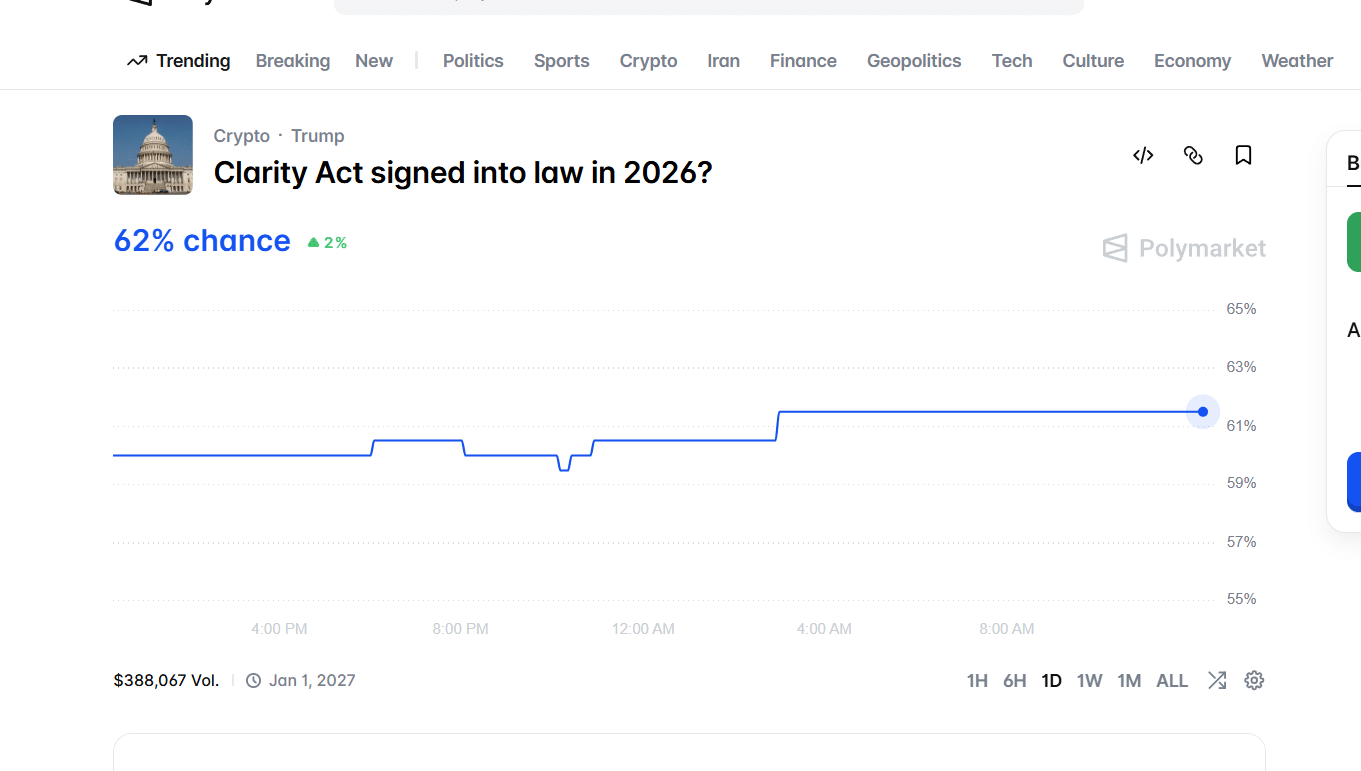
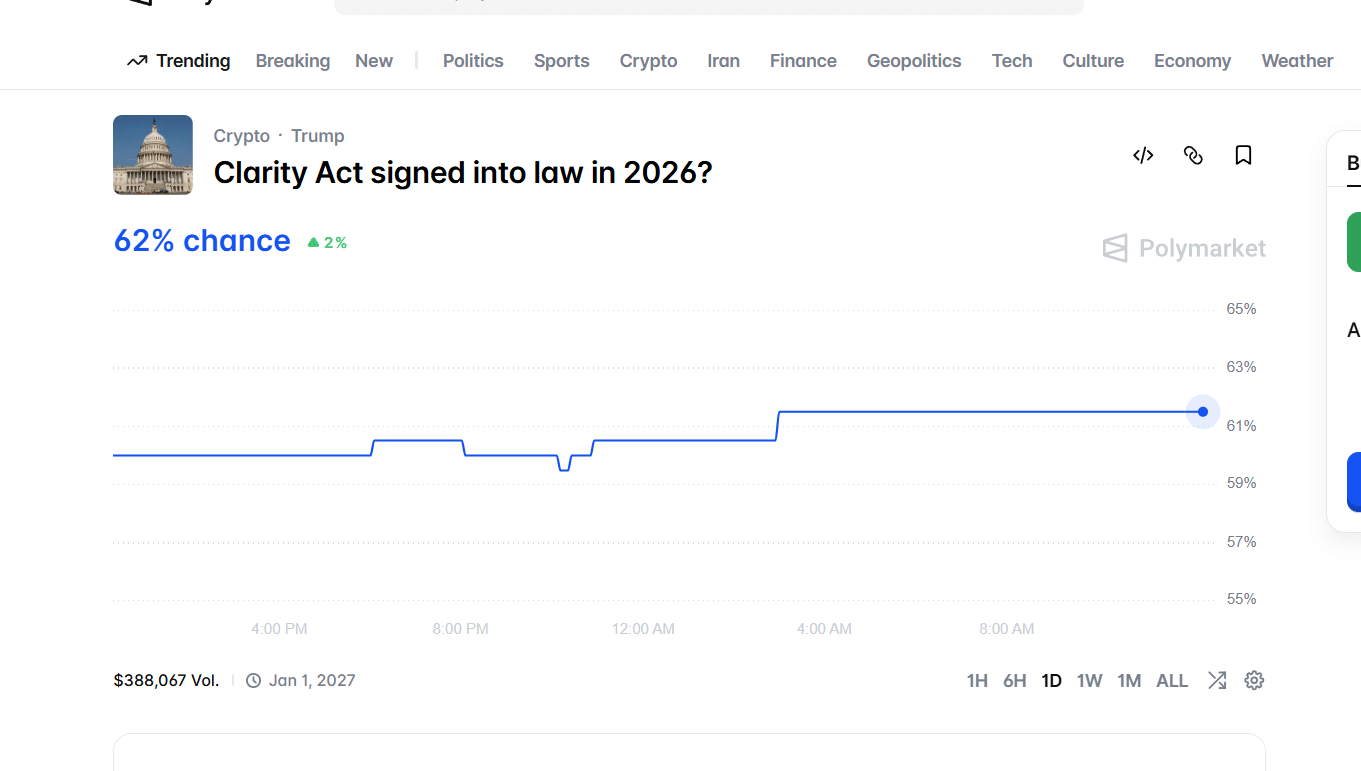
Source: Polymarket

Needless to say, the bill has now become the center of a growing clash between the U.S. government and traditional banks.

This disagreement has stalled the bill since early 2026. Thus, as expected, Trump’s crypto advisor, Patrick Witt, had put it best when he said,

The CLARITY Act must remain a pro-innovation piece of legislation. Attempts to hijack the legislative process and turn it into an anti-competition bill are shameful.


Final Summary

  • Clear rules could unlock large institutional capital that has remained cautious due to regulatory uncertainty.
  • However, a key disagreement over interest-bearing stablecoins continues to slow progress.

Трендові криптовалюти

Пов'язані питання

QWhat is the main disagreement holding up the CLARITY Act according to the article?

AThe main disagreement is over interest-bearing stablecoins, with the crypto industry supporting such products while banks fear they could pull large amounts of money away from traditional deposits.

QWhat did U.S. President Donald Trump say about the CLARITY Act and the banks?

APresident Trump stated that the 'Genius Act' (referring to the CLARITY Act) is being 'threatened and undermined by the Banks' and that this is unacceptable. He argued that the U.S. needs to get Market Structure done ASAP and criticized major banks for resisting crypto reforms despite reporting record profits.

QAccording to the article, what is the predicted probability of the CLARITY Act passing in 2026 on Polymarket?

APolymarket bettors have pushed the odds of the CLARITY Act passing in 2026 to 62%.

QHow did Trump's advisor, Patrick Witt, characterize attempts to change the CLARITY Act?

APatrick Witt characterized attempts to hijack the legislative process and turn the CLARITY Act into an anti-competition bill as 'shameful,' stating that the act must remain a pro-innovation piece of legislation.

QWhat previous legislation created a regulatory framework for U.S. stablecoins, as mentioned in the article?

AThe GENIUS Act, passed in 2025, created a regulatory framework for U.S. stablecoins.

Пов'язані матеріали

Bitcoin Withdrawals Continue: 8 Years of Storage in a Coldcard Cold Wallet Ended in Zero

Coldcard Hardware Wallet Hacked: Losses Mount Due to Vulnerable Seed Generation A critical vulnerability in Coldcard hardware wallets has led to a continued wave of fund thefts. According to Galaxy Research, the total stolen has reached 1,367.05 BTC (approx. $88.6 million) from 4,585 addresses, a significant increase from the initial 594.5 BTC reported on July 30, 2026. Most of the stolen funds remain on the attackers' addresses. The issue is not with the current firmware, which Coinkite has updated, but with seed phrases generated on vulnerable devices between March 2021 and the release of fixed firmware versions. Due to a programmer error, devices switched from using a hardware random number generator to the software-based Yasmarang generator, which was initialized with publicly accessible data like the chip's serial number. This made the seed phrases predictable through offline brute-force attacks, meaning wallets remain at risk until funds are moved to a new wallet generated with the patched firmware. Affected devices include Mk2/Mk3 with firmware 4.0.1–4.1.9 (and up to 5.0.3), Mk4/Mk5 up to version 5.6.0, and Q models up to 1.5.0Q. The only exceptions are seeds created with a high-entropy method like at least 50 independent dice rolls or a strong unique BIP-39 passphrase. All other owners must generate a new seed on the fixed firmware and transfer their assets. A case highlighting the human impact involves a 39-year-old long-term investor who lost 2 BTC (approx. $130,000) in minutes. He had accumulated the Bitcoin over eight years through physical labor, viewing it as a financial lifeline and a retirement plan in a country suffering from hyperinflation. His story underscores that even conservative "buy and hold in cold storage" strategies can be compromised by such underlying technical flaws. From a technical perspective, this incident echoes historical failures where weak random number generators undermined cryptographic security, challenging the assumption that offline storage is automatically foolproof.

cryptonews.ru1 год тому

Bitcoin Withdrawals Continue: 8 Years of Storage in a Coldcard Cold Wallet Ended in Zero

cryptonews.ru1 год тому

Торгівля

Спот

Популярні статті

Як купити ONE

Ласкаво просимо до HTX.com! Ми зробили покупку Harmony (ONE) простою та зручною. Дотримуйтесь нашої покрокової інструкції, щоб розпочати свою криптовалютну подорож.Крок 1: Створіть обліковий запис на HTXВикористовуйте свою електронну пошту або номер телефону, щоб зареєструвати обліковий запис на HTX безплатно. Пройдіть безпроблемну реєстрацію й отримайте доступ до всіх функцій.ЗареєструватисьКрок 2: Перейдіть до розділу Купити крипту і виберіть спосіб оплатиКредитна/дебетова картка: використовуйте вашу картку Visa або Mastercard, щоб миттєво купити Harmony (ONE).Баланс: використовуйте кошти з балансу вашого рахунку HTX для безперешкодної торгівлі.Треті особи: ми додали популярні способи оплати, такі як Google Pay та Apple Pay, щоб підвищити зручність.P2P: Торгуйте безпосередньо з іншими користувачами на HTX.Позабіржова торгівля (OTC): ми пропонуємо індивідуальні послуги та конкурентні обмінні курси для трейдерів.Крок 3: Зберігайте свої Harmony (ONE)Після придбання Harmony (ONE) збережіть його у своєму обліковому записі на HTX. Крім того, ви можете відправити його в інше місце за допомогою блокчейн-переказу або використовувати його для торгівлі іншими криптовалютами.Крок 4: Торгівля Harmony (ONE)Легко торгуйте Harmony (ONE) на спотовому ринку HTX. Просто увійдіть до свого облікового запису, виберіть торгову пару, укладайте угоди та спостерігайте за ними в режимі реального часу. Ми пропонуємо зручний досвід як для початківців, так і для досвідчених трейдерів.

479 переглядів усьогоОпубліковано 2024.12.12Оновлено 2026.06.02

Як купити ONE

Обговорення

Ласкаво просимо до спільноти HTX. Тут ви можете бути в курсі останніх подій розвитку платформи та отримати доступ до професійної ринкової інформації. Нижче представлені думки користувачів щодо ціни ONE (ONE).

活动图片













