On Monday, Citigroup raised its gold price target for the next 0 to 3 months to $4,800 per ounce, while maintaining its target of $5,000 per ounce for the next 6 to 12 months unchanged. The bank believes gold prices still have room to move higher.
At the start of the week, spot gold extended last week's gains, briefly approaching the $4,700 per ounce level during Tuesday's Asian session before subsequently pulling back to around $4,640, showing signs of a short-term accelerated correction. Gold and silver have performed strongly this month; according to Bull Theory analysis, the two precious metals collectively added nearly $5 trillion in market capitalization this month. However, both remain below the all-time highs set earlier this year.
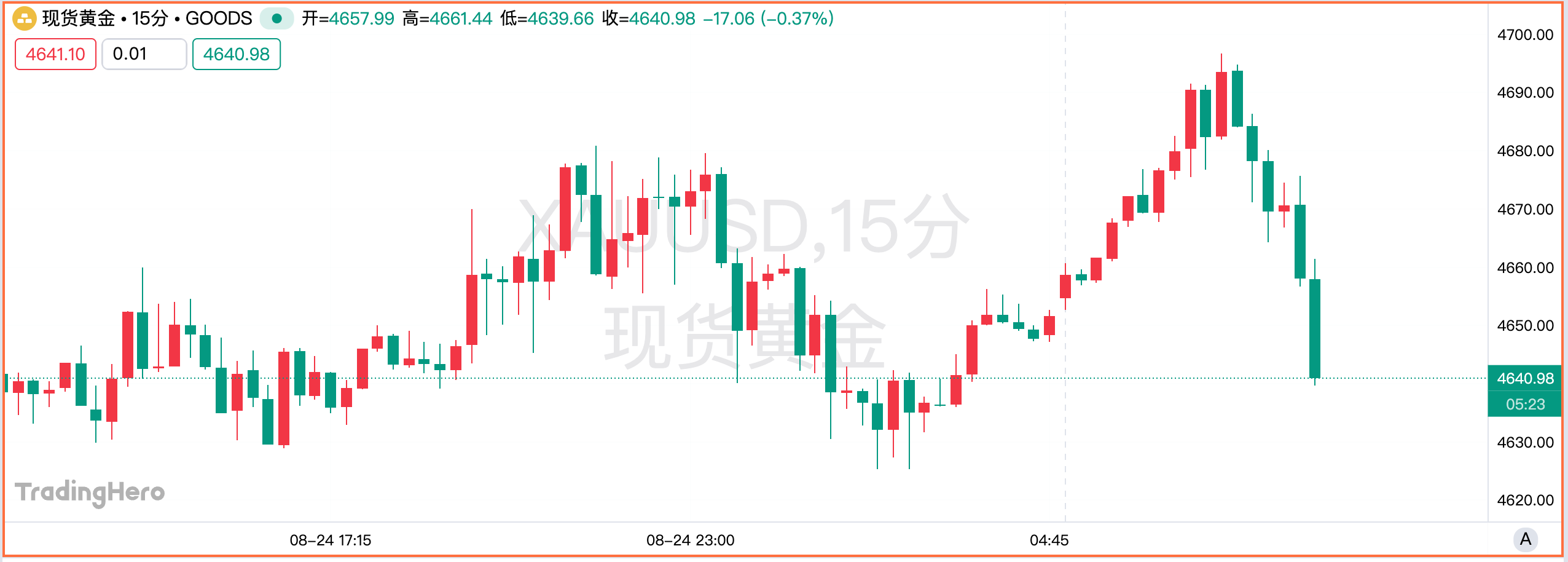
Citigroup believes gold's rally is still supported by multiple factors, including geopolitical risks in the Middle East, expectations for lower real interest rates, and the Federal Reserve's monetary policy pivot. The bank stated that as tensions in the Strait of Hormuz are expected to gradually ease, real interest rates continue to decline, and the Fed's hawkish stance weakens, gold still has a foundation for gains in the coming months.
The recent breakout in gold prices has also been driven by changes in market liquidity. Following the U.S. Treasury's expansion of its long-term bond repurchase program, expectations for easing upward pressure on long-term rates have strengthened, prompting investors to further increase their allocation to precious metals and fueling gold buying. Simultaneously, persistent tensions in the Middle East have reinforced gold's safe-haven appeal, and the rebound in energy prices has further boosted safe-haven demand amid shifting market risk sentiment.
J.P. Morgan also maintains a positive view on the gold market, but the bank believes short-term price action will still depend on macroeconomic data and signals from Federal Reserve policy. Given the significant uncertainty in the Middle East situation, coupled with recent tariff-related news pushing market risk premiums higher, it is normal for investors to pause and adjust their positions.
The market is currently focused on two key events: the U.S. PCE inflation data to be released on Wednesday and remarks from Fed officials at the Jackson Hole conference on Friday. J.P. Morgan noted that the PCE data is particularly important, with its research team expecting the data may reflect elevated inflation levels, while the market has not fully ruled out the possibility of the Fed adjusting interest rate policy in September.
J.P. Morgan pointed out that if inflation data exceeds expectations, the market may reassess the path for rate cuts, potentially pushing gold lower to test its 200-day moving average. However, if inflation falls short of expectations and the market has not fully priced in policy signals from Jackson Hole, gold prices could quickly move towards $5,000 per ounce.
The bank also cautioned that in January of this year, gold rose by approximately $1,100 in a single month, indicating that in the current market environment, gold can still experience significant, rapid volatility. In the short term, J.P. Morgan expects gold may fluctuate within a range of $4,500 to $5,000 per ounce, with the subsequent direction largely dependent on inflation data, Fed policy signals, and changes in geopolitical risks.
Beyond short-term macro factors, continued central bank gold purchases remain a key long-term support for the gold market. Although the market had previously been concerned that the pace of central bank buying might slow, recent data shows the growth trend in global central bank gold reserves has not changed.
The U.S. dollar's movement also affects gold's performance. Recent cooling U.S. inflation, weaker employment data, and rising market expectations for a Fed policy pivot have put pressure on the dollar, and a weaker dollar typically supports prices for dollar-denominated gold.
From a technical perspective, some institutions believe gold has already reclaimed its 200-day moving average, indicating the previous downward pressure has eased somewhat. Even with some weak economic data, gold's upward momentum has not significantly weakened, and the overall market performance remains strong.