Circle's Pullback: Still Worth Buying?

marsbitОпубліковано о 2026-04-04Востаннє оновлено о 2026-04-04

Анотація

Circle: Still Worth Buying After the Pullback? Circle, the issuer of the second-largest stablecoin USDC, is at a critical juncture. Its current valuation of $15-20B primarily reflects its interest income from $770B in USDC reserves. However, data suggests a potential transformation into a fee-based digital dollar infrastructure network. Key evidence for this shift includes: * USDC's on-chain transaction volume grew 247% in FY2025, far outpacing its 72% circulation growth, indicating it's being *used* more, not just held. * Adjusted for on-chain noise, USDC dominates real economic settlement volume (64% per Visa data), despite USDT having 2.4x its market cap. Circle's three-layer revenue structure is evolving: 1. **Interest Income (95% of current revenue):** Tied to USDC circulation and interest rates. Faces headwinds from potential Fed cuts and a revenue-sharing agreement with Coinbase. 2. **Payment & Transaction Fees:** The key to becoming an infrastructure play. The Circle Payments Network (CPN) is scaling rapidly ($5.7B annualized TPV), and non-interest revenue surged to $37M/quarter. 3. **Settlement Platform (Arc):** A long-term bet on becoming an institutional settlement standard, though its value remains unproven. Near-term catalysts include the Coinbase revenue-sharing agreement renewal (Aug 2026) and potential full OCC bank charter approval. A 3-5x return is plausible if USDC circulation grows at 40% CAGR. A 10x return requires multiple successes: CPN scal...

Author: Leo Z

I. What is Circle

Circle is the issuer of USDC. USDC is the world's second-largest stablecoin, with a circulation of approximately $770 billion. Each USDC is backed by an equivalent amount of US dollar assets (primarily short-term US Treasury bonds) as reserves.

Circle's revenue source is simple: it invests these reserves in US Treasury bonds to earn an interest spread. FY2025 total revenue was $2.75 billion, with 95% coming from reserve interest. It went public in June 2025, with a current market capitalization of approximately $150-200 billion.

The market's pricing of Circle is essentially equal to "USDC circulation × interest rate × a conservative multiple." This means: if you believe Circle is merely a company that earns interest, the current pricing is roughly fair. If you believe it is transforming into a fee-based digital dollar infrastructure network, then the current price does not reflect this value at all.

This article aims to answer: Is this transformation happening? How much evidence is there? What is it worth?

II. Core Question: Is USDC Being "Held" or "Used"?

Before discussing valuation, answer a question more important than any financial model.

For the same $770 billion USDC, if it is just held by institutions to earn interest spread, then Circle is an interest rate-sensitive financial company, valued at 10-15x. If it is being frequently used for payments, settlements, cross-border transfers, and developer calls, then Circle is growing into a fee-based infrastructure network, valued at 25-30x.

Two key data points can help you judge:

First, the growth rate of USDC's on-chain transaction volume far exceeds its circulation growth rate. In FY2025, USDC circulation grew by 72%, but on-chain transaction volume grew by 247%. This means each USDC dollar is being used more frequently. This is not "the stock is getting larger," but "the flow velocity is increasing."

Second, USDC has surpassed USDT to become the largest settlement asset. Visa Onchain Analytics filters out approximately 85% of on-chain noise (bots, internal exchange transfers, high-frequency arbitrage). After this adjustment, USDC accounts for 64% of real economic settlement volume (Mizuho, February 2026), while USDT accounts for only about 28%—even though USDT's circulation is 2.4 times that of USDC.

This gap itself is the strongest signal: USDC is transitioning from an "asset people hold" to a "network people use." But this transition is not yet complete—later we will discuss the conditions needed for it to be confirmed.

III. Three-Tier Revenue Structure

Circle's revenue is divided into three tiers. The market is almost only pricing the first tier.

Tier 1: USDC Interest Income—How Circle Makes Money Today

USDC is Circle's starting point and the source of 95% of its current revenue. As of the end of 2025, USDC circulation was $753 billion, a year-on-year increase of 72%, far exceeding Circle's own annualized growth target of 40%.

The revenue logic is simple: approximately 80% of USDC reserves are invested in short-term US Treasury bonds (via the BlackRock-managed USDXX fund), earning an interest spread.

Interest Income ≈ Average USDC Circulation × Reserve Yield

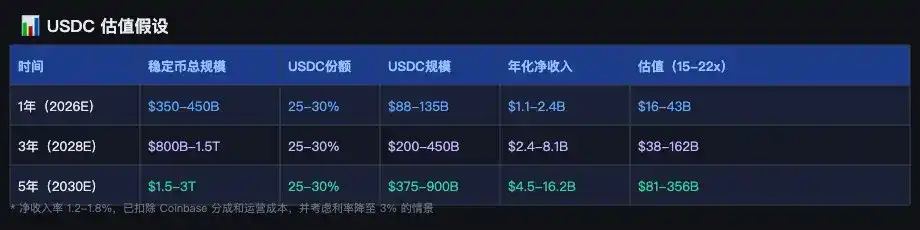
The reserve yield in Q4 2025 was 3.81%, down 68 basis points from the previous quarter. This exposes the core contradiction: circulation is growing rapidly, but interest rates are falling, and the two are offsetting each other. If the Fed's target rate drops to 3%, Circle would need USDC to grow to over $1.5 trillion to maintain its current income level.

Structural issue: Coinbase takes most of the revenue. According to the revenue-sharing agreement signed in 2023, 100% of the interest on USDC on the Coinbase platform goes to Coinbase, and Coinbase takes 50% of the interest off-platform. In FY2025, for every $1 of interest Circle earned, about 60 cents was given to distribution partners.

The good news is that margins are improving. The RLDC (Revenue Less Distribution Costs) margin expanded from 30.0% in Q4 2024 to 40.1% in Q4 2025. The net income rate is 1.2-1.8%, after deducting Coinbase's share and operating costs.
Tier 2: Payment & Transaction Revenue—The New Business in Development

This is the key to determining whether Circle can shed the "interest rate company" label.

CPN (Circle Payments Network) launched in May 2025, providing banks, payment companies, and enterprises with 24/7 cross-border settlement based on USDC. As of February 2026, the annualized TPV reached $5.7 billion, growing about 100-fold since launch. 55 institutions are connected, 74 are under review, and 500+ are in the pipeline. It covers 14 markets including Brazil, Canada, Hong Kong, India, Mexico, Nigeria, and the US.

But $5.7 billion compared to the global cross-border payment market of $160 trillion is still less than 0.04%. The value of CPN lies not in its current scale but in whether its growth can be sustained. If it captures 1% of the cross-border market, that would be $1.6 trillion in annualized transaction volume—the fees generated could approach or even exceed interest income and are not affected by interest rates.

CCTP (Cross-Chain Transfer Protocol) enables native cross-chain transfer of USDC through "burn-mint." It processed $41.3 billion in Q4 2025, a year-on-year increase of 3.7 times. USDC's cross-chain market share rose from 25% at the end of 2024 to 62% in January 2026, covering 30 chains. CCTP V2 introduced Fast Transfer fees—a new revenue source.

Other Revenue (non-interest income) is the most direct "evidence of transformation." In FY2025, it surged from $3 million per quarter to $37 million per quarter, including $24.7 million from subscription services, $12.2 million from transaction revenue, and $7 million from Canton Network validator node revenue. Management guidance for 2026 is $150-170 million.

This revenue is not affected by interest rates and does not require sharing with Coinbase. When it exceeds 10% of total revenue, the market may start to view Circle with a different valuation method. Currently, it is about 4%.

Tier 3: Settlement Platform—Long-Term Possibility

Arc is an institutional-grade settlement chain planned by Circle to launch its mainnet in 2026, with USDC as the native gas token. The testnet has already processed over 166 million transactions, with a confirmation time of 0.5 seconds, and 100+ institutions participating (including Goldman Sachs and Mastercard).

Arc's roadmap is divided into four phases:

M1 Public Testnet (completed) → M2 Real Funds On-Chain (2026) → M3 Margin/Collateral/Settlement Scenarios Live (2027-28) → M4 Integrated into Institutional Standard Operating Procedures (2029-30)

Before M2, Arc's value is zero. But if it eventually becomes the institutional settlement standard, Circle's value will no longer be that of a "fee company" but a "platform company." This is a necessary condition for 10x+ returns.

IV. Judging Whether the Transformation Is Happening: Seven Dimensions

Looking at any single indicator can be misleading. The key is to see if multiple dimensions are improving simultaneously—when scale, activity, margins, new revenue, and user growth all point in the same direction, the transformation is happening.
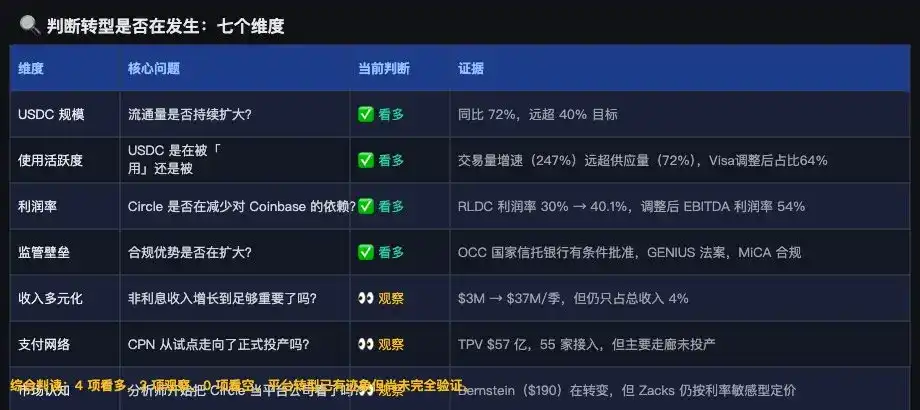
V. Three Most Important Tracking Metrics

1 USDC Circulation (Check Daily)

The base of Circle's income. Circulation × Reserve Yield = Interest Income. Track "Quarterly Average Circulation" rather than the end-of-period snapshot. Currently about $770 billion.

Data Sources: defillama.com/stablecoin/usd-coin (updated daily), circle.com/transparency (weekly reserve attestation)

2 USDC's Share of Visa-Adjusted Transaction Volume (Check Weekly)

Answers the core question: Is USDC being used or held? Supply is only 25%, but adjusted transaction volume is 64%—each USDC dollar does 2-3 times more work than a USDT dollar.

Data Source: visaonchainanalytics.com → Filter by Stablecoin → Click "Show % of Total" → Read the USDC line

3 Other Revenue, Non-Interest Income (Check Quarterly)

The only indicator that directly proves Circle is making money beyond interest. Not affected by interest rates, no sharing with Coinbase. Currently $37 million/quarter, guidance $150-170 million (2026). Valuation methods will change when it breaks through 10% of total revenue.

Data Sources: circle.com/pressroom (quarterly earnings reports), SEC EDGAR search for Circle Internet Group

VI. Near-Term Catalysts

Coinbase Revenue-Sharing Agreement Expiration (August 2026)

This is the single biggest catalyst within 24 months. Currently, Circle gives about 60% of its revenue to distribution partners. If renegotiation raises the RLDC margin from 40% to 50-55%, the effect would be equivalent to an instant 25-35% increase in profit. But Coinbase has little incentive to concede significantly—USDC distribution on the Coinbase platform remains Circle's biggest growth engine. The outcome is uncertain, but the direction is likely better than the status quo.

OCC National Trust Bank Charter

Conditionally approved in December 2025. Full approval would mean:可以直接在美联储开主账户 (earn IORB rate, eliminate counterparty risk), bypass commercial banks to handle the annual $483 billion mint/redemption flow, and build an insurmountable trust barrier for corporate and government adoption of USDC. No other stablecoin issuer has this.

x402 Foundation (Established April 2026)

Coinbase contributed the x402 payment protocol to the Linux Foundation. x402 activates the HTTP 402 status code as an internet-native payment layer, enabling AI agents, APIs, and applications to settle directly within HTTP interactions—using USDC by default.

Participants: Google, AWS, Stripe, Visa, Mastercard, Amex, Shopify, Microsoft, Cloudflare, Circle. If x402 becomes the standard for AI agent payments, every machine-to-machine microtransaction would increase USDC's usage (velocity) without needing to increase holdings (supply).

Note: x402 is led by Coinbase, not Circle. Impact on CRCL: mildly bullish, expands USDC's use cases but does not change the magnitude of the fundamentals.

VII. Conditions for 5-10x Returns

3-5x (High Confidence)—Purely from USDC Growth

USDC at a 40% CAGR reaches approximately $2-3 trillion by 2028. Even if rates drop to 3%, $2.5T × 1.5% net spread = $37.5 billion net income. At 20x, market cap is $750 billion. From the current $150-200 billion to $750 billion is about 4x. Requires no contribution from CPN or Arc.

10x (Requires Multiple Conditions to Materialize Simultaneously)

From $15-20B to $150-200B, must happen simultaneously:

1. CPN TPV breaks through $100 billion in 2-3 years, with at least one major corridor entering full production.

2. Coinbase revenue-sharing agreement improves, RLDC margin reaches 50%+.

3. Other Revenue exceeds 10% of total revenue, proving scalable non-interest income.

4. Arc reaches at least the M2 stage (real funds on-chain), starts being priced by the market.

Currently, only the second condition (margin) is clearly improving. A 10x return is a position you "earn," not one you "gamble" on.

VIII. Main Risks

Interest Rates Fall Faster Than USDC Grows

Q4 2025 already showed this signal: rates fell 68bps, partially offsetting 100% circulation growth. If the Fed drops to 2.5-3% in 2026-2027, there could be a window of 1-2 quarters of earnings below expectations.

Tether's Compliance

USDC's biggest differentiating advantage is compliance. But Tether earned $10 billion in the first three quarters of 2025 and is in talks with the Big Four accounting firms for a full audit. If Tether gains compliant status within 2-3 years, USDC's differentiated advantage could be significantly weakened. USDT currently has over 60% market share and a market cap of $1.83 trillion—it has ample resources.

Competition from New Yield-Bearing Stablecoins & Payment Giants Like Stripe

Ethena (USDe), Sky, and other new stablecoins are grabbing market share by paying yields directly to holders. Circle, bound by its regulatory compliance position, currently cannot pay interest directly to USDC holders.

Stripe is a founding member of the x402 Foundation and is also building its own stablecoin payment system. Stripe's strategy is to integrate all potential winning standards—its involvement does not represent exclusive support for USDC, nor does it preclude Stripe from launching its own stablecoin or deeply integrating USDT in the future.

IX. Conclusion

Circle is not a company that "will definitely become a trillion-dollar" company. But it might be one of the few fintech companies today that has the structural conditions to potentially reach that ceiling.
Current pricing almost only reflects USDC interest income. The market is asking: Is Circle an interest rate-driven financial company, or a fee-based digital dollar infrastructure? The answer is not yet certain—but the data is leaning towards the latter.

The core things to track are three: Is USDC circulation growing? Is each USDC dollar being used more frequently? Is non-interest income increasing? When all three improve simultaneously, the transformation is happening.

Data Sources: Circle IR, SEC EDGAR, DefiLlama, Visa Onchain Analytics, Artemis Terminal, CoinDesk, Mizuho Research

Disclaimer: This article does not constitute investment advice. All data is as of April 2026.

Пов'язані питання

QWhat is the core business model of Circle and its primary source of revenue?

ACircle is the issuer of USDC, the world's second-largest stablecoin. Its core business model involves investing the dollar-denominated reserves backing USDC (primarily in short-term U.S. Treasuries) and earning the interest spread. For FY2025, approximately 95% of its total revenue of $2.75 billion came from this reserve interest income.

QWhat are the two key data points that suggest USDC is transitioning from an asset being 'held' to being 'used'?

AThe two key data points are: 1) USDC's on-chain transaction volume grew 247% in FY2025, significantly outpacing its 72% circulation growth, indicating each dollar is being used more frequently. 2) Adjusted data from Visa Onchain Analytics shows USDC accounts for 64% of real economic settlement volume, despite having a circulation only about 40% the size of USDT's, demonstrating it is the dominant asset for actual economic activity.

QWhat are the three layers of Circle's revenue structure as described in the article?

ACircle's three-layer revenue structure consists of: 1) USDC Interest Income: The primary current revenue from reserve investments. 2) Payment & Transaction Revenue: Income from new services like the Circle Payments Network (CPN) and the Cross-Chain Transfer Protocol (CCTP). 3) Settlement Platform: The potential long-term revenue from Arc, an institutional-grade settlement chain with USDC as its native gas token, which is not yet operational with real funds.

QWhat is identified as the single biggest catalyst for Circle within the next 24 months?

AThe expiration of the revenue-sharing agreement with Coinbase in August 2026 is identified as the single biggest catalyst. Currently, Circle shares approximately 60% of its interest revenue with partners like Coinbase. A renegotiation that improves Circle's Revenue Less Distribution Costs (RLDC) margin could significantly boost its profitability.

QAccording to the article, what conditions are necessary for Circle to achieve a potential 10x return on investment?

AA 10x return requires multiple conditions to be met simultaneously: 1) Circle Payments Network (CPN) TPV exceeding $100 billion within 2-3 years. 2) An improved Coinbase revenue-sharing agreement, raising RLDC margins to 50%+. 3) Non-interest revenue ('Other Revenue') exceeding 10% of total revenue. 4) The Arc settlement platform progressing to at least its M2 stage (real funds on-chain), allowing the market to begin pricing in its value.

Пов'язані матеріали

North Korean Hackers Loot $500 Million in a Single Month, Becoming the Top Threat to Crypto Security

North Korean hackers, particularly the notorious Lazarus Group and its subgroup TraderTraitor, have stolen over $500 million from cryptocurrency DeFi platforms in less than three weeks, bringing their total theft for the year to over $700 million. Recent major attacks on Drift Protocol and KelpDAO, resulting in losses of approximately $286 million and $290 million respectively, highlight a strategic shift: instead of targeting core smart contracts, attackers are now exploiting vulnerabilities in peripheral infrastructure. For instance, the KelpDAO attack involved compromising downstream RPC infrastructure used by LayerZero's decentralized validation network (DVN), allowing manipulation without breaching core cryptography. This sophisticated approach mirrors advanced corporate cyber-espionage. Additionally, North Korea has systematically infiltrated the global crypto workforce, with an estimated 100 operatives using fake identities to gain employment at blockchain companies, enabling long-term access to sensitive systems and facilitating large-scale thefts. According to Chainalysis, North Korean-linked hackers stole a record $2 billion in 2025, accounting for 60% of all global crypto theft that year. Their total historical crypto theft has reached $6.75 billion. Post-theft, they employ specialized money laundering methods, heavily relying on Chinese OTC brokers and cross-chain mixing services rather than standard decentralized exchanges. Security experts, while acknowledging the increased sophistication, emphasize that many attacks still exploit fundamental weaknesses like poor access controls and centralized operational risks. Strengthening private key management, limiting privileged access, and enhancing coordination among exchanges, analysts, and law enforcement immediately after an attack are critical to improving defense and fund recovery chances. The industry's challenge now extends beyond secure smart contracts to safeguarding operational security at the infrastructure level.

marsbit53 хв тому

North Korean Hackers Loot $500 Million in a Single Month, Becoming the Top Threat to Crypto Security

marsbit53 хв тому

Circle CEO's Seoul Visit: No Korean Won Stablecoin Issuance, But Met All Major Korean Banks

Circle CEO Jeremy Allaire's recent activities in Seoul indicate a strategic shift for the company, moving away from issuing a Korean won-backed stablecoin and instead focusing on embedding itself as a key infrastructure provider within Korea’s financial and crypto ecosystem. Despite Korea accounting for nearly 30% of global crypto trading volume—with a market characterized by high retail participation and altcoin dominance—Circle has chosen not to compete for the role of stablecoin issuer. Instead, Allaire met with major Korean banks (including Shinhan, KB, and Woori), financial groups, leading exchanges (Upbit, Bithumb, Coinone), and tech firms like Kakao. This approach reflects a broader industry transition: the core of stablecoin competition is shifting from issuance rights to systemic positioning. With Korean regulators still debating whether banks or tech companies should issue stablecoins, Circle is avoiding regulatory uncertainty by strengthening its role as a service and technology partner. The company is deepening integration with trading platforms, building connections, and promoting stablecoin infrastructure. This positions Circle to benefit regardless of which entity eventually issues a won stablecoin. Allaire also noted the potential for a Chinese yuan stablecoin in the next 3–5 years, underscoring a regional trend of stablecoins becoming more regulated and integrated with traditional finance. Ultimately, Circle’s strategy highlights that future influence in the stablecoin market will belong not necessarily to the issuers, but to the foundational infrastructure layers that enable cross-system transactions.

marsbit1 год тому

Circle CEO's Seoul Visit: No Korean Won Stablecoin Issuance, But Met All Major Korean Banks

marsbit1 год тому

SpaceX Ties Up with Cursor: A High-Stakes AI Gambit of 'Lock First, Acquire Later'

SpaceX has secured an option to acquire AI programming company Cursor for $60 billion, with an alternative clause requiring a $10 billion collaboration fee if the acquisition does not proceed. This structure is not merely a potential acquisition but a strategic move to control core access points in the AI era. The deal is designed as a flexible, dual-path arrangement, allowing SpaceX to either fully acquire Cursor or maintain a binding partnership through high-cost collaboration. This "option-style" approach minimizes immediate regulatory and integration risks while ensuring long-term alignment between the two companies. At its core, the transaction exchanges critical AI-era resources: SpaceX provides its Colossus supercomputing cluster—one of the world’s most powerful AI training infrastructures—while Cursor contributes its AI-native developer environment and strong product adoption. This synergy connects compute power, models, and application layers, forming a closed-loop AI capability stack. Cursor, founded in 2022, has achieved rapid growth with over $1 billion in annual revenue and widespread enterprise adoption. Its value lies in transforming software development through AI agents capable of coding, debugging, and system design—positioning it as a gateway to future software production. For SpaceX, this move is part of a broader strategy to evolve from a aerospace company into an AI infrastructure empire, integrating xAI, supercomputing, and chip manufacturing. Controlling Cursor fills a gap in its developer tooling layer, strengthening its AI narrative ahead of a potential IPO. The deal reflects a shift in AI competition from model superiority to ecosystem and entry-point control. With programming tools as a key battleground, securing developer loyalty becomes crucial for dominating the software production landscape. Risks include questions around Cursor’s valuation, technical integration challenges, and potential regulatory scrutiny. Nevertheless, the deal underscores a strategic bet: controlling both compute and software development access may redefine power dynamics in the AI-driven future.

marsbit2 год тому

SpaceX Ties Up with Cursor: A High-Stakes AI Gambit of 'Lock First, Acquire Later'

marsbit2 год тому

Торгівля

Спот
Ф'ючерси

Популярні статті

Що таке USDC(WORMHOLE)

USD Coin (Wormhole): Всеосяжний огляд Вступ У швидко мінливому світі криптовалют USD Coin (Wormhole), що називається $USDC(Wormhole), вирізняється як піонерське рішення у сфері DeFi (децентралізовані фінанси). Функціонує на кількох блокчейн-платформах, включаючи Solana, USD Coin (Wormhole) є більше ніж просто цифрове представлення американського долара. Він втілює інноваційний дух сучасних фінансів, що дозволяє безшовні трансакції між різними ланцюгами та підвищує взаємодію між різними блокчейн-екосистемами завдяки передовому протоколу Wormhole. Що таке USD Coin (Wormhole)? USD Coin (Wormhole) — це токенізована версія американського долара, розроблена для полегшення безперешкодних трансакцій між різними блокчейн-мережами. Його основна мета — зміцнити ліквідність і поліпшити функціональність екосистеми DeFi. Використовуючи протокол Wormhole, який встановлює надійну мережу міжланцюгового зв'язку, користувачі можуть без зусиль передавати токени USDC між різними платформами. Ця можливість міжланцюгових трансакцій є суттєвим досягненням у використанні криптовалюти, сприяючи більш взаємопов'язаній та ефективній екосистемі, де активи можуть вільно пересуватися між різними блокчейнами. Цінність USD Coin (Wormhole) полягає не тільки в його стабільності, оскільки він закріплений за американським доларом, але й у його здатності заповнювати прогалини між різними блокчейн-середовищами. Цей інноваційний підхід сприяє більшій участі серед користувачів і розробників, прокладаючи шлях для нових і захоплюючих застосувань у сфері децентралізованих фінансів. Хто є творцем USD Coin (Wormhole)? Походження USD Coin (Wormhole) тісно пов'язане з мережею Wormhole, яка була розроблена Jump Crypto. Хоча конкретні індивідуальні творці не документуються, Jump Crypto відзначається своєю участю в просуванні блокчейн-технологій та підтримці їх застосувань у фінансах. Створивши мережу Wormhole, Jump Crypto зіграв життєво важливу роль у просуванні міжланцюгових передач активів, підвищуючи ефективність і різноманітність використання криптовалюти. Хто є інвесторами USD Coin (Wormhole)? Успіх USD Coin (Wormhole) підтримується інвестиціями з кількох значних фондів та організацій у світі криптовалют. Ключовими інвесторами є: Coinbase Ventures: Значна венчурна компанія, яка підтримується однією з провідних криптовалютних бірж у галузі, Coinbase Ventures надає важливий капітал і стратегічну підтримку багатообіцяючим блокчейн-проєктам. Arrington XRP Capital: Спеціалізуючись на цифрових активах, Arrington XRP Capital визнає потенціал інноваційних проектів, таких як USD Coin (Wormhole), і відповідно інвестував для підтримки його розвитку. Jump Trading: Як материнська організація Jump Crypto, Jump Trading приносить не тільки інвестиції, але й багатий досвід у торгових технологіях і динаміці ринку для підтримки проєкту Wormhole. Як працює USD Coin (Wormhole)? Операційна структура USD Coin (Wormhole) ретельно розроблена для забезпечення ефективних міжланцюгових трансакцій, максимізуючи безпеку та ефективність. Ось спрощений огляд того, як він працює: Блокування активів: Коли користувач хоче передати USDC з одного блокчейну на інший, спочатку він блокує свої токени на вихідному блокчейні. Цей процес забезпечує безпеку активів, які будуть знищені або переміщені пізніше. Мінтинг токенів: Після блокування токенів, на цільовому блокчейні випускається еквівалентна кількість USDC. Це надає користувачеві доступ до своїх коштів на новій платформі, що відображає гнучкість, якою володіє протокол Wormhole. Міжланцюговий переказ: Протокол Wormhole ефективно сприяє всьому процесу переказу. Він забезпечує, що після того, як USDC випущений на цільовому ланцюзі, еквівалентні токени знищуються на вихідному ланцюзі. Результатом є безшовний переказ вартості між двома різними блокчейн-середовищами. Ця методологія міжланцюгових трансакцій забезпечує безпеку та прозорість, значно підвищуючи ліквідність у різних екосистемах DeFi. Хронологія USD Coin (Wormhole) Розуміння еволюції USD Coin (Wormhole) надає важливий контекст для його значення у світі криптовалют. Ось хронологія, що підкреслює важливі віхи в історії проєкту: 2021: Запущено проєкт Wormhole, який встановлює рамки для міжланцюгових передач активів і створює передумови для розвитку USD Coin (Wormhole). 2022: Мережею Wormhole відбулося суттєве випробування внаслідок порушення безпеки, що призвело до крадіжки на суму 325 мільйонів доларів. Однак цей інцидент пізніше був вирішений і відшкодований Jump Crypto, що підкреслює прихильність проєкту до безпеки та прозорості. 2023: USD Coin (Wormhole) інтегрується з протоколом міжланцюгового переказу Circle (CCTP), що підвищує його можливості для міжланцюгових переказів і ще більше зміцнює його позицію в екосистемі DeFi. 2024: Продовжується розвиток і розширення мережі Wormhole, спрямоване на збільшення корисності та досяжності USD Coin (Wormhole) та покращення його операційної структури. Ключові особливості Успіх USD Coin (Wormhole) можна віднести до кількох ключових особливостей, які відрізняють його від інших криптовалютних пропозицій: Міжланцюгова взаємодія У центрі USD Coin (Wormhole) знаходиться здатність забезпечувати безшовні перекази між кількома блокчейн-мережами. Ця взаємодія служить основою для децентралізованих фінансів, дозволяючи різним платформам взаємодіяти одна з одною, прискорюючи еволюцію фінансових послуг. Безпека Wormhole використовує добре спроектовану мережу Гвардіанів, що складається з валідаторів вузлів, які забезпечують безпечні міжланцюгові транзакції. Цей колективний нагляд зменшує ризик шахрайства і дає користувачам впевненість у тому, що їхні активи захищені під час міжланцюгових переказів. Підвищення ліквідності Дозволяючи USDC вільно використовуватися між різними блокчейнами, USD Coin (Wormhole) підвищує ліквідність у екосистемі DeFi. Це збільшене ліквідність може сприяти більш ефективному трейдингу, поліпшити цінові стратегії та поліпшити загальну динаміку ринку, що охоплює різні цифрові активи. Висновок USD Coin (Wormhole) є ключовою інновацією в блокчейн-просторі, зміцнюючи можливості децентралізованих фінансів (DeFi) та встановлюючи більш зв'язану фінансову екосистему. Завдяки своїй надійній структурі для міжланцюгових транзакцій, функціям безпеки та потужній підтримці з боку авторитетних інвесторів, USD Coin (Wormhole) має гарні перспективи для відігравання ключової ролі у майбутньому криптовалюти. Оскільки ландшафт цифрових фінансів продовжує розвиватися, USD Coin (Wormhole) не тільки схвалює майбутнє взаємозв'язку між блокчейн-мережами, але й підтверджує силу токенізації та блокчейн-технологій у трансформації нашого сприйняття та використання цінності у цифровому світі. Орієнтуючись на складнощі міжланцюгової функціональності, він демонструє досконалий підхід до забезпечення фінансової інклюзії та інновацій у світі криптовалют.

151 переглядів усьогоОпубліковано 2024.04.03Оновлено 2024.12.03

Що таке USDC(WORMHOLE)

Що таке $USDC

Classic USDC: Всеосяжний огляд Введення в Classic USDC У швидко змінюваному ландшафті ринку криптовалют стейблкоїни стали критично важливими компонентами, зокрема, забезпечуючи стабільність на фоні волатильності, яка характеризує цифрові активи. Один з таких проєктів - Classic USDC, цифрова валютна ініціатива, яка має на меті надати стабільний і надійний засіб обміну. Підтримуючи співвідношення 1:1 з американським доларом, Classic USDC прагне запропонувати користувачам надійний цифровий актив, придатний для різноманітних застосувань у екосистемах web3 та криптовалют. Що таке Classic USDC? Classic USDC в основі своїй є стейблкоїном, який є типом криптовалюти, що має на меті мінімізувати цінову волатильність, яка зазвичай спостерігається на ринку цифрових активів. Зокрема, Classic USDC прагне близько представляти вартість американського долара, забезпечуючи, щоб користувачі могли використовувати цю цифрову валюту для транзакцій, заощаджень та інших фінансових діяльностей без страху раптових цінових коливань, які можуть затруднити багато криптовалют. Основною метою Classic USDC є надання надійного і довіреного цифрового еквівалента американського долара, розробленого для безперебійної інтеграції в широкий спектр застосувань web3, платформ децентралізованих фінансів (DeFi) та інших фінансових систем, пов'язаних з криптовалютами. Шляхом надання стабільної цифрової валюти, Classic USDC прагне сприяти повсякденному комерційним обслуговуванню, зробити технологію блокчейн більш зручною для користувачів і спонукати до прийняття криптовалют для використання в масах. Створювач Classic USDC Особистість творця або команди розробників, що стоїть за Classic USDC, залишається largely невідомою, а відсутність прозорості спричинила певний рівень невизначеності щодо походження проєкту. У той час як багато ініціатив з криптовалют відкрито демонструють своїх засновників і команди розробників, Classic USDC не надає чіткої інформації про своїх творців, що ставить перед потенційними користувачами або інвесторами труднощі в оцінці достовірності та надійності проєкту. Інвестори Classic USDC Поряд з невизначеністю, що оточує її творців, Classic USDC також не має конкретики щодо своїх інвесторів. Фінансова підтримка проєкту може часто надати йому достовірність і стабілізувати його операції; однак відсутність задокументованих інвестиційних фондів або організацій, які підтримують Classic USDC, викликає питання щодо його фінансової структури. Ця відсутність прозорості може ускладнити довіру зацікавлених сторін до проєкту. Як працює Classic USDC? Операційні механізми Classic USDC надзвичайно залежать від його резервної системи, яка є основною в будь-якому стейблкоїні. Classic USDC зобов'язується підтримувати резерв активів, які безпосередньо відповідають вартості цифрової валюти в обігу. Зокрема, за кожним випущеним токеном Classic USDC зберігається еквівалентна кількість активів у резерві, будь то готівка або еквіваленти, які близькі до готівки. Ця стратегія покликана підтримувати вартість Classic USDC, запевняючи користувачів у тому, що викуп їх токенів на американські долари можливий у будь-який час. Ця резервна структура має на меті підвищити стабільність і надійність Classic USDC, позиціонуючи його як безпечну альтернативу на ринку криптовалют. Забезпечуючи, щоб вартість Classic USDC постійно корелювала з американським доларом, проєкт прагне викликати довіру серед користувачів, які можуть бути обережні щодо ширшої динаміки ринку. Історія Classic USDC Історія Classic USDC відзначена кількома важливими етапами, які відображають його шлях і еволюцію в екосистемі криптовалют: 2021: Зазначається початок Classic USDC, який вводить нову цифрову валютну опцію, розроблену для стабільності. Протягом цього року виникають перші записи активності токена, і його початкові цінові рівні були встановлені. 2024: Classic USDC починає відчувати помітні цінові коливання, оскільки ринок криптовалют загалом стикається з різними тенденціями та настроями користувачів. З'являються прогнози щодо його майбутнього потенціалу, що вказує на значний інтерес з боку спостерігачів та аналітиків ринку, які передбачають можливості зростання. Прогнози на майбутнє Експерти припускають, що Classic USDC може досягти вищих рівнів прийняття та стабільності в наступні роки, з потенційними подальшими розвитками, які очікуються близько 2025 і 2026 року. Однак до цих прогнозів слід ставитися з обережним оптимізмом, оскільки ринок криптовалют невід'ємно непередбачуваний, а різні зовнішні фактори можуть вплинути на траєкторію Classic USDC. Ключові моменти щодо Classic USDC Стабільність: Основна пропозиція Classic USDC пов'язана з наданням цифрової валюти, яка паралельна вартості американського долара, забезпечуючи таким чином стабільність на часто волатильному ринку. Резервна система: Зобов'язання проєкту підтримувати резерв активів, щоб підкріпити свою вартість, підкреслює його надійність і операційну стабільність. Інтеграція Web3 і криптовалют: Classic USDC спроектований для спрощення інтеграції в різні програми, прагнучи підвищити досвід користувачів і розширити прийняття криптовалюти у повсякденних транзакціях. Потенціал майбутнього зростання: Хоча він ще на етапі розвитку, Classic USDC має перспективні можливості для зростання в міру зростання усвідомлення та використання стейблкоїнів в контекстах web3 і криптовалют. Висновок Classic USDC позиціонує себе як помітна ініціатива стейблкоїнів у сфері криптовалют, прагнучи надати користувачам надійну цифрову валюту, яка втілює стабільність американського долара. Незважаючи на невизначеність щодо своїх творців і фінансової підтримки, основні принципи Classic USDC—зосереджені на резервно підкріплених гарантіях—намагаються позиціонувати його як надійний варіант для осіб і підприємств, які орієнтуються на цифрову економіку. З нетерпінням спостерігаючи за майбутнім, аналітики ринку очікують, як Classic USDC еволюціонуватиме у відповідь на змінні динаміки ринку криптовалют, потенційно встановлюючи себе як значний гравець у царині стейблкоїнів.

53 переглядів усьогоОпубліковано 2024.05.01Оновлено 2024.12.03

Що таке $USDC

Як купити USDC

Ласкаво просимо до HTX.com! Ми зробили покупку USD Coin (USDC) простою та зручною. Дотримуйтесь нашої покрокової інструкції, щоб розпочати свою криптовалютну подорож.Крок 1: Створіть обліковий запис на HTXВикористовуйте свою електронну пошту або номер телефону, щоб зареєструвати обліковий запис на HTX безплатно. Пройдіть безпроблемну реєстрацію й отримайте доступ до всіх функцій.ЗареєструватисьКрок 2: Перейдіть до розділу Купити крипту і виберіть спосіб оплатиКредитна/дебетова картка: використовуйте вашу картку Visa або Mastercard, щоб миттєво купити USD Coin (USDC).Баланс: використовуйте кошти з балансу вашого рахунку HTX для безперешкодної торгівлі.Треті особи: ми додали популярні способи оплати, такі як Google Pay та Apple Pay, щоб підвищити зручність.P2P: Торгуйте безпосередньо з іншими користувачами на HTX.Позабіржова торгівля (OTC): ми пропонуємо індивідуальні послуги та конкурентні обмінні курси для трейдерів.Крок 3: Зберігайте свої USD Coin (USDC)Після придбання USD Coin (USDC) збережіть його у своєму обліковому записі на HTX. Крім того, ви можете відправити його в інше місце за допомогою блокчейн-переказу або використовувати його для торгівлі іншими криптовалютами.Крок 4: Торгівля USD Coin (USDC)Легко торгуйте USD Coin (USDC) на спотовому ринку HTX. Просто увійдіть до свого облікового запису, виберіть торгову пару, укладайте угоди та спостерігайте за ними в режимі реального часу. Ми пропонуємо зручний досвід як для початківців, так і для досвідчених трейдерів.

345 переглядів усьогоОпубліковано 2024.12.11Оновлено 2025.03.21

Як купити USDC

Обговорення

Ласкаво просимо до спільноти HTX. Тут ви можете бути в курсі останніх подій розвитку платформи та отримати доступ до професійної ринкової інформації. Нижче представлені думки користувачів щодо ціни USDC (USDC).

活动图片