Circle stock recovers 150% as USDC supply hits ATH – Here’s what happened

ambcryptoОпубліковано о 2026-03-17Востаннє оновлено о 2026-03-17

Анотація

Circle's stock (CRCL) has surged by 150% since its February low of $49.9, closing at $125.83 on March 17. The rebound follows an 83% decline from its post-IPO peak of $298, driven by fading hype and a broader crypto downturn. Analysts attribute the recovery primarily to the growing adoption of Circle’s stablecoin, USDC, whose supply reached a record $79 billion—a 13% increase in two months. Over 10% of USDC is concentrated on Solana, and platforms like Hyperliquid saw 155% growth in USDC supply in a month. The expansion occurred despite a contraction in crypto trading, suggesting a decoupling from the broader market. Additionally, AI agentic payments were highlighted as a future growth driver, with Circle betting on stablecoins disrupting the global FX market. While Bitcoin’s recovery lifted other crypto stocks, CRCL outperformed on a YTD basis. Wall Street maintains a "HOLD" rating with a $145 price target.

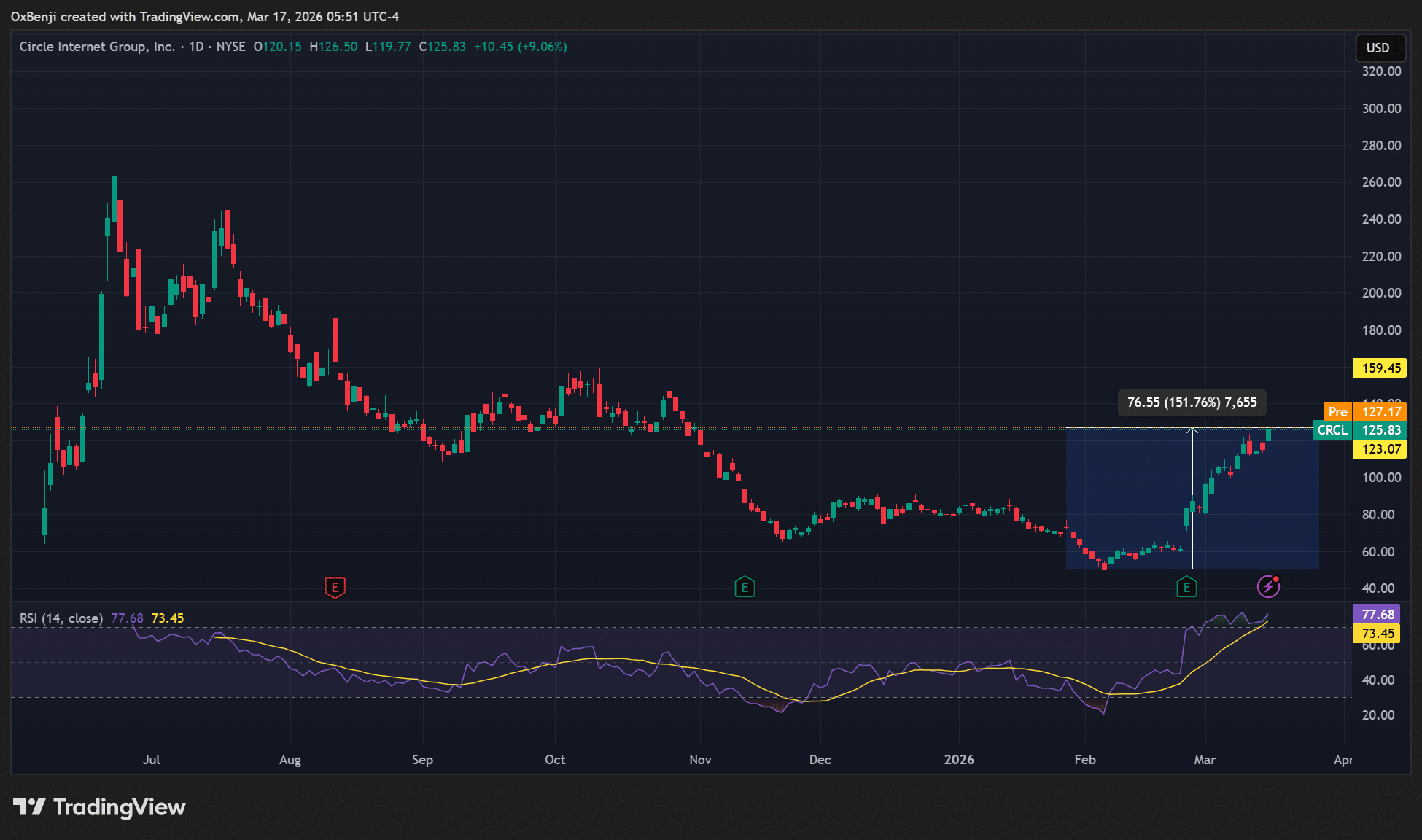
Circle Internet Group stock, CRCL, has recovered by over 150% from its February lows of $49.9 – A 2.5x pump in a month. On the 17th of March alone, the stock added an extra 9%, closing at $125.83.

Despite the remarkable bounce, the stock had fallen hard in late 2025 and early this year. After the initial IPO hype faded and the crypto rout intensified, CRCL slumped 83%, dropping from $298 to $49.

While Bitcoin’s rebound could be partly responsible for the CRCL lift-off, analysts singled out the growing adoption of Circle’s stablecoin USDC as a key driver.

USDC supply hits record $79B

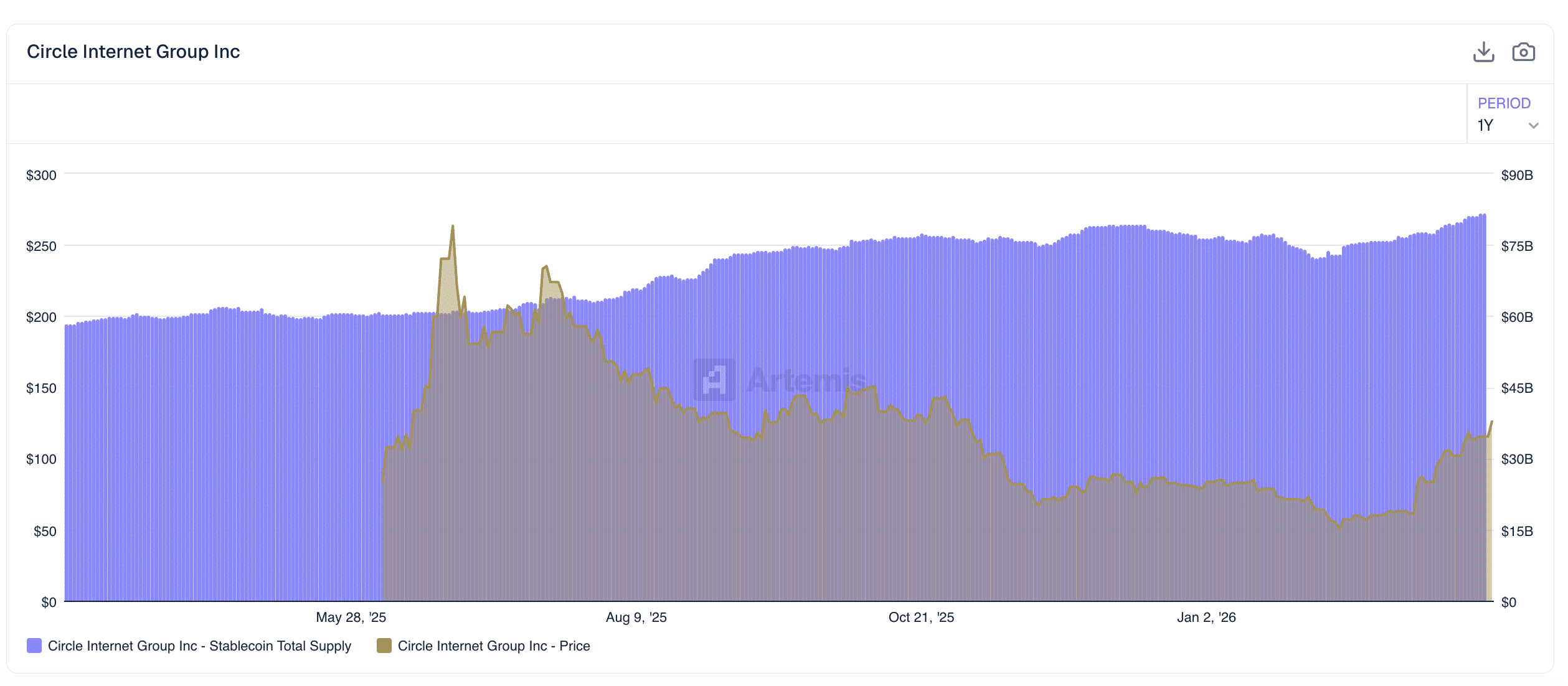
According to Jon Ma, founder of the crypto analytics platform Artemis, USDC adoption could be the greatest catalyst for CRCL’s Q1 recovery.

Noting that the $50 was an evident buy zone, Ma added,

Circle at $50/share was obvious. Stablecoin supply was $73B +25% YoY. Agentic payments were mentioned by Citrini as a winner in 2028.
Source: Artemis

During the February dip, USDC supply was about $70B. Now, its has expanded to $79B, marking a 13% increased in two months.

At the network level, over 10% of the USDC supply is concentrated in Solana [SOL]. Other trading platforms like Hyperliquid have seen 155% growth in USDC supply in the past month alone.

Interestingly, USDC’s push toward a record supply came amid a broader contraction in crypto trading. For analysts, this meant stablecoin was decoupling from the broader crypto market.

Ma’s agentic payments comment referenced a Citrini Research report that theorized that AI agents will transact on stablecoin rails and bypass traditional intermediaries by 2028.

In fact, Circle is already betting on AI agentic payment systems and the possibility that stablecoins could replace the current global foreign exchange (FX) market.

Can CRCL reclaim key levels?

Amid strong fundamentals growth, CRCL has reversed most of its late 2025 losses. Reclaiming the $125-$160 price range could effectively erase all the H2 2025 losses.
Source: CRCL price, TradingView

Meanwhile, the BTC recovery lifted other crypto stocks too, including Robinhood (Nasdaq: HOOD), Coinbase (Nasdaq: COIN), and Strategy (Nasdaq: MSTR). Notably, MSTR was up 14%, and COIN had recovered 22% over the past month.

But on a year-to-date (YTD) basis, Circle’s CRCL still outperformed them all. Despite the 150% upswing, the Wall Street analyst consensus rating for CRCL was a ‘HOLD’ with some projecting a price target of $145.
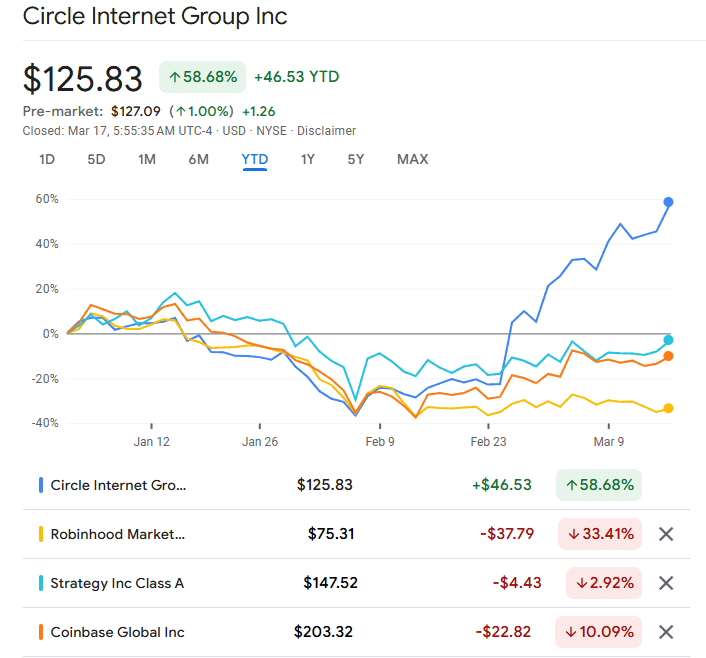
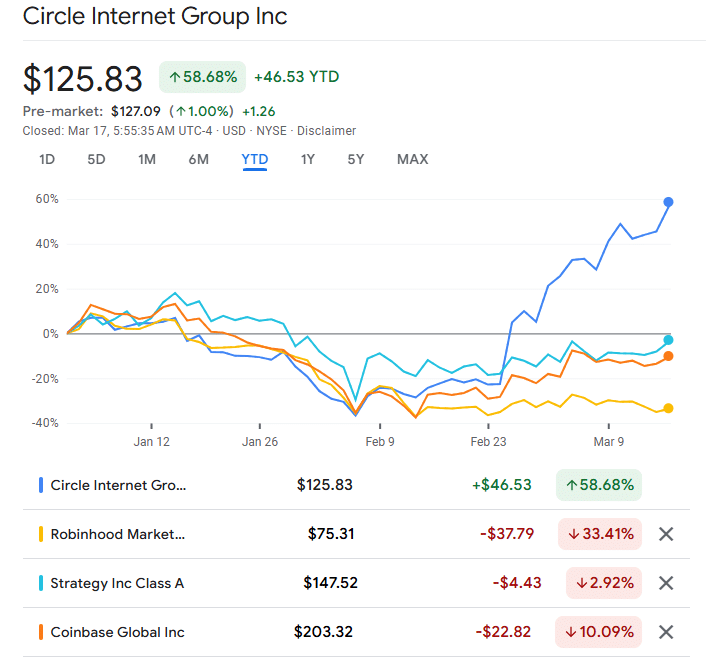
Source: Google Finance (as of March 17, Tuesday, GMT 10.00)

Final Summary

  • CRCL stock has recovered by 150% from the February low of $49, reversing all Q1 2026 losses.
  • Analysts cited strong USDC adoption and AI agentic payments as key catalysts behind the explosive run.


Пов'язані питання

QWhat is the percentage recovery of Circle's stock (CRCL) from its February lows, and what was the closing price on March 17th?

ACircle's stock (CRCL) has recovered by over 150% from its February lows of $49.9, and it closed at $125.83 on March 17th.

QAccording to analysts, what was a key driver behind CRCL's Q1 recovery besides Bitcoin's rebound?

AAnalysts singled out the growing adoption of Circle's stablecoin, USDC, as a key driver for CRCL's Q1 recovery.

QWhat milestone did the supply of USDC reach, and what was the percentage growth from February to the time of writing?

AThe supply of USDC hit a record $79 billion, marking a 13% increase from approximately $70 billion in February.

QWhat future application for stablecoins was cited by Citrini Research and is being bet on by Circle?

ACitrini Research theorized that AI agents will transact on stablecoin rails by 2028, and Circle is betting on AI agentic payment systems and the possibility that stablecoins could replace the global foreign exchange market.

QWhat is the Wall Street analyst consensus rating for CRCL stock, and what is one projected price target mentioned?

AThe Wall Street analyst consensus rating for CRCL was a 'HOLD', with some projecting a price target of $145.

Пов'язані матеріали

In Jinjiang, Fujian, a Storage Super Unicorn Lies Quiet

In Fujian's Jinjiang, a city known for sportswear, lies a quiet semiconductor giant: Fujian Jinhua Integrated Circuit Co. (JHICC). Once a promising domestic DRAM manufacturer alongside Yangtze Memory and ChangXin Memory Technologies (CXMT), its journey was derailed in 2018 when the U.S. placed it on an Entity List and filed criminal charges for alleged trade secret theft. This halted production for years. A turning point came in February 2024 when a U.S. federal court found JHICC not guilty. However, it had lost crucial time. While CXMT soared to become a top-valued A-share company in 2024, JHICC, with an estimated valuation of 80 billion RMB, was just restarting. Its current output is primarily customized DDR4 chips, not the advanced DDR5/HBM demanded for AI, but it still benefits from the broader memory chip upcycle. JHICC's story is tied to Chen Zhengkun, a veteran engineer who left Micron to lead the venture. Founded in 2016 with state-backed funding, JHICC partnered with Taiwan's UMC to develop DRAM technology. Rapid progress was cut short by the U.S. actions, which Micron initiated, partly due to its heavy reliance on the Chinese market. Post-sanctions, Chen's team worked to rebuild the production line with reduced reliance on U.S. technology. According to its records, JHICC achieved small-scale production and revenue growth under immense pressure. It now focuses on the stable "niche" DRAM market (e.g., TVs, routers) with a monthly capacity of ~40,000 wafers, aiming for 60,000 by 2026. It holds over 1,000 patents but remains on the Entity List. For Jinjiang, investing in JHICC was a bold industrial leap. The local government provided unwavering financial and logistical support during the crisis, helping the company survive. JHICC has become the anchor for a growing local semiconductor cluster. Though its scale lags behind domestic peers, JHICC's persistence symbolizes a hard-won foothold in a global market long dominated by Samsung, SK Hynix, and Micron. Having missed one boom, it seeks a place in the new AI-driven memory supercycle.

marsbit1 год тому

In Jinjiang, Fujian, a Storage Super Unicorn Lies Quiet

marsbit1 год тому

Торгівля

Спот
活动图片




