Chen Maobo and Others Revealed as First Batch of Guests for the 2026 Hong Kong Web3 Carnival!

比推Опубліковано о 2025-12-19Востаннє оновлено о 2025-12-19

Анотація

The 2026 Hong Kong Web3 Carnival, co-organized by Wanxiang Blockchain Lab and HashKey Group, will take place from April 20 to 23, 2026, at the Hong Kong Convention and Exhibition Centre. This annual event aims to bridge traditional and innovative sectors while connecting Eastern and Western global perspectives. Confirmed speakers include prominent figures such as Paul Chan Mo-po, Financial Secretary of the Hong Kong SAR; Xiao Feng, Chairman of Wanxiang Blockchain and HashKey Group; and other industry leaders from Solana Foundation, MatrixPort, and Animoca Brands, among others. The event is supported by strategic partners like the Hong Kong Trade Development Council and sponsors including OKX Web3 and Qtum. The carnival has attracted significant cross-industry interest, with over 500 executives from traditional finance and实体 industries registered by December 2025, highlighting its role in fostering dialogue between Web3 innovation and established sectors. Since its inception in 2023, the Hong Kong Web3 Carnival has grown into one of the world's most influential crypto summits, with past editions drawing over 100,000 attendees, 350 projects, and 1,200 speakers. The 2026 edition will continue to leverage Hong Kong’s unique position to deepen global integration of technology, business models, and regulatory practices, while providing a platform for local developers and projects to gain international exposure.

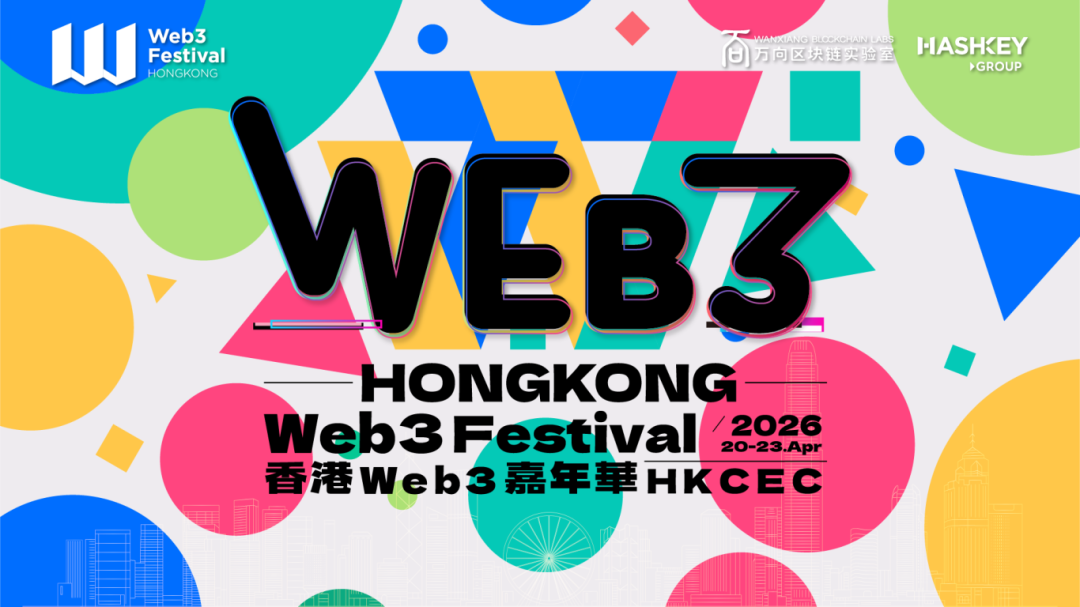
From April 20 to 23, 2026, the 2026 Hong Kong Web3 Carnival, jointly organized by Wanxiang Blockchain Lab and HashKey Group, will once again take place at the Hong Kong Convention and Exhibition Centre.

As an annual industry event held in Hong Kong for four consecutive years, this year's Carnival will continue to unleash its "home advantage," bridging tradition and innovation, connecting the East and the West, and fostering the convergence of global wisdom.


Gathering of Authorities: The 2026 Grand Event Begins Anew

Esteemed speakers and global ecosystem partners have gathered to form a solid foundation and diverse landscape for this year's event.

Currently, Paul Chan Mo-po, Financial Secretary of the Hong Kong Special Administrative Region; Xiao Feng, Chairman of Wanxiang Blockchain and CEO of Hashkey Group; Duncan Chiu, Legislative Council Member (Technology and Innovation) of the Hong Kong Special Administrative Region; Lily Liu, President of Solana Foundation; Cynthia Wu, Co-founder and Chief Business Officer of MatrixPort; Yat Siu, Co-founder and Chairman of Animoca Brands; and Professor Lee Kwok On, Dean of the Global FinTech Institute and Professor at Singapore University of Social Sciences (listed in no particular order), among other global thought leaders, have confirmed their attendance to share cutting-edge insights and perspectives. More distinguished guests will be announced soon. Stay tuned.

Simultaneously, this year's Carnival is honored to collaborate with strategic partner the Hong Kong Trade Development Council and has received strong support from title sponsor OKX Web3, platinum sponsor Qtum, exclusive dinner sponsor Sui Foundation, first-tier booth sponsors bitbaby, HappyMeta, and SlowMist, second-tier booth sponsors Ellipal, Fufuture, and Passey, and third-tier booth sponsor RWA.LTD (sponsors of the same tier listed in alphabetical order), among other global ecosystem partners. Together, they will co-create a global industry event deeply integrating ideas, resources, and opportunities.


Breaking Boundaries: Bridging Tradition and Innovation

The appeal of this year's Carnival extends beyond the native Web3 domain, with a stronger "boundary-breaking" momentum already evident.

Leveraging the extensive resource channels and brand-building efforts of Wanxiang Blockchain Lab and HashKey over the years, as of December 2025, the 2026 Hong Kong Web3 Carnival has attracted over 500 executives from traditional finance and实体产业 (实体产业) who have registered to participate. These attendees are high-net-worth individuals and core decision-makers from enterprises with a strong interest in the Web3领域 (Web3领域).

Genuine collaboration begins with high-quality encounters. This is one of the core values of this year's Carnival: to build a dialogue bridge between cutting-edge digital innovation and vast traditional industry resources, making subsequent integration truly possible.


Connecting East and West: Building a Global Ecosystem

Since its inaugural event in 2023, the Hong Kong Web3 Carnival has rapidly grown into one of the world's most influential crypto summits, providing a high-standard, high-quality, and in-depth platform for global East-West exchange.

Over the past three events, the Carnival has attracted over 100,000 on-site participants, featured more than 350 cutting-edge projects, invited over 1,200 speakers to share their insights, and spawned over 400 side events, successfully creating a vibrant ecosystem centered around the main event and radiating throughout the city.

As partners have noted, this platform is both "the most locally distinctive industry summit, uniquely capable of reaching millions of local high-level developers, entrepreneurs, and newcomers," and始终致力于 (始终致力于) "connecting the world's most forward-looking technological forces," continuously "promoting the industry to find a balance between security, compliance, and innovation."

As a hub connecting Eastern and Western Web3 ecosystems, the 2026 Hong Kong Web3 Carnival will continue to leverage Hong Kong's unique advantage of "背靠内地、面向全球" (backed by the mainland and facing the globe), building an efficient channel between the Asian market and global resources. This year's event will be dedicated to promoting the deep integration of global cutting-edge technologies, business models, and compliance practices with the Asian market. Simultaneously, it will help local outstanding developers, entrepreneurial teams, and innovative projects step onto the international stage, achieving comprehensive connectivity and value linkage from technology and resources to markets.

In April 2026, let us gather once again in Hong Kong—not only to witness the future but to participate in it and define it!

Click "Read More" at the end of the article to purchase tickets and attend!

Original link:https://www.bitpush.news/articles/7596949

Пов'язані питання

QWhen and where will the 2026 Hong Kong Web3 Festival take place?

AThe 2026 Hong Kong Web3 Festival will take place from April 20 to 23, 2026, at the Hong Kong Convention and Exhibition Centre.

QWho are some of the key confirmed speakers for the 2026 Hong Kong Web3 Festival?

AConfirmed speakers include Paul Chan Mo-po, Financial Secretary of the HKSAR; Xiao Feng, Chairman of Wanxiang Blockchain and HashKey Group; Duncan Chiu, Legislative Council Member (Technology & Innovation); Lily Liu, President of Solana Foundation; Cynthia Wu, Co-founder & CCO of MatrixPort; Yat Siu, Co-founder & Executive Chairman of Animoca Brands; and Professor David Lee of the Global FinTech Institute and Singapore University of Social Sciences.

QWhat is a key 'crossover' appeal of the 2026 Hong Kong Web3 Festival mentioned in the article?

AA key 'crossover' appeal is its strong attraction beyond the native Web3 field, having drawn over 500 executives from traditional finance and实体产业 (physical industries) by December 2025, who are high-net-worth individuals and core corporate decision-makers interested in Web3.

QWhat role does the article state the Hong Kong Web3 Festival plays in the global ecosystem?

AThe article states the festival acts as a hub connecting Eastern and Western Web3 ecosystems, providing a high-level platform for global exchange and leveraging Hong Kong's unique advantage of 'backing the mainland and facing the world' to build an efficient channel between Asian markets and global resources.

QWhich organizations are mentioned as the strategic partner and the title sponsor for the 2026 event?

AThe Hong Kong Trade Development Council is the strategic partner, and OKX Web3 is the title sponsor for the 2026 Hong Kong Web3 Festival.

Пов'язані матеріали

Agents Take Over Traffic Distribution Power: What Are Tencent, ByteDance, and Alibaba Competing For?

In the race to dominate the AI era's entry point, China's tech giants—Tencent, ByteDance, and Alibaba—are aggressively deploying AI Agents to control the future of traffic distribution. Alibaba is pursuing a dual-track "closed loop + openness" strategy. Its Qianwen app is evolving into a super-Agent integrated across its ecosystem (Taobao, Alipay, etc.) to handle complex tasks like travel planning. Concurrently, it is opening its platform to external brands (Luckin Coffee, KFC) and has launched a B2B Agent platform, "Wukong," targeting enterprise automation. Its other flagship, Quark, aims to be an "AI super search box" for information and tasks. ByteDance is executing an omnipresent "sprawl strategy." Its Doubao app boasts over 300 million monthly active users and is evolving into a default AI entry point for daily life, with plans for paid versions and e-commerce integration. Its core weapon is the Kouzi platform, a visual "AI assembly factory" for developers to build custom Agents. ByteDance is also pushing hardware integration, collaborating on AI phones and developing smart glasses to embed Doubao everywhere. Tencent is playing its long-held "ultimate card" by quietly embedding an AI Agent directly into WeChat. This Agent, accessible via a swipe, can understand user commands and automatically execute tasks by calling upon WeChat's millions of mini-programs (e.g., finding and ordering coffee). This leverages WeChat's unparalleled 1.4-billion-user ecosystem to position the app as an AI-powered "service operating system," a move that could dramatically reshape the competitive landscape. The core battleground is shifting from competing for "user screen time" to competing to be the "default execution layer" for user intent. The business model is evolving from an "attention economy" to an "intent economy," where the Agent that can most efficiently fulfill a user's need gains control over service access and token flow. This represents a fundamental change in how users connect with digital services, making the fight for the Agent入口 (entry point) a pivotal moment for redefining industry leadership in the AI age.

marsbit33 хв тому

Agents Take Over Traffic Distribution Power: What Are Tencent, ByteDance, and Alibaba Competing For?

marsbit33 хв тому

From Banning Doubao to Embracing Honor: Why Did WeChat Suddenly 'Change Its Face'?

The article explores the sudden shift in WeChat's strategy towards AI assistants from mobile phone manufacturers, transitioning from strict opposition to active collaboration. For over a year, WeChat fiercely resisted attempts by phone AI assistants (like ByteDance's Doubao in late 2025) to control its features via GUI automation ("simulated clicking"), citing security and data control concerns. This stance created a significant barrier for system-level AI integration. Now, Tencent has initiated A2A (Agent-to-Agent) partnerships with major phone brands like Honor, Xiaomi, OPPO, and vivo. This model allows a phone's system AI (e.g., Honor's YOYO) to parse a user's voice command and send a structured request directly to WeChat's own internal AI agent via secure APIs. WeChat then executes the action (e.g., sending a message) and returns the result. The article attributes Tencent's "change of face" to strategic pressure. While leading in social app usage, Tencent trails rivals like ByteDance and Alibaba in standalone AI app popularity. WeChat, with its vast mini-program ecosystem, is Tencent's key asset for an AI comeback. The upcoming WeChat AI agent aims to handle tasks like booking and payments within the app. However, phone system assistants remain the primary AI entry point for most users. The A2A collaboration allows Tencent to extend WeChat's AI reach to this crucial system layer while maintaining control over its core functions and data. For phone manufacturers, embracing A2A is a pragmatic move. The GUI route proved unviable due to WeChat's blocks. A2A offers a compliant path to integrate a vital service, enhancing their AI assistants' usefulness. It allows them to focus on developing their own AI ecosystems for other services while cooperating on WeChat access. The collaboration is framed as a mutual, strategic necessity: Tencent gains a distribution channel, and manufacturers gain a key functionality. The partnership relies on a "dual authorization" mechanism for security, requiring both user and app consent for each action. While questions about long-term data privacy practices remain, experts note A2A is more secure and compliant than GUI automation. Ultimately, this cooperation is seen as a tentative, calculated truce. Tencent's long-term goal is to make WeChat an AI-powered "service OS." Phone manufacturers aim to make their system AI the central user interface. Their paths may converge or clash in the future, but for now, the A2A deal represents the opening chapter in the battle for the AI-era user入口, driven by necessity and strategic calculus on both sides.

marsbit2 год тому

From Banning Doubao to Embracing Honor: Why Did WeChat Suddenly 'Change Its Face'?

marsbit2 год тому

Торгівля

Спот
Ф'ючерси
活动图片


