Charles Hoskinson Blasts Ripple For Backing Bill That Could Crush Competition

bitcoinistОпубліковано о 2026-03-31Востаннє оновлено о 2026-03-31

Анотація

Cardano founder Charles Hoskinson has sharply criticized Ripple and its CEO Brad Garlinghouse for supporting proposed U.S. legislation that would classify most new tokens as securities by default. Hoskinson argues this approach would harm competition, protect established players like Ripple through exemptions, and remove legal protections for DeFi and open-source developers. He warns the bill replicates the SEC’s aggressive regulatory stance and could expose software creators to unreasonable liability. Hoskinson also addressed the XRP community, clarifying that his criticism targets Ripple’s lobbying—not the token itself—and contrasted Ripple’s “mammoth premine” with Cardano’s more distributed token distribution.

Cardano founder Charles Hoskinson used a lengthy weekly livestream to level one of his sharpest recent attacks at Ripple, arguing that the company is backing legislation that could entrench incumbents, weaken DeFi protections, and make it harder for new crypto projects to compete.

The core of Hoskinson’s complaint was not aimed at XRP holders, but at what he described as Ripple’s policy posture in Washington and the behavior of CEO Brad Garlinghouse. In Hoskinson’s telling, Ripple is pushing for rules that would classify new tokens as securities by default while benefiting from carve-outs that would leave larger, established players in a stronger position.

Hoskinson Takes Aim At Ripple Over Competition Fight

Hoskinson said Garlinghouse was “trying to pass a bill that makes everything by default a security until proven otherwise,” calling that framework a non-starter for the broader market. He argued that such an approach would effectively recreate the kind of regulatory pressure that former SEC Chair Gary Gensler brought to the sector, only this time through legislation supported by industry actors rather than enforcement alone.

“He’s trying to pass a bill that makes everything by default a security until proven otherwise, which was the treatment Gary Gensler inflicted on his own ecosystem,” Hoskinson said. “It’s a non-starter, because he knows that he’s going to get an exemption and it reduces competition. So, [expletive] the whole industry. It’s bad behavior.”

That argument sat at the center of a wider rant about market structure, lobbying, and what Hoskinson sees as crypto’s growing willingness to trade open competition for regulatory protection. He said he had already laid out “four different attack vectors” the SEC could use if such a bill were enacted, and warned that the damage would not stop with token issuers.

According to Hoskinson, the proposal would also leave open-source developers exposed by stripping out protections for DeFi builders. “The bill also removed all developer protections for DeFi developers,” he said. “Who takes care of the Tornado Cash people and these other people writing open-source software? We can’t live in a space where you have transitive unlimited liability.”

He extended that point with one of the livestream’s longer analogies, arguing that holding software developers liable for downstream use of their code would amount to a category error. “You write code and people you’ve never met use that code in places you’ve never been to and you’re held absolutely liable for that,” Hoskinson said. “That’s equivalent to you writing a book, someone reads the book and murders somebody based on a character in your book and then you get charged with murder. It’s basically the same thing.”

Hoskinson also took aim at what he described as the XRP community’s reflexive defense of Ripple whenever he criticizes the company. He said there is “no path for people to listen to the content” of his argument because any criticism of Garlinghouse is treated as an attack on XRP itself. He pushed back on that framing by noting that he publicly supported Ripple when the SEC sued the company years ago, but said that did not obligate him to back its current lobbying goals.

“Guys, I did support you when you got sued by the Securities Exchange Commission,” he said. “There’s videos of me. You can pull them up from years ago where I said it was the wrong decision.”

From there, Hoskinson shifted into one of crypto’s oldest fault lines: token distribution. He argued that Ripple had no need for outside help in its legal fight because the organization “gave themselves a mammoth premine,” saying the company already had the resources to defend itself and pursue acquisitions. He contrasted that with Cardano, saying, “I didn’t give myself 70% of the ADA supply.”

At press time, XRP traded at $1.35.
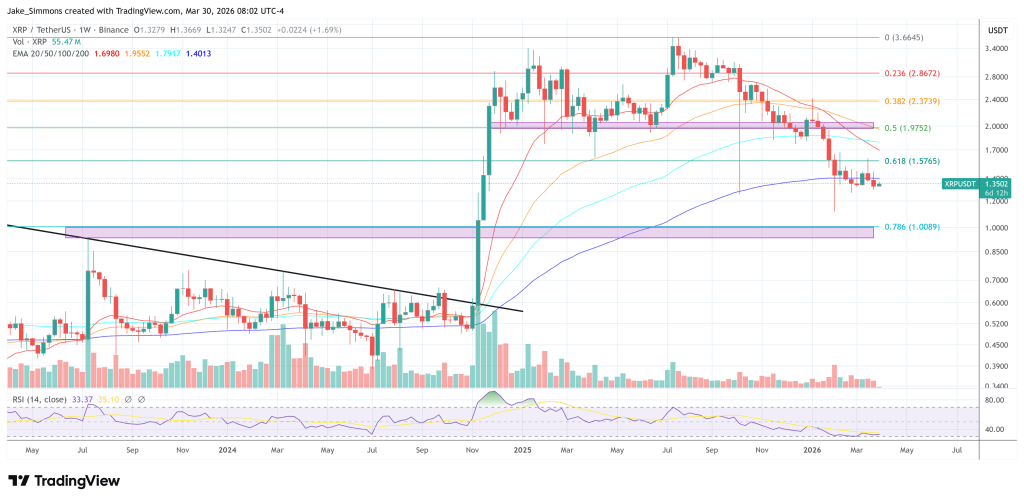
XRP falls below the 200-week EMA again, 1-week chart | Source: XRPUSDT on TradingView.com

Пов'язані питання

QWhat is Charles Hoskinson's main criticism against Ripple in this article?

ACharles Hoskinson criticizes Ripple for backing legislation that would classify new tokens as securities by default, which he believes would entrench incumbents, weaken DeFi protections, reduce competition, and benefit established players like Ripple through exemptions.

QAccording to Hoskinson, what negative consequences would the proposed bill have for DeFi developers?

AHoskinson states the bill would remove developer protections for DeFi builders, exposing open-source developers to 'transitive unlimited liability' where they could be held liable for how others use their code, similar to holding an author responsible if someone committed murder after reading their book.

QHow does Hoskinson contrast Cardano's token distribution with Ripple's?

AHoskinson contrasts the two by stating that Ripple 'gave themselves a mammoth premine' of XRP, giving them ample resources, while emphasizing 'I didn't give myself 70% of the ADA supply' for Cardano.

QWhat does Hoskinson say about the XRP community's response to his criticism of Ripple?

AHoskinson says the XRP community has a reflexive defense mechanism where any criticism of Ripple CEO Brad Garlinghouse is treated as an attack on XRP itself, making it difficult for people to actually listen to the content of his arguments.

QWhat historical support does Hoskinson mention he provided to Ripple, and how does it relate to his current stance?

AHoskinson mentions he publicly supported Ripple years ago when the SEC sued the company, calling it 'the wrong decision,' but clarifies that this past support does not obligate him to back Ripple's current lobbying efforts for what he considers anti-competitive legislation.

Пов'язані матеріали

In Conversation with Ray Dalio: We Are Currently in an AI Bubble, with 1% of My Portfolio in Bitcoin

Ray Dalio, founder of Bridgewater Associates, warns in an interview that the current AI boom shows classic bubble characteristics, which could lead to significant economic downturns as seen in past cycles like 1929 or 2000. He explains that speculative enthusiasm, fueled by debt and overvaluation, often precedes a crash when rising rates or taxation force asset sales, causing widespread losses and recession. Dalio also outlines his "Big Cycle" theory, describing an approximate 80-year pattern where widening wealth gaps, massive government deficits, and shifting geopolitical power (like China's rise) create internal conflict and global instability. He emphasizes that we are in a late-cycle, transitional phase where traditional powers like the US and UK face decline. For personal wealth protection, Dalio advises diversification beyond cash into assets like stocks, bonds, real estate, and particularly gold, which he prefers over Bitcoin. While he holds about 1% of his portfolio in Bitcoin as a non-printable hard asset, he views gold as more secure from technological or governmental threats. Regarding AI's impact, Dalio believes it will disproportionately benefit capital owners, worsening inequality by replacing both physical and cognitive labor. He suggests that human intuition and emotional intelligence, combined with AI, will be key for future workers. On taxation, Dalio argues that wealth taxes are impractical and risk triggering asset sell-offs, reducing productive investment. He points to the UK as a cautionary example of debt, low productivity, and political strife. Geopolitically, Dalio foresees a more regionalized world, with the US showing weakness in prolonged conflicts like with Iran, akin to past imperial declines. The ideal outcome, he suggests, is coexisting powerful blocs (e.g., Americas, China-Asia Pacific) without major war.

marsbit3 год тому

In Conversation with Ray Dalio: We Are Currently in an AI Bubble, with 1% of My Portfolio in Bitcoin

marsbit3 год тому

Daily 7.2 Trillion KRW: Foreign Capital's Record Net Buying on Friday! Wall Street Says Headwinds for Korean Stock Fund Flows Have Subsided

South Korean stock market sees a dramatic shift in fund flows. On July 31, foreign investors made a record net purchase of approximately KRW 7.2 trillion in KOSPI stocks, marking a fundamental reversal from the persistent large-scale net outflows seen in previous months. This contributed to a significant narrowing of foreign net selling in July to KRW 9.8 trillion, down sharply from KRW 48.4 trillion in June and KRW 44.5 trillion in May. Simultaneously, domestic institutional pressure eased. South Korean pension funds and asset managers turned to a net buying position in July, purchasing KRW 1.0 trillion worth of KOSPI shares, contrasting with net sales in May and June. Market volatility is expected to be dampened by new financial regulations. Effective July 31, the Financial Services Commission tightened access for retail investors to single-stock leveraged ETFs by raising the minimum cash deposit requirement. Trading volumes for these products subsequently dropped to about 50% of their monthly average. Citigroup Research maintains its year-end KOSPI target of 10,000 points. The firm cites several supportive factors: the substantial easing of headwinds from capital outflows, a robust fundamental outlook for the semiconductor sector, historically low market valuations, strong economic fundamentals, and the potential for policy support from financial authorities if needed.

marsbit3 год тому

Daily 7.2 Trillion KRW: Foreign Capital's Record Net Buying on Friday! Wall Street Says Headwinds for Korean Stock Fund Flows Have Subsided

marsbit3 год тому

Thanks to Dice Rolls, Bitcoin Keys Are Stored Offline, But Not Everyone Will Do It

The article discusses using dice rolls to generate secure Bitcoin wallet seeds, providing entropy independent of potentially flawed hardware random number generators. It explains that each fair dice roll offers about 2.585 bits of entropy, with around 50 rolls needed for a standard 12-word seed phrase and 99+ recommended for higher security. This method gained attention after a vulnerability was revealed in some Coldcard hardware wallets, where a faulty firmware RNG (dating back to 2021) compromised generated keys. The analysis notes that while a dice-generated main seed was safe from this specific flaw, other Coldcard functions (like creating paper wallets, backup keys, or passwords) could still be vulnerable if they used the defective RNG. The piece argues that while dice-based entropy is technically robust, the manual process is error-prone, tedious, and unrealistic for most new users, who might make mistakes in recording or inputting rolls. It concludes that while manual entropy generation should remain an option for advanced users, the long-term goal is to develop reliable, user-friendly hardware and software that securely generates randomness without requiring specialized knowledge. Coldcard users are advised to check their firmware version and replace any secondary secrets (like paper wallet keys) created with vulnerable devices, while also considering multi-signature setups with devices from different manufacturers for added security.

cryptonews.ru8 год тому

Thanks to Dice Rolls, Bitcoin Keys Are Stored Offline, But Not Everyone Will Do It

cryptonews.ru8 год тому

Торгівля

Спот
活动图片





