Chainlink Founder Sergey Nazarov Identifies 3 Trends That Will Define the Cryptosphere as Hyper Token Soars

bitcoinistОпубліковано о 2026-02-10Востаннє оновлено о 2026-02-10

Анотація

Chainlink co-founder Sergey Nazarov identifies three key trends shaping the crypto industry: real-world asset (RWA) tokenization, cross-chain interoperability, and high-performance infrastructure. These shifts signal a move from speculation to practical, institutional-grade applications. Bitcoin Hyper ($HYPER) emerges as a solution addressing Bitcoin’s scalability and utility limitations. By integrating the Solana Virtual Machine (SVM) as a Bitcoin Layer 2, it enables high-speed, low-cost smart contracts while leveraging Bitcoin’s security. The project has raised over $31.3M in its presale, with significant whale activity, indicating strong institutional interest. Bitcoin Hyper aims to unlock Bitcoin’s dormant capital through DeFi applications, staking rewards, and a decentralized bridge for seamless BTC transfers. This aligns with Nazarov’s vision of a verifiable, interconnected financial ecosystem.

Trusted Editorial content, reviewed by leading industry experts and seasoned editors. Ad Disclosure

Quick Facts:

  • ➡️ Chainlink’s Sergey Nazarov identifies RWA tokenization, cross-chain interoperability, and high-performance infrastructure as the three pillars of the next crypto cycle.
  • ➡️ Bitcoin Hyper addresses the liquidity gap by bringing the Solana Virtual Machine (SVM) to Bitcoin, enabling high-speed smart contracts on the world’s most secure chain.
  • ➡️ Institutional interest in Bitcoin Layer 2s is rising, evidenced by over $31M raised in the Bitcoin Hyper presale and verified whale accumulation.
  • ➡️ Whales join the race with over $1M raised across three transactions-only; FOMO is real.

The crypto market is undergoing a structural transformation that extends far beyond daily price tickers.

In recent keynotes, Chainlink co-founder Sergey Nazarov outlined three critical trends signaling the industry’s shift from speculative experimentation to critical global infrastructure.

It’s a bold claim, but his analysis suggests the next bull cycle won’t be defined by hype, it’ll be defined by the collision of traditional finance (TradFi) and decentralized protocols.

First, Nazarov points to the inevitability of Real-World Assets (RWAs) migrating on-chain. Major institutions aren’t just testing the waters anymore; they’re actively building tokenization platforms. This isn’t just about efficiency, it’s about creating a ‘verifiable web’ where asset ownership is mathematically guaranteed rather than legally promised.

Then there’s the collapse of cross-chain friction. The future isn’t a winner-take-all single chain, but an interconnected ecosystem where liquidity flows seamlessly between networks via protocols like CCIP.

The third trend is perhaps the most immediate: the demand for high-performance infrastructure capable of handling ‘internet-scale’ transactions. As DeFi matures, users are rejecting high latency and exorbitant gas fees.

This sentiment shift is driving capital away from legacy Layer 1s that refuse to scale and toward specialized execution layers. That’s exactly where new solutions are emerging to unlock the dormant capital on the world’s largest blockchain: Bitcoin Hyper ($HYPER).

$HYPER is available here.

Bitcoin Hyper Integrates SVM To Solve The Liquidity Fragmentation Crisis

While Nazarov emphasizes cross-chain standards, a glaring inefficiency remains: Bitcoin holds over 50% of the industry’s market cap but lacks the native programmability to participate in this new ‘verifiable web.’

Enter Bitcoin Hyper ($HYPER). By integrating the Solana Virtual Machine (SVM) directly as a Bitcoin Layer 2, the project introduces high-speed, low-cost transaction execution to the Bitcoin network.

The architecture here is distinct. Rather than relying on slow settlement times, Bitcoin Hyper utilizes a modular setup: Bitcoin L1 handles final settlement and security, while the SVM L2 handles real-time execution.
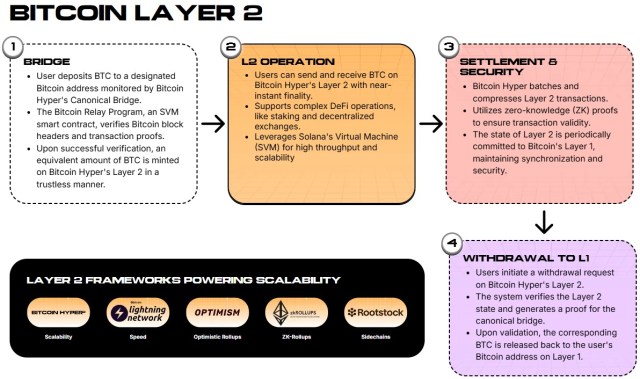
The result? A network capable of sub-second finality and negligible fees, outperforming even Solana in specific latency benchmarks. For developers, this means the ability to build high-performance DeFi applications using Rust, finally bridging the gap between Bitcoin’s liquidity and modern smart contract utility.

Smart money seems to be watching this setup. On-chain data from Etherscan indicates that two whale wallets accumulated $1M+ in recent transactions, with the largest single purchase of $500K occurring on Jan 15, 2026.

This accumulation suggests traders are betting on Layer 2s that can unlock Bitcoin’s yield-bearing potential without compromising its security.

Read more about $HYPER here.

Presale Momentum Accelerates As Capital Rotates Into Bitcoin Layer 2s

The narrative shift toward infrastructure that Nazarov predicts is already reflecting in capital flows. Investors are hunting for protocols offering immediate utility rather than vague roadmap promises.

Bitcoin Hyper ($HYPER) has tapped into this demand, raising over $31.3M in its ongoing presale. With tokens currently priced at $0.0136754, the project is drawing liquidity from traders hedging against Ethereum’s congestion and Solana’s occasional instability.
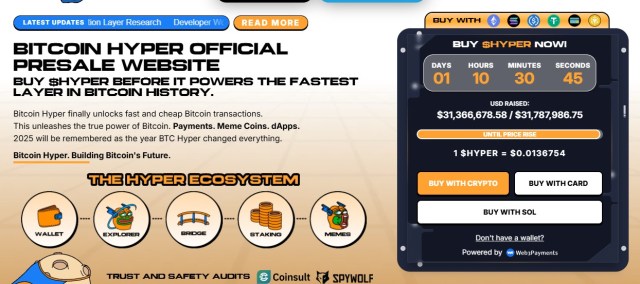
Plus, the economic model is driving interest. Bitcoin Hyper introduces a high-yield staking protocol available immediately after the Token Generation Event (TGE). Unlike traditional mining (which requires hardware), $HYPER staking rewards community participation and governance with a short 7-day vesting period for presale stakers.

It’s a setup designed for both exposure to a high-growth infrastructure token and yield generation on a Bitcoin-native layer.

The project’s Decentralized Canonical Bridge aligns with the industry’s push for interoperability. By allowing trustless transfers of $BTC into the L2 ecosystem, it enables Bitcoin to be used as collateral in lending and derivatives markets previously accessible only to $ETH or $SOL holders.

As the market moves toward the ‘verifiable web’ Nazarov describes, protocols that make Bitcoin actually usable could be positioned to capture significant value.

Buy $HYPER here.

This article is for informational purposes only and does not constitute financial advice. Cryptocurrencies are high-risk assets with significant volatility. The presale data and technical claims regarding Bitcoin Hyper are based on information provided by the project team. Always perform your own due diligence before investing.

Editorial Process for bitcoinist is centered on delivering thoroughly researched, accurate, and unbiased content. We uphold strict sourcing standards, and each page undergoes diligent review by our team of top technology experts and seasoned editors. This process ensures the integrity, relevance, and value of our content for our readers.

patrubogdan

Follow

Full Profile

Related Posts

Russian Lawmaker Predicts Bitcoin Collapse While Smart Money Rotates into Layer 2 Utility

Solana’s Low Fees Create Strong Competition for Base, BNB, and Polygon and Fuel SUBBD Token

Bitcoin Demand Plunges Per CryptoQuant, Yet Maxi Doge Endures

Crypto Markets Catch A Breather As Outflows Begin To Slow: Analysts

SUBBD Token’s Massive Projected Impact on the Content Creation Market in 2026

Government Shutdown Fears Trigger 2% Crypto Dip, But Bitcoin Hyper Remains Unshaken

Трендові криптовалюти

Пов'язані питання

QWhat are the three critical trends identified by Chainlink's Sergey Nazarov that will define the next crypto cycle?

AThe three trends are Real-World Assets (RWA) tokenization, cross-chain interoperability, and high-performance infrastructure capable of handling internet-scale transactions.

QHow does Bitcoin Hyper ($HYPER) address the liquidity fragmentation problem on the Bitcoin network?

ABitcoin Hyper integrates the Solana Virtual Machine (SVM) as a Bitcoin Layer 2, enabling high-speed smart contracts and low-cost transactions while using Bitcoin L1 for final settlement and security.

QWhat evidence suggests institutional interest in Bitcoin Hyper's presale?

AThe project raised over $31.3 million in its presale, with on-chain data showing whale transactions including a single purchase of $500,000 on January 15, 2026.

QWhat technical advantage does Bitcoin Hyper claim over other networks?

AIt claims sub-second finality and negligible fees, outperforming even Solana in specific latency benchmarks, while maintaining Bitcoin's security through its modular architecture.

QHow does Bitcoin Hyper's staking model differ from traditional Bitcoin mining?

AIt offers a high-yield staking protocol with immediate vesting after Token Generation Event (TGE), requiring no hardware and featuring a 7-day vesting period for presale participants, unlike hardware-dependent mining.

Пов'язані матеріали

Annual Salary of Millions Competing for Electricians, Meta Rushes to Open Its Own Technical School

The AI boom is facing an unexpected bottleneck: a severe shortage of skilled construction workers and electricians. As tech giants like Meta, OpenAI, and Alphabet race to build massive data centers—such as OpenAI's $16 billion "Stargate" project—they are hitting a critical labor wall. The U.S. needs an estimated 130,000 more electricians, 240,000 construction workers, and 150,000 supervisors by 2030 for AI infrastructure alone, but tens of thousands of electrician jobs go unfilled each year. While AI companies offer high premiums, with electricians earning up to $280,000 annually, worker scarcity still causes massive losses—delays on a single project can cost $14.2 million per month. The complexity of building AI data centers, which require immense power (equivalent to powering hundreds of thousands of homes), sophisticated electrical systems, and advanced liquid cooling solutions, demands highly skilled technicians who are in short supply. To combat this, companies are investing heavily in training. Meta has committed $115 million to a free training school offering tuition, housing, and stipends, targeting 5,000 new workers. OpenAI is partnering with unions to secure skilled labor. These efforts are paying off, with a significant rise in Gen Z interest in trade schools over college. However, the power demands are staggering. AI data centers are driving a rapid surge in electricity consumption, projected to account for up to 12% of U.S. power use by 2028 and raising costs for consumers. Furthermore, the construction boom is project-based, leading to a potential future glut of trained workers once building peaks, which could depress wages industry-wide. The race for AI supremacy now depends as much on skilled hands as on advanced chips.

marsbit1 год тому

Annual Salary of Millions Competing for Electricians, Meta Rushes to Open Its Own Technical School

marsbit1 год тому

OpenAI No Longer Sells Its Most Expensive Model for Profit

OpenAI is shifting its business strategy away from promoting its most expensive, flagship models for every task. Recent price cuts—80% for GPT-5.6 Luna and 20% for Terra—signal a deeper change: the company now actively advises users that many tasks don't require the most powerful model. Instead, OpenAI recommends a tiered approach: use the high-end GPT-5.6 Sol for complex planning and analysis, then delegate execution to cheaper models like Luna. This mirrors moves by Anthropic, which recently launched Claude Opus 5 at half the price of its top model, Fable 5. Both companies are de-emphasizing flagship models as primary revenue drivers, using them instead for brand prestige and technological showcases. The industry is entering a "mass-market" phase, similar to automotive, where high-volume, cost-effective models handle daily operations and drive scale. OpenAI's price reductions are partly enabled by AI models themselves optimizing underlying code and infrastructure, creating a self-reinforcing cycle of efficiency gains and cost reduction. Competition is shifting from "who is smartest" to "who offers the best value." The goal is no longer selling individual models but fostering widespread API adoption and ecosystem lock-in. By making AI calls cheap and ubiquitous, companies like OpenAI aim to become the indispensable, utility-like infrastructure powering automated workflows—the "water and electricity" of software, quietly embedded everywhere.

marsbit1 год тому

OpenAI No Longer Sells Its Most Expensive Model for Profit

marsbit1 год тому

Торгівля

Спот

Популярні статті

Як купити LINK

Ласкаво просимо до HTX.com! Ми зробили покупку ChainLink (LINK) простою та зручною. Дотримуйтесь нашої покрокової інструкції, щоб розпочати свою криптовалютну подорож.Крок 1: Створіть обліковий запис на HTXВикористовуйте свою електронну пошту або номер телефону, щоб зареєструвати обліковий запис на HTX безплатно. Пройдіть безпроблемну реєстрацію й отримайте доступ до всіх функцій.ЗареєструватисьКрок 2: Перейдіть до розділу Купити крипту і виберіть спосіб оплатиКредитна/дебетова картка: використовуйте вашу картку Visa або Mastercard, щоб миттєво купити ChainLink (LINK).Баланс: використовуйте кошти з балансу вашого рахунку HTX для безперешкодної торгівлі.Треті особи: ми додали популярні способи оплати, такі як Google Pay та Apple Pay, щоб підвищити зручність.P2P: Торгуйте безпосередньо з іншими користувачами на HTX.Позабіржова торгівля (OTC): ми пропонуємо індивідуальні послуги та конкурентні обмінні курси для трейдерів.Крок 3: Зберігайте свої ChainLink (LINK)Після придбання ChainLink (LINK) збережіть його у своєму обліковому записі на HTX. Крім того, ви можете відправити його в інше місце за допомогою блокчейн-переказу або використовувати його для торгівлі іншими криптовалютами.Крок 4: Торгівля ChainLink (LINK)Легко торгуйте ChainLink (LINK) на спотовому ринку HTX. Просто увійдіть до свого облікового запису, виберіть торгову пару, укладайте угоди та спостерігайте за ними в режимі реального часу. Ми пропонуємо зручний досвід як для початківців, так і для досвідчених трейдерів.

1.2k переглядів усьогоОпубліковано 2024.12.13Оновлено 2026.06.02

Як купити LINK

Обговорення

Ласкаво просимо до спільноти HTX. Тут ви можете бути в курсі останніх подій розвитку платформи та отримати доступ до професійної ринкової інформації. Нижче представлені думки користувачів щодо ціни LINK (LINK).

活动图片













