CFTC Partners With SEC On ‘Project Crypto’ For Unified Regulatory Approach

bitcoinistОпубліковано о 2026-01-31Востаннє оновлено о 2026-01-31

Анотація

The U.S. SEC and CFTC are relaunched "Project Crypto" as a joint initiative to create a unified regulatory framework for crypto assets. The effort aims to harmonize oversight, clarify jurisdictional boundaries, eliminate redundant compliance requirements, and enhance interagency coordination. Both agencies emphasized the need for precise, innovation-friendly regulation that supports economic growth while protecting investors. Additionally, the SEC delayed its anticipated innovation exemption for crypto firms, originally expected by early 2026, citing the need for careful implementation and potential disruptions from government shutdowns. The exemption would allow crypto products to launch under principles-based conditions rather than prescriptive rules. Both chairs reaffirmed their commitment to ensuring that the U.S. remains a leader in the evolving digital asset landscape.

The Securities and Exchange Commission (SEC) and Commodity Futures Trading Commission (CFTC) have announced they are relaunching the Project Crypto initiative as a joint policy effort to prepare US markets for the digital era.

SEC-CFTC Joint Efforts For Project Crypto

On Thursday, CFTC Chairman Michael Selig revealed that the regulatory agency is partnering with the SEC on its Project Crypto initiative to bring “coordination, coherence, and a unified approach to the federal oversight of crypto asset markets.”

At a joint event on regulatory harmonization, Selig and SEC Chairman Paul Atkins outlined their plan to advance a clear crypto asset taxonomy, clarify jurisdictional lines, remove duplicative compliance requirements, and reduce regulatory fragmentation through their partnership.

The SEC-CFTC harmonization agenda will focus on the fundamentals, as the chairmen detailed, including aligned definitions, coordinated oversight, and seamless, secure data sharing between agencies. “Harmonization strengthens standards through coherence, predictability, and economic rationality.”

The agencies aim to ensure that “innovation takes root on American soil, under American law, and in service of American investors, customers, and businesses,” Selig affirmed during his opening remarks.

He added that he had directed the CFTC staff to work with the SEC to study “joint codification” of the common-sense crypto asset taxonomy recently laid by Atkins, “as an interim measure while Congress finalizes legislation.”

In a joint statement shared by the CFTC, the pro-industry chairmen explained that Project Crypto was designed to ensure that the US is ready to reinforce its global financial leadership when Congress acts:

At its core, Project Crypto and our broader harmonization efforts reflect a shared philosophy: financial regulation must be precise, not punitive. Rules must be narrowly tailored to address material risks, nimble enough to adapt to technological change and remain anchored in our agencies’ statutory authorities.

Innovation Exemption Timeline Pushed Back

During the panel, Chair Atkins discussed the timeline for the Commission’s long-awaited innovation exemption for the crypto industry, which was initially expected to come before the end of January.

As reported by Bitcoinist, the SEC chair said in December that the regulatory agency could issue innovation exemption rules for crypto firms in early 2026. Notably, the Commission has been studying a rule exemption since July 2025.

The measure would allow crypto firms to quickly launch products by complying with “certain principles-based conditions designed to achieve the core policy aims of the federal securities laws” instead of “burdensome prescriptive regulatory requirements that hinder productive economic activity.”

Atkins affirmed that the agency is still working on the innovation exemption, arguing that they “need to measure twice and cut once.” As he outlined, the agency wants to deliver a rule change that is “fit for purpose that will allow enough people to be able to develop their products, you know, within a predictable ambit of maneuver and then with an end date, an off-ramp, that sort of thing.”

In addition, he noted that last year’s government shutdown delayed progress on crypto regulation, adding that the potential new shutdown could further delay the highly anticipated measure.

Atkins denied that the SEC is waiting on the market structure bill to put out the innovation exemption, arguing that it is within the agency’s authority. However, he emphasized that they are taking the upcoming regulation into account because “there are a lot of moving parts to the situation.”

“I just want to make sure that we keep the train going forward at full speed and for all parties’ sake,” he asserted, but did not offer a new potential timeline for the innovation exemption rollout.

Meanwhile, Chair Selig also shared his plan to explore “ways in which the agency can encourage innovation in software development and support builders as they work toward product market fit.” This includes assessing whether an innovation exemption “may be appropriate in certain circumstances.”
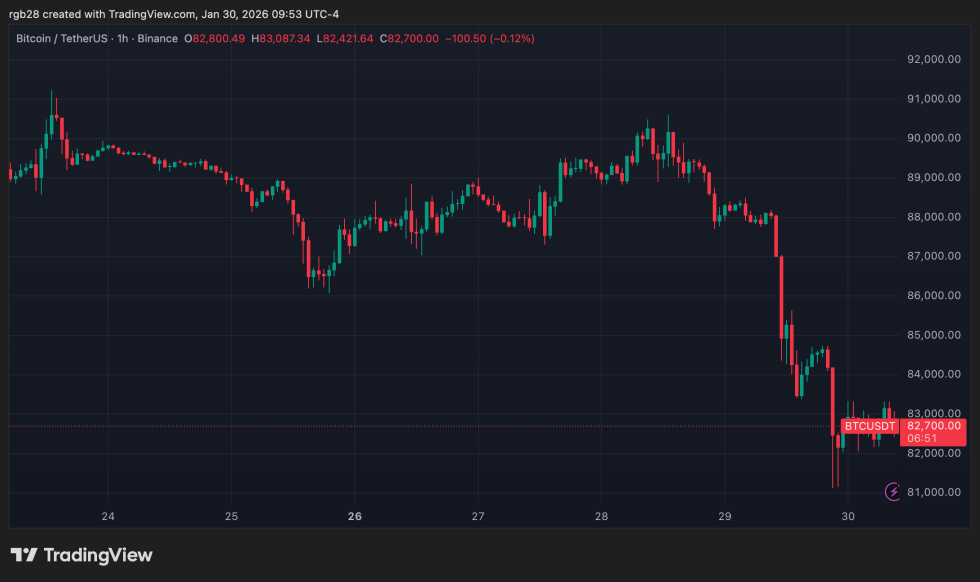
Bitcoin (BTC) trades at $82,700 in the one-week chart. Source: BTCUSDT on TradingView


Пов'язані питання

QWhat is the main purpose of the relaunched 'Project Crypto' initiative announced by the SEC and CFTC?

AThe main purpose is to bring coordination, coherence, and a unified approach to the federal oversight of crypto asset markets, preparing US markets for the digital era.

QWhat are the key focus areas of the SEC-CFTC harmonization agenda as detailed by the chairmen?

AThe key focus areas include advancing a clear crypto asset taxonomy, clarifying jurisdictional lines, removing duplicative compliance requirements, reducing regulatory fragmentation, and ensuring aligned definitions, coordinated oversight, and secure data sharing.

QWhat did CFTC Chairman Michael Selig direct his staff to study in collaboration with the SEC?

AHe directed CFTC staff to work with the SEC to study 'joint codification' of the common-sense crypto asset taxonomy recently laid out by SEC Chairman Atkins, as an interim measure while Congress finalizes legislation.

QWhat is the initial expected timeline for the SEC's innovation exemption for crypto firms, and what was the reason for the delay mentioned?

AThe innovation exemption was initially expected by the end of January but is now anticipated in early 2026. The delay was attributed to the need for careful development ('measure twice and cut once') and was further impacted by last year's government shutdown.

QAccording to the chairmen's joint statement, what is the core philosophy behind Project Crypto and their broader harmonization efforts?

AThe core philosophy is that financial regulation must be precise, not punitive, with rules narrowly tailored to address material risks, nimble enough to adapt to technological change, and anchored in the agencies' statutory authorities.

Пов'язані матеріали

Annual Salary of Millions Competing for Electricians, Meta Rushes to Open Its Own Technical School

The AI boom is facing an unexpected bottleneck: a severe shortage of skilled construction workers and electricians. As tech giants like Meta, OpenAI, and Alphabet race to build massive data centers—such as OpenAI's $16 billion "Stargate" project—they are hitting a critical labor wall. The U.S. needs an estimated 130,000 more electricians, 240,000 construction workers, and 150,000 supervisors by 2030 for AI infrastructure alone, but tens of thousands of electrician jobs go unfilled each year. While AI companies offer high premiums, with electricians earning up to $280,000 annually, worker scarcity still causes massive losses—delays on a single project can cost $14.2 million per month. The complexity of building AI data centers, which require immense power (equivalent to powering hundreds of thousands of homes), sophisticated electrical systems, and advanced liquid cooling solutions, demands highly skilled technicians who are in short supply. To combat this, companies are investing heavily in training. Meta has committed $115 million to a free training school offering tuition, housing, and stipends, targeting 5,000 new workers. OpenAI is partnering with unions to secure skilled labor. These efforts are paying off, with a significant rise in Gen Z interest in trade schools over college. However, the power demands are staggering. AI data centers are driving a rapid surge in electricity consumption, projected to account for up to 12% of U.S. power use by 2028 and raising costs for consumers. Furthermore, the construction boom is project-based, leading to a potential future glut of trained workers once building peaks, which could depress wages industry-wide. The race for AI supremacy now depends as much on skilled hands as on advanced chips.

marsbit28 хв тому

Annual Salary of Millions Competing for Electricians, Meta Rushes to Open Its Own Technical School

marsbit28 хв тому

OpenAI No Longer Sells Its Most Expensive Model for Profit

OpenAI is shifting its business strategy away from promoting its most expensive, flagship models for every task. Recent price cuts—80% for GPT-5.6 Luna and 20% for Terra—signal a deeper change: the company now actively advises users that many tasks don't require the most powerful model. Instead, OpenAI recommends a tiered approach: use the high-end GPT-5.6 Sol for complex planning and analysis, then delegate execution to cheaper models like Luna. This mirrors moves by Anthropic, which recently launched Claude Opus 5 at half the price of its top model, Fable 5. Both companies are de-emphasizing flagship models as primary revenue drivers, using them instead for brand prestige and technological showcases. The industry is entering a "mass-market" phase, similar to automotive, where high-volume, cost-effective models handle daily operations and drive scale. OpenAI's price reductions are partly enabled by AI models themselves optimizing underlying code and infrastructure, creating a self-reinforcing cycle of efficiency gains and cost reduction. Competition is shifting from "who is smartest" to "who offers the best value." The goal is no longer selling individual models but fostering widespread API adoption and ecosystem lock-in. By making AI calls cheap and ubiquitous, companies like OpenAI aim to become the indispensable, utility-like infrastructure powering automated workflows—the "water and electricity" of software, quietly embedded everywhere.

marsbit28 хв тому

OpenAI No Longer Sells Its Most Expensive Model for Profit

marsbit28 хв тому

Will the Fed Definitely Raise Interest Rates in September? How Will Crypto and U.S. Stocks Withstand the Pressure?

The market's expectation for a September Fed rate hike surged dramatically in early August, jumping from under 50% to over 80% within a week. This shift followed a contentious July FOMC meeting, where a 9-3 vote to hold rates revealed growing dissent from hawkish members advocating for an immediate hike to combat persistent inflation. The primary catalyst for this repricing is rising oil prices, driven by renewed geopolitical tensions around the Strait of Hormuz, which threaten global supply. Energy costs directly influence inflation metrics, making the upcoming July CPI report (due August 12th) a critical data point. If it shows inflation reaccelerating, the probability of a September hike will solidify. For Bitcoin and crypto assets, this is typically bearish news. Bitcoin continues to behave as a high-beta, liquidity-sensitive risk asset. A rate hike raises the opportunity cost of holding non-yielding assets and could drive capital toward money markets, pressuring crypto prices in the short term. However, historical patterns suggest that if a hike is perceived as the end of a tightening cycle rather than the start, any negative price impact may be brief. U.S. stocks, particularly crypto-linked equities like Coinbase and growth-oriented tech stocks, are also vulnerable. Higher rates increase discount rates in valuation models, putting pressure on high-multiple companies. This coincides with a pivotal tech earnings season where investor focus has shifted from massive AI capital expenditure to tangible revenue and cash flow generation. Companies with negative cash flow and weak growth narratives could face heightened volatility if borrowing costs rise in September. In summary, a September Fed hike has evolved into a mainstream market scenario. Key factors to watch are oil prices, the July CPI report, and Fed communications, which will determine the final decision and its impact on volatile crypto and equity markets.

marsbit38 хв тому

Will the Fed Definitely Raise Interest Rates in September? How Will Crypto and U.S. Stocks Withstand the Pressure?

marsbit38 хв тому

Торгівля

Спот
活动图片




