CFTC gives prediction markets leeway on data and record-keeping rules

cointelegraphОпубліковано о 2025-12-12Востаннє оновлено о 2025-12-12

Анотація

The U.S. Commodity Futures Trading Commission (CFTC) has issued no-action letters to several prediction market platforms—including Polymarket US, LedgerX, PredictIt, and Gemini Titan—exempting them from certain swap data reporting and record-keeping requirements. The exemption applies under specific conditions, such as ensuring full collateralization of contracts and publishing transaction data post-execution. Prediction markets allow trading on event outcomes and are regulated as designated contract markets. The no-action relief temporarily reduces enforcement risk but does not change existing laws. The sector has seen significant growth, with platforms like Kalshi and Polymarket recording billions in trading volume.

The Commodity Futures Trading Commission has issued “no-action” letters to a group of prediction markets, exempting them from requirements related to swap data reporting and record-keeping regulations.

The CFTC’s Division of Market Oversight and the Division of Clearing and Risk won’t initiate enforcement action against several prediction market platforms for shirking certain recordkeeping demands, provided they follow other specific requirements, the agencies said in a statement on Thursday.

“The no-action letters apply only in narrow circumstances and are comparable to no-action letters issued for other similarly situated designated contract markets and derivatives clearing organizations,” they added.

The companies that received a no-action letter are Polymarket US, LedgerX, PredictIt and crypto exchange Gemini’s prediction markets arm, Gemini Titan.
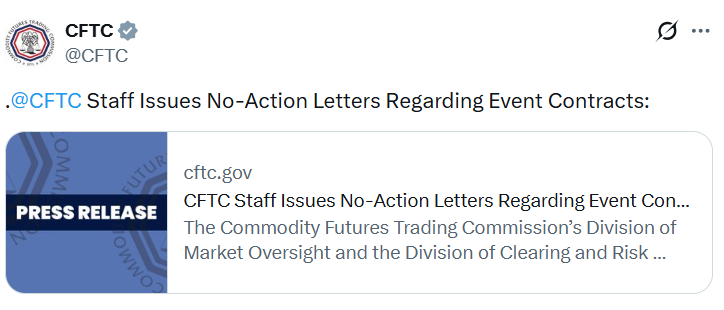
Source: CFTC


As part of the requirements to avoid enforcement, the platforms must fully collateralize all their contracts by ensuring its completely covered by assets held in reserve, and also publish time and sales data for all event contract transactions on their websites “after execution of the transactions,” according to the letters.

Prediction markets and event contracts enable traders to take positions on the outcome of various events, including sports and unconventional topics such as the clothing choices of political figures.

These contracts trigger extensive reporting and record-keeping obligations in the US as prediction markets are regulated as designated contract markets; however, the no-action letter now frees them from the threat of immediate enforcement risk if those obligations aren’t kept.

Related: Gemini soars 14% as new license opens door to US prediction markets

A no‐action letter means the CFTC staff won’t recommend enforcement if the requesting party fails to comply with certain regulations under very specific terms; however, it doesn’t change the law, and they are generally used to temporarily reduce regulatory risk while the market or product evolves.

Prediction markets record bumper 2025

Prediction markets have become one of the most popular crypto offerings this year, with trading volumes on platforms such as Kalshi and Polymarket regularly recording billions of transactions.

Kalshi has had a trading volume of $5.`14 billion over the last 30 days, according to DeFi data aggregator DefiLlama. In comparison, Polymarket, a cryptocurrency-based prediction market, has recorded $1.9 billion in trading volume over the last 30 days.

Crypto.com recently began offering a prediction market platform, which is set to be integrated with Trump Media, while tech researcher Jane Manchun Wong said on Nov.19 that website data indicated Coinbase was also working on creating a prediction market platform.

Magazine: Can Robinhood or Kraken’s tokenized stocks ever be truly decentralized?

Пов'язані матеріали

How Does x402 V2 Enable Autonomous Payments for AI Agents?

The x402 protocol, initially developed by Coinbase, leverages the HTTP 402 status code to embed payment logic directly into web requests. The newly released V2 upgrade introduces significant improvements to address limitations in cross-chain support, scalability, identity authentication, and repeated payments experienced in V1. Key enhancements include: - **Wallet Identity and Reusable Sessions**: Supports wallet-based authentication (e.g., Sign-In-With-X via CAIP-122), allowing reusable sessions after initial payment. This reduces latency and costs for high-frequency use cases like AI agent tasks and LLM inference. - **Unified Payment Interface**: Enables multi-chain payments (e.g., Base, Solana) and compatibility with traditional systems (ACH, SEPA, credit cards) via Facilitators. Dynamic payTo routing allows context-aware pricing and complex market structures. - **Modular Architecture**: A plugin-driven SDK simplifies integration, supporting easy expansion to new chains and payment methods without core changes. Multi-Facilitator support automates optimal payment path selection based on preferences. - **Automatic Discovery**: Services can expose metadata for automatic synchronization, ensuring real-time pricing and availability updates without manual intervention. For end-users, V2 enables seamless, subscription-like access with reduced friction. Developers benefit from flexible, low-maintenance payment integration and dynamic pricing models. AI agents gain autonomy to make economic decisions, such as purchasing API calls or compute resources independently using allocated budgets. x402 V2 evolves from a pay-per-use tool into a versatile economic layer, though challenges like ecosystem adoption, modular risks, and regulatory uncertainty remain.

比推13 хв тому

How Does x402 V2 Enable Autonomous Payments for AI Agents?

比推13 хв тому

Bitcoin (BTC) Price Trend and Investor Sentiment Suggest a Bullish December

Bitcoin (BTC) is showing signs of a potential bullish December, challenging a decade-old bearish seasonal pattern where November losses typically extend into year-end declines. Key factors supporting this shift include reduced leverage, with open interest dropping from $94 billion to $60 billion, and Bitcoin’s price reclaiming its monthly volume-weighted average price (rVWAP), indicating controlled distribution. Liquidity dynamics have also shifted, with deep liquidity clusters moving upward, and around $3 billion in short positions set to liquidate near $96,000. Market structure diverges from historical cycles due to spot ETF inflows, introducing constant structural demand and accelerating price discovery. Analysts note that Bitcoin’s four-year cycle, while not obsolete, is no longer time-aligned, resembling extended accumulation phases like mid-2016 or late-2019. Macro liquidity (M2) growth has plateaued, creating a late-cycle environment where risk assets rally despite underlying economic softening. Supporting indicators, such as CNY/USD and ETH/BTC correlations, along with improving PMI data and gold’s relative strength, suggest continued risk-on momentum rather than cycle fatigue. While buy-sell ratios show urgency, analysts caution this may reflect positioning squeeze rather than sustainable accumulation. Overall, December’s performance may depend more on structural forces—ETF flows, liquidity rotation, and shifting macro correlations—than traditional halving-driven周期 patterns.

cointelegraph_中文29 хв тому

Bitcoin (BTC) Price Trend and Investor Sentiment Suggest a Bullish December

cointelegraph_中文29 хв тому

Торгівля

Спот
Ф'ючерси
活动图片