Centrifuge: Can CFG bulls break past $0.18 as TVL hits $1.6B? Examining…

ambcryptoОпубліковано о 2026-04-03Востаннє оновлено о 2026-04-03

Анотація

Over the past 24 hours, Centrifuge (CFG) was a top performer among altcoins, surging 12% following its announcement to expand to Base Chain and enable trading of tokenized S&P 500. This move into real-world asset tokenization appears to be a key driver behind the rally. From a technical perspective, CFG's price rebounded from a key Fibonacci retracement zone around $0.14, rallying to a daily high of $0.172. The MACD indicator confirmed a short-term bullish trend shift, though the $0.17 level is acting as resistance. The next major target is $0.1857, a zone that has triggered bearish reversals three times previously. Fundamentally, Centrifuge's ecosystem is experiencing strong growth. Its Total Value Locked (TVL) has increased to $1.6 billion, up from $1.2 billion, supported by four asset classes including treasuries, AAA CLOs, private credit, and now S&P 500. Network revenue also showed positive growth in March compared to February. Additionally, the number of unique addresses and token holders continues to grow steadily, reaching 19,699 and 9,111 respectively. In summary, CFG's price momentum is being driven by both robust network expansion and a favorable technical setup, though it faces a significant resistance test near the $0.18 level.

The past 24 hours have seen altcoins react differently, with the majority of them recording losses. Centrifuge [CFG] was one of the standout performers with a 12% increase, ranking among the top ten daily gainers.

Centrifuge’s announcement to expand to Base Chain, where it allowed the trading of tokenized S&P 500 as a new asset class, drove the rally. Is tokenization the main driver of CFG? Can bulls keep up with the pace?

CFG price bounces off KEY retracement level

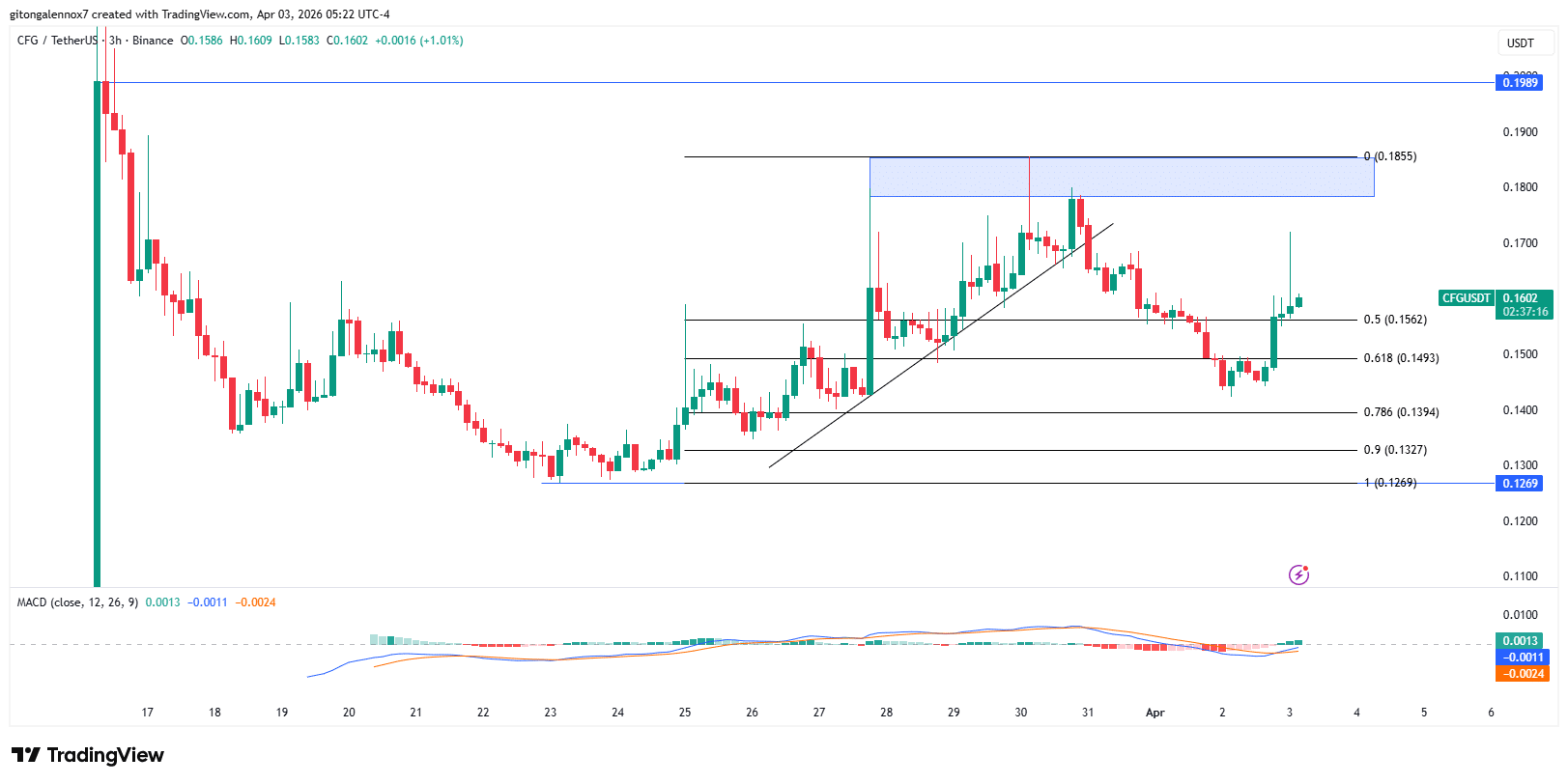
The charts clearly showed the current bullish momentum, with CFG rallying from a low of $0.14 to a daily high of $0.172. The altcoin lost its rising trendline support on the 31st of March but seemed to have ended the correction phase.

CFG bounced off the zone between 0.618 and 0.786 Fibonacci Retracement levels. To be specific, the altcoin respected the optimal zone at the 0.75 Fib level but seems to be seeing rejection around $0.17.

Holding through the premium zone, which is above the 0.5 Fib level, the altcoin increases the potential to hit $0.1857. However, this zone has sparked bearish reversals three times as CFG makes the fourth attempt.
Source: CFG/USDT on TradingView

Interestingly, bulls are showing strength, though it’s weak. The MACD lines have had a crossover confirming a short-term trend shift in the altcoin’s price action.

That puts $0.1857 as a potential reversal zone unless bulls can gather enough momentum past the resistance. This resistance zone was 18% away from $0.1561, which was a discount area considering the rally that started on the 23rd of March.

Growth in Centrifuge’s TVL, revenue, and holders

As Centrifuge continued to expand its chain, its Total Value Locked (TVL), revenue, and number of holders followed suit.

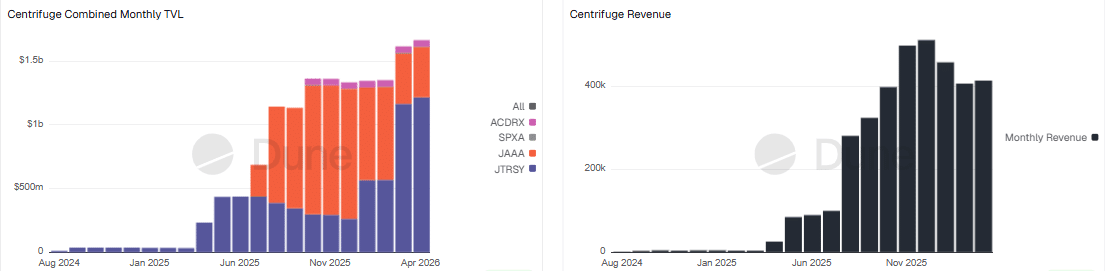
For instance, its TVL grew to $1.6 billion from $1.2 billion. This trend is continued as the asset classes have increased to four, which include treasuries, AAA CLOs, private credit, and now S&P 500. Treasuries accounted for the largest share of $1.2 billion.

Its revenue showed steady growth even though there was a slight dip since the year started. March recorded higher revenue than February, indicating the growth was back to positive territory.
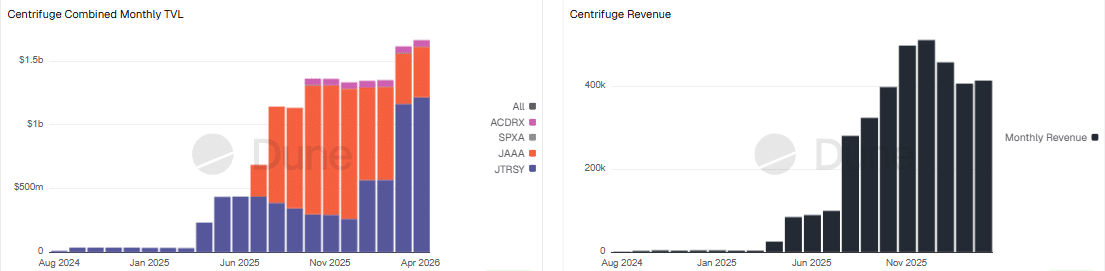
Source: Dune Analytics

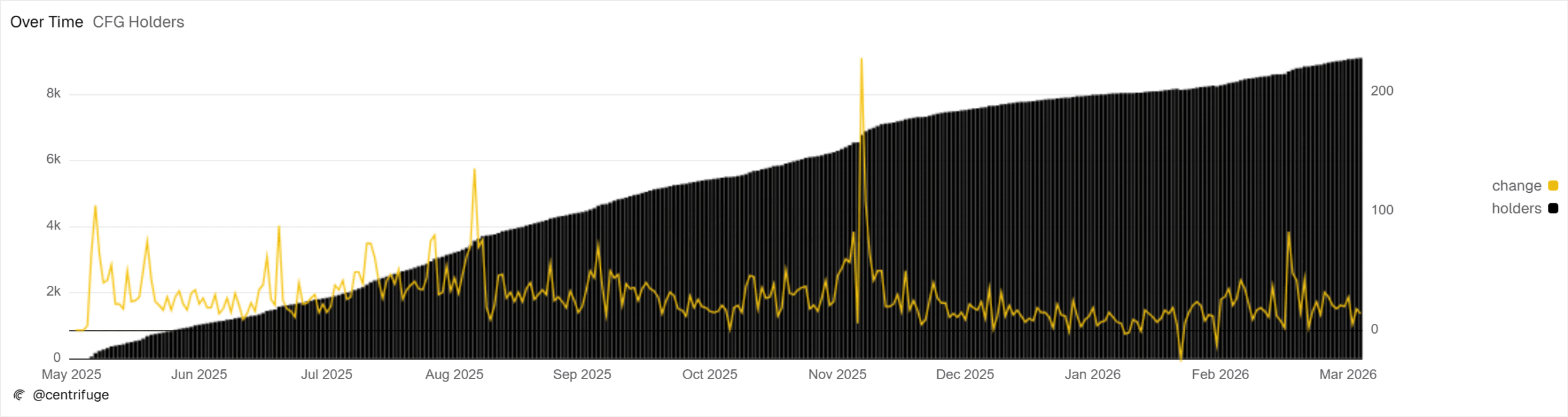
Dune Analytics recorded a total of 19,699 unique addresses interacting with CFG. Moreover, holders were growing steadily day by day since May 2025.

Only 14 new holders had been added in the past 24 hours, taking the total over time to 9,111.
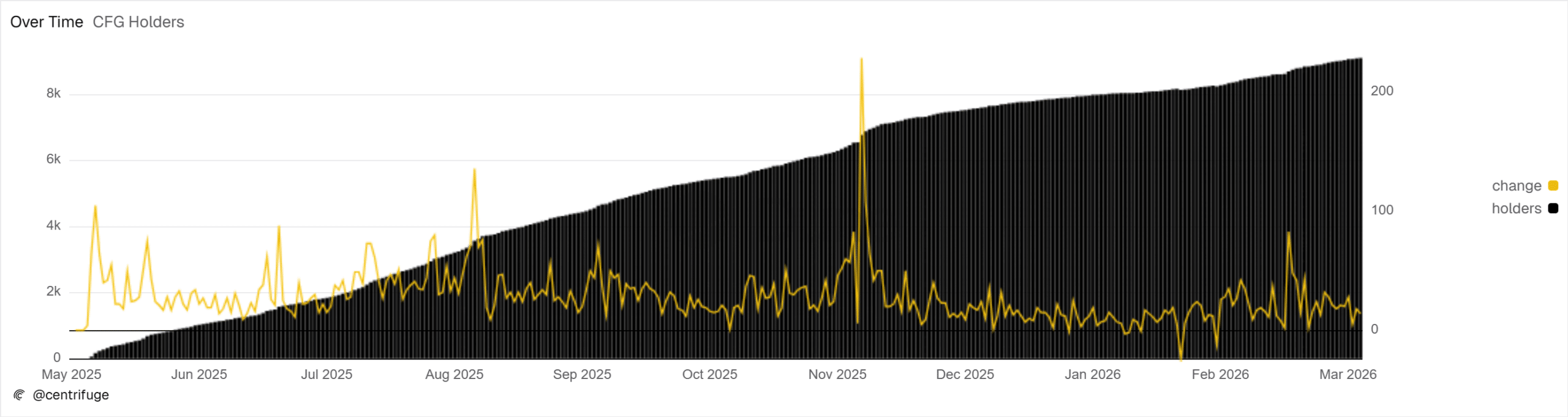
Source: Dune Analytics

In summary, CFG prices were mainly driven by the network activity alongside a bullish technical setup.


Final Summary

  • Centrifuge surges 12% amid Base Chain integration to trade tokenized S&P 500, but CFG faces a key test at $0.18.
  • Centrifuge’s network activity was thriving, as seen in TVL, revenue, and number of holders.

Пов'язані питання

QWhat was the recent price performance of Centrifuge (CFG) and what drove its rally?

ACentrifuge (CFG) was one of the top ten daily gainers with a 12% increase in the past 24 hours. The rally was driven by its announcement to expand to Base Chain, allowing the trading of tokenized S&P 500 as a new asset class.

QWhat key technical level did CFG's price bounce from, and what is the next potential target?

ACFG's price bounced off the zone between the 0.618 and 0.786 Fibonacci Retracement levels, specifically respecting the 0.75 Fib level. The next potential target is $0.1857, provided bulls can gather enough momentum to break past the current resistance.

QHow has Centrifuge's Total Value Locked (TVL) changed recently, and what are its main asset classes?

ACentrifuge's TVL grew to $1.6 billion from $1.2 billion. Its main asset classes include treasuries (accounting for the largest share of $1.2 billion), AAA CLOs, private credit, and now S&P 500.

QWhat does the data from Dune Analytics show about the number of CFG holders?

ADune Analytics recorded a total of 19,699 unique addresses interacting with CFG. The number of holders has been growing steadily since May 2025, with a total of 9,111 holders over time, adding 14 new holders in the past 24 hours.

QWhat are the main factors driving CFG's price according to the article's summary?

ACFG's price is mainly driven by network activity, such as the expansion to Base Chain and the addition of new asset classes, alongside a bullish technical setup that includes a bounce from key Fibonacci levels.

Пов'язані матеріали

Will the Fed Definitely Raise Interest Rates in September? How Will Crypto and U.S. Stocks Withstand the Pressure?

The market's expectation for a September Fed rate hike surged dramatically in early August, jumping from under 50% to over 80% within a week. This shift followed a contentious July FOMC meeting, where a 9-3 vote to hold rates revealed growing dissent from hawkish members advocating for an immediate hike to combat persistent inflation. The primary catalyst for this repricing is rising oil prices, driven by renewed geopolitical tensions around the Strait of Hormuz, which threaten global supply. Energy costs directly influence inflation metrics, making the upcoming July CPI report (due August 12th) a critical data point. If it shows inflation reaccelerating, the probability of a September hike will solidify. For Bitcoin and crypto assets, this is typically bearish news. Bitcoin continues to behave as a high-beta, liquidity-sensitive risk asset. A rate hike raises the opportunity cost of holding non-yielding assets and could drive capital toward money markets, pressuring crypto prices in the short term. However, historical patterns suggest that if a hike is perceived as the end of a tightening cycle rather than the start, any negative price impact may be brief. U.S. stocks, particularly crypto-linked equities like Coinbase and growth-oriented tech stocks, are also vulnerable. Higher rates increase discount rates in valuation models, putting pressure on high-multiple companies. This coincides with a pivotal tech earnings season where investor focus has shifted from massive AI capital expenditure to tangible revenue and cash flow generation. Companies with negative cash flow and weak growth narratives could face heightened volatility if borrowing costs rise in September. In summary, a September Fed hike has evolved into a mainstream market scenario. Key factors to watch are oil prices, the July CPI report, and Fed communications, which will determine the final decision and its impact on volatile crypto and equity markets.

marsbit3 хв тому

Will the Fed Definitely Raise Interest Rates in September? How Will Crypto and U.S. Stocks Withstand the Pressure?

marsbit3 хв тому

A 'Overlooked' Market Event: Joint US-Japan-South Korea Intervention, Rare US Treasury Involvement, and Bessent's Quiet 'Market Rescue'?

Summary: The United States, Japan, and South Korea executed their largest coordinated foreign exchange intervention in nearly 30 years. The action targeted depreciation pressure on the Japanese yen and South Korean won. This move is seen as a significant effort by the US to stabilize the financial markets of its key allies and prevent the spillover of risks. Key details: * Japan reportedly intervened on July 30 using approximately 8.45 trillion yen (about $52.8 billion). South Korean authorities also intervened that day, selling dollars to support the won. * Notably, the US Treasury Department intervened directly in yen markets for the first time in roughly 30 years. The New York Fed, reportedly acting on behalf of the Treasury, sold euros to buy yen via Goldman Sachs and Morgan Stanley on July 31. Analysts view the use of the euro-yen pair as a way to alleviate yen pressure without adding selling pressure to the US dollar. * Prior to the action, the New York Fed conducted "rate checks" on both USD/JPY and EUR/JPY, a newer signaling tool that falls between verbal and physical intervention. The intervention is interpreted as going beyond traditional currency stabilization. Analysts, such as Michael Hartnett of Bank of America, suggest it resembles a "Price Keeping Operation" for the AI era. The core US objectives are perceived to be: 1. Preventing rapid yen depreciation from triggering a sharp rise in Japanese government bond yields. 2. Containing financial stress from spreading across Asian markets like South Korea and Japan. 3. Reducing the risk of disorderly capital flows impacting the US bond market. This coordinated action underscores the importance of Japan and South Korea as critical partners in the US semiconductor and AI supply chain. Stabilizing their financial markets is seen as vital to mitigating risks to the broader tech industry and the US market itself. The intervention coincides with market pressures, including the KOSDAQ index hitting a low since October 2022. While seen as a move to control volatility, some analysts caution it may not fundamentally reverse existing market trends.

marsbit7 хв тому

A 'Overlooked' Market Event: Joint US-Japan-South Korea Intervention, Rare US Treasury Involvement, and Bessent's Quiet 'Market Rescue'?

marsbit7 хв тому

Will the Federal Reserve Definitely Raise Interest Rates in September? How Will Cryptocurrencies and US Stocks Bear the Pressure?

In early August 2024, market expectations for a September Federal Reserve rate hike surged dramatically, from below 50% to over 80%, driven by renewed inflation concerns. This shift followed a contentious July FOMC meeting where a 9-3 vote to hold rates revealed a growing hawkish faction advocating for an immediate hike, citing prolonged above-target inflation. The key catalyst is escalating conflict near the Strait of Hormuz, which has pushed oil prices up approximately 20% in July, threatening to reignite inflation. The next critical data point is the July CPI report on August 12th; a hot reading could solidify hike expectations. For crypto assets, particularly Bitcoin, this represents near-term pressure. Bitcoin continues to exhibit high-beta, risk-on characteristics, making it sensitive to tightening liquidity and higher opportunity costs. However, historical precedent suggests that if a hike is perceived as the cycle's end rather than its start, the negative impact may be brief, with markets quickly pivoting to anticipate future rate cuts. U.S. stocks, especially crypto-linked equities like Coinbase and high-valuation tech stocks, face amplified volatility. Higher rates increase discount rates in valuation models, pressuring growth stocks. This coincides with a pivotal tech earnings season where investor focus has shifted from massive AI capital expenditures to demonstrable revenue and cash flow generation. Companies with negative cash flows and weak growth narratives could see severe pressure if a September hike materializes, as financing costs would rise. Key indicators to watch include oil prices, upcoming inflation data, and Fed commentary at events like the Jackson Hole symposium.

Odaily星球日报7 хв тому

Will the Federal Reserve Definitely Raise Interest Rates in September? How Will Cryptocurrencies and US Stocks Bear the Pressure?

Odaily星球日报7 хв тому

Торгівля

Спот
活动图片