Cardano Gets Filecoin-Backed Storage Upgrade

bitcoinistОпубліковано о 2026-04-23Востаннє оновлено о 2026-04-23

Анотація

Cardano's ecosystem has integrated a significant storage upgrade through a collaboration between Blockfrost and Filecoin. This new premium storage tier offers Cardano builders a decentralized, verifiable backup solution without requiring any changes to their existing workflows. The integration, which was initially announced in late 2024, has now been productized, providing enhanced data resilience for applications on Cardano. Charles Hoskinson endorsed the move, welcoming Filecoin as "one of the OGs" to the ecosystem. The service leverages Filecoin's decentralized storage network to strengthen app reliability and underscores a commitment to decentralization by coordinating two major layer-1 blockchain ecosystems.

A new storage offering is moving from partnership language to product language inside the Cardano stack. Filecoin said Blockfrost has added a premium storage tier for developers backed by Filecoin, giving builders a distributed, verifiable backup layer without requiring changes to existing workflows.

Hoskinson Backs Filecoin Move Into Cardano

Cardano developers using Blockfrost already rely on the API provider to avoid running their own infrastructure. Filecoin posted via X: “Blockfrost added a premium storage tier for Cardano developers backed by Filecoin. Distributed across independent providers, verifiable, with no infrastructure overhead. For data-driven apps on Cardano, that’s a reliability upgrade with no workflow changes required.”

Charles Hoskinson amplified the announcement with a short but pointed endorsement, calling Filecoin “one of the OGs” and welcoming it to the Cardano ecosystem. The comment was brief, but it gave the rollout added visibility across Cardano circles and framed the integration as more than a quiet backend feature.

Philip DiSarro, the founder and CEO of Anastasia Labs, a Cardano-focused smart contract development and security firm, added via X: “This is a beast of a collaboration / announcement.”

The older press release behind the announcement fills in what the product actually does. In December 2024, Filecoin Foundation and Blockfrost said they were collaborating to integrate Filecoin as a decentralized storage backup layer for apps built with Blockfrost. At the time, the framing centered on redundancy, quality assurance and decentralization. The new development is that those ideas now appear to have been packaged into a “premium storage tier” for developers rather than remaining a general infrastructure collaboration.

A premium tier implies a concrete service offering developers can select as part of their stack, with clearer user value: preserve data across a decentralized storage network, keep access seamless, and do it without forcing teams to rework their application flow.

Filecoin’s wording around the launch was explicit: “For data-driven apps on Cardano, that’s a reliability upgrade with no workflow changes required.” That is the core pitch. Not a new chain, not a migration, not another middleware maze. Just a harder-to-break storage layer sitting behind the tools many builders already use.

The original release also made clear why Filecoin was the chosen layer. “By archiving its IPFS Gateway clusters on Filecoin, the world’s largest decentralized storage network, Blockfrost will introduce a new service tier for builders that includes both IPFS and Filecoin storage. This integration not only strengthens the resilience of future Cardano apps but also highlights a commitment to decentralization by prioritizing the coordination of two leading layer-1 blockchain ecosystems.”

At press time, ADA traded at $0.2555.
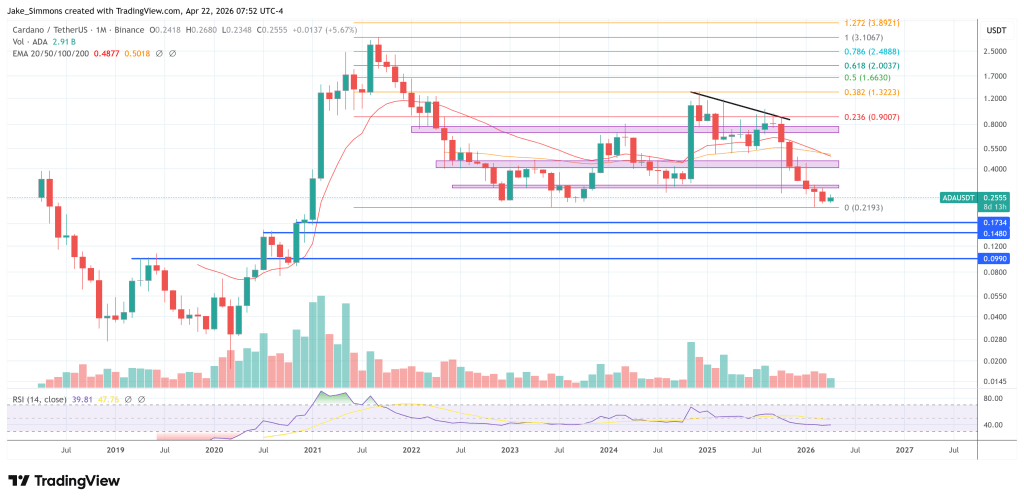
ADA remains below key resistance, 1-monthly chart | Source: ADAUSDT on TradingView.com

Пов'язані питання

QWhat is the new storage offering for Cardano developers announced by Filecoin and Blockfrost?

ABlockfrost has added a premium storage tier for Cardano developers backed by Filecoin, providing a distributed, verifiable backup layer without requiring changes to existing workflows.

QHow did Charles Hoskinson respond to Filecoin's integration into the Cardano ecosystem?

ACharles Hoskinson gave a short but pointed endorsement, calling Filecoin 'one of the OGs' and welcoming it to the Cardano ecosystem, which increased the visibility of the rollout.

QWhat are the key benefits of the Filecoin-backed premium storage tier for Cardano developers?

AThe key benefits include distributed storage across independent providers, verifiability, no infrastructure overhead, enhanced reliability for data-driven apps, and no required workflow changes.

QWhy was Filecoin chosen as the storage layer for Blockfrost's integration?

AFilecoin was chosen because it is the world's largest decentralized storage network, and integrating it with Blockfrost's IPFS Gateway clusters strengthens the resilience of Cardano apps and highlights a commitment to decentralization by coordinating two leading layer-1 blockchain ecosystems.

QWhat was the price of ADA at the time of the article's publication?

AAt press time, ADA traded at $0.2555.

Пов'язані матеріали

Seeking Alpha's Hot Article: Why Might the U.S. Stock Market Crash in June?

In a recent Seeking Alpha article, financial professor and analyst Damir Tokic argues that the US stock market may be poised for a significant crash in June 2026. The core thesis centers on a "mega-bubble" in equities, particularly within the technology sector, which has driven the S&P 500 to near-record valuations, with a Shiller P/E ratio exceeding 40—a level comparable to the 2000 dot-com bubble. Tokic identifies two primary catalysts for a potential collapse. First, he points to unsustainable market exuberance fueled by what he terms the "Trump Stimulus"—massive AI capital expenditure by tech giants, which he believes is politically driven and cannot last. Second, and more urgently, he highlights the escalating Iran war as a critical threat. The ongoing closure of the Strait of Hormuz has created a severe global energy supply crunch. Strategic petroleum reserves are projected to hit critically low operational levels by June, potentially causing oil prices to spike above $200 per barrel and triggering a severe, supply-driven inflationary shock. This scenario, Tokic warns, would force the Federal Reserve's hand. Despite currently maintaining a dovish bias, the Fed would likely be compelled to officially pivot to a hawkish stance at its June FOMC meeting to combat soaring inflation and bond yields. He contends that such a shift—or even a failure to act, which would destroy Fed credibility—could be the trigger that punctures the market bubble. The resulting downturn, he concludes, could rival the bear markets of 2000 and 2008, advising investors to prepare for a major correction.

marsbit7 хв тому

Seeking Alpha's Hot Article: Why Might the U.S. Stock Market Crash in June?

marsbit7 хв тому

AI PC Battle: Bet on the Toll Booth, Not the Camp

**Title:** The AI PC Battle: Don't Bet on Sides, Bet on the Tollbooth **Summary:** The AI PC competition is moving beyond simple "x86 vs. Arm" narratives. The core investment thesis should focus on identifying which players can sustain margins, cash flow, and pricing power throughout the upgrade cycle, rather than backing a particular architecture. The opportunity is analyzed in three layers: 1. **The Advanced Foundry Tollbooth:** TSMC is positioned to collect "tolls" regardless of which chip designer wins, due to its dominant ~70% share in advanced semiconductor manufacturing, which is essential for high-end AI PC chips. 2. **Compute & Platform Spillover:** AMD represents an offensive in the x86 CPU+GPU space, while NVIDIA leverages its GPU and CUDA software stack dominance. Both benefit from the demand for increased local AI compute. 3. **Architecture Diffusion & Turnaround Plays:** ARM and Intel offer potential for significant upside (elasticity), but investments here require stricter discipline due to higher execution risks and competitive challenges. The industry is transitioning from concept to shipment validation. While short-term forecasts for AI PC adoption have been revised down slightly due to tariffs and procurement delays, the long-term trend towards AI becoming a standard PC feature remains intact. The key driver for upgrade cycles will be whether compelling enterprise applications (e.g., privacy-sensitive computing, low-latency inference) emerge beyond consumer-focused features like meeting summarization. Investment strategy should prioritize companies with platform-level advantages and recurring revenue streams. TSMC offers high certainty as the foundational tollbooth. AMD presents a strong offensive play within the established ecosystem. ARM and Intel are higher-risk, higher-potential-reward turnaround bets. The report cautions against chasing short-term hype and emphasizes a disciplined, long-term approach focused on buying ecosystem strength and cash-flow certainty after market enthusiasm subsides. **Key Risks:** Underwhelming AI PC applications slowing upgrade cycles; slow improvement in Windows on Arm compatibility; macro/tariff impacts on PC demand; potential advanced node supply-demand mismatches affecting TSMC; high overall AI sector valuations making stocks vulnerable to a risk-off shift in markets.

marsbit21 хв тому

AI PC Battle: Bet on the Toll Booth, Not the Camp

marsbit21 хв тому

Ten-Thousand-Word Analysis: From $10 to $290, MRVL Wins the Entire AI Era by 'Not Making GPUs'

Marvell Technology's stock price surged from under $10 in 2016 to a record $290 in June 2026, fueled not by making GPUs, but by dominating AI infrastructure connectivity. This analysis argues the market misvalues MRVL as merely a smaller Broadcom in custom AI chips, overlooking its true, unique position. Marvell's core strength lies in enabling high-speed data flow for AI clusters through three interconnected businesses. First, it holds a commanding ~70% market share in high-speed optical DSPs (essential for data center light modules), a deep-moat business with accelerating growth. Second, its custom AI chip design business serves hyperscalers like AWS, Microsoft, and Google, with a significant revenue pipeline despite lower margins. Third, stable cash flows come from Ethernet switch chips and enterprise storage controllers. Together, they form a full-stack "AI data movement" platform. CEO Matt Murphy's transformative leadership since 2016, involving strategic divestments, key acquisitions (like Inphi for optical DSPs), and securing long-term agreements with major cloud providers, repositioned the company. A pivotal $2 billion strategic investment from NVIDIA in 2026 underscored Marvell's critical role in the AI ecosystem, particularly through collaborations like NVLink Fusion. While Marvell faces risks—including client concentration (losing the Amazon Trainium3 design), lower-margin business mix, competitive threats, insider selling, and complex supply chains—its fundamentals remain strong. The optical interconnect moat is widening with the acquisition of Celestial AI (photonics fabric), and financial metrics show accelerating revenue growth and operating leverage. With a PEG ratio suggesting undervaluation relative to its growth, the thesis is that the market undervalues Marvell's monopolistic position in AI "plumbing" while overemphasizing its competitive custom chip segment. The story transcends investing, symbolizing how in any complex system—from the internet to AI—the value of "connection" ultimately surpasses that of individual "nodes."

marsbit51 хв тому

Ten-Thousand-Word Analysis: From $10 to $290, MRVL Wins the Entire AI Era by 'Not Making GPUs'

marsbit51 хв тому

AI Relay Stations Spark Heated Debate on Zhihu: Behind Cheap Tokens, What Are Users Really Worried About?

A discussion on Zhihu about "AI relay stations" shifted the niche developer topic of "cheap tokens" into broader user awareness. Users moved beyond simply questioning the legitimacy of these services to focus on practical concerns: Where do cheap tokens truly come from? Is the model being accessed the real one? Can relay stations see prompts, code, and API keys? For occasional users, are the risks worth it? The core debate centered less on price and more on trust. A primary worry is model authenticity—the risk of "model swapping," where users paying for a premium model might be routed to a cheaper one, creating an information asymmetry. Others argued that cost comparisons matter; while cheaper than official pay-as-you-go APIs, relay stations may not be the lowest-cost option versus subscriptions, domestic models, or free tiers, making user needs assessment crucial. Speculation about token sources ranged from legitimate bulk discounts to gray-area methods like account sharing or exploiting regional pricing. This opacity makes risk assessment difficult for users. Data security emerged as a critical concern, especially for enterprise use. When processing sensitive information like code, contracts, or client data, the inability to verify a relay station's data handling, retention, or access policies poses significant compliance and confidentiality risks. The evolving consensus suggests relay stations can be used cautiously for low-sensitivity, disposable tasks (e.g., summarizing public info, simple translation). However, they should not be the default for sensitive, professional, or production workflows involving proprietary data, Agents, or automated systems. Recommendations include avoiding large prepayments, not relying on a single service, using test prompts to monitor quality, anonymizing data where possible, and keeping official channels as backups. Ultimately, the discussion framed tokens not just as a billing unit but as a measure of real cost encompassing price, model integrity, data security, and service stability. The popularity of relay stations highlights user demand for affordable access, but the debate underscores a key trade-off: the savings from cheap tokens may come at the price of trust, transparency, and control over one's data and AI experience.

marsbit1 год тому

AI Relay Stations Spark Heated Debate on Zhihu: Behind Cheap Tokens, What Are Users Really Worried About?

marsbit1 год тому

Торгівля

Спот
Ф'ючерси

Популярні статті

Як купити ADA

Ласкаво просимо до HTX.com! Ми зробили покупку Cardano (ADA) простою та зручною. Дотримуйтесь нашої покрокової інструкції, щоб розпочати свою криптовалютну подорож.Крок 1: Створіть обліковий запис на HTXВикористовуйте свою електронну пошту або номер телефону, щоб зареєструвати обліковий запис на HTX безплатно. Пройдіть безпроблемну реєстрацію й отримайте доступ до всіх функцій.ЗареєструватисьКрок 2: Перейдіть до розділу Купити крипту і виберіть спосіб оплатиКредитна/дебетова картка: використовуйте вашу картку Visa або Mastercard, щоб миттєво купити Cardano (ADA).Баланс: використовуйте кошти з балансу вашого рахунку HTX для безперешкодної торгівлі.Треті особи: ми додали популярні способи оплати, такі як Google Pay та Apple Pay, щоб підвищити зручність.P2P: Торгуйте безпосередньо з іншими користувачами на HTX.Позабіржова торгівля (OTC): ми пропонуємо індивідуальні послуги та конкурентні обмінні курси для трейдерів.Крок 3: Зберігайте свої Cardano (ADA)Після придбання Cardano (ADA) збережіть його у своєму обліковому записі на HTX. Крім того, ви можете відправити його в інше місце за допомогою блокчейн-переказу або використовувати його для торгівлі іншими криптовалютами.Крок 4: Торгівля Cardano (ADA)Легко торгуйте Cardano (ADA) на спотовому ринку HTX. Просто увійдіть до свого облікового запису, виберіть торгову пару, укладайте угоди та спостерігайте за ними в режимі реального часу. Ми пропонуємо зручний досвід як для початківців, так і для досвідчених трейдерів.

973 переглядів усьогоОпубліковано 2024.12.10Оновлено 2026.06.02

Як купити ADA

Обговорення

Ласкаво просимо до спільноти HTX. Тут ви можете бути в курсі останніх подій розвитку платформи та отримати доступ до професійної ринкової інформації. Нижче представлені думки користувачів щодо ціни ADA (ADA).

活动图片