Cardano Founder Says ‘Leios Is Coming’ As Proposal Heads To DReps

bitcoinistОпубліковано о 2026-05-15Востаннє оновлено о 2026-05-15

Анотація

Cardano founder Charles Hoskinson announced progress on the Leios consensus upgrade as a ₳27.7 million funding proposal moves toward DRep approval. The proposal seeks to advance Leios from a public testnet prototype to a mainnet-ready release candidate, aiming to increase Cardano's transaction capacity by 10–65x to support its 2030 scaling goals of handling over 27 million monthly transactions. The upgrade enhances, rather than replaces, the existing Ouroboros Praos protocol. The six to nine-month project is structured around development, rigorous testing, and hard-fork enablement, with funding managed via milestone-based disbursements. The proposal acknowledges risks including community readiness, governance dependencies, and potential operational impacts on stake pool operators.

Cardano founder Charles Hoskinson signaled renewed momentum behind Leios, the network’s next major consensus upgrade, as Input Output moved a ₳27.7 million funding proposal toward DRep approval. The proposal seeks to mature Leios from an early public testnet prototype into a mainnet-ready release candidate, positioning the upgrade as a central piece of Cardano’s 2030 scaling strategy.

“Leios is coming,” Hoskinson wrote on X, quoting Sebastian Nagel, who said: “Cardano, if your governance permits, we’ll ship Leios.” The short exchange framed the next phase of Cardano’s scaling roadmap as both a technical delivery question and a governance decision.

Cardano’s Biggest Scaling Bet

The proposal, authored by Carlos Lopez de Lara and Nagel, asks DReps to approve a treasury withdrawal of ₳27,714,342 to fund six to nine months of development. The work is intended to move Leios from its current prototype and testnet phase toward a release candidate suitable for mainnet integration. According to the proposal, each milestone would be independently assured, while undisbursed ada would be returned to the treasury.

Leios is designed to enhance, rather than replace, Ouroboros Praos, Cardano’s existing consensus protocol. The proposal says the upgrade introduces endorser blocks and committee-based validation to increase transaction capacity while preserving Praos’s security model. IO frames the design as a way to scale Cardano without undermining decentralization or making stake pool operations economically unviable.

“Cardano needs a step change in throughput to meet its 2030 ambitions, and Leios is how it gets there. This proposal funds the path from public testnet to a mainnet-ready release candidate — delivering a 10–65x increase in transaction capacity,” the proposal states. “Why this scale matters: Cardano’s 2030 strategy targets growth from roughly 800,000 monthly transactions to over 27 million.”

That 2030 target is a key justification for the funding request. The proposal argues that sustainable utilization at that level would require at least 6x current capacity, while Leios is expected to deliver 10x or more under validated parameter settings. Elsewhere, the accompanying IO article says Leios could support a phased throughput increase from 2x to 30x current capacity on mainnet, with full capacity demonstrated on testnet before broader rollout.

The work is organized around three objectives. The first is a release candidate, including a substantial rewrite of consensus components, implementation of the Leios block structure for the Dijkstra era, conformance testing against the Agda formal specification, and integration into the primary node by the fourth quarter of 2026.

The second is “high confidence,” built through parameter exploration, continuous load testing, adversarial testing, red-team exercises, and an updated threat model. The third is hard-fork enablement, covering client interfaces, technical documentation, SPO and developer workshops, support for adjacent infrastructure such as DB-Sync, Mithril and Blockfrost, testnet hard forks, governance artifacts and contingency procedures.

The proposal is careful to separate work within IO’s control from external dependencies. A mainnet hard fork would still depend on broader ecosystem readiness, governance action submission and a community vote. The document explicitly describes those as risks rather than promises.

Funding would be administered through Intersect’s treasury reserve smart contract framework, with milestone-based disbursements and third-party assurance. The budget allocates ₳23.83 million, or 86%, to development, with smaller portions assigned to infrastructure, security and audits, legal and compliance, ecosystem support, operations, governance and other costs.

The risk section is direct. It identifies community readiness, hard-fork timing, final cardano-node integration and possible governance constraints as factors that could delay or limit activation. It also notes technical limitations, including potential higher operational costs for SPOs, greater chain growth, and high-throughput assumptions tied to adversarial stake conditions.

At press time, ADA traded at $0.2661.
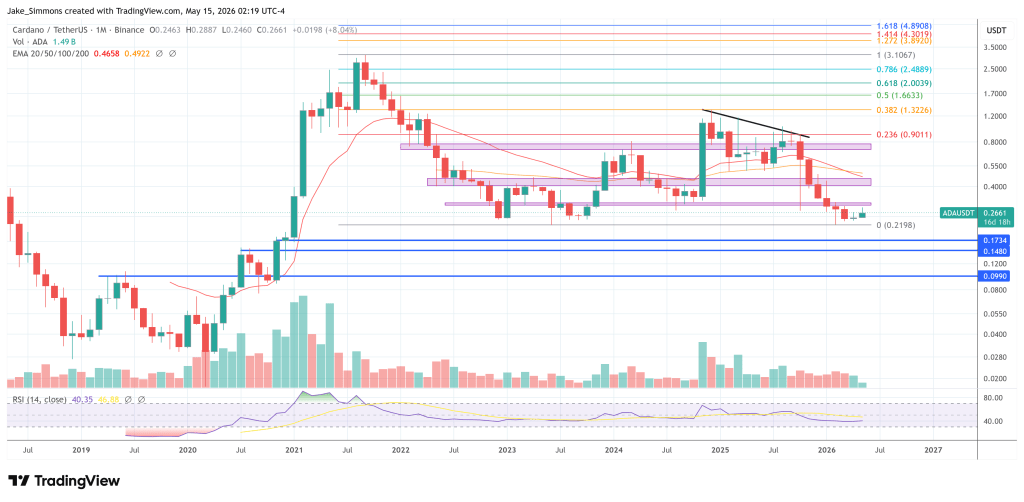
ADA remains below key resistance, 1-monthly chart | Source: ADAUSDT on TradingView.com

Пов'язані питання

QWhat is the purpose of the 27.7 million ADA funding proposal submitted to the DReps for Leios?

AThe purpose of the 27.7 million ADA funding proposal is to mature Leios from an early public testnet prototype into a mainnet-ready release candidate, funding six to nine months of development work to achieve this goal.

QHow does the Leios upgrade aim to improve Cardano's transaction capacity according to the proposal?

AThe Leios upgrade aims to increase Cardano's transaction capacity by 10x to 65x, introducing endorser blocks and committee-based validation to enhance throughput while preserving the security model of the existing Ouroboros Praos consensus protocol.

QWhat are the three main objectives of the Leios development work outlined in the proposal?

AThe three main objectives are: 1) Delivering a release candidate with a rewritten consensus, 2) Building high confidence through extensive testing and security exercises, and 3) Enabling the hard fork through client interfaces, documentation, workshops, and ecosystem support.

QWhat are some of the key risks associated with the Leios activation mentioned in the proposal?

AKey risks include community readiness, hard-fork timing dependencies, final node integration, potential governance constraints, higher operational costs for SPOs, increased chain growth, and high-throughput assumptions tied to adversarial stake conditions.

QWhat is the target for Cardano's monthly transactions by 2030 as cited in the article, and why does it necessitate the Leios upgrade?

ACardano's 2030 strategy targets growth from roughly 800,000 to over 27 million monthly transactions. This necessitates the Leios upgrade because sustainable utilization at that level requires at least a 6x increase in capacity, which Leios is designed to provide (10x or more).

Пов'язані матеріали

Fei-Fei Li's Team Clarifies the Concept of 'World Models', Sora Merely a Renderer

"World Models" has become a widely used yet confusing term in AI. To address this, a team led by Fei-Fei Li and World Labs proposed a functional taxonomy based on the Partially Observable Markov Decision Process framework. This taxonomy categorizes systems called "world models" into three distinct projections: Renderers, Simulators, and Planners. Renderers, like OpenAI's Sora and other video generation models, focus on producing photorealistic visual outputs for human perception. They prioritize visual fidelity over physical accuracy. Simulators, such as NVIDIA Omniverse, aim to compute precise future environmental states for computational tasks like engineering analysis or digital twins. Planners, like Vision-Language-Action models, take in observations and goals to output executable actions for robots or agents. The article clarifies that most current "world models," including Sora, are primarily Renderers. They generate convincing visuals but lack the core ability to simulate state transitions based on actions, a key requirement for a true world model in classic reinforcement learning definitions. This conceptual confusion has practical implications, leading to potential misalignment in technology selection, investment, and public understanding of AI capabilities. Clear categorization is crucial. It helps enterprises avoid costly mistakes (e.g., using a renderer for robot training), allows investors to accurately assess markets, and enables researchers to build comparable benchmarks. While future systems may integrate these functions, recognizing current boundaries is essential for honest assessment and progress.

marsbit39 хв тому

Fei-Fei Li's Team Clarifies the Concept of 'World Models', Sora Merely a Renderer

marsbit39 хв тому

Bloomberg Uncovered: How Do China's Wealthy Circumvent the Annual $50,000 Limit to Transfer Assets?

**Summary: How Wealthy Chinese Circumvent $50,000 Annual Foreign Exchange Limits** Despite China's strict capital controls, including an annual $50,000 per person foreign exchange quota, an estimated $150 billion in funds still leaves the country annually via various gray and underground channels. This report outlines the evolution of China's "capital wall" and the methods used to bypass it. **The Evolving Capital Controls:** * **Foundation (1994):** The system of "current account convertibility with strict capital account controls" was established. * **Quota Set (2007):** The $50,000 individual annual forex purchase limit was formalized. * **Crackdown Begins (2015-2017):** Following market volatility, enforcement tightened. Banks were required to scrutinize transactions, and channels like using UnionPay cards for Hong Kong insurance premiums or buying overseas property were blocked. * **Digital & Legal Upgrades (2024-2026):** Enhanced algorithms now flag suspicious patterns (e.g., "smurfing"). The Common Reporting Standard (CRS) provides Chinese tax authorities with data on citizens' offshore accounts. Unlicensed cross-border brokers have been targeted. **Five Primary Methods for Moving Capital:** 1. **Underground Banking / "Hawala" (Duiqiao):** The largest-scale method. No money crosses borders. Clients pay RMB to a domestic account; an overseas associate deposits equivalent foreign currency into the client's offshore account. Risks include high fees, account freezes, and legal penalties. 2. **"Smurfing" or "Ant Moving":** Using multiple individuals' $50,000 quotas to pool funds for one offshore recipient. Increasingly detected by anti-money laundering algorithms. 3. **Trade Invoice Manipulation:** Businesses over-invoice imports or under-invoice exports via offshore shell companies, creating a pretext to transfer excess funds abroad under the guise of trade. 4. **Channel Migration:** After a crackdown on internet brokers, funds flow toward more compliant but costly channels like major banks' cross-border wealth management services or Qualified Domestic Institutional Investor (QDII) quotas. 5. **Structural Arrangements:** High-net-worth individuals use complex, high-cost legal structures involving offshore trusts, insurance, and investment migration programs to transfer asset ownership. **Regulatory Response: Focusing on People, Not Just Money** The current strategy extends oversight from enterprises to **individual residents**. Tools like CRS allow retroactive visibility into offshore assets. Cryptocurrencies, once seen as a potential loophole, are now actively monitored and prosecuted as an illegal channel. The underlying driver remains: with significant wealth concentrated among millions of affluent households seeking diversification amid domestic economic shifts, the incentive to move assets offshore persists despite regulatory barriers.

marsbit59 хв тому

Bloomberg Uncovered: How Do China's Wealthy Circumvent the Annual $50,000 Limit to Transfer Assets?

marsbit59 хв тому

Торгівля

Спот
Ф'ючерси

Популярні статті

Як купити ADA

Ласкаво просимо до HTX.com! Ми зробили покупку Cardano (ADA) простою та зручною. Дотримуйтесь нашої покрокової інструкції, щоб розпочати свою криптовалютну подорож.Крок 1: Створіть обліковий запис на HTXВикористовуйте свою електронну пошту або номер телефону, щоб зареєструвати обліковий запис на HTX безплатно. Пройдіть безпроблемну реєстрацію й отримайте доступ до всіх функцій.ЗареєструватисьКрок 2: Перейдіть до розділу Купити крипту і виберіть спосіб оплатиКредитна/дебетова картка: використовуйте вашу картку Visa або Mastercard, щоб миттєво купити Cardano (ADA).Баланс: використовуйте кошти з балансу вашого рахунку HTX для безперешкодної торгівлі.Треті особи: ми додали популярні способи оплати, такі як Google Pay та Apple Pay, щоб підвищити зручність.P2P: Торгуйте безпосередньо з іншими користувачами на HTX.Позабіржова торгівля (OTC): ми пропонуємо індивідуальні послуги та конкурентні обмінні курси для трейдерів.Крок 3: Зберігайте свої Cardano (ADA)Після придбання Cardano (ADA) збережіть його у своєму обліковому записі на HTX. Крім того, ви можете відправити його в інше місце за допомогою блокчейн-переказу або використовувати його для торгівлі іншими криптовалютами.Крок 4: Торгівля Cardano (ADA)Легко торгуйте Cardano (ADA) на спотовому ринку HTX. Просто увійдіть до свого облікового запису, виберіть торгову пару, укладайте угоди та спостерігайте за ними в режимі реального часу. Ми пропонуємо зручний досвід як для початківців, так і для досвідчених трейдерів.

973 переглядів усьогоОпубліковано 2024.12.10Оновлено 2026.06.02

Як купити ADA

Обговорення

Ласкаво просимо до спільноти HTX. Тут ви можете бути в курсі останніх подій розвитку платформи та отримати доступ до професійної ринкової інформації. Нижче представлені думки користувачів щодо ціни ADA (ADA).

活动图片