Can RAIN crypto recover as $10M sell-off sparks downside fears?

ambcryptoОпубліковано о 2026-03-28Востаннє оновлено о 2026-03-28

Анотація

RAIN Protocol (RAIN) experienced a sharp decline of over 17% in 24 hours, significantly underperforming the broader crypto market. Despite support from Enlivex as its Digital Asset Treasury, the token faced heavy selling pressure, including a $10 million sell-off by a large holder. RAIN broke below a key support level at $0.0082, with high volatility and increased sell volume raising concerns of a further drop toward a $3.5 billion market cap. However, a swift recovery followed, and a reclaim of $0.0082—or a break above $0.0092—could invalidate the bearish outlook. Institutional buying contrasted with retail and whale selling, highlighting mixed market sentiment.

Rain Protocol [RAIN], a decentralized prediction markets protocol, has lost more than 17% in the past 24 hours as of writing. This was the case even though the protocol was supported by Enlivex [Nasdaq: ENLV] as the Digital Asset Treasury (DAT), which aided in the shift to capital markets.

Historical performance of RAIN crypto

While the overall market fell by around 3%, RAIN fell by double digits. The altcoin fell by 9.5% in Q1 2026, after rising in the third and fourth quarters of 2025.

In Q3, the altcoin rose by more than 378% as Q4 closed 112% higher. For the first quarter of 2026, only January has been bullish, where RAIN recorded 23% in gains, as February and March lost 6.41% and 21.6%, respectively.
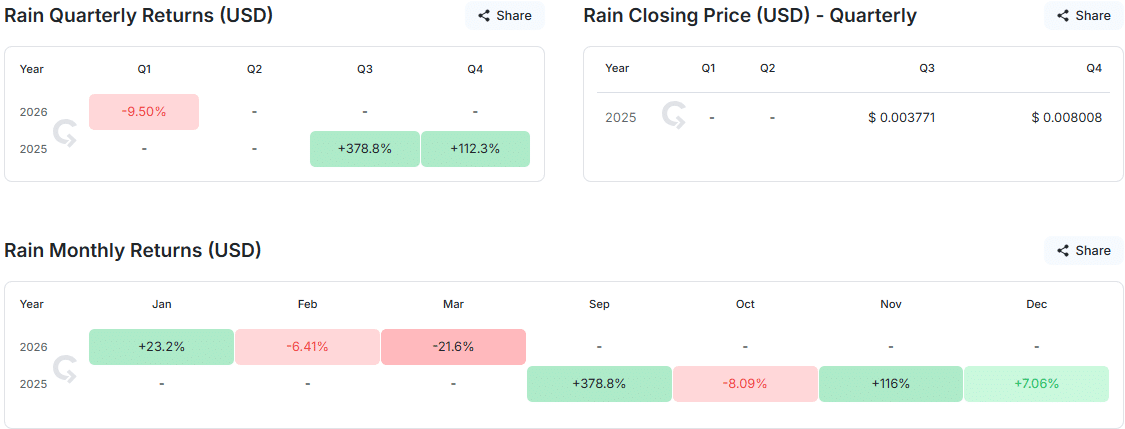
Source: CryptoRank

While the altcoin’s price continues to crash, it still commands a significant market cap of around $3.89 billion. Will the market cap continue to fall as sell volume rises to $46 million?

RAIN price loses a KEY support level

On the charts, the altcoin has been trading inside a consolidation since the beginning of February. The Bollinger Bands (BB) had been tight during this period and expanded upon breakdown below $0.0082.

The Balance of Power indicator was choppy and in the negative territory with a reading of 0.96. This reading was an indication that sellers were the stronger force at the time of writing.

Now, holding below the key support level at $0.0082 while volatility stays high would push the cap toward $3.5 billion.

Conversely, a reclaim of this level alongside the middle band of the BB would invalidate the outlook. Therefore, it would be deemed a fakeout, turning the structure bullish if RAIN breaks above $0.0092.
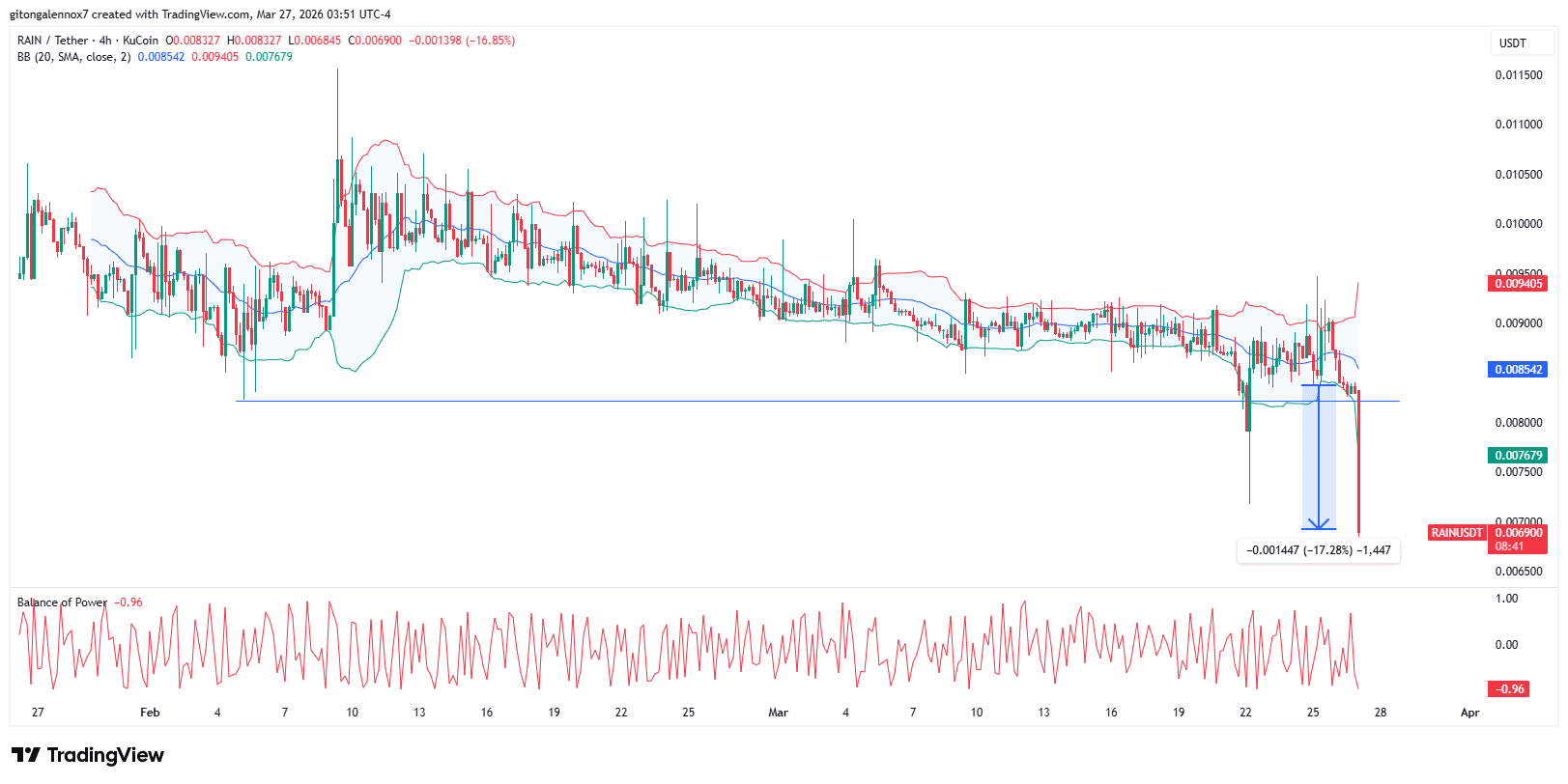
Source: RAIN/USDT on TradingView

This is because bulls rejected the breakdown, resulting in a strong green candle. However, RAIN had to maintain the rebound momentum to invalidate the structure break.

What accelerated selling pressure?

Meanwhile, it’s worth noting what was behind this sharp drop that was swiftly recovered. For instance, the daily token volume has been rising for the past week, with the high being $28.84 million.

The data showed that the volume came from sellers as the price dropped. For its Total Value Locked (TVL), it remained flat around $4 million since the start of February.
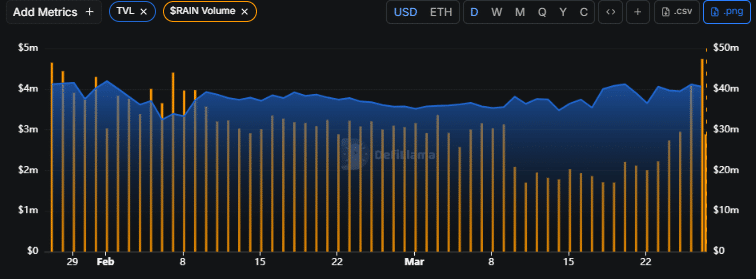
Source: DefiLlama

To be specific, the selling of tokens was driven mainly by the Token Millionaire wallet. As per Nansen AI, more than $10 million in RAIN was offloaded as the portfolio’s valuation dropped from $80 million to $69 million.
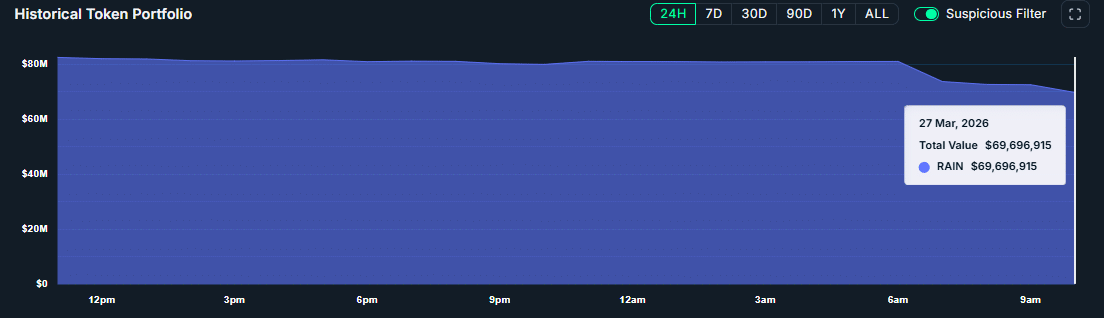
Source: Nansen AI

The volume data showed that the selling pressure came from big holders and retailers. However, institutions like Enlivex were buying, even reporting profits of $1.23 billion following their treasury around the Rain Protocol.


Final Summary

  • RAIN loses 17% of its market cap, but price action recovers swiftly shortly after.
  • The next price move for RAIN depended on its reaction around $0.0082 and $0.0092.

Пов'язані питання

QWhat was the percentage decrease in RAIN crypto's value in the past 24 hours as mentioned in the article?

ARain Protocol [RAIN] lost more than 17% in the past 24 hours.

QAccording to the article, what was the key support level that RAIN's price lost on the charts?

AThe key support level that RAIN lost was $0.0082.

QWhat specific event accelerated the selling pressure, causing a sharp drop in RAIN's price?

AThe selling pressure was accelerated by a Token Millionaire wallet offloading more than $10 million worth of RAIN tokens.

QDespite the sell-off, which institution was reported to be buying RAIN and even making a profit?

AInstitutions like Enlivex were buying RAIN and reported profits of $1.23 billion from their treasury involvement with the Rain Protocol.

QWhat are the two critical price levels that will determine RAIN's next price move, as per the article's analysis?

AThe next price move for RAIN depends on its reaction around the $0.0082 and $0.0092 price levels.

Пов'язані матеріали

Annual Salary of Millions Competing for Electricians, Meta Rushes to Open Its Own Technical School

The AI boom is facing an unexpected bottleneck: a severe shortage of skilled construction workers and electricians. As tech giants like Meta, OpenAI, and Alphabet race to build massive data centers—such as OpenAI's $16 billion "Stargate" project—they are hitting a critical labor wall. The U.S. needs an estimated 130,000 more electricians, 240,000 construction workers, and 150,000 supervisors by 2030 for AI infrastructure alone, but tens of thousands of electrician jobs go unfilled each year. While AI companies offer high premiums, with electricians earning up to $280,000 annually, worker scarcity still causes massive losses—delays on a single project can cost $14.2 million per month. The complexity of building AI data centers, which require immense power (equivalent to powering hundreds of thousands of homes), sophisticated electrical systems, and advanced liquid cooling solutions, demands highly skilled technicians who are in short supply. To combat this, companies are investing heavily in training. Meta has committed $115 million to a free training school offering tuition, housing, and stipends, targeting 5,000 new workers. OpenAI is partnering with unions to secure skilled labor. These efforts are paying off, with a significant rise in Gen Z interest in trade schools over college. However, the power demands are staggering. AI data centers are driving a rapid surge in electricity consumption, projected to account for up to 12% of U.S. power use by 2028 and raising costs for consumers. Furthermore, the construction boom is project-based, leading to a potential future glut of trained workers once building peaks, which could depress wages industry-wide. The race for AI supremacy now depends as much on skilled hands as on advanced chips.

marsbit1 год тому

Annual Salary of Millions Competing for Electricians, Meta Rushes to Open Its Own Technical School

marsbit1 год тому

OpenAI No Longer Sells Its Most Expensive Model for Profit

OpenAI is shifting its business strategy away from promoting its most expensive, flagship models for every task. Recent price cuts—80% for GPT-5.6 Luna and 20% for Terra—signal a deeper change: the company now actively advises users that many tasks don't require the most powerful model. Instead, OpenAI recommends a tiered approach: use the high-end GPT-5.6 Sol for complex planning and analysis, then delegate execution to cheaper models like Luna. This mirrors moves by Anthropic, which recently launched Claude Opus 5 at half the price of its top model, Fable 5. Both companies are de-emphasizing flagship models as primary revenue drivers, using them instead for brand prestige and technological showcases. The industry is entering a "mass-market" phase, similar to automotive, where high-volume, cost-effective models handle daily operations and drive scale. OpenAI's price reductions are partly enabled by AI models themselves optimizing underlying code and infrastructure, creating a self-reinforcing cycle of efficiency gains and cost reduction. Competition is shifting from "who is smartest" to "who offers the best value." The goal is no longer selling individual models but fostering widespread API adoption and ecosystem lock-in. By making AI calls cheap and ubiquitous, companies like OpenAI aim to become the indispensable, utility-like infrastructure powering automated workflows—the "water and electricity" of software, quietly embedded everywhere.

marsbit1 год тому

OpenAI No Longer Sells Its Most Expensive Model for Profit

marsbit1 год тому

Торгівля

Спот
活动图片





