Can Pump.fun Crack the Creator Token Conundrum by 2026?

比推Опубліковано о 2025-12-17Востаннє оновлено о 2025-12-17

Анотація

Based on Delphi's upcoming 2026 applications report, this analysis examines Pump.fun, a leading meme coin launchpad, and its challenges in realizing its vision for creator tokens. While Pump.fun dominates the launchpad space, its core challenge remains unresolved: creating a sustainable economic model for creator tokens. Most creator tokens fail to retain value, as the token itself becomes part of the product with unclear utility for holders. The notable exception was the viral @onlybagwork phenomenon, which demonstrated the potential of the model by generating over 2300 SOL in fees for its creators without them selling their holdings. However, such success has proven fleeting, and no subsequent creator token has achieved similar organic momentum or valuation. The platform's shift to using 100% of net revenue for $PUMP token buybacks has fueled a significant price increase, giving it a lower market-cap-to-revenue ratio than major competitors like Hyperliquid. Despite a sharp decline in daily launchpad revenue from its peak, Pump.fun maintains a structural advantage and dominant market share. Looking ahead to 2026, key questions remain: Can Pump.fun design a sustainable incentive structure for creator tokens? How will it manage upcoming token unlocks? The report suggests the team may need to focus its strategy, which currently spans streaming, Initial Community Offerings (ICM), and mobile. Potential strategic directions include expanding into iGaming—a natural fit for its u...

Author: Simon

Compiled by: Deep Tide TechFlow

Original title: Can Pump.fun Tell a New Story Next Year?


The following content is excerpted from Delphi's upcoming "2026 Application Outlook Report," focusing on Pump(.)fun — one of the consumer applications we are most interested in for the coming year.

Since we published the initial Pump report (before its funding round), many things have changed. Many of the dynamics we predicted have been validated, but some areas have fallen short of expectations, leaving users and investors disappointed. However, the core challenges facing Pump remain unchanged.

To realize Pump's grand vision, the team needs to strike a balance between the short-term profit-seeking nature of the crypto industry and its long-term vision for the platform. It is worth noting that once a project launches a token, its operational environment shifts; the token itself becomes an independent product with inherent reflexivity, continuously shaping user expectations. Pump is no exception.

Since completing its funding round, the Pump team has increased its investment in crypto-native streaming, but this area has not developed as smoothly as we anticipated, at least not yet reaching the ideal state.

Pump has not yet succeeded in attracting core creators from outside the crypto ecosystem, and the CCM meta (creator coin meta) that emerged on the Pump platform was short-lived. The most notable moment came from the "Bagwork" campaign, which not only demonstrated the potential of creator-driven tokens but also revealed the structural issues hindering the model's development.
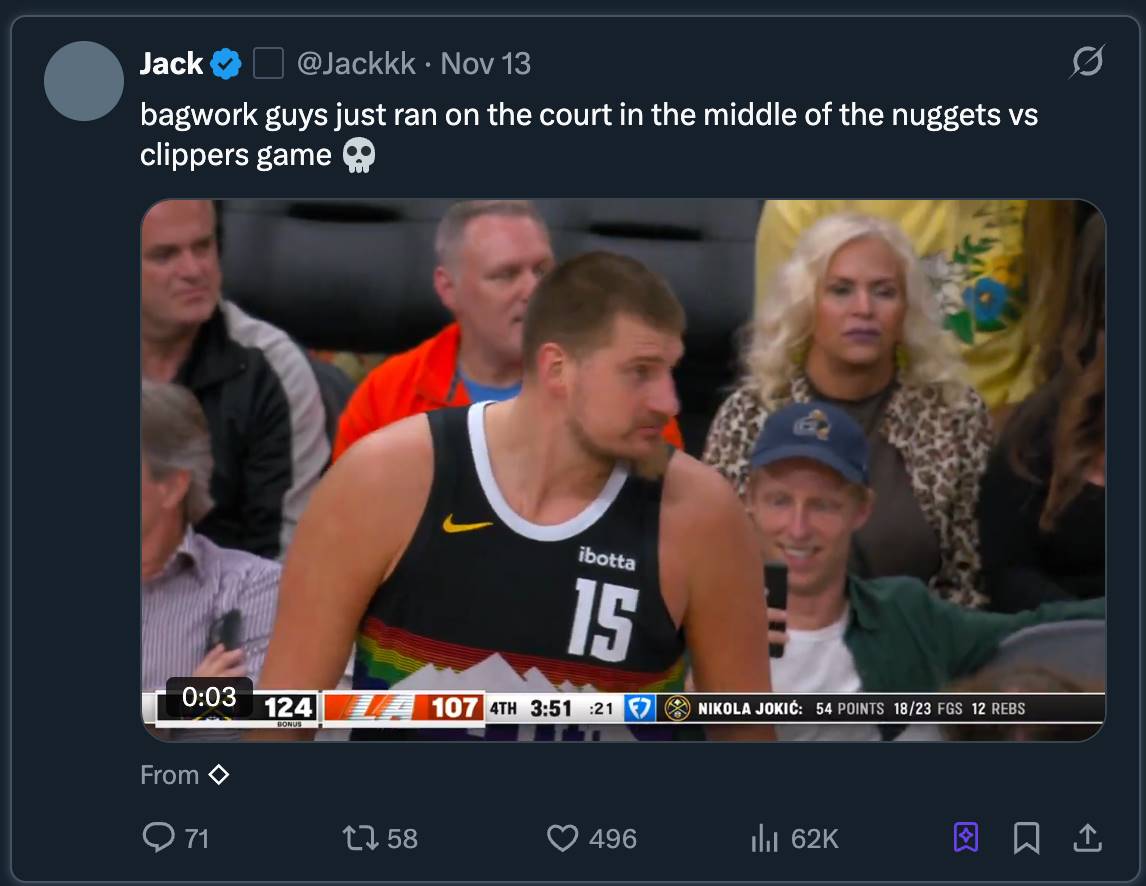
This viral explosion was led by a group of teenagers who, with some support from Pump, executed a series of sensational events: snatching Bradley Martyn's hat, storming the Dodgers' game field, rushing onto the Knicks' court, and even getting tattoos of Pumpfun and Bagwork.

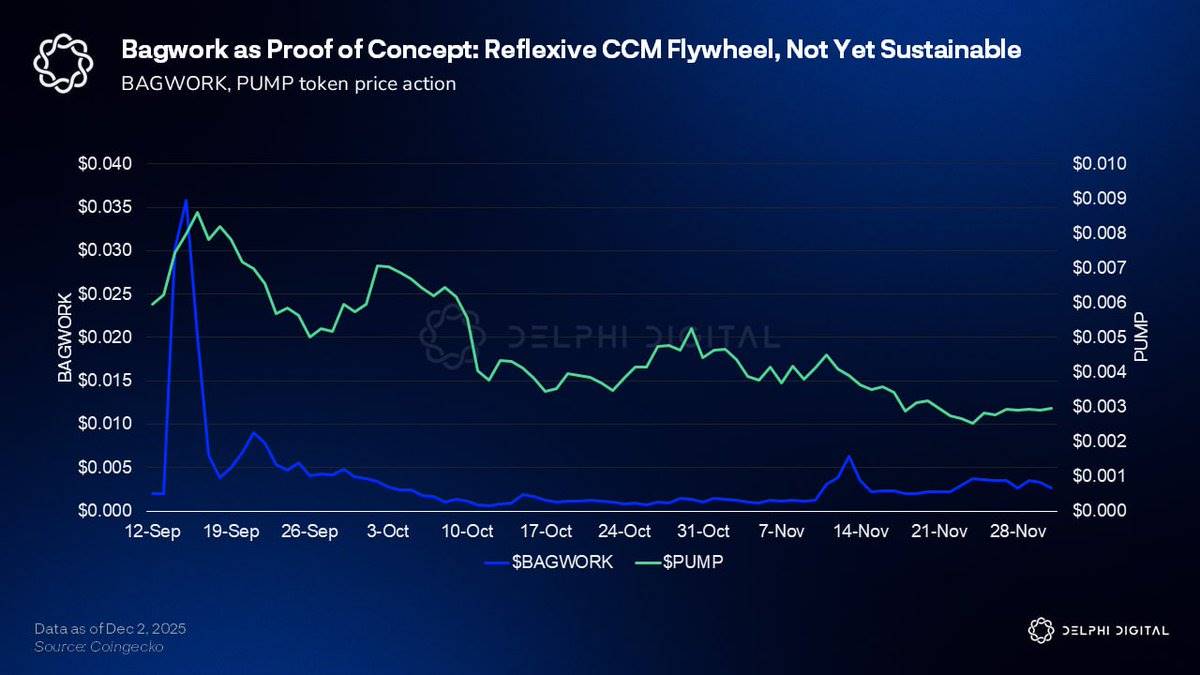
The rise of @onlybagwork almost perfectly coincided with the peak of Pump.fun's frenzy in mid-September. At that time, the fully diluted valuation (FDV) of $PUMP reached approximately $8.5 billion, and Bagwork's market cap briefly exceeded $50 million.

However, since then, no creator token has come close to such organic momentum or reached similar valuation peaks.

The Knicks court incident occurred more recently, long after the initial hype, and now Bagwork's market cap is just over $2 million.
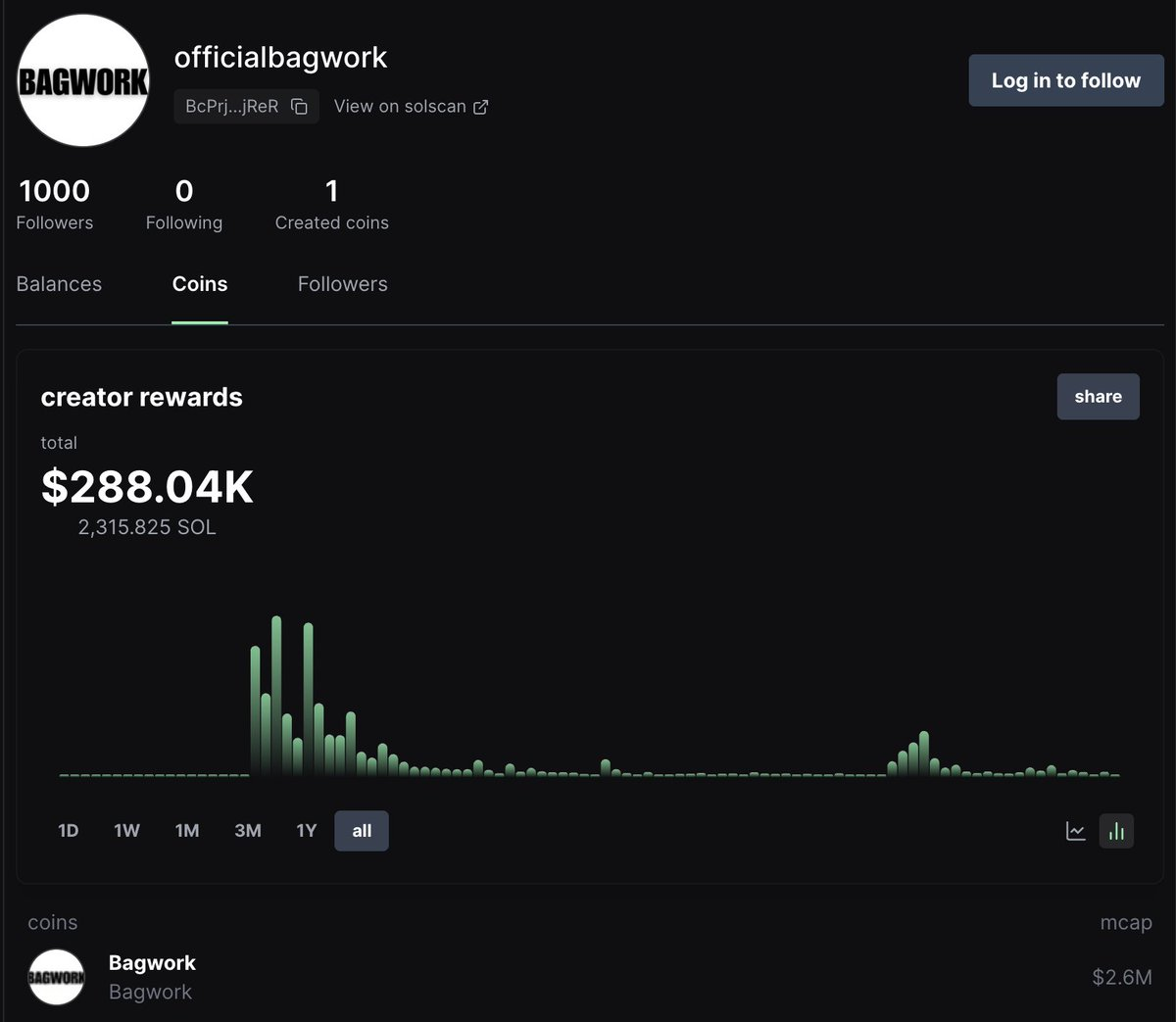
Bagwork is one of the few cases in Pump's streaming experiment that actually worked as intended. The Bagwork team earned over 2300 SOL in creator revenue from $BAGWORK trading fees (approximately $300,000 at current prices).

Notably, all of this was achieved without the team selling their holdings. Viral events directly translated into attention, trading volume, and fee revenue, creating the closest case to a true creator token flywheel effect for Pump to date.

However, beyond Bagwork, Pump has struggled to realize its streaming vision. Creator tokens have consistently failed to retain their value. This phenomenon can be traced back to a fundamental issue: the token itself is part of the product.

Currently, the economic rationale for owning or supporting a streamer's token remains unclear. Bagwork's early success quickly faded, and since then, every major streamer token has failed to gain similar traction, eventually trending toward zero.
Creators can achieve short-term gains through the CCM fee structure, but the reputational risk associated with crashed tokens makes this model unattractive to larger, more established creators who could have helped the platform reach a broader audience. From a trader's perspective, these tokens remain a zero-sum game environment rather than genuine communities.

This is the most critical issue Pump needs to address as it moves into 2026.

So far, the team has not made meaningful attempts at deeper creator incentive mechanisms, and airdrop allocations remain untouched. Apart from the informal support provided during the Bagwork frenzy, Pump has not taken any coordinated measures, such as targeted airdrops, creator rewards, or other incentive mechanisms that could have been used to kickstart early momentum, create more PvE (Player vs. Environment)-style incentives, and provide creators with a space to experiment without immediately damaging their communities.
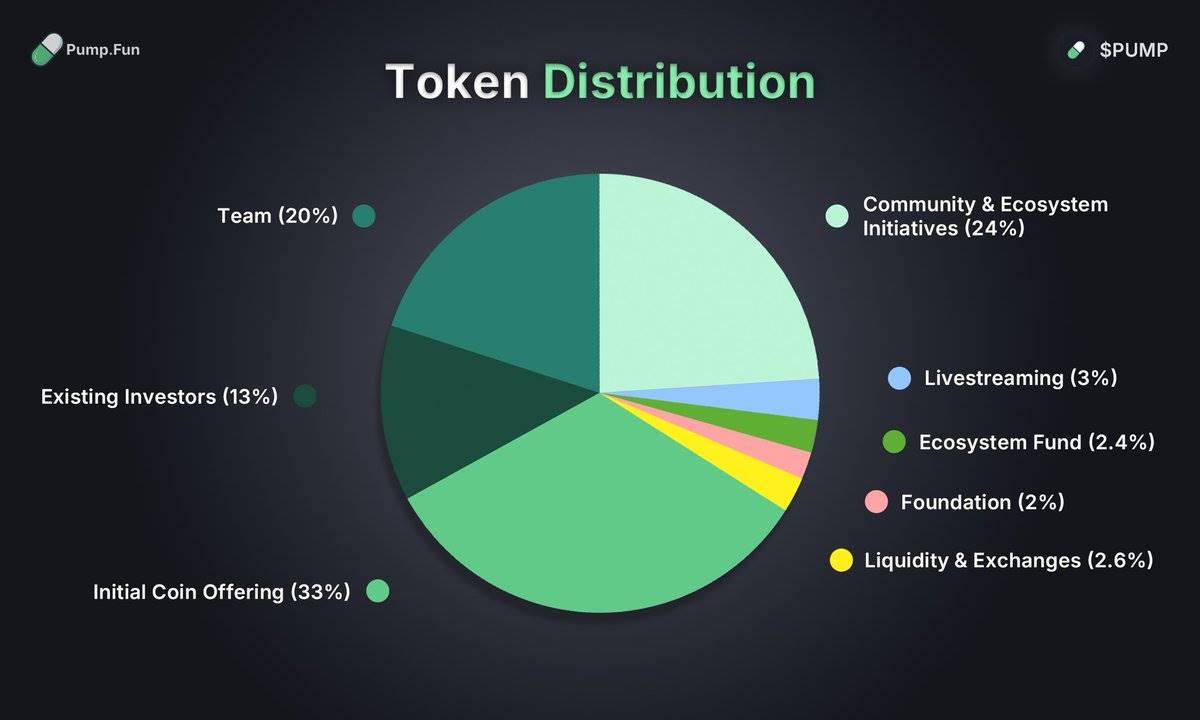
The good news is that this provides Pump with significant flexibility.

The untouched "Community & Ecosystem Initiatives" treasury remains a powerful lever the team can utilize as the model matures. If Pump can design a sustainable incentive structure for creator tokens, it could open up a new economic category for creators looking to leverage crypto mechanisms for monetization and audience expansion.

Although this potential upside is substantial, until then, streaming will continue to manifest as a series of short-lived hype cycles rather than a durable and repeatable vertical.

On the token side, the primary catalyst that drove $PUMP from around $0.025 to $0.085 was the team's decision to use 100% of net revenue for buybacks.
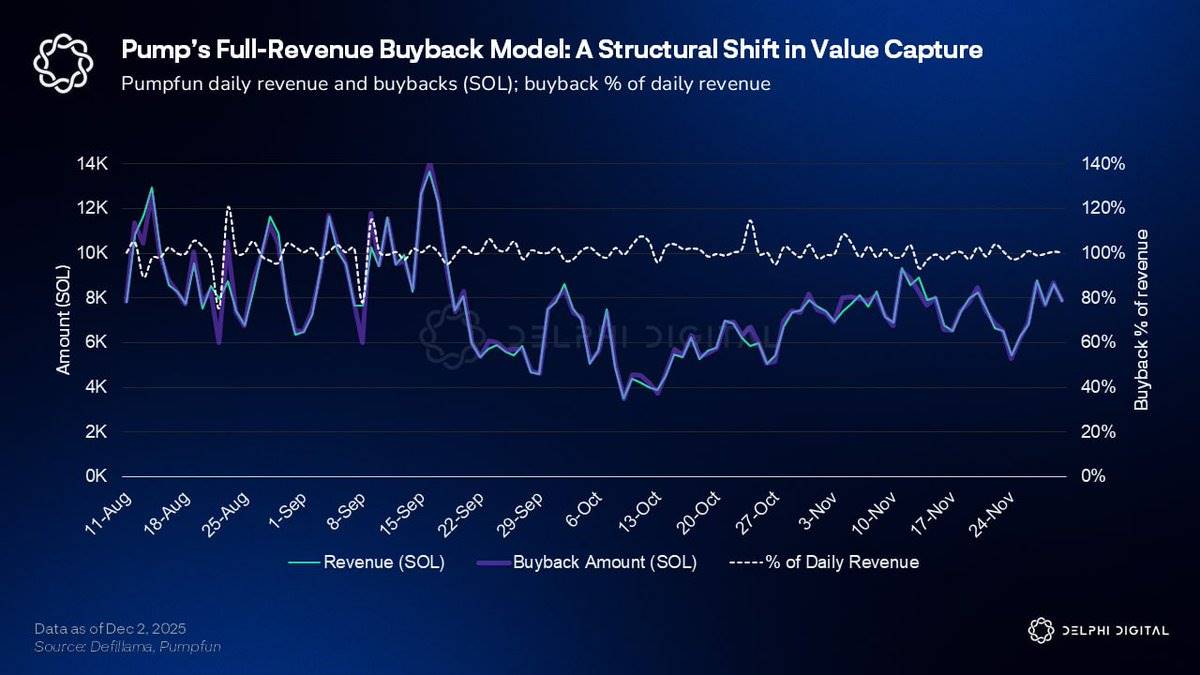
Pump shifted from initially planning to use about a quarter of its revenue for buybacks to almost fully adopting a Hyperliquid-style buyback model. This change was made after the market clearly indicated that a partial buyback model would not be well-received. This shift ignited one of the strongest large-cap token rallies this year in a liquidity-scarce and challenging altcoin market.

In terms of the buyback-to-market-cap ratio, no other major token currently trades at a lower multiple.
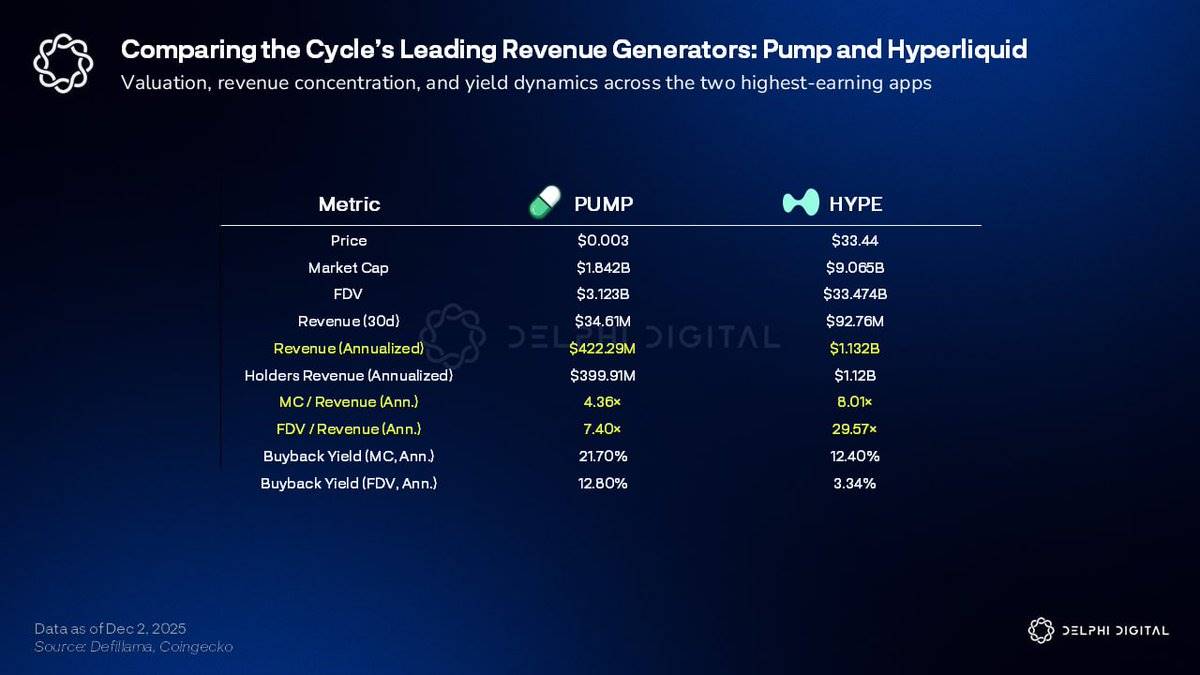
Based on current data, Pump's annualized revenue is $422 million, with a market cap of $1.84 billion, implying a market-cap-to-revenue ratio (MC/Rev) of 4.36x and an annualized buyback yield of approximately 12.8%. This is significantly lower than other large-cap tokens, including Hyperliquid's ~8.01x MC/Rev and ~3.34% yield.

Even so, the market remains skeptical about Pump's long-term business prospects.

Market concerns may include: whether the team can consistently deliver meaningful products; the impact of future unlocks on the market with approximately 40% of the token supply still locked; and the uncertainty surrounding the final allocation of airdrop and creator incentive distributions. Additionally, the overall contraction of Meme coin activity in the crypto market, reduced end-user activity, and questions about the sustainability of Pump's revenue base also raise doubts.

Despite these concerns, Pump still dominates the Meme coin launchpad space. Even in the current extremely tough market environment, Pump still earns (and buys back) about $1 million daily.
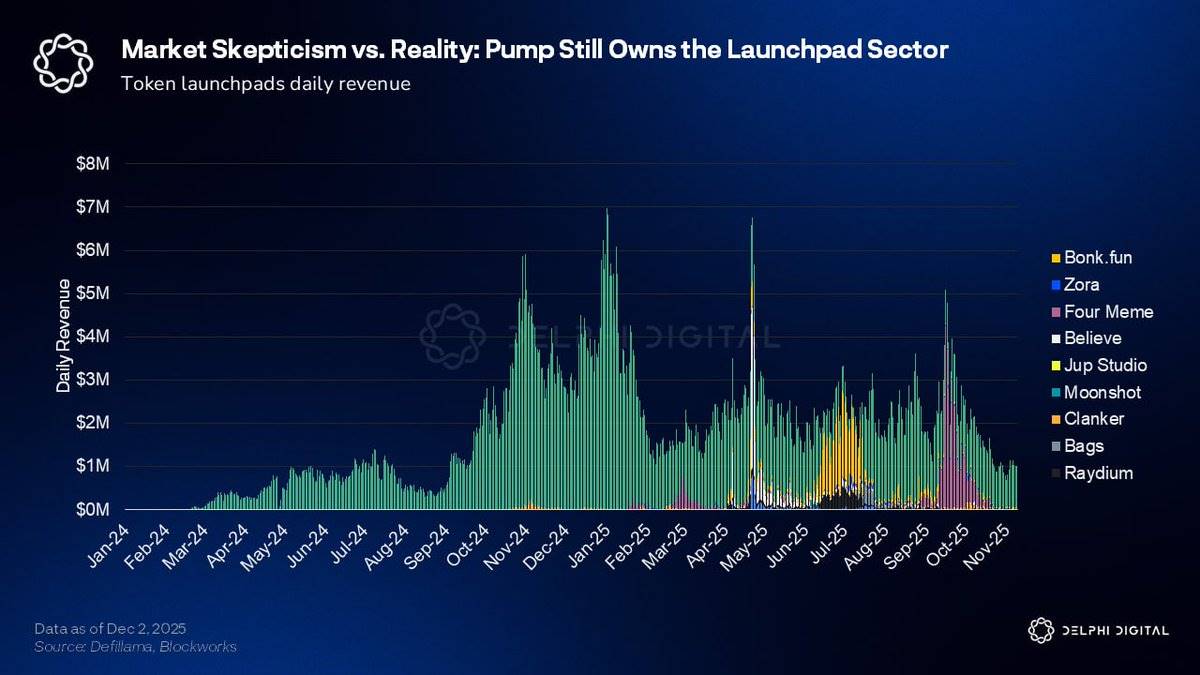
Pump's daily launchpad revenue has dropped nearly 85% from its peak of close to $14 million earlier this year to currently around $2 million. However, competitors have only posed a threat to Pump's position for brief periods, failing to bring substantial challenges. This aligns with our prediction in the initial report regarding the short-lived Bonk and Raydium challenge phases: even during cyclical trading volume contractions, Pump has maintained structural advantages and dominated the industry's activity share.

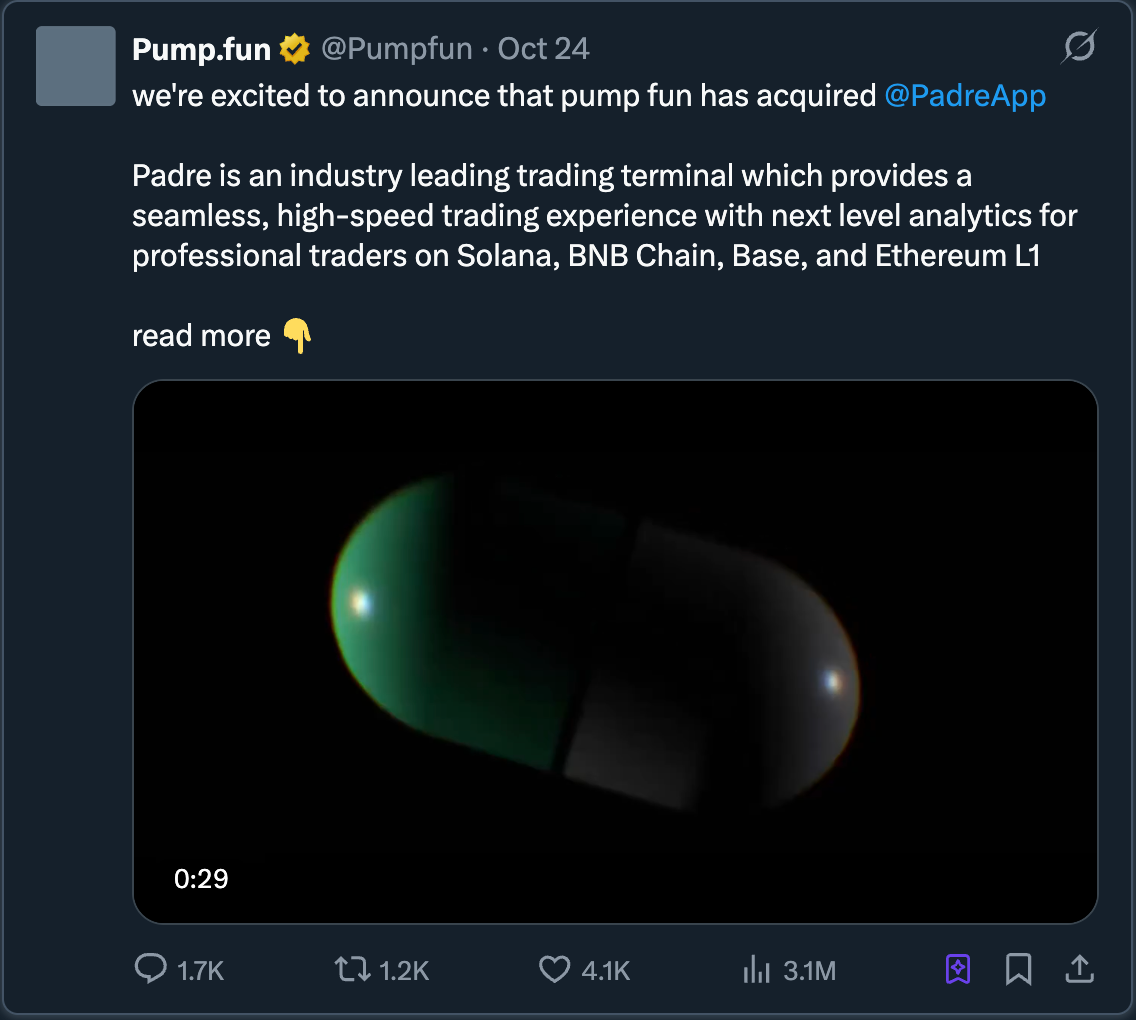
The acquisition of Padre supports the view that Pump intends to expand beyond Solana into a multi-chain ecosystem and has achieved support for BNB ecosystem assets through the Padre frontend. This also aligns with our earlier prediction that Pump would eventually acquire a terminal or terminal-related asset to strengthen user acquisition channels and integrate more of the user journey.
Beyond these moves, the team has recently maintained a low-profile strategy. An investor call is currently planned but had not been held at the time of writing, so more details may be disclosed later.
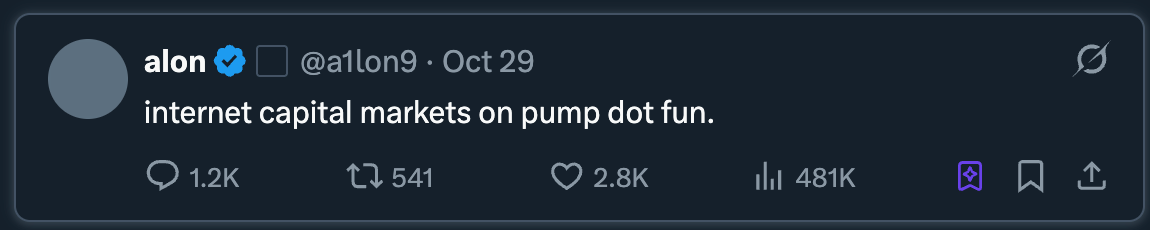
The leadership team has also expressed interest in the broader ICM (Initial Community Offering) category, although we believe this is not the core area of Pump's current brand positioning or product strengths. Pump initially experimented with the Believe model but failed to gain significant market attention. MetaDAO has become the dominant player in the "high-quality founder + community" fundraising space.

Furthermore, the culture and structure of ICM seem less aligned with Pump's brand positioning. Pump's brand core revolves around speculation, speed, and the Meme culture of creators, rather than long-term governance or Futarchy-based systems. For Pump to succeed in the ICM space, they would need to lean towards more governance-focused structures and attract non-crypto teams looking to operate on-chain. However, this does not fully align with the needs and positioning of Pump's current users and creators. Although theoretically, ICM could offer some potential upside if the team takes action, we see this more as a secondary or optional direction rather than a natural extension of Pump's existing flywheel into 2026.
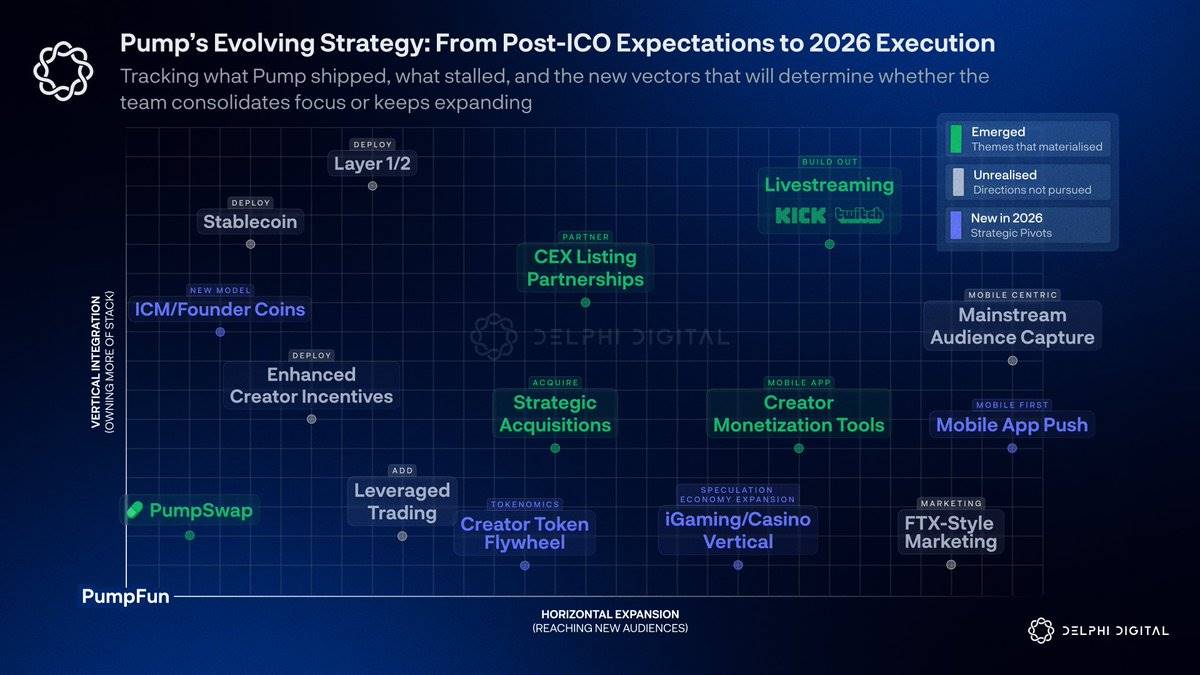
Looking ahead to 2026, Pump's main questions focus on: whether it can finally establish an incentive-compatible creator token model; whether it can achieve substantial multi-chain market expansion through Padre; how to manage the risks of token unlocks and declining revenue visibility; and which product vertical to prioritize as its main focus. Currently, Pump's strategy seems scattered across multiple directions, including streaming, ICM, and mobile.

At some point in the future, the team may need to clearly focus on one core breakthrough. For most of 2025, that breakthrough seemed to be streaming, but this is no longer clear now.

The bigger question is whether Pump can attract larger non-crypto creators. This might require redesigning the creator token flywheel mechanism, providing stronger, longer-term incentives to support viral growth beyond the crypto-native user base. Pump has the basic conditions to achieve this. The 2025 Bagwork frenzy briefly showcased the potential success of this model, a time when Pump seemed close to crossing the chasm.

Furthermore, Pump still has vast room to expand its product suite. One strategic direction the team should seriously evaluate is entering the iGaming or casino-related vertical. Adopting a model similar to Kick or Stake would naturally fit Pump's speculation-driven user base. This direction would deeply synergize with its Meme coin and streaming strategic goals, and the profit potential in this field is already proven.
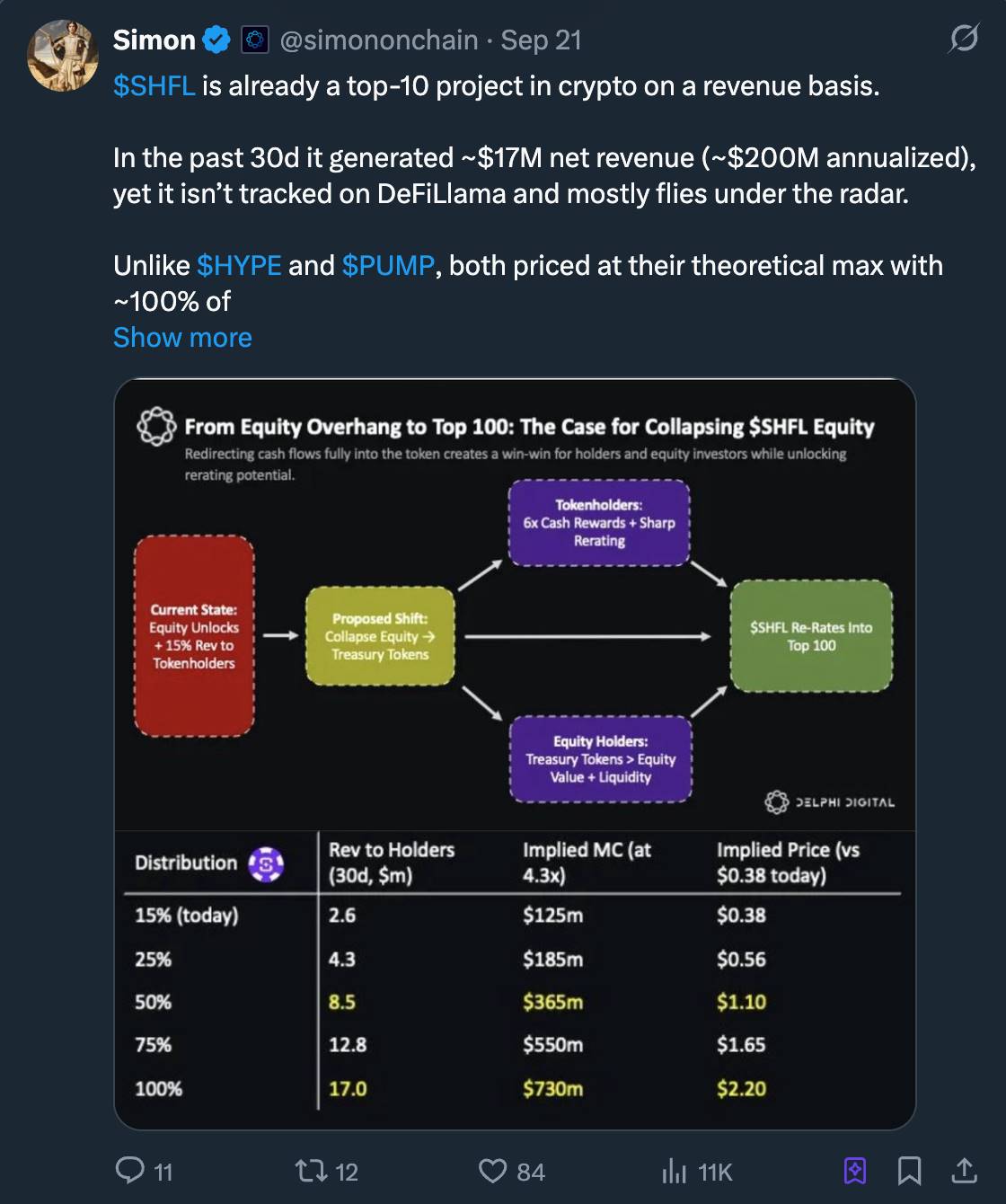
Shuffle's net gaming revenue and weekly lottery distribution demonstrate the huge potential of this area with successful execution.

Pump's mobile application is another underutilized advantage. Deeper expansion into mobile could broaden user acquisition channels, make the product more accessible to mainstream users, and provide creators with more monetization scenarios. If combined with iGaming, this could not only significantly expand Pump's potential audience but also strengthen the platform's existing successful elements.

Despite the uncertainties, Pump remains one of the most resilient consumer applications of this cycle, maintaining dominance even as the overall market landscape has shifted. Substantial progress in any key direction could trigger a significant shift in market sentiment and help Pump break through to attract a broader non-crypto-native user base.


Twitter:https://twitter.com/BitpushNewsCN

BitPush TG Group:https://t.me/BitPushCommunity

BitPush TG Channel: https://t.me/bitpush

Original link:https://www.bitpush.news/articles/7596421

Трендові криптовалюти

Пов'язані питання

QWhat is the core challenge that Pump.fun still faces in 2026 according to the article?

AThe core challenge is creating a sustainable and incentive-compatible creator token model. The fundamental problem is that the token itself is part of the product, and the economic rationale for holding or supporting a streamer's token remains unclear, causing most tokens to trend toward zero and making the model unattractive to larger, established creators.

QWhat was the Bagwork phenomenon, and why was it significant for Pump.fun?

ABagwork was a viral event led by a group of teenagers who engaged in attention-grabbing stunts, which coincided with the peak of Pump.fun's activity in mid-September. It was significant because it was one of the few cases where Pump.fun's streaming experiment worked as intended, generating over 2300 SOL in creator fees and briefly showcasing the potential flywheel effect of a true creator token without the team selling their holdings.

QHow does Pump.fun's current market cap to revenue (MC/Rev) ratio compare to other major tokens like Hyperliquid?

APump.fun's MC/Rev ratio is 4.36x with an annualized buyback yield of ~12.8%, which is significantly lower than other major tokens. For comparison, Hyperliquid has an MC/Rev ratio of ~8.01x and a yield of ~3.34%.

QWhat strategic direction does the article suggest could be a natural fit for Pump.fun's user base and existing strategy?

AThe article suggests that entering the iGaming or casino-related verticals would be a natural strategic fit. This approach, similar to models like Kick or Stake, aligns with Pump.fun's speculation-driven user base and could create deep synergies with its meme coin and streaming goals, leveraging proven monetization potential.

QDespite a significant drop in daily launchpad revenue, what advantage does Pump.fun maintain in the meme coin platform space?

APump.fun maintains a dominant structural advantage and continues to command the majority share of industry activity, even during cyclical trading volume contractions. It still earns and buys back approximately $1 million daily, and competitors have only posed a threat briefly without providing a substantial challenge.

Пов'язані матеріали

Gate Research Institute: The 'Wall Street-ization' Wave of Crypto Financial Products – Competition or Integration?

The article titled "Gate Research Institute: Are Crypto Financial Products Sparking a 'Wall Street' Wave—Competition or Convergence?" explores the evolving relationship between the crypto ecosystem and traditional finance (TradFi). The piece begins by reflecting on Bitcoin's original 2009 vision of decentralization, disintermediation, and moving away from banks. It then contrasts this with the 2024 landscape, where key crypto assets like Bitcoin are increasingly held through Wall Street products like ETFs issued by giants like BlackRock. The article questions whether this signifies that TradFi is systematically taking over the rights to issue, price, custody, and distribute crypto financial assets. The core argument is that this is not a zero-sum takeover but rather a bidirectional convergence where each side addresses the other's weaknesses. Crypto offers 24/7 global markets, programmable settlement, and open access but lacks compliant channels, institutional-grade custody, deep fiat liquidity, and mainstream distribution. TradFi possesses these but is constrained by legacy systems, limited operating hours, and slow settlement. Two primary convergence paths are highlighted: * **Path A (CEX to TradFi):** Exemplified by Gate, which has progressed from offering tokenized stocks and CFDs to providing direct, real stock trading (US, Hong Kong, South Korea) within its platform, using USDT. * **Path B (TradFi to Crypto):** Exemplified by Robinhood, which has integrated crypto trading, acquired exchanges like Bitstamp, and is moving traditional assets like stocks onto the blockchain via tokenization and its own Layer 2. Both paths are ultimately competing to become the next-generation, unified financial account—a "super account" where users can seamlessly trade cryptocurrencies, stocks, ETFs, RWA (Real World Assets), and tokenized treasury products in one interface. The growth of RWA and tokenized treasuries (e.g., BlackRock's BUIDL) is presented as the asset-layer fusion, providing stable, yield-bearing assets on-chain and acting as a bridge between the two worlds. In conclusion, the "Wall Street-ization" of crypto is framed as a mutual transformation. Decentralized ideals persist in the protocol layer, while at the application layer, a more efficient, global, and accessible unified capital market is emerging from this convergence. The future competition lies not between crypto exchanges and stockbrokers, but between platforms vying to offer the most comprehensive asset coverage, liquidity, and user experience within a single account.

marsbit2 хв тому

Gate Research Institute: The 'Wall Street-ization' Wave of Crypto Financial Products – Competition or Integration?

marsbit2 хв тому

Claude's Major New Feature: Screen Recording + Voice, Distilling Your Skills into AI Tasks in One Click

Claude has introduced a major new feature called "Record a Skill," available for Pro, Max, and Team users. This function, found in the Claude desktop app's CoWork menu, allows users to create reusable AI skills simply by recording their screen and providing voice narration while performing a task. Claude then automatically analyzes the recording and generates a functional Skill. A hands-on test confirmed the feature works seamlessly. Users start recording via the Skills manager, perform their workflow while verbally explaining the steps and logic, and avoid including sensitive information. After recording, Claude processes the content and creates the Skill, which can be saved and later invoked with a slash command (/). This eliminates the need for manual adjustments or writing complex instruction files. The innovation goes beyond mere efficiency. Previously, creating a Skill required writing a detailed SKILL.md file in Markdown—a significant barrier for non-technical users. "Record a Skill" bypasses this by directly capturing both actions and the implicit reasoning shared in the narration. This lowers the barrier to knowledge transfer and automation, addressing a core challenge in corporate knowledge management: the difficulty of getting experts to write and maintain documentation. However, the feature also highlights a shift in the nature of work. A case study from March 2026 showed a freelancer whose five-year client relationship was effectively replaced by a hand-coded Claude Skill automating their content workflow. With the even lower barrier of screen recording, the ability to distill personal expertise into automatable skills accelerates this trend. The "moat" for work is moving from simply knowing how to do a task to mastering tasks that are difficult or impossible to automate.

marsbit7 хв тому

Claude's Major New Feature: Screen Recording + Voice, Distilling Your Skills into AI Tasks in One Click

marsbit7 хв тому

Feeding AI "Noise" Can Also Boost Scores, This Work Enables Positive Transfer with Noise

Feeding "Noise" to AI Can Improve Performance: A Method Enables Positive Transfer from Noise This work, Semi-Supervised Noise Adaptation (SSNA), introduces a Noise Adaptation Framework (NAF) that challenges traditional transfer learning. Instead of requiring a labeled source domain of real data (e.g., images, text), NAF uses randomly generated Gaussian noise as the source. For a target task with C classes, it constructs C noise clusters by sampling from Gaussian distributions. Although this synthetic noise contains no semantic meaning, NAF trains it to form a discriminative class structure in a shared representation space—clustering same-class noise and separating different classes. The key is aligning this learned structure from the noise domain to the real, sparsely labeled target domain. A small number of target labels are still essential to establish the correspondence between noise clusters and actual classes. The training objective combines: 1) supervised loss on the few labeled target samples, 2) classification loss for the noise to build its structure, and 3) a distribution alignment loss (using Negative Domain Similarity) to minimize the gap between the noise and target domains in the shared space. Experiments show significant gains in few-label settings. With just 4 labels per class, NAF with a ResNet-18 backbone improves accuracy over a standard supervised baseline (ERM) by +12.35% on CIFAR-10, +7.61% on CIFAR-100, +4.38% on DTD-47, and +2.74% on Caltech-101. It also benefits fine-grained datasets and scales to ImageNet-1K (with 100 labels/class) and text classification (AG News). NAF can be integrated into existing semi-supervised methods like FixMatch for further gains. Ablation studies confirm the transferred benefit comes from the discriminative structure of the noise, not randomness itself. Collapsing all noise into a single point causes negative transfer, while increasing separation between noise cluster centers improves performance. The amount of noise per class is less critical once a basic structure forms. In conclusion, this work demonstrates that for positive transfer, the semantic content of source data may not be necessary. What can be effectively transferred is the *organizational structure* of categories within a representation space. This offers a promising alternative for scenarios where real source data is unavailable due to privacy, copyright, or procurement constraints.

marsbit8 хв тому

Feeding AI "Noise" Can Also Boost Scores, This Work Enables Positive Transfer with Noise

marsbit8 хв тому

Торгівля

Спот

Популярні статті

Як купити PUMP

Ласкаво просимо до HTX.com! Ми зробили покупку Big Pump (PUMP) простою та зручною. Дотримуйтесь нашої покрокової інструкції, щоб розпочати свою криптовалютну подорож.Крок 1: Створіть обліковий запис на HTXВикористовуйте свою електронну пошту або номер телефону, щоб зареєструвати обліковий запис на HTX безплатно. Пройдіть безпроблемну реєстрацію й отримайте доступ до всіх функцій.ЗареєструватисьКрок 2: Перейдіть до розділу Купити крипту і виберіть спосіб оплатиКредитна/дебетова картка: використовуйте вашу картку Visa або Mastercard, щоб миттєво купити Big Pump (PUMP).Баланс: використовуйте кошти з балансу вашого рахунку HTX для безперешкодної торгівлі.Треті особи: ми додали популярні способи оплати, такі як Google Pay та Apple Pay, щоб підвищити зручність.P2P: Торгуйте безпосередньо з іншими користувачами на HTX.Позабіржова торгівля (OTC): ми пропонуємо індивідуальні послуги та конкурентні обмінні курси для трейдерів.Крок 3: Зберігайте свої Big Pump (PUMP)Після придбання Big Pump (PUMP) збережіть його у своєму обліковому записі на HTX. Крім того, ви можете відправити його в інше місце за допомогою блокчейн-переказу або використовувати його для торгівлі іншими криптовалютами.Крок 4: Торгівля Big Pump (PUMP)Легко торгуйте Big Pump (PUMP) на спотовому ринку HTX. Просто увійдіть до свого облікового запису, виберіть торгову пару, укладайте угоди та спостерігайте за ними в режимі реального часу. Ми пропонуємо зручний досвід як для початківців, так і для досвідчених трейдерів.

353 переглядів усьогоОпубліковано 2024.12.12Оновлено 2026.06.02

Як купити PUMP

Обговорення

Ласкаво просимо до спільноти HTX. Тут ви можете бути в курсі останніх подій розвитку платформи та отримати доступ до професійної ринкової інформації. Нижче представлені думки користувачів щодо ціни PUMP (PUMP).

活动图片