Can Alibaba Cloud Rewrite Itself?

marsbitОпубліковано о 2026-05-20Востаннє оновлено о 2026-05-20

Анотація

Over the past five months, Alibaba Cloud's MaaS (Model as a Service) revenue has surged 15x, marking a strategic overhaul where the company is shifting its 17-year-old system designed for "humans using cloud" to a new paradigm centered on "Agents consuming Tokens." At its recent summit, Alibaba Cloud announced a full-stack upgrade encompassing "chip-cloud-model-inference," all optimized for AI Agents. Key launches include the new AI product portal "QianWen Cloud," hyper-node servers powered by the in-house AI chip Zhenwu M890, and the latest flagship model, Qwen3.7-Max. Senior VP Liu Weiguang described this as building "China's largest AI factory," where chips are raw materials, the cloud is the workshop, models are machines, and the inference platform is the assembly line, with Tokens as the final product. The company is now emphasizing its chip strategy, unveiling the Zhenwu M890 and a two-year roadmap for future chips. With over 560,000 chips deployed across 400+ clients, Alibaba Cloud aims to control the marginal cost per Token, mirroring Google's integration of TPU and Gemini for optimal cost-performance. The cloud infrastructure itself is being rewritten. Traditional cloud interfaces are being transformed into standardized, Agent-callable Skills. A new scheduling logic focuses on "task scheduling" over "resource scheduling" to handle the unpredictable, elastic workloads of Agents. Liu noted that AI applications now automatically provision cloud resources, with one cu...

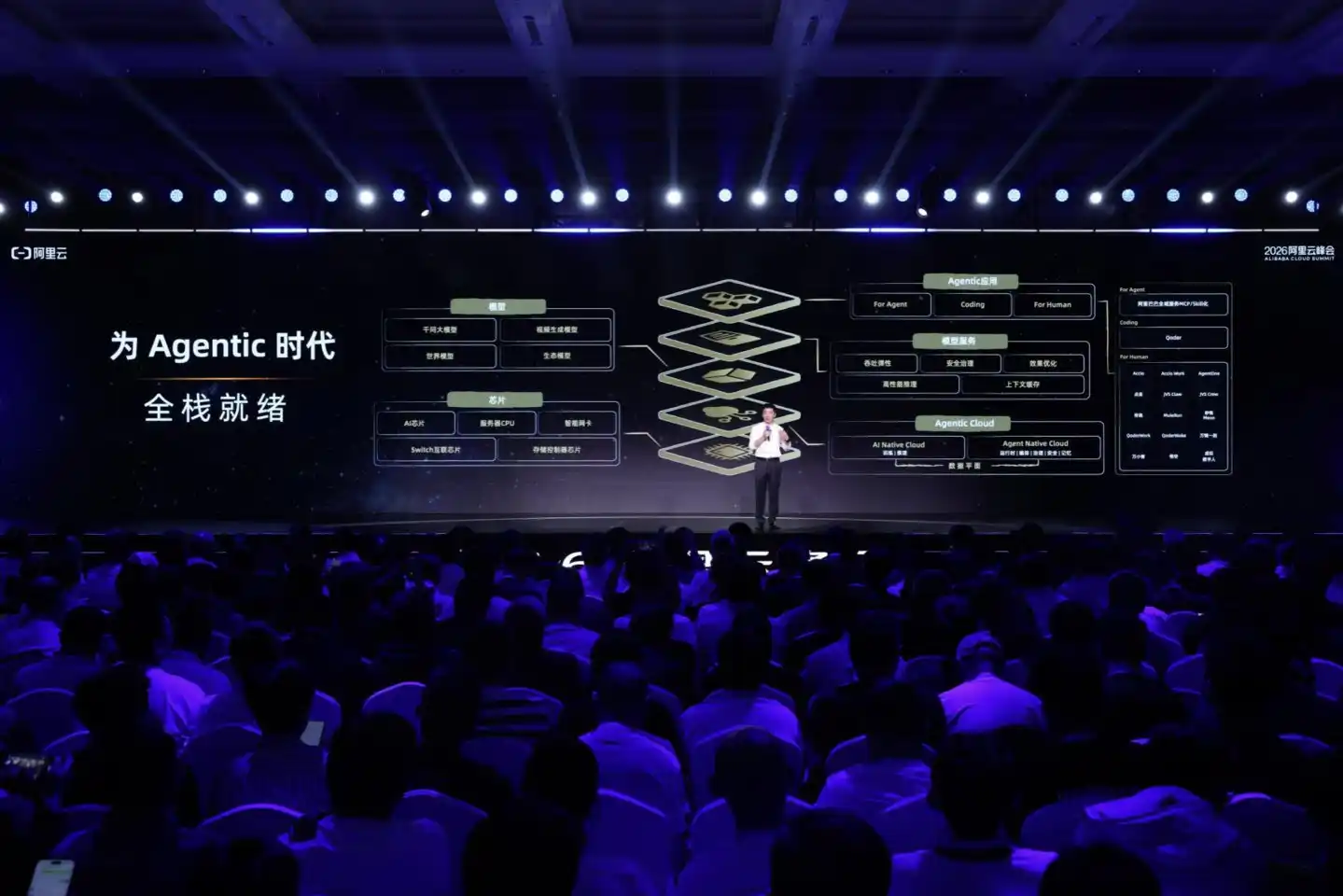
Over the past five months, the MaaS revenue of Alibaba Cloud has grown 15 times, which is just one facet of Alibaba Cloud's self-reconstruction. At the summit, Alibaba Cloud announced the completion of a full-stack Agentization upgrade covering "chip-cloud-model-inference," simultaneously launching the new AI product official website "Qianwen Cloud," the hyper-node server equipped with the self-developed AI chip Zhenwu M890, and the latest flagship model Qwen3.7-Max.

In the words of Alibaba Cloud Senior Vice President Liu Weiguang, "We are building China's largest AI factory." The factory metaphor implies a complete production logic: chips are the raw materials, the cloud is the workshop, models are the machines, the inference platform is the assembly line, and the final commodity produced is the Token.

The essence of this reconstruction is to transform the entire system built over the past 17 years around "humans using the cloud" into a new system centered on "Agents consuming Tokens."

Why Play the Chip Card Now?

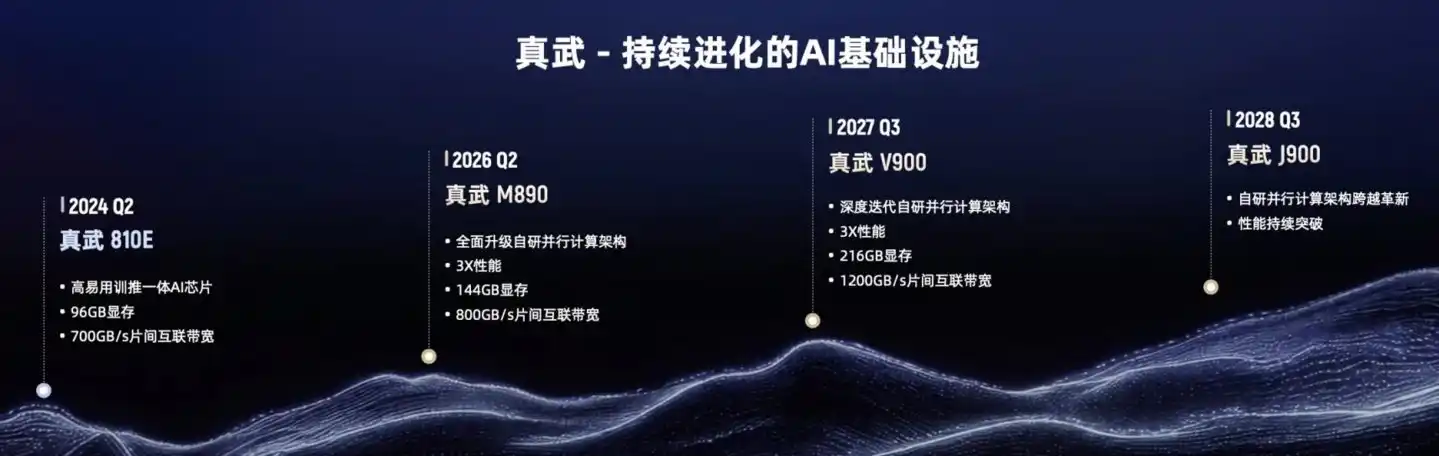
Alibaba Cloud rarely emphasized chips in public before. At this summit, it not only released the new-generation training-and-inference integrated AI chip Zhenwu M890 but also unprecedentedly disclosed its chip roadmap for the next two years, with successive generations of products, Zhenwu V900 and Zhenwu J900, progressing year by year.

The Zhenwu M890 is equipped with 144GB of video memory, an inter-chip interconnect bandwidth of 800GB/s, and performance three times that of the previous generation Zhenwu 810E. Paired with the self-developed ICN Switch interconnect chip, 128 AI chips can be combined into a single machine, with P2P latency compressed to within 150 nanoseconds.

But beyond the specifications, the more crucial information is scale. The Zhenwu series has cumulatively shipped 560,000 units and has already entered over 400 clients across more than 20 industries, including telecommunications, FAW, and SPDB.
Liu Weiguang repeatedly used Google as an analogy. The deep integration of Google's TPU and Gemini allowed Google to achieve optimal cost-effectiveness within its own framework. Alibaba Cloud certainly wants to follow the same path. He summarized the competitive logic in one sentence: "If the future competition is about every chip generating more high-quality Tokens than competitors, then we win."

Combined with the Yitian CPU, Panmai Smart NIC, and Zhenyue storage master control chip, T-Head's chip landscape has expanded from a single point to complete coverage of computing power, networking, and storage. When inference demand expands exponentially, only by holding chips in one's own hands can the marginal cost of each Token be controlled.

The reasoning is not complicated. Model companies can compete on parameters, but cloud providers ultimately compete on whose Tokens are cheaper, more stable, and faster. Chips are the starting point of this cost war.

The Cloud Itself Must Be Rewritten

Chips solve the problem of "being able to run," but Agents' demands on the cloud extend far beyond computing power.

The interaction logic of traditional cloud products is designed for humans: opening the console, looking at menus, configuring parameters, clicking buttons. This setup is completely unusable for Agents. Agents don't view web pages or click buttons; they need structured capability descriptions, standardized calling protocols, and predictable feedback.

Alibaba Cloud CTO Li Feifei used a set of comparisons to illustrate the problem: Traditional cloud workloads are steady-state; an ECS instance, once launched, might run for months or even years. But Agent workloads are characterized by "irregular elasticity, short lifecycles, and instant scaling up and down." After an Agent completes a task, its sandbox is destroyed. The next request might come in a few milliseconds, or it might not come for several hours.

To address this, Alibaba Cloud has done three things.

First, it made cloud products Skill-based, MCP-based, and CLI-based. Simply put, each cloud product is packaged into a standardized interface that Agents can directly call, using the cloud like calling functions.

Second, it built a dedicated runtime environment for Agents—lightweight sandboxes, multi-Agent collaboration, cross-task memory, and data flow channels.

Third, it rebuilt the scheduling logic, shifting from "resource scheduling" to "task scheduling," because traditional resource orchestration methods cannot withstand the concurrency of massive numbers of Agents.

Liu Weiguang stated that some AI applications, after going online, automatically provision cloud resources in the background—virtual machines, database instances, sandbox environments—without any human intervention. The volume of resources automatically provisioned for one customer in a single day is equivalent to two weeks of manual operations in the past.

"This essentially means Agents are using the cloud by themselves." Liu Weiguang provided an internal conversion formula: Token consumption can be proportionally converted into GPU usage, and each additional GPU card roughly drives a one-to-one increase in CPU. In other words, the growth in Token revenue is not cannibalizing traditional cloud revenue but is pulling it up, provided the cloud platform can handle the Agent workload.

Therefore, Alibaba Cloud is not merely adding a layer of AI capability to the original system. It is rewriting everything from interaction methods, scheduling logic, and billing models to product forms.

Models Are Not for Chatting

The third layer of the full-stack reconstruction is the model. Qwen3.7-Max ranked first among domestic models in the global Arena blind test overall leaderboard, surpassing Kimi-K2.6, DeepSeek-v4-pro, and GLM-5.1. The focus of this release is Alibaba's redefinition of the direction of model capabilities.

Alibaba Group's Tongyi large model leader Zhou Jingren said, "In the past, we pursued how well the model 'spoke.' Now we demand that the model 'gets things done.'"
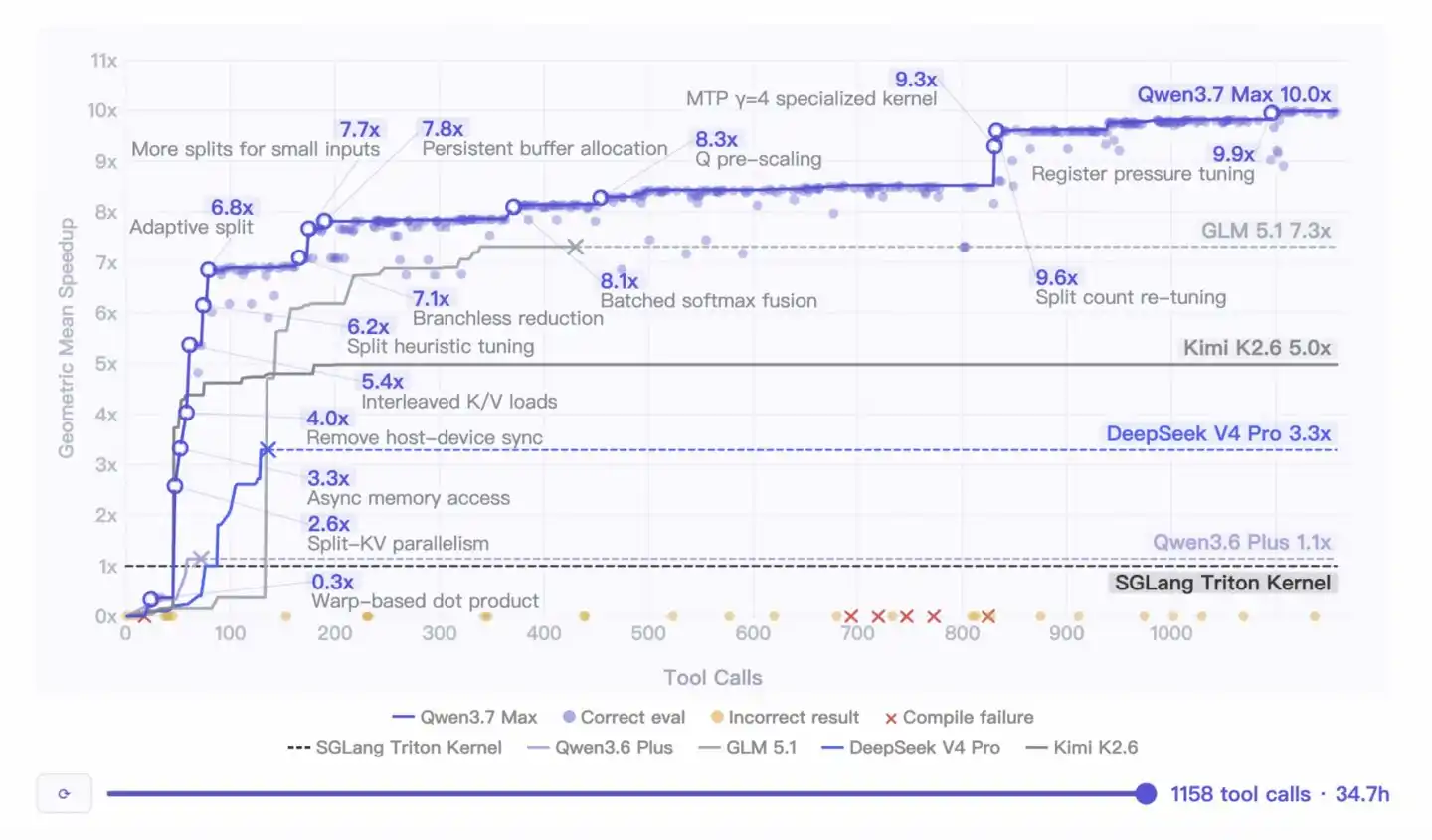
Taking Alibaba Cloud's practice in chips as an example, on the previously untrained Zhenwu M890 chip, Qwen3.7-Max, relying solely on a task description, autonomously worked for 35 hours from scratch, independently completing the writing and optimization of a production-grade AI computing kernel. The final performance was 10 times higher than the official version, with no human intervention or intermediate guidance throughout the entire process.

This demonstrates the model's core capability in Agent scenarios: long-range autonomous execution. It takes a task, breaks it down, plans, writes code, debugs—working continuously for 35 hours without stopping.

To support this level of inference demand, the Bailian platform has also undergone corresponding upgrades: pooled scheduling to improve GPU utilization, context caching to eliminate redundant calculations, and elastic throughput scheduling to handle concurrency peaks.

In terms of ecosystem, Bailian remains open for access. Besides the Qianwen model matrix, it has also onboarded third-party models such as Zhipu's GLM-5.1, MiniMax's M2.7, and Moonshot AI's Kimi K2.6.

Liu Weiguang mentioned, "Clients in practice don't use just one model; they use a combination of multiple models. We provide the combinations; clients find the mix that best suits them on the platform." At the summit, executives from six leading domestic model companies collectively took the stage, creating a scene reminiscent of a "domestic AI alliance."

Within the last three months, the Qianwen flagship model has iterated through three versions: 3.5, 3.6, and 3.7. This release rhythm itself sends a signal: the competition in model capabilities is far from over, and Alibaba intends to establish a long-term advantage through the vertical integration of self-developed chips and self-developed models.

The Real Bet of This Reconstruction

Looking back, the underlying logic of Alibaba Cloud's full-stack reconstruction is simple and pure. When AI revenue growth far outpaces traditional cloud business, when Tokens might replace ECS as the largest product line, when Agents start automatically provisioning cloud resources without humans needing to log into the console, the entire technical system designed for humans has reached a point where it must be changed.

But the difficulty of execution is another matter. Liu Weiguang himself admitted that the transformation is "easy to talk about, very hard to do." In the past, the sales team interacted with clients' IT departments. Now, doing MaaS requires dialogue with business units or even the CEO.

"Your conversational ability, your experience, are requirements of a completely different level." Alibaba Cloud has already established dedicated MaaS sales roles for large enterprise clients, operating and being assessed separately from traditional IaaS sales.

Performance metrics are also changing, no longer just looking at call volume, but at "high-quality Tokens"—Tokens that solve real problems, not chit-chat Tokens. Three core metrics: daily growth in paying customers, the number of core business systems integrated with models, and the efficiency of Agents autonomously completing task loops.

These adjustments at the organizational and mechanism levels often indicate a company's true judgment more than technical announcements. Alibaba Cloud wants to rebuild its revenue structure, customer relationships, and sales system. Liu Weiguang stated, "When we were building the cloud before, the client's IT budget was calculable—how many servers offline, roughly how much to move them up—you could see the problem. But with MaaS, the answer to this problem is unknown; once you get in, it might exceed your imagination."

The problem statement can't be seen, and the answer is uncertain, but Alibaba Cloud has still decided to dismantle and rewrite its entire system because the only certainty is that AI is an opportunity ten or even a hundred times larger than any before.

This is probably the most noteworthy information from this summit: not which chip has more computing power, or which model ranks where, but that China's largest cloud provider is betting on a future it believes will come, with an aggressive posture approaching that of a startup. (Author: Zhang Shuai, Editor: Yang Lin)


Пов'язані питання

QWhat is the core reason behind Alibaba Cloud's comprehensive 'chip-cloud-model-inference' stack reconstruction according to the article?

AThe core reason is to transform its entire 17-year-old system built around 'people using cloud' into a new system centered on 'Agents consuming Tokens'. This is driven by the recognition that AI revenue growth vastly outpaces traditional cloud business, and Tokens could replace ECS as the largest product line as Agents begin to automatically provision cloud resources.

QWhy does the article emphasize Alibaba Cloud's focus on developing its own AI chips like Zhenwu M890 now?

AThe article emphasizes it because, in an era where inference demand is expanding exponentially, controlling the cost of each Token is crucial for competition. By developing its own chips (like Zhenwu), Alibaba Cloud aims to control the marginal cost per Token from the source, similar to Google's strategy with TPU and Gemini, to ultimately provide cheaper, more stable, and faster Tokens.

QHow does Agent's demand for cloud differ from traditional human user demand as described in the text?

AAgent demand differs fundamentally: it is 'irregularly elastic, short-lived, and instantly scalable then gone,' requiring structured capability descriptions, standardized calling protocols, and predictable feedback. In contrast, traditional cloud workloads are steady-state (e.g., an ECS instance running for months). Agents do not interact with web consoles; they need cloud services encapsulated as standardized, function-like interfaces.

QWhat key shift in Alibaba Cloud's model capability focus is highlighted with the release of Qwen3.7-Max?

AThe key shift is moving from pursuing models that 'speak well' to models that 'can accomplish tasks.' The focus is now on long-term autonomous execution capabilities. For example, Qwen3.7-Max autonomously wrote and optimized a production-level AI computing kernel for the new Zhenwu M890 chip over 35 hours without human intervention, improving performance tenfold.

QAccording to the article, what organizational and operational changes is Alibaba Cloud making to support its MaaS (Model-as-a-Service) transformation?

AAlibaba Cloud is making several changes: 1) Establishing dedicated MaaS sales roles for large clients, separate from traditional IaaS sales with independent assessments. 2) Shifting key performance indicators (KPIs) from mere call volume to 'high-quality Tokens' that solve real problems. Core metrics now include daily growth of paying customers, number of core business systems integrated with models, and the efficiency of Agents completing task loops autonomously. 3) Changing sales dialogue from IT departments to business units or CEOs, requiring different skills and experience levels.

Пов'язані матеріали

After Three Consecutive Quarters of Decline, Can the Crypto Market Find a Window for Stabilization in Q3?

The cryptocurrency market has just concluded its worst-performing quarter since 2022, with total capitalization dropping 12.6% to $2.1 trillion. All core metrics indicate capital is leaving the sector, not just rotating within it. Bitcoin fell 14.2% and Ethereum dropped 25.4% in Q2, breaking their previous correlation with US tech stocks. A key driver is the reversal in US spot Bitcoin ETF flows, which saw a net outflow of approximately $4.67 billion in Q2, including a record monthly outflow near $4.5 billion in June. While recent data suggests long-term holders are accumulating again, sustained ETF outflows mean continued selling pressure. Market focus is now singularly on the Federal Reserve. The upcoming July FOMC meeting is seen as the most critical event for Q3. A dovish signal could support Bitcoin reclaiming a $68,000-$84,000 range, while a hawkish stance might establish a new trading band around $50,000-$56,000. Additionally, regulatory uncertainty persists, with the progress of the crucial *CLARITY Act* stalling in the Senate, reducing its perceived 2026 passage probability to 40-45%. Despite the broad downturn, a few sectors showed growth. Prediction markets saw nominal volume surge 48.7% year-over-year to $113.8 billion, and tokenized collectibles transaction volume rose 143% quarterly to $1.4 billion. The Real-World Asset (RWA) tokenization sector also continued steady growth, now representing ~$28.1 billion in on-chain value. The market's foundation for an extreme crash appears limited, with Bitcoin price hovering near its 200-week moving average. However, the trading paradigm has shifted from narrative-driven speculation to decisions based on price action, policy developments, and interest rate expectations, making a broad sentiment-driven rally unlikely in the near term.

marsbit19 год тому

After Three Consecutive Quarters of Decline, Can the Crypto Market Find a Window for Stabilization in Q3?

marsbit19 год тому

BIT Trading Moment: BTC Still Suppressed by Weekly 200 EMA, Rejection May Restart Decline; Storage and Semiconductors that Surged Last Night Begin Falling in Evening Trading

**Crypto & Stock Market Wrap: Bitcoin Tests Resistance, Stocks Retreat After AI Surge** Bitcoin consolidates around $66,000, facing key resistance near $68,000—an area seen as a major psychological and technical hurdle where previous rallies have failed. Analysts note the cryptocurrency is caught between its 200-week moving average (~$63,333) and 200-week EMA (~$68,328). A clear break above $68k is needed to signal a stronger bullish trend, while a rejection could lead to a retest of $63k support. Market sentiment remains cautious, with low futures open interest pointing to a low-liquidity rebound rather than a full bull market. Bitcoin spot ETFs saw another $203 million inflow. US stock futures pointed lower after a strong Tuesday session led by a massive rebound in semiconductors and memory stocks. The rally was fueled by renewed optimism about AI-driven hardware demand, with Micron, SanDisk, and SK Hynix surging. However, those gains reversed in pre-market trading. Super Micro Computer (SMCI) soared over 20% after hours on strong guidance and a record backlog. Other standouts included Rocket Lab and nuclear energy plays Oklo and X-Energy. Rising oil prices (Brent above $91) and climbing Treasury yields (10-year near 4.64%), however, are reigniting inflation concerns and acting as a headwind for equities. In Asia, markets were mixed. South Korea's KOSPI pared early gains to close slightly higher as semiconductor stocks like SK Hynix gave back initial surges. Japan's Nikkei edged lower as the yen hit a fresh 38-year low against the dollar, raising fears of potential market intervention. Key events to watch include the Samsung Galaxy launch, AMD's AI event, and a slew of major tech earnings from Alphabet, Tesla, and IBM after the close on Wednesday, followed by the ECB meeting and Intel's earnings on Thursday.

marsbit20 год тому

BIT Trading Moment: BTC Still Suppressed by Weekly 200 EMA, Rejection May Restart Decline; Storage and Semiconductors that Surged Last Night Begin Falling in Evening Trading

marsbit20 год тому

Former CFTC Chairman, Circle President Tarbert: Preaching Long-Termism While Cashing Out $30 Million Himself

Former CFTC Chairman and Circle President Heath Tarbert has consistently advocated for a long-term vision in public, urging patience from investors as Circle’s stock price has fallen significantly from its peak. However, it has been revealed that since Circle’s IPO, Tarbert has continuously sold his CRCL shares through pre-arranged trading plans, cashing out approximately $30 million, without making any public market purchases. This contrast between his public messaging and personal actions has drawn criticism. Tarbert joined Circle in July 2023 as Chief Legal Officer, leveraging his regulatory experience to help guide the company through its IPO and expansion. Despite promoting stablecoins as long-term infrastructure, he established a 10b5-1 trading plan just before Circle went public, leading to substantial stock sales over the following year. In March 2026, he initiated another plan to sell more shares. His career trajectory highlights a pattern of moving between high-level regulatory roles and influential positions in the financial sector. After resigning as CFTC Chairman in early 2021, he joined Citadel Securities as Chief Legal Officer just 27 days later, during a period of intense regulatory scrutiny for the firm. He later joined Circle, aiding its efforts to navigate regulatory challenges for its public listing. While Tarbert's expertise in policy and compliance is valuable to companies like Circle, his actions—advocating long-term confidence while personally divesting—raise questions about the alignment between his public statements and his private financial decisions, leaving investors who followed his advice to bear the market risks.

marsbit20 год тому

Former CFTC Chairman, Circle President Tarbert: Preaching Long-Termism While Cashing Out $30 Million Himself

marsbit20 год тому

Gate Research Institute: The 'Wall Street-ization' Wave of Crypto Financial Products – Competition or Integration?

The article titled "Gate Research Institute: Are Crypto Financial Products Sparking a 'Wall Street' Wave—Competition or Convergence?" explores the evolving relationship between the crypto ecosystem and traditional finance (TradFi). The piece begins by reflecting on Bitcoin's original 2009 vision of decentralization, disintermediation, and moving away from banks. It then contrasts this with the 2024 landscape, where key crypto assets like Bitcoin are increasingly held through Wall Street products like ETFs issued by giants like BlackRock. The article questions whether this signifies that TradFi is systematically taking over the rights to issue, price, custody, and distribute crypto financial assets. The core argument is that this is not a zero-sum takeover but rather a bidirectional convergence where each side addresses the other's weaknesses. Crypto offers 24/7 global markets, programmable settlement, and open access but lacks compliant channels, institutional-grade custody, deep fiat liquidity, and mainstream distribution. TradFi possesses these but is constrained by legacy systems, limited operating hours, and slow settlement. Two primary convergence paths are highlighted: * **Path A (CEX to TradFi):** Exemplified by Gate, which has progressed from offering tokenized stocks and CFDs to providing direct, real stock trading (US, Hong Kong, South Korea) within its platform, using USDT. * **Path B (TradFi to Crypto):** Exemplified by Robinhood, which has integrated crypto trading, acquired exchanges like Bitstamp, and is moving traditional assets like stocks onto the blockchain via tokenization and its own Layer 2. Both paths are ultimately competing to become the next-generation, unified financial account—a "super account" where users can seamlessly trade cryptocurrencies, stocks, ETFs, RWA (Real World Assets), and tokenized treasury products in one interface. The growth of RWA and tokenized treasuries (e.g., BlackRock's BUIDL) is presented as the asset-layer fusion, providing stable, yield-bearing assets on-chain and acting as a bridge between the two worlds. In conclusion, the "Wall Street-ization" of crypto is framed as a mutual transformation. Decentralized ideals persist in the protocol layer, while at the application layer, a more efficient, global, and accessible unified capital market is emerging from this convergence. The future competition lies not between crypto exchanges and stockbrokers, but between platforms vying to offer the most comprehensive asset coverage, liquidity, and user experience within a single account.

marsbit20 год тому

Gate Research Institute: The 'Wall Street-ization' Wave of Crypto Financial Products – Competition or Integration?

marsbit20 год тому

Торгівля

Спот
活动图片




