Bybit Partners with Stockholm Open as LiquidChain Redefines Cross-Chain Infrastructure

bitcoinistОпубліковано о 2026-02-10Востаннє оновлено о 2026-02-10

Анотація

Bybit has partnered with the Stockholm Open, rebranding it the 'BNP Paribas Nordic Open,' as part of a strategic move to target high-net-worth and institutional investors in Europe. This shift reflects a broader trend of crypto exchanges building credibility with sophisticated capital. However, this institutional interest highlights a critical weakness in the market: fragmented on-chain infrastructure and liquidity across major blockchains like Bitcoin, Ethereum, and Solana. This gap is driving demand for unified cross-chain solutions. LiquidChain ($LIQUID) is addressing this by building a Layer 3 infrastructure designed to fuse liquidity from these ecosystems into a single execution layer. Its 'Cross-Chain Virtual Machine' aims to enable 'Single-Step Execution,' allowing users to perform complex actions across chains in one transaction without manual bridging. The protocol is currently in its presale phase, having raised over $533K with tokens priced at $0.0136. This early capital inflow indicates investor interest in utility-driven infrastructure projects that solve liquidity fragmentation, positioning them to capture the next wave of DeFi volume as the need for interconnected blockchain rails intensifies.

Trusted Editorial content, reviewed by leading industry experts and seasoned editors. Ad Disclosure

Quick Facts:

  • ➡️ Bybit’s partnership with the Stockholm Open signals a strategic pivot toward high-net-worth and institutional demographics in Europe.
  • ➡️ The gap between institutional interest and on-chain user experience is driving demand for unified infrastructure solutions.
  • ➡️ LiquidChain is addressing liquidity fragmentation by fusing BTC, ETH, and SOL ecosystems into a single execution layer.
  • ➡️ Infrastructure projects are seeing steady capital inflows, with early backers focusing on utility-driven tokenomics over pure governance rights.

The intersection of digital assets and elite sports hit another milestone this week.

Bybit announced its title partnership with the Stockholm Open, rebranding the tournament to the ‘BNP Paribas Nordic Open’ with the exchange as a top-tier partner. This isn’t just about slapping a logo on a court; it’s a calculated push into high-net-worth territory.

By aligning with the oldest ATP indoor tournament, Bybit is positioning itself directly in front of a European institutional audience, a demographic that has historically been skittish about entering the volatile crypto fray.

Why the shift? Sports sponsorships have evolved from simple awareness plays to strategic credibility moves. Just as Crypto.com’s arena naming rights tried to normalize digital assets for retail, Bybit’s entry into the ‘gentleman’s sport’ of tennis targets a sophisticated, capital-rich investor class.

The data suggests exchanges are pivoting marketing spend toward trust-building, anticipating a market shift from retail speculators to long-term holders.

But there’s a catch. Bringing institutional capital on-chain exposes a glaring weakness in the current market structure: infrastructure fragmentation. While exchanges smooth the on-ramp, the actual on-chain experience is still plagued by complex bridging, wrapped asset risks, and liquidity that’s fractured across chains like Ethereum and Solana.

As traditional finance (TradFi) eyes the exit, the rails they’re expected to run on are still being built. This gap between marketing promise and technical reality has shifted smart money focus toward Layer 3 (L3) solutions capable of unifying these ecosystems.

Among the protocols addressing this friction is LiquidChain ($LIQUID), a cross-chain liquidity layer that has quietly started accumulating capital in its early presale stages.

Read more about $LIQUID here.

Unifying Fragmented Liquidity Across Bitcoin, Ethereum, and Solana

The current DeFi landscape effectively forces users and developers into silos. A developer building on Solana can’t easily access Ethereum liquidity without relying on cumbersome bridges or wrapped tokens, mechanisms that have historically been vectors for major hacks.

LiquidChain ($LIQUID) aims to solve this via its Layer 3 infrastructure, designed to fuse Bitcoin, Ethereum, and Solana liquidity into a single execution environment.

This distinction is critical. Most ‘interoperability’ protocols merely message between chains. LiquidChain operates as a Cross-Chain Virtual Machine (VM), enabling what the protocol calls ‘Single-Step Execution.’ In practice, a user could stake an asset on Ethereum and take a loan against it on Solana in a single transaction, without manually bridging funds.

For developers, the appeal lies in the ‘Deploy-Once’ architecture, writing code once that can simultaneously tap into the user bases of the three largest blockchains.

Of course, the risk here is execution complexity. Building an L3 that handles verifiable settlement across non-EVM (Bitcoin) and high-speed (Solana) chains is a heavy technical lift. Yet, the demand for a Unified Liquidity Layer is undeniable.

As liquidity fragmentation continues to dilute capital efficiency, protocols that can abstract away the underlying chain are positioned to capture the next wave of DeFi volume.

$LIQUID is available here.

Early Capital Flows Into LiquidChain’s $0.0135 Presale Round

While the broader market reacts to macro signals and exchange partnerships, on-chain metrics show a rotation into infrastructure plays.

LiquidChain has currently raised $533K in its ongoing presale, with tokens priced at $0.0136. This raise amount is notable not for its size relative to the massive ICOs of 2017, but for the steady accumulation during a period where capital is generally risk-averse.
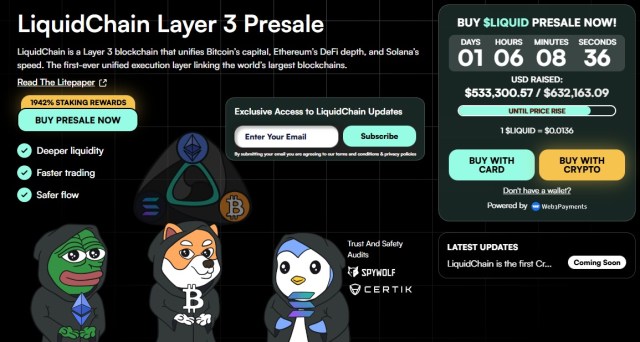
The pricing structure suggests early positioning before the protocol moves toward mainnet deployment. Investors seem to be betting on the ‘transaction fuel’ narrative, where the native $LIQUID token is required to power cross-chain operations and liquidity staking.

Unlike governance-only tokens, infrastructure tokens often derive value from network usage volume. If LiquidChain succeeds in capturing even a fraction of the cross-chain arbitrage and settlement market, the utility demand for the token could theoretically decouple from pure speculation.

What most coverage misses is the timing. With Bitcoin’s ecosystem expanding via L2s and Solana’s dominance in retail memes, the need for a connecting layer hasn’t been higher. The presale data points to a subset of the market hedging against the “winner takes all” chain thesis, opting instead to invest in the rails that connect them all.

$LIQUID is available here.

This article is not financial advice. Cryptocurrency investments, including presales and Layer 3 protocols, carry high risks, including total loss of capital. Always conduct independent due diligence before investing.

Editorial Process for bitcoinist is centered on delivering thoroughly researched, accurate, and unbiased content. We uphold strict sourcing standards, and each page undergoes diligent review by our team of top technology experts and seasoned editors. This process ensures the integrity, relevance, and value of our content for our readers.

patrubogdan

Follow

Full Profile

Related Posts

Meme Coins Outpace Blue Chips as Retail Liquidity Rotates, Igniting Maxi Doge’s $4.5M Rise

AI Can’t Save the Market Alone, But It Can Transform It: How SUBBD Token Redefines Content Economics

Russian Lawmaker Predicts Bitcoin Collapse While Smart Money Rotates into Layer 2 Utility

Solana’s Low Fees Create Strong Competition for Base, BNB, and Polygon and Fuel SUBBD Token

Chainlink Founder Sergey Nazarov Identifies 3 Trends That Will Define the Cryptosphere as Hyper Token Soars

Bitcoin Demand Plunges Per CryptoQuant, Yet Maxi Doge Endures

Пов'язані питання

QWhat is the strategic significance of Bybit's partnership with the Stockholm Open?

ABybit's partnership with the Stockholm Open, rebranding it to the 'BNP Paribas Nordic Open', is a strategic move to target a high-net-worth and institutional European audience. It's a calculated effort to build credibility and position itself in front of a sophisticated, capital-rich investor class that has been cautious about entering the volatile crypto market.

QWhat key problem in the crypto market is LiquidChain aiming to solve?

ALiquidChain is addressing the problem of liquidity fragmentation across different blockchains. It aims to unify the fractured liquidity silos of Bitcoin, Ethereum, and Solana into a single execution layer, eliminating the need for complex bridges and wrapped assets which are vectors for hacks.

QHow does LiquidChain's 'Single-Step Execution' work?

ALiquidChain's 'Single-Step Execution' is enabled by its Cross-Chain Virtual Machine (VM). It allows a user to perform a complex action, such as staking an asset on Ethereum and taking a loan against it on Solana, in a single transaction without manually bridging funds between the chains.

QWhat is the current status and price of LiquidChain's ($LIQUID) presale?

AAs detailed in the article, LiquidChain's presale has raised $533K. The tokens are currently priced at $0.0136 in this ongoing early funding round.

QAccording to the article, how are infrastructure project tokens like $LIQUID different from governance-only tokens?

AInfrastructure tokens like $LIQUID derive their value from network usage and utility, as they are required to power cross-chain operations and liquidity staking. This is in principle from governance-only tokens, whose value is more closely tied to speculation and voting rights rather than direct utility demand from transaction volume.

Пов'язані матеріали

Understanding CPO (Co-Packaged Optics) in One Article: Why Nvidia Is Willing to Spend $3.2 Billion on a Fiber?

NVIDIA and Corning announced a multi-year strategic partnership on May 6, 2026, with NVIDIA committing up to $3.2 billion to support Corning's U.S. expansion. This investment will triple Corning's manufacturing plants and significantly boost its optical fiber and communications production capacity. The core driver behind this massive investment is the fundamental shift from copper to optical interconnect technology within AI data centers. As GPU clusters scale, copper wires face critical limitations: severe signal attenuation over distance, high energy consumption for signal integrity, and excessive heat generation. Optical fiber, transmitting light instead of electrical signals, solves these issues with minimal loss, near-light speed, and lower power needs. The article outlines a three-stage evolution of data center interconnect: 1. **Traditional Copper Interconnects:** The mainstream solution of the 2010s, now being phased out due to scaling bottlenecks. 2. **Pluggable Optical Modules:** The current mainstream, where modules convert electrical signals to light externally. This process still introduces energy loss and latency. 3. **CPO (Co-Packaged Optics):** The next-generation technology where the optical engine is integrated directly with the GPU chip package. This drastically reduces the electrical signal travel distance to mere millimeters, slashing power consumption and latency while boosting data density. NVIDIA CEO Jensen Huang has identified CPO as an essential core technology for AI infrastructure. NVIDIA's investment signifies a strategic shift from being a buyer to actively controlling its supply chain for critical components. With demand for specialized optical fiber far outstripping supply—evidenced by soaring prices—securing long-term manufacturing capacity has become a competitive necessity. While Corning's expansion may pressure some suppliers, a projected global fiber supply gap of 5-15% over the next few years creates a significant opportunity window, particularly for Chinese manufacturers competitive in optical preforms, chips, and modules. Ultimately, NVIDIA's move is not about chasing a trend but an engineering imperative. The transition to light-based interconnects like CPO is driven by the physical limits of copper, marking a definitive step in the ongoing AI computing revolution.

marsbit11 хв тому

Understanding CPO (Co-Packaged Optics) in One Article: Why Nvidia Is Willing to Spend $3.2 Billion on a Fiber?

marsbit11 хв тому

KOL's Perspective: Why Is SOL Set to Rise from This Point?

**Summary: Why SOL is Positioned for Growth at This Level** The article argues that SOL is poised for an upward move from its current price point, citing several key factors. Primarily, SOL has just broken out of a 4-month consolidation phase. This breakout signals a return of risk appetite to the broader crypto market, as SOL is seen as a key indicator of overall crypto health. The token's ownership has reportedly shifted from short-term traders and tourists to long-term accumulators, leading to low volume. Any meaningful increase in trading activity could thus trigger significant upward momentum. Fundamental strengths include strong institutional adoption, integration with DeFi and RWAs (Real-World Assets), and the potential benefits from the Clarity Act. Despite its high volatility—having dropped 70% from its all-time high but still up 12x from its bear market low—SOL is highlighted as one of the few tokens from the last cycle to reach new highs. It boasts a robust ecosystem of applications, users, and protocols. Future catalysts include the expected influx of AI developers following the Miami Accelerate conference, which focused on AI on Solana. Furthermore, Solana is positioned as the premier chain for memecoin activity, a trend expected to continue and drive network usage and fees. The article concludes that recent price action reflects a healthy transfer to long-term holders, setting the stage for growth.

marsbit1 год тому

KOL's Perspective: Why Is SOL Set to Rise from This Point?

marsbit1 год тому

Those Pre-Bitcoin PoW Protocols Have Recently Been Reimplemented

This article details a recent surge in replicating pre-Bitcoin Proof-of-Work (PoW) protocols, specifically focusing on Hal Finney's 2004 RPOW (Reusable Proofs of Work). Within five days in May 2026, multiple independent builders in the Bitcoin/cypherpunk community launched projects inspired by this early electronic cash proposal. The initiative began with Fred Krueger's `rpow2.com`, a centralized but auditable system that replaced RPOW's original IBM 4758 hardware with Ed25519 signatures. Initially a faithful replica, it later adopted Bitcoin-like features (21M supply cap, difficulty adjustment) and a controversial 5.24% founder allocation. This sparked rapid forks, including `rpow4.com` which incorporated full Bitcoin parameters, a prediction market (`rpowmarket.com`), and a DEX (`rpow2swap.com`). Concurrently, Mike In Space created a prototype of Wei Dai's 1998 b-money proposal (`b-money.replit.app`), pushing the historical exploration even further back. The article contrasts these centralized, server-dependent experiments with Bitcoin's core innovation of decentralized, trustless consensus. It also highlights a parallel development: the `HASH` project on Ethereum, which uses smart contract hooks to enable a purely fair-launch, browser-mineable PoW token with 0% allocations to team or VCs. The collective activity is framed as a meme-driven, educational exploration of cypherpunk history rather than a serious financial movement, with all projects heavily disclaiming any investment value.

marsbit1 год тому

Those Pre-Bitcoin PoW Protocols Have Recently Been Reimplemented

marsbit1 год тому

South Korean Exchanges 'Battle' Regulators, Challenging the Boundaries of Enforcement and Legislation

South Korea's cryptocurrency industry is engaged in a rare, direct confrontation with regulators. The Financial Intelligence Unit (FIU), the primary anti-money laundering (AML) watchdog, has recently imposed heavy penalties on major exchanges like Upbit and Bithumb for alleged violations involving unregistered overseas VASPs and AML procedures. However, exchanges are now actively challenging these actions in court and through industry associations. In a significant shift, the Seoul Administrative Court ruled in favor of Upbit's operator, Dunamu, overturning part of an FIU-ordered business suspension. The court found the FIU's penalty criteria and justification insufficiently clear. Similarly, the court suspended the enforcement of a six-month business suspension against Bithumb pending a final ruling, citing potential irreversible harm to the exchange. Beyond legal battles, the industry is contesting proposed legislative amendments. The Digital Asset eXchange Alliance (DAXA) strongly opposes a draft rule that would mandate Suspicious Transaction Reports (STRs) for all crypto transfers over 10 million KRW (~$6,800). DAXA argues this "poison pill" clause violates legal principles and would overwhelm the STR system, increasing reports from 63,000 to an estimated 5.45 million annually for major exchanges, thereby crippling effective AML monitoring. This conflict highlights a structural tension in South Korea's crypto governance: comprehensive digital asset laws are still developing, while regulators rely heavily on AML enforcement. The industry's move from passive compliance to active legal and legislative challenges signifies a new phase, pressing for clearer rules and more proportionate enforcement. While short-term disputes may intensify, this clash could ultimately lead to a more mature and sustainable regulatory framework for South Korea's vibrant crypto market.

marsbit1 год тому

South Korean Exchanges 'Battle' Regulators, Challenging the Boundaries of Enforcement and Legislation

marsbit1 год тому

Торгівля

Спот
Ф'ючерси
活动图片





