Buybacks and Telegram fuel LIT’s 40% surge, but can the rally extend itself?

ambcryptoОпубліковано о 2026-04-09Востаннє оновлено о 2026-04-09

Анотація

LIT, the native token of Peter Thiel-backed Lighter perpetual DEX, surged 40% in April, driven by an aggressive buyback program and a key Telegram integration. The project has repurchased and locked 10 million LIT (4% of the 250 million circulating supply) and is buying back tokens at a rate of about 1% per month. Meanwhile, Telegram’s integration of Lighter for leveraged trading attracted 40,000 new users. Despite this, open interest saw only a modest increase, though daily revenue rose from $35K to over $100K. A trader cautioned that the rally faces a key resistance level at the 200-EMA, and further gains depend on bulls flipping it into support.

Peter Thiel-backed Lighter perpetual DEX has accelerated the buyback of its native LIT token. On 08 April, the project announced it had bought and locked 10 million LIT. This translated to 4% of the current circulation of 250 million tokens since its debut last December.

A month ago, the buyback program was at 3% of the circulating supply. At its current pace, the project is buying back about 1% of supply or an average of 2.4 million LIT per month. If the trend persists, it would take the DEX about 10 months to lock the entire current circulating supply.

Worth pointing out, however, that LIT’s total supply is capped at 1 billion, and only 250 million LIT tokens were released after the debut. The first wave of unlocks will begin in December 2026.

In the meantime, how is the market responding to the aggressive LIT buyback though?

Telegram spikes Lighter traction

Well, the reception has been very positive and bullish. Since late March, the token has recovered by over 40%, rising from a record low of $0.74 to above $1.13.

LIT’s uptrend momentum was further boosted by a recent Telegram integration. The privacy-focused messenger will use Lighter to power its native trading with up to 50x leverage across crypto and non-crypto assets.

It’s been about a week since the Telegram integration. So, AMBCrypto dug deeper to check whether the partnership is driving meaningful traction for the DEX or not.

According to Lightalytics data, Lighter recorded about 40K new registered users after the Telegram update.
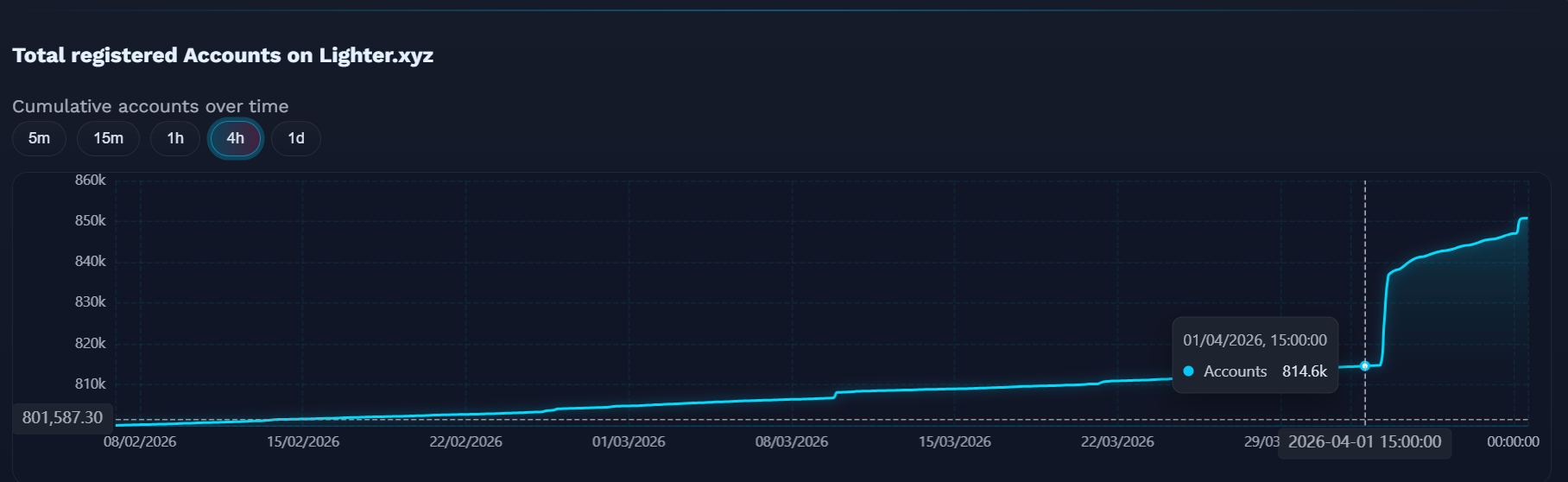
Source: Lightalytics

Will LIT extend the 40% rally?

However, the Open Interest (OI), which tracks users’ opened bets, posted only a slight improvement.

The OI rose by about $40 from $675 million to $717 million. Interestingly, the little traction saw daily revenue rise from $35K to over $100K over the last seven days.
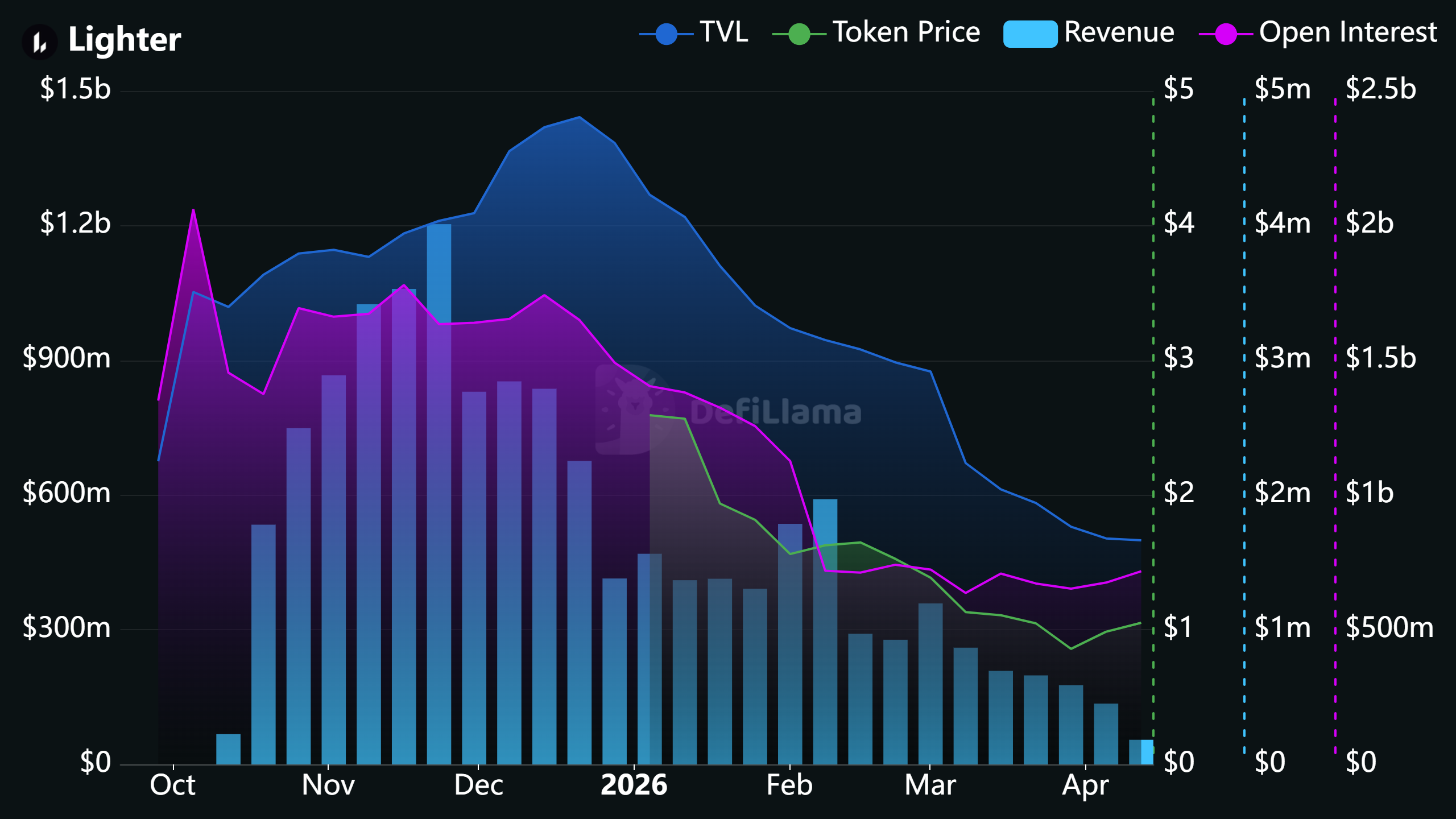
Source: DeFiLlama

Since most of the revenue is being channeled to buybacks, any further improved traction could help bolster LIT’s recovery.

Even so, a trader recently cautioned that the rally had hit the 200-EMA (Exponential Moving Average) – A key dynamic resistance that may derail bulls in the near-term. An extended rally could only be confirmed if bulls flip the 200-EMA into support.
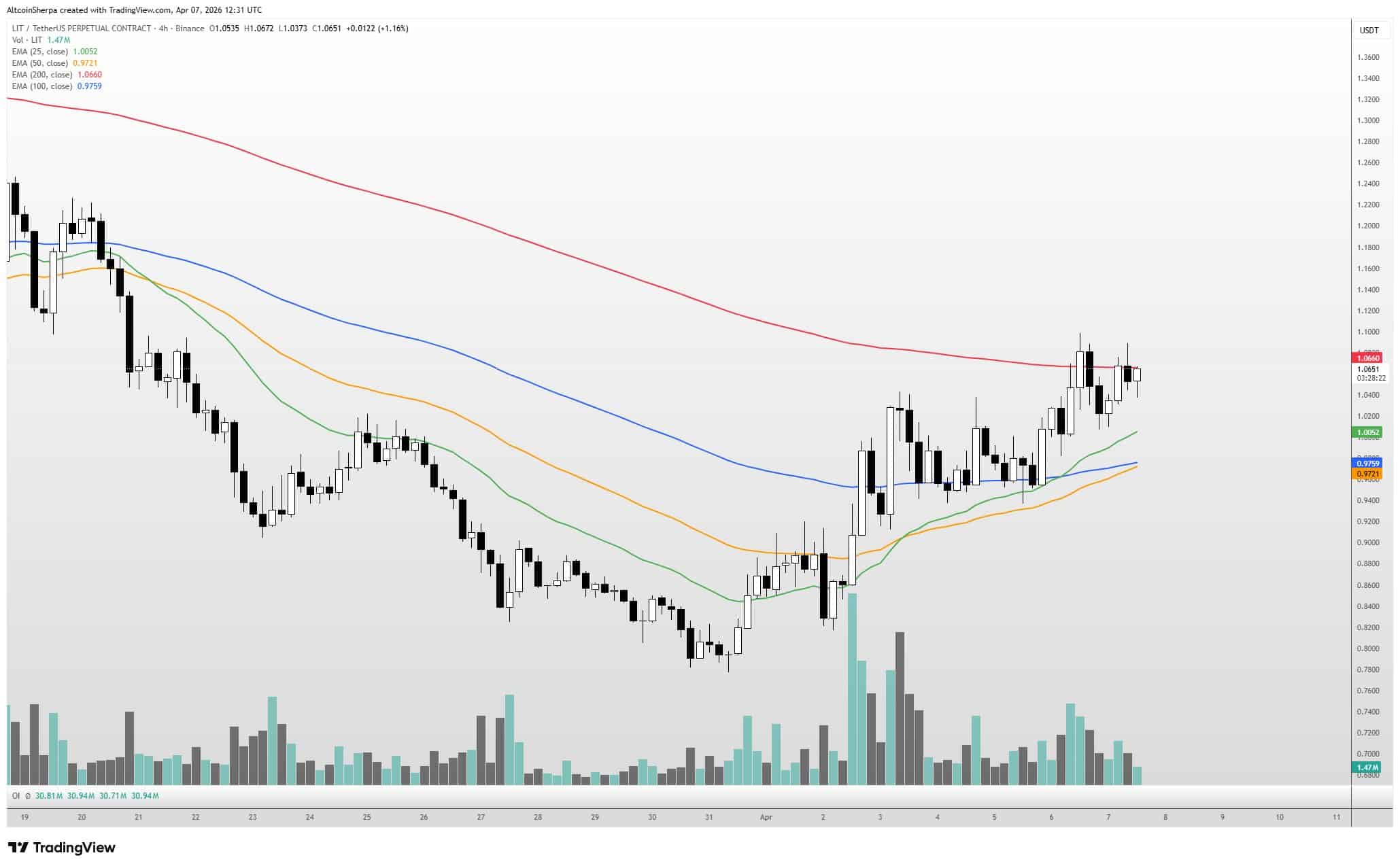
Source: X

Final Summary

  • Lighter’s buyback program has hit 10 million LIT or 4% of the circulating supply of 250 million.
  • Aggressive buyback program and Telegram integration fueled LIT’s 40% rally in April.

Пов'язані питання

QWhat is the current percentage of LIT's circulating supply that has been bought back by the project?

AThe project has bought back 4% of the current circulating supply of 250 million LIT tokens.

QWhat two main factors are credited with fueling LIT's 40% price surge in April?

AThe aggressive buyback program and the integration with Telegram fueled LIT's 40% rally.

QHow many new registered users did Lighter record after the Telegram integration was announced?

ALighter recorded about 40,000 new registered users after the Telegram update.

QWhat key technical resistance level did the rally hit, according to a trader's caution?

AThe rally hit the 200-EMA (Exponential Moving Average), which is a key dynamic resistance that could derail the bulls in the near-term.

QWhen is the first wave of LIT token unlocks scheduled to begin?

AThe first wave of unlocks is scheduled to begin in December 2026.

Пов'язані матеріали

NVIDIA Begins Adding Soap to the Bubble

NVIDIA is taking on a dual role: not just as a leading chip supplier, but as a massive capital allocator across the entire AI supply chain. In 2026, the company has committed over $40 billion in investments within five months, targeting everything from optical fiber manufacturing and data center operations to foundational AI model development. This investment spree, described as a systematic "sprinkler" approach, primarily funds companies that are major buyers of NVIDIA's own GPUs. Critics, including analysts from Goldman Sachs, label this a "circular revenue" loop—comparable to a supplier financing a customer to buy more of its products. A prominent example is NVIDIA's investment in OpenAI, which is expected to generate around $13 billion in revenue for NVIDIA, much of which may be reinvested back into OpenAI. While CEO Jensen Huang dismisses the "circular financing" critique as "absurd," arguing the investments are confidence votes in long-term generational shifts, some analysts express discomfort. They note that while investments in critical supply chain components like optics are strategically sound, funding new cloud providers like CoreWeave feels like "pre-paying for your own GPUs." The strategy carries significant risks. If the AI investment cycle turns, the market may question how much demand is genuine versus artificially sustained by NVIDIA's own balance sheet. Despite posting record-breaking earnings—$215.9 billion in annual revenue and $120 billion in net profit for FY2026—NVIDIA's stock fell after its report, signaling that "beating expectations" may no longer be enough to assure investors about the duration of the AI spending boom. The article concludes that while a bubble isn't necessarily a fraud, NVIDIA's actions resemble adding soap to a bubble—making it appear more robust and durable. This creates a complex scenario requiring extreme冷静 from investors to distinguish between real structural growth and financial engineering.

marsbit13 хв тому

NVIDIA Begins Adding Soap to the Bubble

marsbit13 хв тому

Short Positions Have Been Squeezed Out: Will the Next Leg of the U.S. Stock AI Rally Continue in Seoul?

"Short Squeeze Exhausted: Will the Next Leg of the AI Rally Continue in Seoul?" A Nomura report suggests the US AI stock rally, which saw the S&P 500 rise ~16.6% in 28 days largely driven by 10 key stocks, may be pausing. The fuel from short covering, CTA fund positioning, and volatility-control strategies is nearing its limit. For the rally to continue, new momentum from retail and sentiment-driven FOMO (Fear Of Missing Out) is needed. South Korea's market provided a potential answer on the very day the report was published. The KOSPI index surged 4.32%, triggering a buy-side circuit breaker, led by massive gains in chip giants SK Hynix (+11.98%) and Samsung. This surge is characterized by retail "hynix FOMO" and overseas funds precisely buying into AI themes via chip-focused ETFs, shifting from broad Korean market ETFs. The Korean rally is a high-beta extension of the US AI capital expenditure story, as major cloud providers plan massive infrastructure spending, directly benefiting memory chip leaders. However, this linkage also implies vulnerability. The sustainability of this next leg depends on whether US tech stocks correct, the trajectory of US inflation (with upcoming CPI data key), and geopolitical tensions around the Strait of Hormuz. Seoul has emerged as the new epicenter of the AI trade, but its fate remains tied to these broader macro and market dynamics.

marsbit18 хв тому

Short Positions Have Been Squeezed Out: Will the Next Leg of the U.S. Stock AI Rally Continue in Seoul?

marsbit18 хв тому

Borrowing Money from a Hundred Years Later, Building Incomprehensible AI

Tech giants like Alphabet, Amazon, Meta, and Microsoft are undergoing a radical financial transformation due to AI. Their traditional "light-asset, high-free-cash-flow" model is being dismantled by staggering capital expenditures on AI infrastructure—data centers, GPUs, and power. Combined 2026 guidance exceeds $700 billion, a 4.5x increase from 2022, causing free cash flow to plummet (e.g., Amazon's fell 95%). To fund this, they are borrowing unprecedented sums through long-dated, multi-currency bonds (e.g., Alphabet's 100-year bond). The world's most conservative capital—pensions, insurers—is now funding Silicon Valley's most speculative bet. This shift makes these companies resemble heavy-asset industrials (railroads, utilities) rather than software firms, threatening their premium valuations. Historically, such infrastructure booms (railroads, fiber optics) followed a pattern: genuine technology, overbuilding fueled by competitive frenzy, aggressive debt financing, and a crash triggered by financial conditions—not technology failure. The infrastructure remained, but many original builders and financiers did not survive. The core gamble is a "time arbitrage": using cheap debt today to build scale and lock in customers before AI capabilities commoditize. They are betting that AI revenue will materialize before debt comes due. Their positions vary: Amazon is under immediate cash pressure; Meta's path to monetization is unclear; Alphabet has a robust core business buffer; Microsoft has the shortest path from infrastructure to revenue. The contract is set: the most risk-averse global capital has lent its time to Silicon Valley, awaiting a future that is promised but uncertain.

marsbit1 год тому

Borrowing Money from a Hundred Years Later, Building Incomprehensible AI

marsbit1 год тому

Торгівля

Спот
Ф'ючерси

Популярні статті

Як купити TON

Ласкаво просимо до HTX.com! Ми зробили покупку The Open Network (TON) простою та зручною. Дотримуйтесь нашої покрокової інструкції, щоб розпочати свою криптовалютну подорож.Крок 1: Створіть обліковий запис на HTXВикористовуйте свою електронну пошту або номер телефону, щоб зареєструвати обліковий запис на HTX безплатно. Пройдіть безпроблемну реєстрацію й отримайте доступ до всіх функцій.ЗареєструватисьКрок 2: Перейдіть до розділу Купити крипту і виберіть спосіб оплатиКредитна/дебетова картка: використовуйте вашу картку Visa або Mastercard, щоб миттєво купити The Open Network (TON).Баланс: використовуйте кошти з балансу вашого рахунку HTX для безперешкодної торгівлі.Треті особи: ми додали популярні способи оплати, такі як Google Pay та Apple Pay, щоб підвищити зручність.P2P: Торгуйте безпосередньо з іншими користувачами на HTX.Позабіржова торгівля (OTC): ми пропонуємо індивідуальні послуги та конкурентні обмінні курси для трейдерів.Крок 3: Зберігайте свої The Open Network (TON)Після придбання The Open Network (TON) збережіть його у своєму обліковому записі на HTX. Крім того, ви можете відправити його в інше місце за допомогою блокчейн-переказу або використовувати його для торгівлі іншими криптовалютами.Крок 4: Торгівля The Open Network (TON)Легко торгуйте The Open Network (TON) на спотовому ринку HTX. Просто увійдіть до свого облікового запису, виберіть торгову пару, укладайте угоди та спостерігайте за ними в режимі реального часу. Ми пропонуємо зручний досвід як для початківців, так і для досвідчених трейдерів.

544 переглядів усьогоОпубліковано 2024.12.10Оновлено 2025.03.21

Як купити TON

Обговорення

Ласкаво просимо до спільноти HTX. Тут ви можете бути в курсі останніх подій розвитку платформи та отримати доступ до професійної ринкової інформації. Нижче представлені думки користувачів щодо ціни TON (TON).

活动图片













