Brian Armstrong Praises ‘Diamond Hands’ as Coinbase Reports Strong Retail Activity

bitcoinistОпубліковано о 2026-02-17Востаннє оновлено о 2026-02-17

Анотація

Brian Armstrong, CEO of Coinbase, reports that retail investors are displaying "diamond hands" by continuing to accumulate Bitcoin and Ethereum despite recent market volatility. According to Coinbase data, most retail customers now hold equal or greater amounts of these cryptocurrencies in native units compared to December 2025, indicating accumulation during price declines. This behavior contrasts with previous cycles where retail often sold during corrections. Armstrong's comments come amid his own significant stock sales, totaling over $550 million since April 2025 under a prearranged trading plan. Analysts suggest sustained retail buying could stabilize markets, though sentiment remains sensitive to macro conditions and regulatory challenges.

Retail investors appear to be holding their ground through the latest wave of crypto market volatility, according to new data shared by Brian Armstrong, chief executive of Coinbase.

The exchange says many individual users have continued accumulating major cryptocurrencies despite price swings, a trend Armstrong described as evidence of “diamond hands.”

The remarks arrive at a time when digital asset markets remain uncertain, shaped by macroeconomic pressure, regulatory developments, and leveraged trading activity. While prices have fluctuated sharply, Coinbase’s internal metrics suggest retail traders are behaving differently compared to previous downturns.
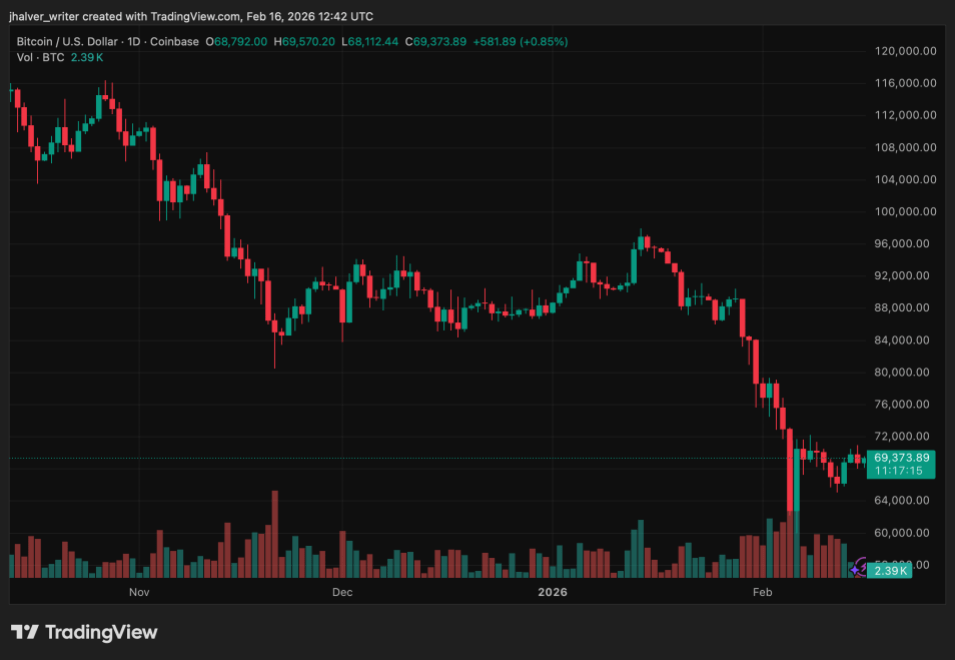
BTC's price trends to the downside on the daily chart. Source: BTCUSD on Tradingview

Retail Investors Buy the Dip During Market Volatility

Armstrong said platform data shows most retail customers now hold equal or greater amounts of Bitcoin and Ethereum than they did in December 2025. The figures track “native units,” meaning the number of coins held rather than their dollar value, indicating accumulation even as prices moved lower.

Bitcoin recently traded near $68,500, while Ethereum hovered around the $2,000 level after a period of declines and rebounds. According to Coinbase, many users responded to the pullback by adding to their positions rather than exiting the market.

The trend contrasts with earlier crypto cycles, when retail investors were often seen selling during sharp corrections. Analysts note that steady spot buying from smaller investors can help counterbalance volatility driven by derivatives markets, where leveraged positions frequently amplify price swings through liquidations.

Coinbase also reported that retail accumulation contributed to renewed activity on the platform, with its stock rising in recent sessions alongside increased trading interest in the two largest cryptocurrencies.

Executive Stock Sales Draw Attention

Armstrong’s praise for retail resilience has coincided with scrutiny over his own share sales. Regulatory filings show the CEO has sold more than $550 million worth of Coinbase stock between April 2025 and January 2026, including transactions exceeding $100 million in recent months.

The sales were executed under a prearranged Rule 10b5-1 trading plan, a mechanism commonly used by public-company executives to schedule stock disposals in advance.

Supporters argue that such plans are standard financial management tools, while critics say the scale of the sales sends mixed signals, encouraging retail investors to hold through volatility.

Similarly, Coinbase continues to navigate broader challenges, including regulatory disputes tied to new product expansions such as prediction markets in several U.S. states.

What Retail Resilience Means for Market Sentiment

Market analysts say sustained retail accumulation could play a stabilizing role if macro conditions improve. Historically, periods where smaller investors continue buying during downturns have sometimes preceded recovery phases in crypto cycles.

However, sentiment remains sensitive to interest rate expectations, geopolitical risks, and institutional flows. For Coinbase, the combination of strong retail engagement and ongoing insider selling highlights the complex balance between leadership messaging, investor perception, and market performance in a volatile environment.

Cover image from ChatGPT, BTCUSD chart from Tradingview

Пов'язані питання

QWhat does Brian Armstrong's praise of 'diamond hands' refer to in the context of Coinbase's recent report?

AIt refers to retail investors holding or accumulating major cryptocurrencies like Bitcoin and Ethereum despite recent market volatility and price declines, rather than selling their positions.

QHow does the current behavior of retail investors on Coinbase differ from previous crypto market downturns?

AUnlike previous cycles where retail investors often sold during sharp corrections, current data shows they are accumulating more coins or holding their ground, demonstrating increased resilience.

QWhat potential market impact does sustained retail accumulation have according to analysts?

AAnalysts suggest that steady spot buying from retail investors can help counterbalance volatility driven by derivatives markets and may play a stabilizing role if macroeconomic conditions improve, sometimes preceding recovery phases.

QWhat controversy has emerged alongside Armstrong's comments about retail investor behavior?

AArmstrong has faced scrutiny for selling over $550 million worth of Coinbase stock between April 2025 and January 2026 through prearranged trading plans, which some say sends mixed signals while encouraging retail investors to hold.

QWhat specific metric does Coinbase use to show retail accumulation despite price declines?

ACoinbase tracks 'native units' - the actual number of coins held by users - rather than dollar value, showing most retail customers hold equal or greater amounts of Bitcoin and Ethereum compared to December 2025 despite lower prices.

Пов'язані матеріали

Dan Koe: The Counterintuitive Truth—You Don't Need to Remember Everything You Read

Dan Koe: The Counterintuitive Truth — You Don't Need to Remember Everything You Read The central idea is that deliberately trying to remember information is often misguided. True learning isn't about memorizing facts but about having important knowledge surface naturally when needed through use. Most forgetting is normal, not a failure. The article reframes learning using a control theory framework—a four-step feedback loop: having a clear Goal, accurately Sensing your current state, Comparing the gap, and Acting to close it. Most learning stalls because people only do step 2 (blind input) without a goal to create the necessary "error signal" for focused action. The most effective method is to start with output, not input. Begin a meaningful personal project first, and learn only what's necessary to complete it. This project-driven, "just-in-time" learning ensures knowledge is contextual and retained. The concept of a "Second Brain" often fails because it becomes a digital graveyard—over-collected and under-utilized. The goal should be building a "Second Subconscious"—a dynamic system that proactively surfaces relevant ideas during creation, not a static storage vault. Tools like Obsidian+Claude or Eden can help by automating organization and enabling semantic search, but their value depends on linking knowledge to active projects. Ultimately, what matters is not what you store, but what you filter and internalize. Focus on ideas that shape your worldview, use projects as filters, and transform collected material through writing and sharing. AI should be used to reduce friction in research and editing, not to formulate your core views. In conclusion, remembering is a byproduct, not the goal. Knowledge that sticks comes from pursuing personal goals, applying it in real projects, and digesting it through creation. The tools are merely aids; the crucial step is to start doing meaningful work and let the necessary knowledge find you.

marsbit1 год тому

Dan Koe: The Counterintuitive Truth—You Don't Need to Remember Everything You Read

marsbit1 год тому

A New Era: The Fundamental Transformation of China's Entrepreneurs

A profound generational shift is underway among Chinese entrepreneurs. The wealth and influence once dominated by real estate and internet giants is now being claimed by a new wave of founders driving breakthroughs in AI, semiconductors, and robotics. This change is vividly reflected in 2026's wealth rankings. Figures like Zhang Yiming (ByteDance), Liang Wenfeng (DeepSeek), Chen Tianshi (Cambricon), and Wang Xingxing (Unitree Robotics) are ascending. Their wealth stems not from traditional business models but from market expectations for future technological competitiveness, with AI, chips, and smart hardware becoming the primary engines of wealth creation. Their common trait is a foundational focus on technology, often starting from the laboratory rather than a business plan. Examples include Chen Tianshi's decade-long push in AI chips, Liang Wenfeng's core algorithmic innovations at DeepSeek with a compact team, and Zhu Yiming's "no salary until profitable" 9-year journey to build Changxin Memory into a global DRAM player. This transition marks a fundamental shift in China's economic imperative: from commercial expansion and learning to indigenous innovation and deep industrial capability. While the previous generation built the foundational market and infrastructure, this new cohort is tasked with achieving global leadership in core technologies, moving China from "keeping pace" to pioneering original, breakthrough innovations that are industrialized at scale. The baton is being passed to those competing on the world stage through technological originality.

marsbit1 год тому

A New Era: The Fundamental Transformation of China's Entrepreneurs

marsbit1 год тому

Торгівля

Спот
活动图片