Brian Armstrong Praises ‘Diamond Hands’ as Coinbase Reports Strong Retail Activity

bitcoinistОпубліковано о 2026-02-17Востаннє оновлено о 2026-02-17

Анотація

Brian Armstrong, CEO of Coinbase, reports that retail investors are displaying "diamond hands" by continuing to accumulate Bitcoin and Ethereum despite recent market volatility. According to Coinbase data, most retail customers now hold equal or greater amounts of these cryptocurrencies in native units compared to December 2025, indicating accumulation during price declines. This behavior contrasts with previous cycles where retail often sold during corrections. Armstrong's comments come amid his own significant stock sales, totaling over $550 million since April 2025 under a prearranged trading plan. Analysts suggest sustained retail buying could stabilize markets, though sentiment remains sensitive to macro conditions and regulatory challenges.

Retail investors appear to be holding their ground through the latest wave of crypto market volatility, according to new data shared by Brian Armstrong, chief executive of Coinbase.

The exchange says many individual users have continued accumulating major cryptocurrencies despite price swings, a trend Armstrong described as evidence of “diamond hands.”

The remarks arrive at a time when digital asset markets remain uncertain, shaped by macroeconomic pressure, regulatory developments, and leveraged trading activity. While prices have fluctuated sharply, Coinbase’s internal metrics suggest retail traders are behaving differently compared to previous downturns.
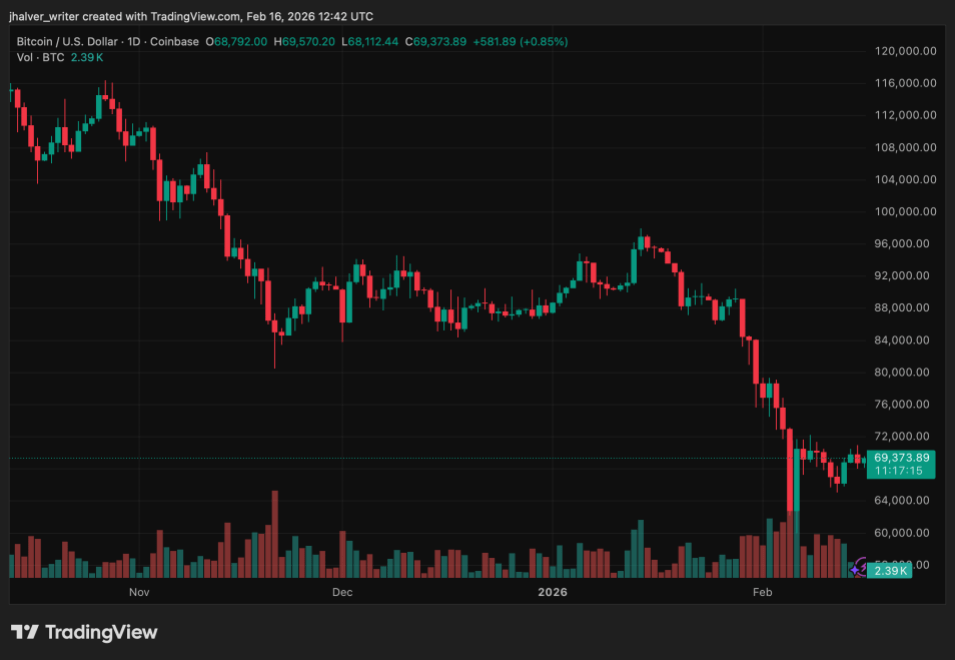
BTC's price trends to the downside on the daily chart. Source: BTCUSD on Tradingview

Retail Investors Buy the Dip During Market Volatility

Armstrong said platform data shows most retail customers now hold equal or greater amounts of Bitcoin and Ethereum than they did in December 2025. The figures track “native units,” meaning the number of coins held rather than their dollar value, indicating accumulation even as prices moved lower.

Bitcoin recently traded near $68,500, while Ethereum hovered around the $2,000 level after a period of declines and rebounds. According to Coinbase, many users responded to the pullback by adding to their positions rather than exiting the market.

The trend contrasts with earlier crypto cycles, when retail investors were often seen selling during sharp corrections. Analysts note that steady spot buying from smaller investors can help counterbalance volatility driven by derivatives markets, where leveraged positions frequently amplify price swings through liquidations.

Coinbase also reported that retail accumulation contributed to renewed activity on the platform, with its stock rising in recent sessions alongside increased trading interest in the two largest cryptocurrencies.

Executive Stock Sales Draw Attention

Armstrong’s praise for retail resilience has coincided with scrutiny over his own share sales. Regulatory filings show the CEO has sold more than $550 million worth of Coinbase stock between April 2025 and January 2026, including transactions exceeding $100 million in recent months.

The sales were executed under a prearranged Rule 10b5-1 trading plan, a mechanism commonly used by public-company executives to schedule stock disposals in advance.

Supporters argue that such plans are standard financial management tools, while critics say the scale of the sales sends mixed signals, encouraging retail investors to hold through volatility.

Similarly, Coinbase continues to navigate broader challenges, including regulatory disputes tied to new product expansions such as prediction markets in several U.S. states.

What Retail Resilience Means for Market Sentiment

Market analysts say sustained retail accumulation could play a stabilizing role if macro conditions improve. Historically, periods where smaller investors continue buying during downturns have sometimes preceded recovery phases in crypto cycles.

However, sentiment remains sensitive to interest rate expectations, geopolitical risks, and institutional flows. For Coinbase, the combination of strong retail engagement and ongoing insider selling highlights the complex balance between leadership messaging, investor perception, and market performance in a volatile environment.

Cover image from ChatGPT, BTCUSD chart from Tradingview

Пов'язані питання

QWhat does Brian Armstrong's praise of 'diamond hands' refer to in the context of Coinbase's recent report?

AIt refers to retail investors holding or accumulating major cryptocurrencies like Bitcoin and Ethereum despite recent market volatility and price declines, rather than selling their positions.

QHow does the current behavior of retail investors on Coinbase differ from previous crypto market downturns?

AUnlike previous cycles where retail investors often sold during sharp corrections, current data shows they are accumulating more coins or holding their ground, demonstrating increased resilience.

QWhat potential market impact does sustained retail accumulation have according to analysts?

AAnalysts suggest that steady spot buying from retail investors can help counterbalance volatility driven by derivatives markets and may play a stabilizing role if macroeconomic conditions improve, sometimes preceding recovery phases.

QWhat controversy has emerged alongside Armstrong's comments about retail investor behavior?

AArmstrong has faced scrutiny for selling over $550 million worth of Coinbase stock between April 2025 and January 2026 through prearranged trading plans, which some say sends mixed signals while encouraging retail investors to hold.

QWhat specific metric does Coinbase use to show retail accumulation despite price declines?

ACoinbase tracks 'native units' - the actual number of coins held by users - rather than dollar value, showing most retail customers hold equal or greater amounts of Bitcoin and Ethereum compared to December 2025 despite lower prices.

Пов'язані матеріали

How Many Tokens Away Is Yang Zhilin from the 'Moon Chasing the Light'?

The article explores the intense competition between two leading Chinese AI companies, DeepSeek and Kimi (Moon Dark Side), and the mounting pressure on Yang Zhilin, the founder of Kimi. While DeepSeek re-emerged after 15 months of silence with its powerful V4 model—boasting 1.6 trillion parameters and low-cost, long-context capabilities—Kimi has been focusing on long-context processing and multi-agent systems with its K2.6 model. Yang faces a threefold challenge: technological rivalry, commercialization pressure, and investor expectations. Despite Kimi’s high valuation (reaching $18 billion), its revenue heavily relies on a single product with low paid conversion rates, while DeepSeek’s strategic silence and open-source influence have strengthened its market position and valuation prospects, now targeting over $20 billion. Both companies reflect broader trends in China’s AI ecosystem: Kimi aims for global influence through open-source contributions and agent-based advancements, while DeepSeek prioritizes foundational innovation and hardware independence, notably shifting to Huawei’s chips. Their competition is seen as vital for China’s AI progress, with the gap between top Chinese and U.S. models narrowing to just 2.7% on the Elo rating scale. Ultimately, the article argues that this rivalry, though anxiety-inducing for leaders like Zhilin, is essential for driving innovation and solidifying China’s role in the global AI landscape.

marsbit1 год тому

How Many Tokens Away Is Yang Zhilin from the 'Moon Chasing the Light'?

marsbit1 год тому

TechFlow Intelligence Bureau: ChatGPT Helps Amateur Mathematician Crack 60-Year-Old Problem, CFTC Sues New York Regulator Over Coinbase and Gemini

An amateur mathematician, with the assistance of ChatGPT, has solved a combinatorial mathematics puzzle originally proposed by Hungarian mathematician Paul Erdős in the 1960s. This marks another milestone in AI-aided mathematical research, demonstrating the evolving capabilities of large language models in formal reasoning. In other AI developments, OpenAI introduced a new privacy filter tool for enterprise API usage, automatically screening sensitive data. Meanwhile, the Qwen3.6-27B model achieved 100 tokens per second on a single RTX 5090 GPU using quantization, significantly lowering the cost barrier for local AI deployment. In crypto and Web3, the U.S. CFTC sued New York’s financial regulator, challenging its oversight of Coinbase and Gemini—a first-of-its-kind federal-state regulatory clash. Following a vulnerability, KelpDAO and major DeFi protocols established a recovery fund. Tether froze $344 million in assets linked to Iran’s central bank upon U.S. Treasury request, highlighting the centralized control risks in stablecoins. Separately, Litecoin underwent a 3-hour chain reorganization to undo a privacy-layer exploit. In the U.S., former President Trump invoked the Defense Production Act to address power grid bottlenecks affecting AI data centers and dismissed the entire National Science Board, raising concerns over research independence. A retail trader gained 250% on a $600k Intel options bet amid AI-related speculation. Xiaomi announced its first performance electric vehicle, targeting rivals like Tesla. Meanwhile, iPhone users reported devices automatically reinstalling a hidden app daily, suspected to be MDM-related. A Chinese securities report noted that A-share institutional crowding has reached its second-longest streak since 2007, signaling high valuations and potential style rotation. The day’s developments reflect a dual narrative: AI is enabling unprecedented individual breakthroughs, while centralized power structures—whether governmental or corporate—are becoming more assertive, underscoring that decentralization is as much a political-economic challenge as a technical one.

marsbit1 год тому

TechFlow Intelligence Bureau: ChatGPT Helps Amateur Mathematician Crack 60-Year-Old Problem, CFTC Sues New York Regulator Over Coinbase and Gemini

marsbit1 год тому

Торгівля

Спот
Ф'ючерси
活动图片





