BREAKING: Mastercard Just Opened Its Global Payment Network To Crypto — Which Altcoins Made The Cut?

bitcoinistОпубліковано о 2026-06-03Востаннє оновлено о 2026-06-03

Анотація

Mastercard announced the expansion of its global settlement infrastructure to support on-chain settlement using regulated stablecoins. This enables card transactions to settle 24/7, eliminating delays from traditional banking hours. The initial rollout supports six stablecoins—USDC, PYUSD, USDG, USDP, RLUSD, and SoFiUSD—across eight blockchains, including Ethereum, Solana, and the XRP Ledger. The service is launching with partners in the U.S. and Latin America. This is a back-end settlement upgrade, not a consumer-facing change, allowing network partners to optionally use blockchain rails while traditional fiat settlement remains available.

Mastercard announced on June 3 that it will expand its global settlement infrastructure to support on-chain settlement using crypto via regulated stablecoins — enabling card transactions to settle 24 hours a day, seven days a week, across weekends and holidays for the first time in the network’s history, per the company’s official press release.

Six regulated crypto and stable coins are supported in the initial rollout: Circle’s USDC, PayPal’s PYUSD, Paxos-issued USDG and USDP, Ripple’s RLUSD, and SoFi’s SoFiUSD. Settlement will operate across eight blockchain networks — Ethereum, Solana, Polygon, Base, Arbitrum, the XRP Ledger, Canton, and Tempo — per the official announcement.

ARQ (formerly DolarApp), CBW Bank, Cross River, Lead Bank, and Nuvei are among the first partners to support stablecoin settlement optionality, with the initial rollout targeting the United States and Latin America before broader expansion through 2026.
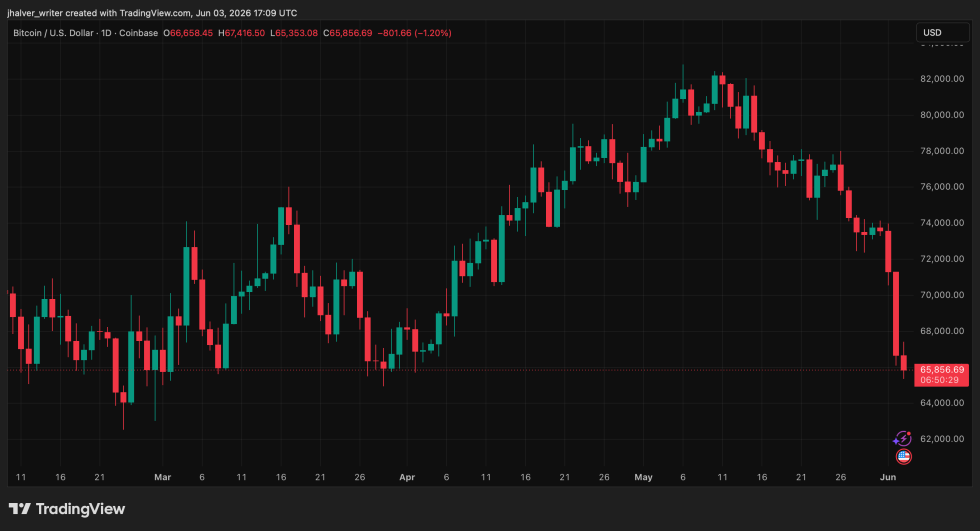
BTC's price trends to the downside on the daily chart. Source: BTCUSD on Tradingview

What Changes For Crypto — And What Doesn’t

The announcement is a settlement-layer development, not a consumer-facing product shift. Issuers and acquirers on Mastercard’s network can now choose to settle card-based transactions using regulated stablecoins on-chain rather than through traditional banking rails — or continue using existing fiat processes. Both options run in parallel. No cardholder needs to change how they pay.

What changes is the back-end infrastructure that clears and finalizes transactions between merchants, banks, and payment processors. That infrastructure can now operate on blockchain networks around the clock — removing the dead zones created by banking hours, weekend closures, and public holidays that have been a structural friction point in global payments for decades, per Mastercard’s press release.

Raj Dhamodharan, Mastercard’s Executive Vice President for Blockchain and Digital Assets, described the enhancement as expanding how partners manage liquidity while operating in an always-on digital economy, per the announcement. Ripple SVP Jack McDonald called it a landmark validation that blockchain technology is ready for the world’s most critical payment infrastructure, per Benzinga’s reporting of his statement.

This development marks a pivotal and historic moment for the nascent sector. The world’s second-largest card network opening its global settlement rails to six regulated stablecoins across eight blockchains — not as a pilot, not as a proof of concept, but as a live network-level enhancement — is the clearest institutional validation the stablecoin economy has received to date.

Cover image from Grok, BTCUSD chart from Tradingview

Пов'язані питання

QWhat major announcement did Mastercard make on June 3 regarding its payment network?

AMastercard announced it is expanding its global settlement infrastructure to support on-chain settlement using regulated stablecoins, enabling card transactions to be settled 24/7 for the first time in the network's history.

QWhich six regulated stablecoins are supported in the initial rollout of Mastercard's new settlement system?

AThe six supported stablecoins are Circle's USDC, PayPal's PYUSD, Paxos-issued USDG and USDP, Ripple's RLUSD, and SoFi's SoFiUSD.

QHow many and which blockchain networks will this settlement system operate across according to the announcement?

ASettlement will operate across eight blockchain networks: Ethereum, Solana, Polygon, Base, Arbitrum, the XRP Ledger, Canton, and Tempo.

QWho are among the first partners to support stablecoin settlement optionality with Mastercard?

AThe first partners include ARQ (formerly DolarApp), CBW Bank, Cross River, Lead Bank, and Nuvei.

QWhat is the key difference this announcement makes for crypto transactions on Mastercard's network?

AThe announcement is a settlement-layer development, not a consumer-facing change. Issuers and acquirers can now choose to settle card transactions using regulated stablecoins on-chain, operating 24/7, instead of or alongside traditional banking rails. Cardholders' payment methods do not change.

Пов'язані матеріали

On-Chain Figures on the Eve of Kickoff: 1.6 Billion Traded Before the World Cup Even Begins

"On-Chain Numbers on the Eve of the World Cup: $1.6 Billion Traded Before Kick-off" Analysis of on-chain markets before the 2026 FIFA World Cup reveals significant crypto integration into football. The most striking figure is the approximately **$1.6 billion** in total trading volume on the single "World Cup Winner" contract on the Polymarket prediction market platform, accumulated before a single match was played. This represents explosive growth for a sector whose annual volume surged from ~$16B in 2024 to ~$64B in 2025. The ecosystem is maturing beyond speculation. Key developments include: 1) **Infrastructure upgrades** like Polymarket's migration to native, regulated USDC stablecoin for settlements; 2) **Reliable data oracles**, such as Chainlink, being used to resolve real-world match outcomes on-chain; and 3) **Official recognition**, with FIFA appointing its first-ever "Prediction Markets" partner. Over 100 contracts now cover everything from the outright winner to individual match results and even non-sporting risks like venue relocation. This evolution marks a fundamental shift. While crypto firms are absent from FIFA's top-tier sponsor list, the technology has deeply penetrated the tournament's financial and predictive infrastructure through regulated stablecoin settlements, decentralized oracles, and new official partnership categories. The regulatory landscape remains complex and varies by jurisdiction, but on-chain markets for the World Cup are already a multi-billion-dollar reality.

marsbit10 хв тому

On-Chain Figures on the Eve of Kickoff: 1.6 Billion Traded Before the World Cup Even Begins

marsbit10 хв тому

From SpaceX's IPO to the Future of Crypto: Which Crypto Sectors Will Host the Trillion-Dollar Narrative?

From the SpaceX IPO, which targets a $750 billion raise at a $1.77 trillion valuation, we can extrapolate capital flow trends relevant to crypto. The focus shifts from speculative narratives to foundational infrastructure and real-world asset (RWA) integration. Key crypto sectors poised to benefit include: 1. **AI Infrastructure**: The narrative is moving from consumer-facing AI applications to underlying, scarce resources like compute power and decentralized GPU networks (e.g., TAO, RENDER, AKT, IO). These protocols are positioning as the essential "picks and shovels" providers for the AI economy. 2. **Real-World Assets (RWA)**: Beyond tokenized treasury bonds, RWA's future lies in on-chain equity and pre-IPO assets like SpaceX. This could democratize access to high-growth assets and reshape global capital flows, benefiting infrastructure projects like ONDO, LINK, and Plume that facilitate issuance, data, and liquidity. 3. **Core Financial Infrastructure**: Stablecoins, payment networks, and DePIN (Decentralized Physical Infrastructure Networks) are critical for settling the future on-chain economy. Their role expands from internal trading tools to foundational layers for global finance, AI systems, and real-world asset networks, leading to potential value reassessment. In summary, the next cycle may prioritize long-term infrastructure value—AI compute, asset tokenization networks, and settlement layers—over short-lived application hype, mirroring the broader market's shift towards funding the foundational systems of the future.

marsbit31 хв тому

From SpaceX's IPO to the Future of Crypto: Which Crypto Sectors Will Host the Trillion-Dollar Narrative?

marsbit31 хв тому

Tech Stocks Plunge and Bitcoin Slumps, Retail Investors Face Ultimate Test Ahead of SpaceX IPO

Technology stocks suffered their biggest drop in months, and Bitcoin fell below the $60,000 mark, coinciding with the eve of SpaceX's massive IPO plans. The sell-off was triggered by strong U.S. jobs data, dashing hopes for Fed rate cuts and reviving fears of further hikes. High-valuation sectors like AI and semiconductors led the declines, with the Nasdaq plunging over 4%. Cryptocurrencies, sensitive to higher interest rates and a strong dollar, also tumbled sharply. This market stress test raises critical questions about the limits of retail investor capital and its next destination. SpaceX's upcoming IPO, which plans to allocate an unusually high 30% of shares to retail investors, now faces a more uncertain landscape. Analysts warn that to buy SpaceX,散户 may need to sell existing holdings, with Tesla seen as a potential source of funds. The market is saturated with speculative options—from crypto and meme stocks to zero-day options and AI-themed ETFs—all competing for the same pool of retail attention and capital. While SpaceX's listing could inject fresh excitement, it also enters a fiercely competitive environment where investor loyalty is fleeting. The ease of zero-commission trading and lower barriers to margin trading accelerate capital rotation between narratives, making it difficult for any single story, even a historic IPO like SpaceX's, to dominate for long.

华尔街日报1 год тому

Tech Stocks Plunge and Bitcoin Slumps, Retail Investors Face Ultimate Test Ahead of SpaceX IPO

华尔街日报1 год тому

Торгівля

Спот
Ф'ючерси
活动图片