Breaking: Alibaba Bans Claude Entirely, Mandatory Uninstallation Effective July 10th

marsbitОпубліковано о 2026-07-03Востаннє оновлено о 2026-07-03

Анотація

Alibaba has issued an internal notice to completely ban the use of Claude and all other Anthropic products, effective July 10. The decision follows the discovery of a covert user detection mechanism in Claude Code, starting from version 2.1.91 released in April 2026. The mechanism reportedly operated in three steps: secretly identifying users in China by checking system time zones and proxy/API addresses for keywords related to major Chinese tech and AI firms; silently tagging these users by subtly altering date formats and characters in system prompts to encode status information; and transmitting this modified data back to Anthropic's servers with normal requests. This code was intentionally obfuscated and not mentioned in update logs. Anthropic has acknowledged this "experimental" feature and claims to have removed it in a July 2 update. However, the breach of trust, coupled with a recent wave of account bans for Chinese users—often without refunds—prompted Alibaba's decisive action. The company will promote its self-developed Qoder as an alternative. This move signifies a major shift for Chinese tech giants, from actively adopting powerful external AI tools to prioritizing security and control over core business operations.

Just moments ago, Alibaba issued an internal notice—a complete ban on Claude, officially effective July 10th!

The entire suite, including Sonnet, Opus, Fable, and even the popular Claude Code—all Anthropic products—are blacklisted. Not a single one is allowed to remain on employee computers.

It is reported that due to recently exposed security risks involving implanted backdoors in Claude Code, Alibaba has comprehensively assessed the situation and added it to the high-risk software list, recommending the self-developed Qoder as an alternative.

Earlier this year, to promote AI internally, Alibaba not only provided free quotas for its self-developed models but also offered substantial reimbursement for employee expenses on external models.

Many programmers were burning hundreds of dollars weekly on Claude, GPT, and Gemini.

Claude Code Hides a "Stealth Trojan"

What solidified Alibaba's decision was security.

A few days ago, reverse engineering analysis in the developer community revealed: Starting from version 2.1.91 released in April 2026, Claude Code has included a hidden user detection mechanism.
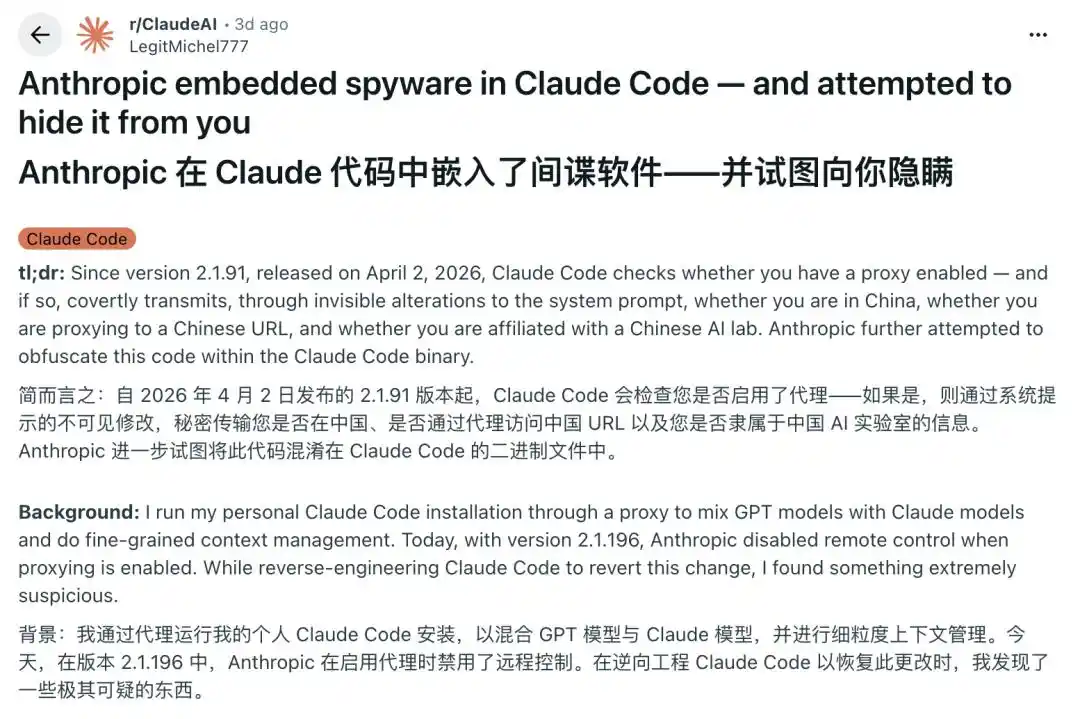
In simple terms, this mechanism does three things—

Step one, quietly checking who you are. It reads your computer's system timezone to see if it's Asia/Shanghai or Asia/Urumqi.

Simultaneously, it checks your proxy address or custom API for keywords related to Chinese cloud providers and AI companies like Alibaba, ByteDance, Baidu, Moonshot AI, and MiniMax.

Step two, tagging you covertly. If a match is found, it won't notify you with a pop-up. Instead, it stealthily alters the system prompt: changing the date format from "2026-06-30" to "2026/06/30".

It replaces the apostrophe in "Today's date is" with Unicode characters that are visually indistinguishable—right single quotation mark (’), modifier letter apostrophe (ʼ), modifier letter prime (ʹ), corresponding to three statuses: "Matched Chinese domain but not AI lab", "Associated with Chinese AI lab", and "Matched both".

Step three, quietly sending it back. These tampered prompts are sent to Anthropic's servers along with your every normal request.

What the user sees is just a normal date; what the server sees is an additional layer of environmental fingerprinting.

What's more unsettling is that this detection code itself was deliberately hidden—the core logic is encrypted and obfuscated, a list of 147 monitored domains is password-protected, and it's never mentioned in the version update logs.

In other words, Anthropic not only did it secretly but also took special care to prevent discovery.

A tool installed on your computer, with filesystem and shell execution permissions, secretly marks and signals your identity, hiding for over two months from deployment until exposure.

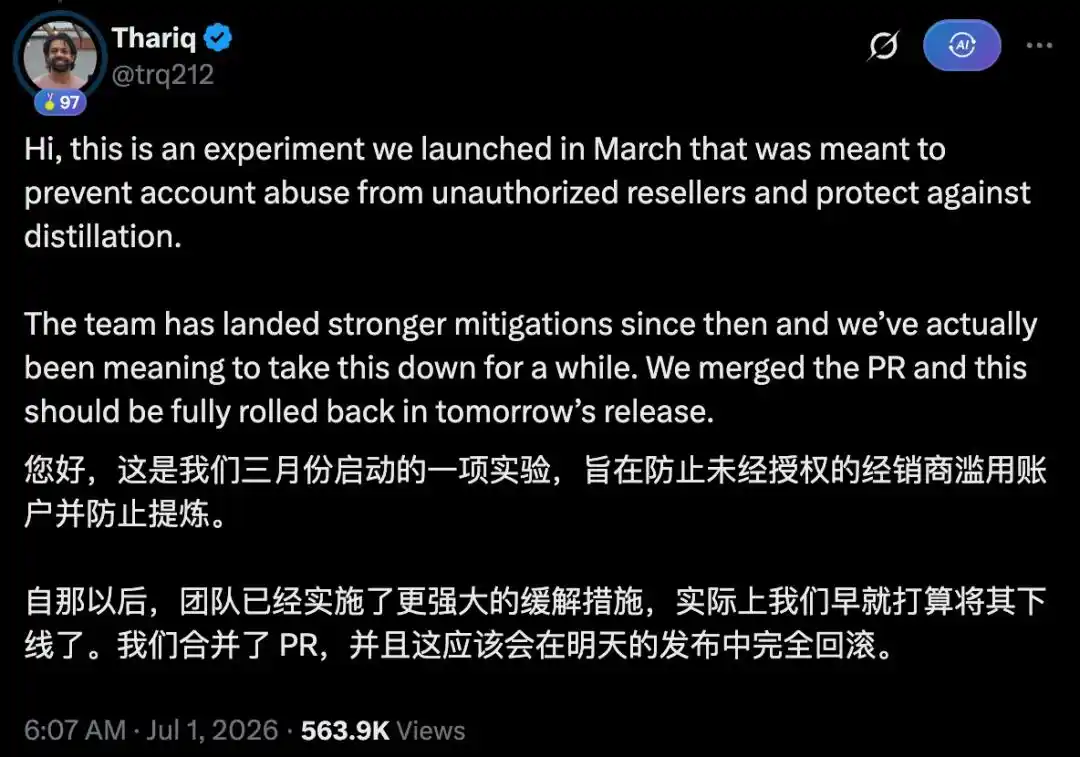
Afterwards, Anthropic Claude Code team member Thariq Shihipar publicly acknowledged this "experimental" measure, stating it was rolled back and removed in the new version released on July 2nd.
For a company that entrusts its most critical engineering code to Claude Code, this is a collapse of trust.

You open up your entire code repository, development environment, and internal logic to it, and it's secretly concerned with who you are, where you're from, and who you're connected to.

Trust, once cracked, cannot be mended by even the strongest model.

Ban Wave Adds Fuel to the Fire

Around the same time this hidden mechanism was exposed, Anthropic launched a new wave of large-scale account bans.

In recent days, a significant number of Chinese users were abruptly locked out, with both personal subscriptions and team accounts affected.

Even more frustratingly, many accounts that paid directly through the official website received no refunds after being deemed non-compliant, with appeal success rates practically zero.

From "Begging to Use" to "Company-Wide Ban"

For the past two years, it was Chinese developers queuing up to "beg to use" Claude: scrambling for quotas, finding relays, enduring the constant risk of bans, all to access that "world's best".

Now, one of China's largest tech companies is the first to decisively show Claude the door.

The once-treasured tool, once used with reimbursement, is now high-risk software. The roles of giver and receiver have been reversed for the first time.

This also signals that leading Chinese tech companies are shifting their attitude towards "building core business on others' closed-source tools" from "borrowing what's available" to "security first".

It's not about not wanting good tools; it's that good tools must also withstand scrutiny.

There are countless tools for writing code, but one principle holds true: Only the tools you can trust in your own hands are truly unremovable.

This article is from the WeChat public account "New Zhiyuan", author: New Zhiyuan

Пов'язані питання

QWhat is the main action that Alibaba is taking regarding Claude's products, and when is it effective?

AAlibaba is implementing a comprehensive ban on all Claude products, including Sonnet, Opus, Fable, and Claude Code. The ban is set to officially take effect on July 10th, requiring all employee computers to have the software uninstalled.

QWhat specific security risk prompted Alibaba to ban Claude Code?

AThe ban was prompted by the discovery that Claude Code, starting from version 2.1.91 released in April 2026, contained a covert user detection mechanism. This mechanism secretly identified users from China, tagged them with hidden markers using modified Unicode characters in prompts, and transmitted this data back to Anthropic's servers without user knowledge.

QHow did Anthropic respond to the discovery of the hidden detection mechanism in Claude Code?

AAnthropic's Claude Code team member, Thariq Shihipar, publicly acknowledged the 'experimental' measure. The company stated it had rolled back and removed the feature in a new version released on July 2nd.

QWhat does Alibaba's decision to ban Claude signal about the approach of major Chinese tech companies towards foreign AI tools?

AAlibaba's decision signals a strategic shift from a 'borrowing approach' to a 'security-first' mentality. It indicates that leading Chinese tech companies are becoming more cautious about building core business operations on closed-source, foreign-developed tools, prioritizing security and trustworthiness over perceived performance advantages.

QWhat alternative solution does Alibaba offer to its employees after banning Claude products?

AFollowing the ban on Claude products, Alibaba recommends its employees use the company's self-developed AI coding tool, Qoder, as an alternative solution.

Пов'язані матеріали

Bitcoin Withdrawals Continue: 8 Years of Storage in a Coldcard Cold Wallet Ended in Zero

Coldcard Hardware Wallet Hacked: Losses Mount Due to Vulnerable Seed Generation A critical vulnerability in Coldcard hardware wallets has led to a continued wave of fund thefts. According to Galaxy Research, the total stolen has reached 1,367.05 BTC (approx. $88.6 million) from 4,585 addresses, a significant increase from the initial 594.5 BTC reported on July 30, 2026. Most of the stolen funds remain on the attackers' addresses. The issue is not with the current firmware, which Coinkite has updated, but with seed phrases generated on vulnerable devices between March 2021 and the release of fixed firmware versions. Due to a programmer error, devices switched from using a hardware random number generator to the software-based Yasmarang generator, which was initialized with publicly accessible data like the chip's serial number. This made the seed phrases predictable through offline brute-force attacks, meaning wallets remain at risk until funds are moved to a new wallet generated with the patched firmware. Affected devices include Mk2/Mk3 with firmware 4.0.1–4.1.9 (and up to 5.0.3), Mk4/Mk5 up to version 5.6.0, and Q models up to 1.5.0Q. The only exceptions are seeds created with a high-entropy method like at least 50 independent dice rolls or a strong unique BIP-39 passphrase. All other owners must generate a new seed on the fixed firmware and transfer their assets. A case highlighting the human impact involves a 39-year-old long-term investor who lost 2 BTC (approx. $130,000) in minutes. He had accumulated the Bitcoin over eight years through physical labor, viewing it as a financial lifeline and a retirement plan in a country suffering from hyperinflation. His story underscores that even conservative "buy and hold in cold storage" strategies can be compromised by such underlying technical flaws. From a technical perspective, this incident echoes historical failures where weak random number generators undermined cryptographic security, challenging the assumption that offline storage is automatically foolproof.

cryptonews.ru1 год тому

Bitcoin Withdrawals Continue: 8 Years of Storage in a Coldcard Cold Wallet Ended in Zero

cryptonews.ru1 год тому

Торгівля

Спот
活动图片





