"Bond Market Storm" Sweeps Across US, Europe, and Japan, Long-term Bond Yields Approach Decades-high

marsbitОпубліковано о 2026-08-19Востаннє оновлено о 2026-08-19

Анотація

A severe bond market selloff is sweeping the US, Europe, and Japan, driving long-term government bond yields to multi-decade highs. The US 30-year yield hit 5.33%, its highest since 2007, while yields in France, Germany, the UK, and Japan have also surged to levels not seen in over a decade. The Bloomberg global investment-grade sovereign bond index yield has risen to a record 4.5%. This global selloff is driven by structural forces: persistent geopolitical tensions fueling inflation risks, loosening fiscal discipline from governments, and a systematic withdrawal of traditional long-term bond buyers like pension funds. Crucially, the yield surge is primarily driven by rising real yields, not inflation expectations, indicating investors demand higher compensation for holding long-dated debt. The spike in borrowing costs is creating significant political pressure, particularly for the US administration ahead of the midterm elections, as high public debt interest payments exacerbate budget deficits. While some investors see value emerging in long-duration bonds, others remain cautious, noting that only an economic downturn or external shock might alter the current trajectory of rising yields.

Author: Dong Jing, Wall Street Insights

The global sovereign bond market is experiencing its most intense selling wave in decades, with long-end yields climbing relentlessly under the triple pressure of inflation concerns, fiscal expansion, and structurally shrinking demand, leading to a sharp increase in governments' financing costs.

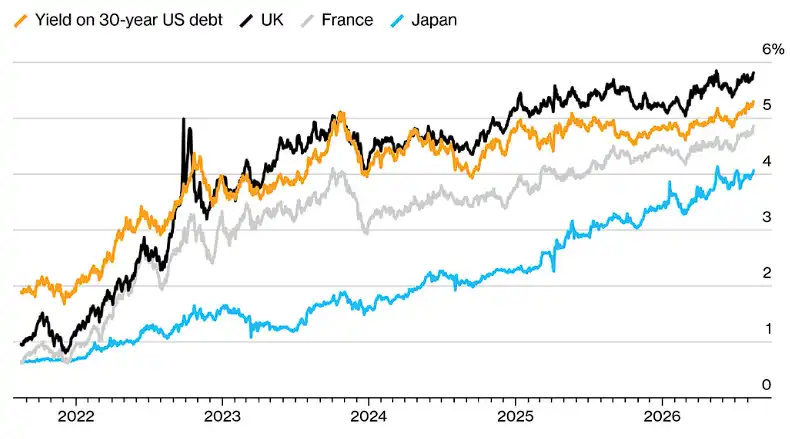
The yield on the US 30-year Treasury note touched 5.33% this week, its highest level since 2007; the yield on the same-maturity French government bond rose to a peak not seen since 2008; the German 30-year bond yield returned to its 2011 level; the UK's equivalent gilt yield approached 6%; while Japan's 30-year government bond yield climbed to its highest since 1999.
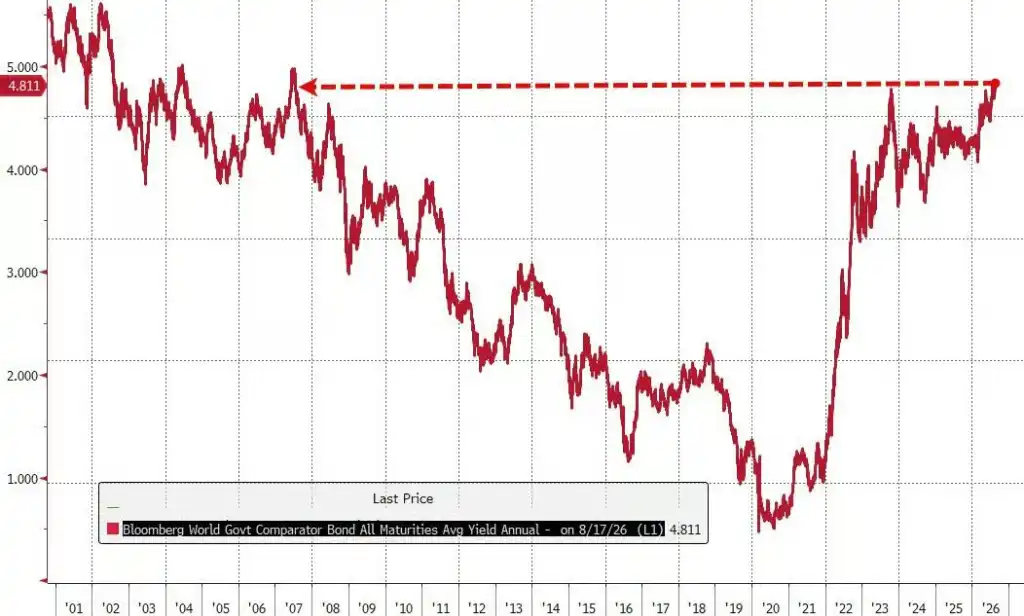
As reported by Wall Street Insights, the composite yield for global government bonds has returned to 2007 levels. Additionally, data compiled by Bloomberg shows that the average yield of a benchmark portfolio of investment-grade sovereign bonds has soared to around 4.5%, the highest since records began in 2015.
This wave of selling is not an isolated event in a single market but is driven by global structural forces—persistent geopolitical turmoil exacerbating supply shocks and inflation risks, lax fiscal discipline among governments, and a systematic shrinkage in demand from traditional long-term bond buyers. Analysis indicates that this signals a rewriting of the pricing logic for long-term fixed-income assets; for the Trump administration, the high financing costs have already become a political pressure point ahead of the midterm elections.

US Treasury Yields Surge Across the Curve, Long End Bears the Brunt

The epicenter of this bond market storm lies at the long end. Since the end of June, the yield on the US 30-year Treasury has risen by nearly 40 basis points cumulatively. After touching 5.33% during Tuesday's session, it retreated slightly to 5.28%, but remains near its highest level in nearly two decades.

Long-dated bonds are leading the decline due to their higher sensitivity to risk factors such as inflation. Justin Onuekwusi, Chief Investment Officer at St. James's Place, stated:

"The signal the market is sending is: we expect inflation to be higher in the future, or at least more uncertain, therefore we require a higher yield to hold long-term bonds."

Skylar Montgomery Koning, a Bloomberg macro strategist, pointed out a key difference in this structural rise in yields: deficit expansion is occurring against a backdrop where the economy is not significantly weakening.

"Typically, deficit widening coincides with a softening economy, leading policy rates lower and providing a cushion for the bond market. However, pro-cyclical fiscal expansion now means governments are borrowing more when rates are already elevated, pushing yields even higher."

Europe and Japan Under Simultaneous Pressure, Financing Costs Hit Multi-year Highs in Multiple Countries

European bond markets are similarly affected. The yield on France's 30-year government bond has risen to its highest since 2008, with investors eyeing political uncertainties stemming from the 2027 budget negotiations and next year's presidential election.

According to a Bloomberg report, people familiar with the matter said Germany sold 30-year bonds via a syndicate on Tuesday, paying its highest rate in 15 years.

In Japan, although absolute yield levels remain lower than other major markets, the upward momentum for the 30-year government bond yield is equally persistent and strong, having climbed to its highest since 1999.

Faced with the sharp rise in long-term financing costs, some countries have begun adjusting their bond issuance strategies, shifting towards shorter maturities.

UK authorities have suspended most of their planned long-dated bond issuance. However, governments have limited room to maneuver—in the new environment where they can no longer lock in financing costs for decades at ultra-low rates, policy options have significantly narrowed.

For the Trump administration, the persistent rise in long-term bond yields is no longer just a market issue but a political liability. The high government financing costs are transmitting to corporate loans and consumer credit, creating noticeable pressure ahead of the midterm elections.

Interest payments on US public debt have consistently been a core driver of budget deficit expansion. So far this fiscal year, interest expense has totaled $1.17 trillion, a 15% year-on-year increase, partly due to the rise in Treasury yields. The US annual deficit is approaching $2 trillion, with the national debt total nearing the $40 trillion mark.

Chris Iggo, formerly Chief Investment Officer at AXA IM Core and now at BNP Paribas Asset Management, stated:

"The November election may bring more policy risks and will keep markets highly focused on fiscal issues ahead of the usual budget season. Ideally, no one wants to face rising mortgage rates just before an important election cycle, even if current rates remain below their 2023 levels."

Led by Ed Yardeni, the strategist team at Yardeni Research said on Tuesday there's no reason to panic about the US bond market yet, "We're not pushing the panic button, but we are watching closely to see if the bond vigilantes will."

Dual Supply-Demand Imbalance, Real Yields Become Main Driver

It is noteworthy that although inflation concerns are an important backdrop to this sell-off, the long-end breakeven inflation rates—market indicators for future inflation expectations—in most major markets have remained relatively stable overall. The rise in yields has been primarily driven by real yields, the additional return investors demand above inflation compensation for holding the bonds.

On the supply side, long-term bond issuance by technology companies to finance artificial intelligence investments has further exacerbated long-end supply pressure. A recent example is Alphabet Inc., Google's parent company, deciding to issue its first-ever A$5 billion (approximately $3.6 billion) bond in the Australian bond market.

On the demand side, traditional long-term bond buyers are systematically retreating. Institutions such as pension funds have historically been a stable source of demand for long-term bonds, but this demand pillar is eroding as defined-benefit pension plans decline and regulatory policies steer more capital toward stocks. Meanwhile, governments are expanding their bond issuance, increasingly relying on price-sensitive private investors to absorb the supply.

The minutes from the Federal Reserve's June meeting show officials have discussed changes in the ownership structure of Treasury securities—ownership is shifting from "official sectors that are relatively price-insensitive" to "private investors that are more price-sensitive," a shift that could push up term premiums. Anshul Pradhan, Head of US Rates Strategy at Barclays, noted that this change in buyer structure over the past decade has contributed to an increase of about 90 basis points in the term premium of 30-year US Treasuries.

Faced with the ongoing rise in yields, institutional investors hold differing views on the market outlook.

Kelsey Berro, a Portfolio Manager at J.P. Morgan Asset Management, believes the current repricing offers a potentially attractive entry window for new capital. "We see more value at the long end, particularly in real yields," she said.

However, AXA's Iggo is more cautious:

"It's hard to judge what level yields need to reach to truly improve the total return outlook for long-duration fixed-income assets. The only thing that could change this picture is a sudden deterioration in economic data or some external shock—and the latter seems more likely than the former."


Пов'язані питання

QWhat are the three key drivers behind the recent sharp sell-off in global sovereign bond markets, as mentioned in the article?

AThe three key drivers are concerns over inflation, fiscal expansion by governments, and a structural shrinkage in demand for long-term bonds.

QAccording to the article, which country's long-term bond yield has reached its highest level since 2007, and what is the specific yield mentioned?

AThe US 30-year Treasury bond yield has reached its highest level since 2007, with a mentioned specific yield of 5.33%.

QWhat is identified as the main driver pushing bond yields higher in most major markets, rather than inflation expectations?

AThe main driver pushing yields higher is the rise in real yields, which is the extra return investors demand above inflation compensation, while breakeven inflation rates have remained relatively stable.

QWhat specific change in the investor base for US Treasuries does the Federal Reserve's June meeting minutes discuss, and what is its potential impact according to Barclays?

AThe minutes discuss a shift in holders from 'price-insensitive official sectors' to 'more price-sensitive private investors.' According to Barclays, this change over the past decade has added about 90 basis points to the term premium for the 30-year US Treasury.

QWhat political challenge does the persistently high bond yield pose for the Trump administration, according to the analysis in the article?

AThe persistently high government borrowing costs are translating into higher costs for corporate loans and consumer credit, creating a significant political pressure point ahead of the midterm elections.

Пов'язані матеріали

Token Economy Surges, Have Ordinary People Got a Slice of the Pie?

Token Frenzy: Is the Average Person Getting a Piece of the Pie? As AI adoption soars in China, daily Token consumption—the basic unit for AI text processing—has skyrocketed, exceeding 140 trillion. This "Token economy" is often measured like GDP, touted as a sign of progress. However, this metric primarily reflects supply-side activities: corporate investment, infrastructure scaling, and platform revenues. The crucial question of whether this growth translates into tangible benefits for ordinary citizens—higher wages, better jobs, improved public services, or increased leisure—remains largely unanswered. The article argues there's a fundamental mismatch. Policy, exemplified by subsidies in Beijing's Yizhuang district, often stimulates "demand" by incentivizing companies to consume more Tokens (an intermediate business cost), rather than by boosting household income or final consumer spending. This creates a closed loop where growth in Token usage justifies further production capacity expansion, without necessarily extending value to the broader population. Several disconnects are highlighted. High Token usage doesn't equal completed tasks, increased profits, or macroeconomic productivity gains. Even when corporate efficiency improves, the benefits may not trickle down due to existing economic structures favoring investment over household consumption. The risk is that AI, a genuinely productive technology, becomes another tool for supply-side expansion within a system adept at measuring output (like server capacity and call volumes) but less focused on distributing the gains widely. Drawing a parallel to Henry Ford's assembly line, the piece notes that Ford's revolution combined ruthless production efficiency with a social compact (higher wages, stability) that enabled mass consumption. Today's "Token economy" narrative enthusiastically champions the first part—process re-engineering and cost reduction—but lacks a credible mechanism for the second: ensuring that productivity gains lead to broader societal welfare. The ultimate challenge is not whether Tokens have value, but whether their economic benefits can escape a system that excels at building supply but struggles to cultivate its own demand.

marsbit16 хв тому

Token Economy Surges, Have Ordinary People Got a Slice of the Pie?

marsbit16 хв тому

Overnight Global Shock: Why Did AI Stocks Plunge Across the Board?

Overnight, U.S. AI-related stocks fell sharply, with the Nasdaq down 1.33% and the Philadelphia Semiconductor Index plunging nearly 5%. Panic spread globally, dragging down Asia-Pacific markets. Key negative drivers included: 1. **Geopolitical Tension & Macro Pressure:** Escalating U.S.-Iran tensions pushed oil prices higher, fueling inflation fears and expectations of prolonged high interest rates. Rising bond yields pressured high-valuation, capital-intensive AI stocks, especially as soaring AI infrastructure financing costs became evident. 2. **AI Commercialization Concerns:** OpenAI's Q2 results showed slowing revenue growth and widening losses, dampening market optimism about near-term AI application profitability. This shifted investor focus from pure capital expenditure narratives to actual commercial returns. 3. **Supply Chain Uncertainty:** U.S.-South Korea semiconductor investment disputes intensified. Market fears that Korean memory giants (Samsung, SK Hynix) face a dilemma—either divert capital to costly U.S. production or risk trade barriers—disrupted the critical HBM memory sector, amplifying sell-offs via leveraged ETFs. While long-term AI demand remains, the market is now scrutinizing real profitability, financing costs, and supply chain stability rather than paying premiums for unchecked growth stories. For markets like China's A-shares, the impact is primarily sentiment-driven, requiring distinction between short-term panic and fundamental deterioration.

marsbit17 хв тому

Overnight Global Shock: Why Did AI Stocks Plunge Across the Board?

marsbit17 хв тому

Q2 Wall Street Institutional Crypto Holdings: Most Institutions Increased Positions Against the Trend, ETH Exposure Outperformed BTC Across the Board

In Q2 2024, despite a roughly 14.2% decline in Bitcoin's price, many Wall Street institutions increased their crypto holdings, revealing a divergence from ETF flow trends. Overall institutional Bitcoin exposure grew by 7.5% to ~536k BTC, while aggregate spot Bitcoin ETF holdings declined. Notably, exposure concentration increased, with fewer reporting institutions holding larger positions. A key trend was the significant outperformance of Ethereum (ETH) exposure growth over Bitcoin (BTC) among major banks. For instance, JPMorgan's ETH exposure surged 67.3% versus 12.2% for BTC, and Morgan Stanley's ETH exposure grew 18.6% versus 3.7%. Individual bank holdings of Ethereum ETFs like ETHA saw dramatic increases, even as the overall Ethereum ETF market experienced net outflows during the quarter. Trading firms like Jane Street significantly rebuilt its iShares Bitcoin Trust (IBIT) position, while several hedge funds, including Brevan Howard and Graham Capital, reduced spot ETF holdings but added substantial option positions (both calls and puts), indicating more complex strategies. Institutions showed diverging views on crypto-related equities: some sold shares of MicroStrategy (MSTR) after its announced Bitcoin sales, while others like Renaissance Technologies and BlackRock were buyers. New entrants like Spain's Santander Bank disclosed initial crypto ETF positions. Meanwhile, long-term holders like Abu Dhabi's sovereign wealth funds paused their accumulation, and Harvard's endowment maintained a flat Bitcoin position. Key signals include the deepening institutionalization of crypto assets, a clear institutional preference for accumulating Ethereum, and growing divergence in views on crypto equities. This institutional buying in Q2 preceded a price recovery and renewed inflows into Ethereum ETFs in July and August.

marsbit35 хв тому

Q2 Wall Street Institutional Crypto Holdings: Most Institutions Increased Positions Against the Trend, ETH Exposure Outperformed BTC Across the Board

marsbit35 хв тому

TSMC, Another Winning Bet

TSMC Gains Another Strategic Advantage as Samsung Delays 1.4nm Process Samsung Foundry has adjusted its advanced process roadmap, postponing the mass production timeline for its 1.4nm process from 2027 to 2029. This two-year delay signals a strategic shift from aggressively pursuing the next node to focusing on maturing and scaling its 2nm platform. Samsung plans to extend the commercial lifespan of its 2nm technology through derivative versions optimized for different applications, including those incorporating backside power delivery for AI and HPC chips. A notable aspect of this shift is Samsung's cautious approach toward High-NA EUV lithography. The company views it as essential for 1nm-class nodes and beyond but not as an immediate necessity for 1.4nm, opting instead to refine its existing Low-NA EUV-based processes. This highlights a broader industry trend where the competition is evolving beyond simply reaching the next node. Success now depends on achieving high yield, managing soaring costs, integrating new transistor architectures like GAA, and delivering a compelling overall package of performance, power efficiency, and area (PPA) at a viable cost. While Samsung consolidates its 2nm efforts, TSMC continues its advance. Its N2 node is in production, and the A16 node (post-2nm, ~1.6nm) is scheduled for mass production in the second half of 2026. A16 introduces TSMC's Super Power Rail backside power delivery technology, which is expected to deliver significant performance and power efficiency gains. TSMC's previously stated cautious stance on High-NA EUV appears validated by Samsung's roadmap adjustment. The delay underscores that the competition in leading-edge semiconductor manufacturing is entering a new phase. It is no longer just a race to smaller node numbers but a multifaceted contest involving process maturity, yield, cost, design-technology co-optimization (DTCO), and advanced packaging. Samsung aims to solidify its 2nm platform over the next three years. However, as it targets 1.4nm for 2029, the industry will be watching how far ahead TSMC and Intel have moved by then.

marsbit41 хв тому

TSMC, Another Winning Bet

marsbit41 хв тому

Торгівля

Спот
活动图片