BNY Partners with Key Companies to Expand Crypto Custody in the UAE

bitcoinistОпубліковано о 2026-05-08Востаннє оновлено о 2026-05-08

Анотація

BNY, the world's largest custodian bank, has announced a strategic collaboration with Finstreet Limited and ADI Foundation to establish regulated, institutional-grade digital asset custody infrastructure in the Abu Dhabi Global Market (ADGM). This marks the first time a U.S. global systemically important bank has introduced crypto custody services to the UAE. The initiative will begin with Bitcoin and Ethereum custody, with plans to expand into stablecoins, tokenized assets, and other regulated digital instruments, subject to final agreements and regulatory approvals. BNY provides its global custody expertise, Finstreet contributes its licensed digital market ecosystem within ADGM, and ADI Foundation supplies sovereign-grade blockchain infrastructure via its ADI Chain. Choosing ADGM as the anchor jurisdiction underscores its institutional-grade regulatory framework under English common law. The move aligns with the UAE's broader efforts to build sovereign digital currency infrastructure, including a regulated dirham-backed stablecoin. BNY's entry signals that regulated digital asset infrastructure in the Gulf is now a present reality, positioning Abu Dhabi as a key hub for institutional crypto adoption and future financial innovation.

BNY, the world’s largest custodian bank overseeing $59.4 trillion in assets, has announced a strategic collaboration with Finstreet Limited and ADI Foundation to build regulated, institutional-grade digital asset custody infrastructure anchored in the Abu Dhabi Global Market (ADGM) — marking the first time a US global systemically important bank has brought crypto custody to the UAE.

The announcement, made on May 7 via BNY’s official newsroom, positions Abu Dhabi as the geographic anchor for an initiative that begins with Bitcoin and Ethereum custody before expanding into stablecoins, tokenized real-world assets, and other regulated digital instruments. All efforts remain subject to definitive agreements and relevant regulatory approvals, per the official release.
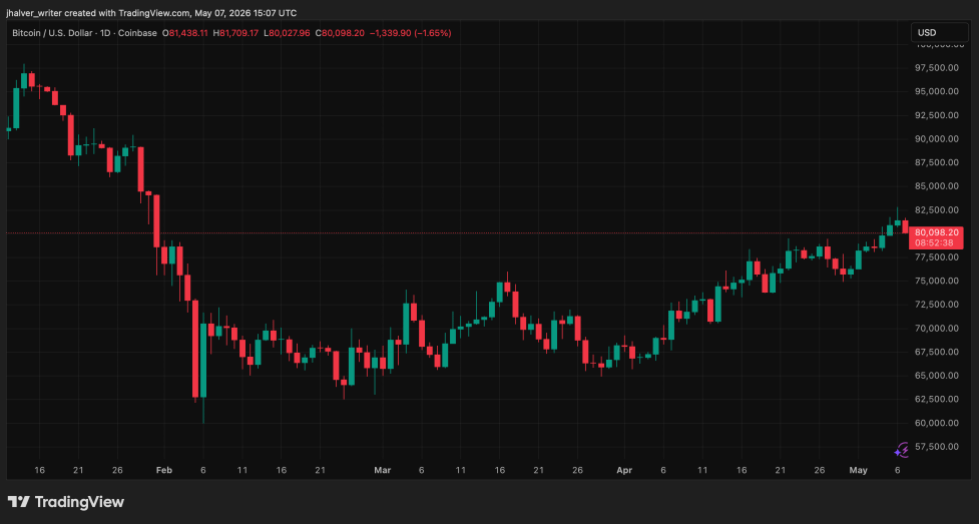
Bitcoin's price trends to the upside on the daily chart. Source: BTCUSD on Tradingview

Three Institutions, Three Distinct Roles

The architecture of the collaboration reflects three distinct layers of infrastructure, each contributed by a different partner. BNY brings its globally recognized custody backbone — the institution has offered digital asset custody to a select group of US clients since 2022, and obtained a Category 4 license in ADGM ahead of this expansion.

Finstreet Limited, a subsidiary of International Holding Company (IHC) through Sirius International Holding and based within ADGM, contributes its digital market ecosystem. Its licensed subsidiaries cover multilateral trading, custody and depository services, and investment advisory — giving the partnership a direct plug into Abu Dhabi’s institutional capital markets infrastructure.

ADI Foundation provides what it describes as sovereign-grade blockchain infrastructure through ADI Chain, a Layer 2 blockchain also founded under the IHC umbrella. Ajay Bhatia, Principal Council Member at ADI Foundation, noted in the release that ADI Chain is designed to unlock new opportunities in custody, trade finance, and lending from Abu Dhabi to the world.

Abu Dhabi’s Crypto Institutional Bet

The choice of ADGM as the anchor jurisdiction is deliberate. While Dubai’s VARA framework has attracted retail exchanges and Web3 startups, ADGM has built its reputation on institutional-grade licensing under English common law — a framework that has drawn Galaxy Digital, Circle, and Tether’s USDt to the market in recent months, per CryptoTimes.

IHC separately announced the launch of DDSC, a dirham-backed stablecoin fully regulated by the Central Bank of the UAE, which is currently in early-stage government and institutional adoption, according to the FX News Group. That context matters: BNY is entering a market that is actively building its own sovereign-grade digital currency infrastructure, not merely accommodating crypto adoption from the outside.

Hani Kablawi, Executive Vice Chair at BNY, characterized the move in the official release as a commitment to building financial infrastructure for the future — noting that the UAE is entering a new phase marked by deeper markets, greater digital sophistication, and stronger global connectivity.

This development marks a critical juncture for the nascent sector’s institutional custody landscape. As the world’s largest custodian plants its flag in Abu Dhabi, the signal to other global financial institutions considering Middle East expansion is clear: regulated digital asset infrastructure in the Gulf is no longer a future consideration — it is being built now.

Cover image from Grok, BTCUSD chart from Tradingview

Трендові криптовалюти

Пов'язані питання

QWhat is the significance of BNY's collaboration in Abu Dhabi for the crypto custody sector?

AIt marks the first time a US global systemically important bank has brought crypto custody to the UAE, signaling a major institutional commitment and building regulated digital asset infrastructure in the region now, not in the future.

QWhich three companies are partnering with BNY, and what unique role does each play?

ABNY provides its global custody backbone and ADGM license; Finstreet Limited contributes its licensed digital market ecosystem (trading, custody, advisory) within ADGM; and ADI Foundation supplies sovereign-grade blockchain infrastructure through its ADI Chain.

QWhy was Abu Dhabi Global Market (ADGM) chosen as the anchor jurisdiction for this initiative?

AADGM has built a reputation for institutional-grade licensing under English common law, attracting firms like Galaxy Digital and Circle, unlike Dubai's VARA which focuses more on retail and Web3 startups.

QWhat digital assets will the custody service initially support, and what is the planned expansion?

AThe service will begin with Bitcoin and Ethereum custody, with plans to expand into stablecoins, tokenized real-world assets, and other regulated digital instruments.

QHow does the recent launch of a dirham-backed stablecoin (DDSC) relate to BNY's market entry?

AIt shows BNY is entering a market that is actively building its own sovereign-grade digital currency infrastructure, not just accommodating external crypto adoption, indicating deeper local market development.

Пов'язані матеріали

Just now, DeepSeek V4 updates with DSpark, improving inference speed by 80%

DeepSeek has updated its DeepSeek V4 model with the DSpark speculative decoding framework, achieving a significant 60-85% speedup in generation for Flash models and 57-78% for Pro models while maintaining the same overall throughput. This engineering-focused update, rather than a core architectural change, introduces DSpark to address latency and throughput bottlenecks in high-concurrency production environments. DSpark combines high-throughput parallel generation with adaptive load-aware verification. Its key innovations include a semi-autoregressive generation architecture to model dependencies within token blocks and a hardware-aware confidence-scheduled verification system. This system uses a confidence head to predict token acceptance probabilities, allowing it to dynamically optimize verification length per request and allocate compute only to tokens with the highest expected payoff. The asynchronous scheduler is designed for real-world deployment, ensuring zero-overhead scheduling and continuous CUDA graph replay while preserving the target model's output distribution. In tests across mathematical reasoning, code generation, and daily dialogue, DSpark outperformed state-of-the-art models like Eagle3 and DFlash, increasing average acceptance length by 26.7%-30.9% and 16.3%-18.4% respectively on Qwen3 target models. DeepSeek also open-sourced DeepSpec, a full-stack codebase for training and evaluating speculative decoding draft models, providing a standardized toolkit that includes data preparation tools, model implementations, training code, and evaluation scripts.

marsbit3 год тому

Just now, DeepSeek V4 updates with DSpark, improving inference speed by 80%

marsbit3 год тому

BIT Research: The 2028 Halving Is Not the End, the Real Shake-Up of the Bitcoin Mining Industry Is Just Beginning

The Bitcoin mining industry is undergoing its most complex structural adjustment since inception. Despite Bitcoin's price holding near $61,000 and the network hash rate approaching a record 1 ZH/s, miner profitability is deteriorating. The industry is operating close to its breakeven point, with the 2028 halving expected to accelerate consolidation. The challenges extend beyond the halving's subsidy reduction; the industry's revenue model has yet to successfully transition towards a fee-driven structure. Increasingly, mining companies are evolving from simple Bitcoin producers into infrastructure and energy operators, including providers of AI/HPC computing power. Competition is shifting from pure hash rate expansion to business model upgrades. Economic pressure is evident. The theoretical daily mining revenue at current prices is around $78 million, yet the actual figure is only about $33 million—a 136% gap. Transaction fees remain low at roughly $220k daily, far below historical implied levels. With a current estimated industry-wide breakeven price near $65,000, mining alone is struggling to generate ideal profits. The 2028 halving is projected to push the fundamental production cost floor to approximately $93,289. This will likely accelerate a shift towards consolidation among larger, well-capitalized miners with diversified revenue streams. Competitive advantage will belong to institutionalized players with access to low-cost energy, AI/HPC hosting operations, and stronger balance sheets. In essence, Bitcoin mining is transitioning from a "mining business" to an "infrastructure business." Future profitability and resilience will depend less on block rewards and more on diversified income sources like energy management and computational infrastructure services. For investors, the key question is not the halving itself, but which miners can successfully navigate this business model transformation.

marsbit5 год тому

BIT Research: The 2028 Halving Is Not the End, the Real Shake-Up of the Bitcoin Mining Industry Is Just Beginning

marsbit5 год тому

This is How God Karpathy Uses Claude?

Andrej Karpathy, a prominent figure in AI, has reportedly joined Anthropic, leading to a noticeable decrease in his open-source contributions and social media activity. A document claiming to be his personal "CLAUDE.md" file—a set of instructions for the Claude AI to follow within a specific codebase—has been circulating online. While its authenticity is unverified, the content aligns closely with Karpathy's publicly shared principles on effective AI-assisted programming. The document outlines key rules for AI coding assistants, emphasizing the importance of reading existing code thoroughly before writing new code to maintain consistency. It advises against over-engineering, advocating for simple, surgical modifications that match the project's existing style. Other guidelines include clarifying assumptions upfront, writing meaningful tests, thoughtful debugging, and carefully considering dependencies. The core message is that these principles help prevent common AI coding failures, such as introducing unnecessary abstractions, style drift, or making invisible architectural decisions. The community has noted that even experts like Karpathy require detailed instructions to guide AI effectively, akin to managing a junior developer. A related GitHub repository, "andrej-karpathy-skills," which encapsulates these ideas, is reported to significantly reduce Claude's code error rate. Ultimately, the advice stresses that the best CLAUDE.md is tailored to one's own tech stack and coding practices.

marsbit5 год тому

This is How God Karpathy Uses Claude?

marsbit5 год тому

Торгівля

Спот

Популярні статті

Що таке $BANK

Bank AI: Революційний крок у майбутнє банківської справи Вступ В епоху, що характеризується швидкими технологічними змінами, Bank AI знаходиться на перетині штучного інтелекту (ШІ) та банківських послуг. Цей інноваційний проєкт прагне переосмислити фінансовий ландшафт, підвищуючи ефективність роботи, заходи безпеки та досвід клієнтів завдяки потужності ШІ. Розпочинаючи дослідження Bank AI, ми заглибимося в суть проєкту, його операційні динаміки, історичний контекст і значущі етапи. Що таке Bank AI? У своїй основі Bank AI представляє собою трансформаційну ініціативу, спрямовану на інтеграцію штучного інтелекту в різні банківські операції. Цей проєкт використовує можливості ШІ для автоматизації процесів, покращення протоколів управління ризиками та підвищення взаємодії з клієнтами через персоналізовані послуги. Основні цілі Bank AI включають: Автоматизація банківських функцій: Використовуючи технології ШІ, Bank AI прагне автоматизувати рутинні завдання, зменшуючи навантаження на людські ресурси та підвищуючи ефективність. Покращене управління ризиками: Проєкт використовує алгоритми ШІ для прогнозування та виявлення ризиків, тим самим зміцнюючи заходи безпеки проти шахрайства та інших загроз. Персоналізація банківських послуг: Bank AI зосереджується на пропозиції індивідуальних фінансових продуктів і послуг, аналізуючи дані і поведінку клієнтів. Покращення досвіду клієнтів: Впровадження рішень на основі ШІ, таких як чат-боти та віртуальні асистенти, має на меті забезпечити користувачам більш природну взаємодію, революціонізуючи спосіб, яким клієнти спілкуються з банками. З цими цілями Bank AI займає важливу роль в робленні банківської справи більш ефективною, безпечною та орієнтованою на користувача. Хто є творцем Bank AI? Деталі стосовно творця Bank AI залишаються невідомими. Таким чином, жодна конкретна особа або організація не були ідентифіковані в доступній інформації. Анонімність навколо створення проєкту піднімає питання, але це не зменшує його амбітного бачення та цілей. Хто є інвесторами Bank AI? Аналогічно творцеві проєкту, конкретна інформація стосовно інвесторів або організацій, що підтримують Bank AI, не була розкрито. Без цієї інформації важко окреслити фінансову підтримку та інституційну підтримку, які могли б сприяти розвитку проєкту. Тим не менше, важливість наявності міцної інвестиційної бази є вирішальною для забезпечення розвитку в такій інноваційній сфері. Як працює Bank AI? Bank AI функціонує на кількох інноваційних фронтах, фокусуючись на унікальних факторах, які відрізняють його від традиційних банківських структур. Нижче наведено ключові операційні характеристики: Автоматизація: Застосовуючи алгоритми машинного навчання, Bank AI автоматизує різні ручні процеси в банках. Це призводить до зниження операційних витрат і дозволяє працівникам перенаправити свої зусилля на більш стратегічні завдання. Покращене управління ризиками: Інтеграція ШІ в практики управління ризиками забезпечує банки інструментами для точного прогнозування потенційних загроз, таких як шахрайство, забезпечуючи при цьому безпеку інформації і активів клієнтів. Індивідуальні фінансові рекомендації: Завдяки безперервному навчанню з інтерaktionen з клієнтами, системи ШІ розвивають тонке розуміння потреб користувачів, що дозволяє їм пропонувати персоналізовані поради щодо фінансових рішень. Покращені взаємодії з клієнтами: Використовуючи чат-ботів і віртуальних асистентів на базі ШІ, Bank AI дозволяє створити більш залучений досвід для клієнтів, дозволяючи користувачам швидше отримувати відповіді на свої запитання, зменшуючи час очікування та підвищуючи рівень задоволеності. Разом ці операційні характеристики позиціонують Bank AI як піонера в банківському секторі, встановлюючи нові стандарти для надання послуг і операційної досконалості. Хронологія Bank AI Для розуміння траєкторії Bank AI необхідно ознайомитися з його історичним контекстом. Нижче наведено хронологію, що підкреслює важливі етапи та розробки: Ранні 2010-ті: Концептуалізація інтеграції ШІ в банківські послуги почала привертати увагу, коли банківські установи визнали потенційні переваги. 2018: Відбулося помітне збільшення впровадження технологій ШІ, коли банки почали використовувати інструменти ШІ, такі як чат-боти для базового обслуговування клієнтів та системи управління ризиками для покращення безпеки. 2023: Софістикація ШІ продовжувала розвиватися, з введенням генеративного ШІ для більш складних завдань, таких як обробка документів і аналіз інвестицій в реальному часі. Цей рік став важливим стрибком у можливостях, які забезпечує технологія ШІ для банків. 2024-актуальний статус: Станом на цей рік, Bank AI знаходиться на зростаючій траєкторії, з постійними дослідженнями та розробками, які готові подальше покращити можливості в банківських операціях. Продовження дослідження застосувань ШІ натякає на захоплюючі події, які ще попереду. Ключові моменти про Bank AI Інтеграція ШІ в банківську справу: Bank AI зосереджується на прийнятті штучного інтелекту для оптимізації банківських процесів та покращення досвіду користувачів. Автоматизація та фокус на управлінні ризиками: Проєкт сильного підкреслює ці сфери, прагнучи зshift тягар рутинних завдань, водночас підвищуючи безпеку через прогнозну аналітику. Персоналізовані банківські рішення: Завдяки використанню даних клієнтів, Bank AI забезпечує персоналізовані банківські послуги, що відповідають потребам окремих користувачів. Прихильність до розвитку: Bank AI залишається відданим постійним дослідженням і розробкам, що забезпечують його адаптацію та постійну актуальність у міру того, як технології продовжують розвиватися. Висновок Підсумовуючи, Bank AI є важливим кроком вперед у банківській індустрії, використовуючи штучний інтелект для переформатування операційних парадигм, підвищення безпеки та сприяння задоволеності клієнтів. Незважаючи на прогалини в інформації щодо творця та інвесторів, чіткі цілі і функціональні механізми Bank AI забезпечують міцну основу для його подальшої еволюції. Оскільки технологія ШІ продовжує розвиватися та інтегруватися в банківський сектор, Bank AI має всі шанси суттєво вплинути на майбутнє фінансових послуг, покращуючи спосіб, яким ми розуміємо та взаємодіємо з банківською справою.

155 переглядів усьогоОпубліковано 2024.04.06Оновлено 2024.12.03

Що таке $BANK

Як купити BANK

Ласкаво просимо до HTX.com! Ми зробили покупку Lorenzo Protocol (BANK) простою та зручною. Дотримуйтесь нашої покрокової інструкції, щоб розпочати свою криптовалютну подорож.Крок 1: Створіть обліковий запис на HTXВикористовуйте свою електронну пошту або номер телефону, щоб зареєструвати обліковий запис на HTX безплатно. Пройдіть безпроблемну реєстрацію й отримайте доступ до всіх функцій.ЗареєструватисьКрок 2: Перейдіть до розділу Купити крипту і виберіть спосіб оплатиКредитна/дебетова картка: використовуйте вашу картку Visa або Mastercard, щоб миттєво купити Lorenzo Protocol (BANK).Баланс: використовуйте кошти з балансу вашого рахунку HTX для безперешкодної торгівлі.Треті особи: ми додали популярні способи оплати, такі як Google Pay та Apple Pay, щоб підвищити зручність.P2P: Торгуйте безпосередньо з іншими користувачами на HTX.Позабіржова торгівля (OTC): ми пропонуємо індивідуальні послуги та конкурентні обмінні курси для трейдерів.Крок 3: Зберігайте свої Lorenzo Protocol (BANK)Після придбання Lorenzo Protocol (BANK) збережіть його у своєму обліковому записі на HTX. Крім того, ви можете відправити його в інше місце за допомогою блокчейн-переказу або використовувати його для торгівлі іншими криптовалютами.Крок 4: Торгівля Lorenzo Protocol (BANK)Легко торгуйте Lorenzo Protocol (BANK) на спотовому ринку HTX. Просто увійдіть до свого облікового запису, виберіть торгову пару, укладайте угоди та спостерігайте за ними в режимі реального часу. Ми пропонуємо зручний досвід як для початківців, так і для досвідчених трейдерів.

668 переглядів усьогоОпубліковано 2025.05.09Оновлено 2026.06.02

Як купити BANK

Обговорення

Ласкаво просимо до спільноти HTX. Тут ви можете бути в курсі останніх подій розвитку платформи та отримати доступ до професійної ринкової інформації. Нижче представлені думки користувачів щодо ціни BANK (BANK).

活动图片