Blockchain Is South Korea’s New Fiscal Weapon — A Blow To Privacy?

bitcoinistОпубліковано о 2026-04-16Востаннє оновлено о 2026-04-16

Анотація

South Korea is launching a pilot program to replace government expense credit cards with blockchain-based deposit tokens for treasury fund execution. This initiative, led by the Ministry of Finance and Economy, builds on a previous project with the Ministry of Environment. Deposit tokens are digital representations of bank deposits on permissioned blockchains, enabling programmable settlement, transparent tracking, and real-time reporting. Unlike CBDCs, they are issued by commercial banks. The pilot aims to enhance spending transparency, reduce intermediaries, and eliminate card-processing fees for small merchants. While improving efficiency, it raises privacy concerns. If successful, South Korea could become a model for blockchain-based fiscal systems.

South Korea is kicking off a pilot that will replace government expense credit cards with blockchain‐based deposit tokens.

Blockchain Goes TradFi?

The Ministry of Finance and Economy announced on an official press release that the pilot project for the execution of national treasury funds using blockchain‐based digital currency has been approved.

This new official venture marks the second time in which South Korea’s government uses digital currency and deposit tokens for the execution of national treasury funds, following another pilot project for building electric‐vehicle charging facilities and paying national subsidies together with the Ministry of Environment.

Deposit tokens are digital claims on commercial bank deposits, issued on permissioned blockchain rails, spendable by citizens and companies at participating merchants and service providers.

In simpler words, deposit tokens are digital versions of the money already kept in a normal bank account. The bank “wraps” those deposits into tokens on a private (permissioned) blockchain, and you can then spend those tokens at approved shops or service providers, just like using a card or mobile wallet.

In contrast with Central Bank Digital Currencies (CBDCs), that are digital versions of a country’s official money, created and managed directly by its central bank, deposit tokens have programmable settlement, transparent tracking of public money, and real‐time reporting for the state.

Pilot Details

The press release states that under the current National Treasury Funds Management Act, business promotion costs and related operating expenses are required to be paid with government purchase cards, effectively blocking the use of deposit tokens. Thanks to the new regulatory sandbox, those same payments can now be made with deposit tokens, creating a real‐world testbed for a new government payment and settlement method.

The new pilot is expected to serve as an opportunity to put blockchain‐based fiscal execution on a full footing and eliminate frictions in the current card‐payment setup by using blockchain’s built‐in transparency.

Quoting the press release, translated by Bitcoinist:

This pilot will allow us to preset and manage in advance the spending time and permitted business categories when business promotion expenses are executed using deposit tokens that leverage blockchain technology. This is not only expected to improve the transparency of spending but, by eliminating intermediaries in the payment structure, completely remove card‐processing fees borne by small merchants.

A Trade-Off For Traders

South Korea continues moving ahead with its Digital Asset Basic Act, a broad crypto rulebook that will set standards for stablecoins, tokenized real‐world assets, and crypto ETFs in the local market. A few weeks ago, the National Policy Committee of Korea pushed the “second‐phase” of the debate until after the June 3 local elections.

The trade‐off for South Korean traders is evident: they gain efficiency and control vs. losing some privacy and risking potential overreach. It is safe to expect tailwind for bank‐chain infrastructure, permissioned blockchain providers, and tokenization narratives.

Future “state money on chain” flows may favor bank‐issued tokens over fully open stablecoins, which could reshape liquidity, FX corridors, and on‐chain yield strategies.

If the pilot scales, South Korea could become the reference model for how blockchains handle real‐world fiscal flows.
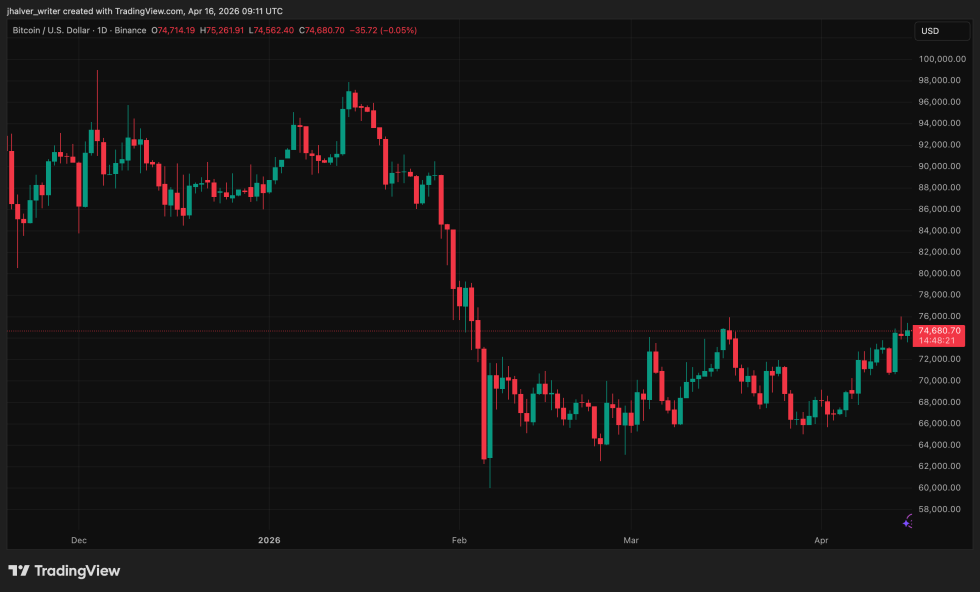
At the moment of writing, BTC trades for the highs $74ks on the daily chart. Source: BTCUSD on Tradingview.

Cover image from Perplexity. BTCUSD chart from Tradingview.

Пов'язані питання

QWhat is the South Korean government piloting to replace government expense credit cards?

AThe South Korean government is piloting the use of blockchain-based deposit tokens to replace government expense credit cards.

QHow do deposit tokens differ from Central Bank Digital Currencies (CBDCs)?

ADeposit tokens are digital claims on commercial bank deposits issued on permissioned blockchains, while CBDCs are digital versions of a country's official money created and managed directly by its central bank. Deposit tokens offer programmable settlement, transparent tracking, and real-time reporting.

QWhat are the expected benefits of using blockchain-based deposit tokens for government spending according to the press release?

AThe benefits include improved spending transparency by allowing preset management of spending time and permitted business categories, and the elimination of card-processing fees for small merchants by removing intermediaries.

QWhat is the potential trade-off mentioned for South Korean traders in adopting this system?

AThe trade-off is that traders gain efficiency and control but may lose some privacy and risk potential government overreach.

QWhat broader legislative framework is South Korea advancing alongside this pilot project?

ASouth Korea is advancing the Digital Asset Basic Act, a comprehensive crypto rulebook that will set standards for stablecoins, tokenized real-world assets, and crypto ETFs in the local market.

Пов'язані матеріали

Will the Fed Definitely Raise Interest Rates in September? How Will Crypto and U.S. Stocks Withstand the Pressure?

The market's expectation for a September Fed rate hike surged dramatically in early August, jumping from under 50% to over 80% within a week. This shift followed a contentious July FOMC meeting, where a 9-3 vote to hold rates revealed growing dissent from hawkish members advocating for an immediate hike to combat persistent inflation. The primary catalyst for this repricing is rising oil prices, driven by renewed geopolitical tensions around the Strait of Hormuz, which threaten global supply. Energy costs directly influence inflation metrics, making the upcoming July CPI report (due August 12th) a critical data point. If it shows inflation reaccelerating, the probability of a September hike will solidify. For Bitcoin and crypto assets, this is typically bearish news. Bitcoin continues to behave as a high-beta, liquidity-sensitive risk asset. A rate hike raises the opportunity cost of holding non-yielding assets and could drive capital toward money markets, pressuring crypto prices in the short term. However, historical patterns suggest that if a hike is perceived as the end of a tightening cycle rather than the start, any negative price impact may be brief. U.S. stocks, particularly crypto-linked equities like Coinbase and growth-oriented tech stocks, are also vulnerable. Higher rates increase discount rates in valuation models, putting pressure on high-multiple companies. This coincides with a pivotal tech earnings season where investor focus has shifted from massive AI capital expenditure to tangible revenue and cash flow generation. Companies with negative cash flow and weak growth narratives could face heightened volatility if borrowing costs rise in September. In summary, a September Fed hike has evolved into a mainstream market scenario. Key factors to watch are oil prices, the July CPI report, and Fed communications, which will determine the final decision and its impact on volatile crypto and equity markets.

marsbit10 хв тому

Will the Fed Definitely Raise Interest Rates in September? How Will Crypto and U.S. Stocks Withstand the Pressure?

marsbit10 хв тому

A 'Overlooked' Market Event: Joint US-Japan-South Korea Intervention, Rare US Treasury Involvement, and Bessent's Quiet 'Market Rescue'?

Summary: The United States, Japan, and South Korea executed their largest coordinated foreign exchange intervention in nearly 30 years. The action targeted depreciation pressure on the Japanese yen and South Korean won. This move is seen as a significant effort by the US to stabilize the financial markets of its key allies and prevent the spillover of risks. Key details: * Japan reportedly intervened on July 30 using approximately 8.45 trillion yen (about $52.8 billion). South Korean authorities also intervened that day, selling dollars to support the won. * Notably, the US Treasury Department intervened directly in yen markets for the first time in roughly 30 years. The New York Fed, reportedly acting on behalf of the Treasury, sold euros to buy yen via Goldman Sachs and Morgan Stanley on July 31. Analysts view the use of the euro-yen pair as a way to alleviate yen pressure without adding selling pressure to the US dollar. * Prior to the action, the New York Fed conducted "rate checks" on both USD/JPY and EUR/JPY, a newer signaling tool that falls between verbal and physical intervention. The intervention is interpreted as going beyond traditional currency stabilization. Analysts, such as Michael Hartnett of Bank of America, suggest it resembles a "Price Keeping Operation" for the AI era. The core US objectives are perceived to be: 1. Preventing rapid yen depreciation from triggering a sharp rise in Japanese government bond yields. 2. Containing financial stress from spreading across Asian markets like South Korea and Japan. 3. Reducing the risk of disorderly capital flows impacting the US bond market. This coordinated action underscores the importance of Japan and South Korea as critical partners in the US semiconductor and AI supply chain. Stabilizing their financial markets is seen as vital to mitigating risks to the broader tech industry and the US market itself. The intervention coincides with market pressures, including the KOSDAQ index hitting a low since October 2022. While seen as a move to control volatility, some analysts caution it may not fundamentally reverse existing market trends.

marsbit14 хв тому

A 'Overlooked' Market Event: Joint US-Japan-South Korea Intervention, Rare US Treasury Involvement, and Bessent's Quiet 'Market Rescue'?

marsbit14 хв тому

Will the Federal Reserve Definitely Raise Interest Rates in September? How Will Cryptocurrencies and US Stocks Bear the Pressure?

In early August 2024, market expectations for a September Federal Reserve rate hike surged dramatically, from below 50% to over 80%, driven by renewed inflation concerns. This shift followed a contentious July FOMC meeting where a 9-3 vote to hold rates revealed a growing hawkish faction advocating for an immediate hike, citing prolonged above-target inflation. The key catalyst is escalating conflict near the Strait of Hormuz, which has pushed oil prices up approximately 20% in July, threatening to reignite inflation. The next critical data point is the July CPI report on August 12th; a hot reading could solidify hike expectations. For crypto assets, particularly Bitcoin, this represents near-term pressure. Bitcoin continues to exhibit high-beta, risk-on characteristics, making it sensitive to tightening liquidity and higher opportunity costs. However, historical precedent suggests that if a hike is perceived as the cycle's end rather than its start, the negative impact may be brief, with markets quickly pivoting to anticipate future rate cuts. U.S. stocks, especially crypto-linked equities like Coinbase and high-valuation tech stocks, face amplified volatility. Higher rates increase discount rates in valuation models, pressuring growth stocks. This coincides with a pivotal tech earnings season where investor focus has shifted from massive AI capital expenditures to demonstrable revenue and cash flow generation. Companies with negative cash flows and weak growth narratives could see severe pressure if a September hike materializes, as financing costs would rise. Key indicators to watch include oil prices, upcoming inflation data, and Fed commentary at events like the Jackson Hole symposium.

Odaily星球日报14 хв тому

Will the Federal Reserve Definitely Raise Interest Rates in September? How Will Cryptocurrencies and US Stocks Bear the Pressure?

Odaily星球日报14 хв тому

Торгівля

Спот
活动图片





