Blockchain Games Defeated by Reality, Web3 Doesn't Believe in Dreams

marsbitОпубліковано о 2026-03-31Востаннє оновлено о 2026-03-31

Анотація

The article "Chain Games Succumb to Reality, Web3 Doesn't Believe in Dreams" discusses the significant downturn in the perceived failure of blockchain gaming. It begins with Solana Foundation President Lily Liu declaring that "blockchain games are dead," a sentiment echoed by Meta's abandonment of its metaverse vision after an $80 billion investment, which shared core concepts with Web3 gaming like virtual worlds and digital asset ownership. Numerous high-profile blockchain games have shut down recently. Examples include "Pirate Nation," which closed after raising $33 million, and others like "Ember Sword," "Nyan Heroes," and "Symbiogenesis," all ceasing operations due to funding shortages or failed token economies. Even well-funded projects like "Wildcard," backed by $46 million from Paradigm, saw their tokens crash shortly after launch. A central issue is misaligned incentives: Web3 games were often funded by investors seeking returns, not players seeking quality gameplay. This led to capital structures driven by speculation rather than sustainable user engagement. Many studios, like Oxalis Games with "Moonfrost," eventually abandoned blockchain elements to release traditional games on platforms like Steam, leaving early investors and NFT holders with losses. Industry reports note a dramatic drop in investment, from peaks of $10 billion in 2022 to just $293 million in 2025, with scams and loss of trust becoming major concerns. Despite the downturn, some industry leaders ...

Author: Chloe, ChainCatcher

Recently, Lily Liu, President of the Solana Foundation, posted on X stating that "games on the blockchain will not return," and declared that blockchain games are dead.

Her judgment stems from a Polymarket post: "Mark Zuckerberg's Meta is gradually abandoning its metaverse vision after spending $80 billion." Although Meta's blueprint did not explicitly involve blockchain or crypto assets, its strategy highly overlaps with the future depicted by Web3 blockchain games in recent years: virtual worlds, digital asset ownership, and immersive online economies.

Even the wealthiest player has quit. As the crypto industry's most promising "breakout" narrative, are blockchain games today on their last legs?

The Collapse of the Entire Sector: Blockchain Game Projects Shutting Down One After Another?

Last August, Proof of Play released an announcement that seemed like a confession to the market: its fully on-chain pirate RPG "Pirate Nation" would shut down within 30 days. Two dedicated blockchains went offline, token rewards zeroed out, and community players could only burn their assets in exchange for so-called "certificates" that might one day be useful—but probably won't be. This game studio had raised $33 million two years prior, vowing to build the future of on-chain gaming.

After the announcement, the PIRATE token plummeted 92% in a few days. Co-founder Adam Fern admitted: "Shutting down Pirate Nation was one of the toughest decisions I've ever been part of. But the truth is, it could never become a breakthrough mass-market title."

Pirate Nation is not an isolated case; it is just a small part of the great blockchain game collapse of 2025.

Let's review the list of blockchain games that announced shutdowns last year. "Ember Sword," an Ethereum game that attracted $203 million through NFT land sales, announced its closure in May last year, with developer Bright Star Studios citing a lack of funds.

"Nyan Heroes," a third-person shooter battle royale game built on Solana, was once on the wishlist of over 250,000 PC platform players but also ended operations in May last year due to broken financing. Its NYAN token fell over 99% from its peak. Square Enix, creator of "Final Fantasy," also saw its Ethereum-based game "Symbiogenesis" come to an end in July.

Gala Games' MMORPG, officially licensed by "The Walking Dead," also went offline in July. The NFT-based mechanized combat game "MetalCore" shut down its servers in March and then vanished without a trace, with the developer quietly shifting to release a new game on Steam that has nothing to do with blockchain.

The most recent case that left the market sighing was "Wildcard." After its TGE in March this year, its market cap peaked at only $1.1 million, with the community widely questioning the project's irresponsibility and soft rug. According to crypto asset data platform RootData, Wildcard had raised $46 million in funding, led by Paradigm.
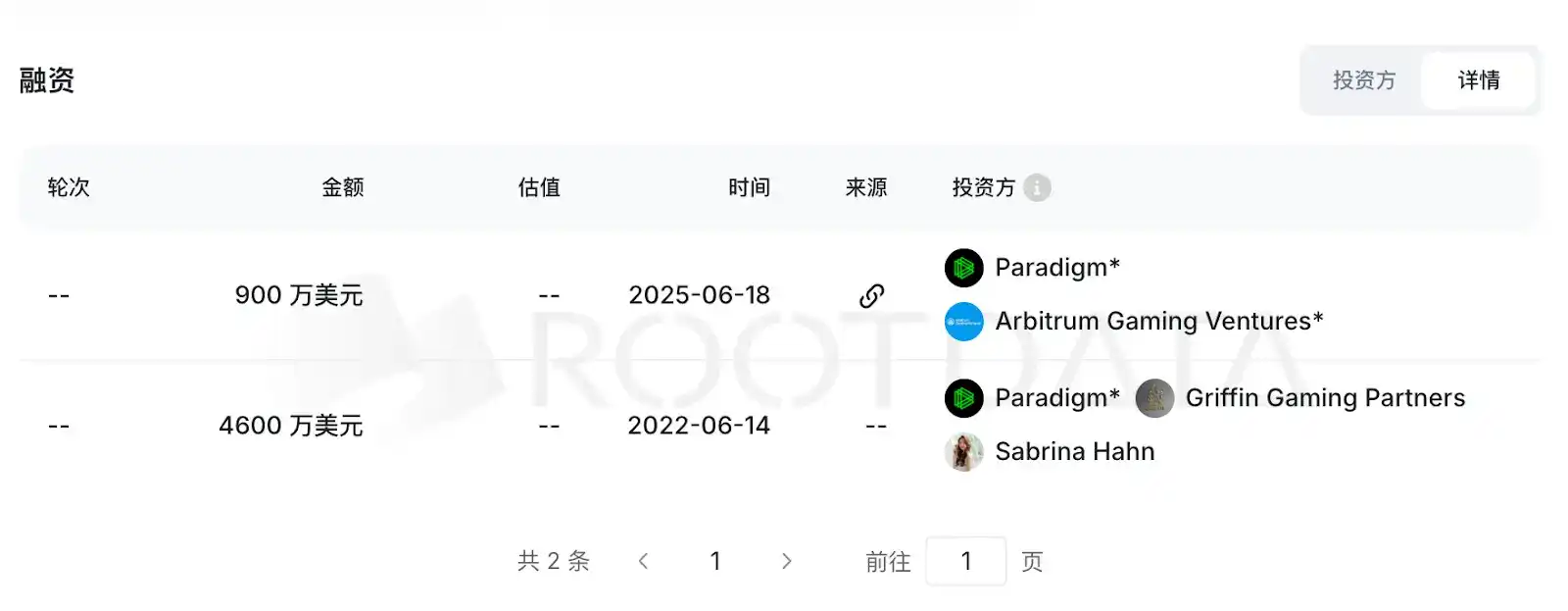
Its founder, Paul Bettner, had previously worked on well-known games like "Words With Friends" and "Lucky's Tale." But now, even with top VC backing and veteran game developers at the helm, the collapse of the entire blockchain gaming sector could not be stopped.

In addition, there are "Deadrop," "Blast Royale," "Mojo Melee," "Tokyo Beast," "OpenSeason," "Captain Tsubasa Rivals"—each project背后是数百万甚至数千万美元的投资、无数游戏用户的积累,以及最终化为乌有的承诺。

Web2 Players Want a Good Game, Web3 Players Only Want Profits

Most founders have real game development backgrounds, and their visions for on-chain games during fundraising were not entirely empty talk. Why did they still end up shutting down or returning to Web2?

"Web3 games built an entire investor-driven capital structure through tokens and NFTs before validating player demand." In other words, the people funding these games and the people who ultimately need to stay in the games were not the same group from the start.

When development revealed that the on-chain player base was smaller and more short-term arbitrage-oriented than expected, with tokens continuously falling and development costs rising, studios were left with only the choices of shutting down or abandoning their blockchain identity to turn to the traditional market. Either way, early Web3 investors and NFT holders ended up footing the bill.

The farm simulation game "Moonfrost" is a typical case. Developer Oxalis Games raised $6.5 million, ran a Play-to-Airdrop campaign for over a year, and sold 1,833 NFT boxes at $150 each. Then, in November 2025, the team announced leaving Web3 and relaunched on Steam as a paid PC game, with no NFTs, tokens, or blockchain.

And just the day before the announcement, CEO Ric Moore was still publicly talking about how to build "slow and meaningful Web3 games." The team's reason: "Web3 players want to make money, Web2 players just want a good game." It took them three years and millions of real dollars to see the real rules.

The 2025 Blockchain Game Alliance (BGA) industry report also confirmed the ebb tide of blockchain games: annual investment in blockchain games dropped to about $293 million, a惊人 drop compared to $4 billion in 2021 and the peak of $10 billion in 2022. DWF Labs described the current phase as a "necessary reset." The biggest aftermath of the sector's failure may be the credibility crisis of the entire blockchain gaming space.

The BGA report showed that 36% of respondents listed "scams, fraud, or rug pulls" as the biggest threat to the industry. Even though most project shutdowns were not intentional scams, from an external perspective, the repeated cycle of "fundraising, token issuance, collapse" is almost indistinguishable from rug pulls. "This industry needs real game developers and real users who want to play games. Both are indispensable."

Infrastructure and Market Conditions as Advantages, Stablecoins and AI Bring New Opportunities

The collapse of the blockchain gaming narrative does not mean consumer-level applications in the crypto industry have come to an end. The BGA report shows that 65.8% of industry practitioners remain optimistic about the next 12 months, with this optimism based on deliverable products and sustainable revenue models. Meanwhile, stablecoins processing large-scale transfer volumes, AI tools compressing game development costs to a fraction of what they were, etc.—infrastructure and market conditions have never disappeared.甚至从不少开发者的观点中,可以看到几条可能的路径。

NEXPACE CEO Sunyoung Hwang, when discussing their "MapleStory Universe," proposed a core principle: Wallets, gas fees, and tokenomics are obstacles, not value-adds, for most players. The blockchain layer should do meaningful work behind the scenes, such as enabling true asset ownership and driving open economies, while players focus on the game itself. "If the operation of the infrastructure渗透到了游戏体验中, the game design has failed."

Animoca Brands CEO Robby Yung and PLAY Network CEO Christina Macedo believe retention rate is the only truth. D1, D7, D30 retention data was crucial in the console era, the mobile game era, and remains so in the crypto industry. Macedo pointed out that the standard benchmark for mobile games is 35-45% D1 retention, 15-25% D7, and 5-10% D30, while most Web3 games simply don't meet these basic health metrics.

Yield Guild Games co-founder Gabby Dizon believes the industry failed because it "spent too long measuring the wrong things," including outdated metrics like VC funding amount, token price, and NFT sales volume. The real metric is simply whether players are willing to pay because they see value in the game experience.

Finally, there are the opportunities brought by stablecoins and AI.

The BGA report indicated that over a quarter of respondents see stablecoins as key to the industry's success. Compared to highly volatile game tokens, stablecoins are more user-friendly and easier to understand for new users, and are increasingly used for tournament prizes, in-game rewards, and cross-border payments. Sequence further pointed out that smart game developers are paying attention to stablecoin payments, whether for on-chain assets or other scenarios, due to the significant advantages of lower fees, instant settlement, and easier profit sharing.

And AI is changing the cost structure. Simon Davis of Mighty Bear Games noted that AI-native teams are surpassing the output of traditional studios with a fraction of the cost and manpower. Animoca Brands also believes that sustainability in 2026 will hinge on AI-driven or AI-assisted development practices, which will彻底改变 the economic model of producing quality game content.

Blockchain Games Aren't Dead Yet, Is the Current Phase a Necessary Reset?

The core contradiction of the past blockchain game cycle has never changed: investor-driven capital structures ran ahead of player demand validation. When retention rates couldn't support the token economy, when development costs devoured funding figures, project方's endgame was only shutdown or de-blockchainization, with early holders always footing the bill.

But this shake-up has also led to a more pragmatic consensus among game developers: make blockchain invisible, measure success by retention rates rather than token prices, use stablecoins instead of highly volatile tokens as the payment layer, and leverage AI to重构 development costs. The common thread in these directions is: first make a game that can withstand the检验 of traditional market metrics, then let blockchain发挥 its true value underlyingly.

Blockchain games may not be dead as Lily Liu said, but the market is indeed saying goodbye to the old cycle of using tokens to drive user numbers until development funds are exhausted, ultimately forcing a return to Web2.


Пов'язані питання

QWhat was the main reason given by Solana Foundation's president Lily Liu for declaring that blockchain games are dead?

ALily Liu's judgment was based on a Polymarket post stating that Meta, after investing $80 billion, was gradually abandoning its metaverse vision. Although Meta's blueprint did not explicitly involve blockchain or crypto assets, its strategy highly overlapped with the future depicted by Web3 blockchain games, such as virtual worlds, digital asset ownership, and immersive online economies.

QWhich blockchain game, funded with $33 million, announced its shutdown last year and saw its token PIRATE plummet by 92%?

AProof of Play's fully on-chain pirate RPG 'Pirate Nation' announced its shutdown last year. The PIRATE token暴跌 92% shortly after the announcement.

QAccording to the article, what is the fundamental conflict that led to the failure of many blockchain games?

AThe core conflict was that investor-driven capital structures were established ahead of validating player demand. When retention rates could not support the token economy and development costs consumed the funding, projects were forced to shut down or remove their blockchain elements, leaving early holders to bear the losses.

QWhat new opportunities do stablecoins and AI present for the blockchain gaming industry according to the BGA report?

AThe BGA report indicated that over a quarter of respondents see stablecoins as key to the industry's success, as they are more user-friendly for new players and are increasingly used for tournament prizes, in-game rewards, and cross-border payments. AI is seen as a tool that can drastically change the cost structure of game development, allowing AI-native teams to outperform traditional studios with a fraction of the cost and manpower.

QWhat key metrics do industry leaders like Animoca Brands' CEO and PLAY Network's CEO believe are the true measure of a game's success, which most Web3 games failed to achieve?

AThey believe that retention rates are the only true measure of success. The standard benchmarks are D1 retention of 35-45%, D7 retention of 15-25%, and D30 retention of 5-10%. Most Web3 games failed to meet these basic health metrics.

Пов'язані матеріали

Understanding CPO (Co-Packaged Optics) in One Article: Why Nvidia Is Willing to Spend $3.2 Billion on a Fiber?

NVIDIA and Corning announced a multi-year strategic partnership on May 6, 2026, with NVIDIA committing up to $3.2 billion to support Corning's U.S. expansion. This investment will triple Corning's manufacturing plants and significantly boost its optical fiber and communications production capacity. The core driver behind this massive investment is the fundamental shift from copper to optical interconnect technology within AI data centers. As GPU clusters scale, copper wires face critical limitations: severe signal attenuation over distance, high energy consumption for signal integrity, and excessive heat generation. Optical fiber, transmitting light instead of electrical signals, solves these issues with minimal loss, near-light speed, and lower power needs. The article outlines a three-stage evolution of data center interconnect: 1. **Traditional Copper Interconnects:** The mainstream solution of the 2010s, now being phased out due to scaling bottlenecks. 2. **Pluggable Optical Modules:** The current mainstream, where modules convert electrical signals to light externally. This process still introduces energy loss and latency. 3. **CPO (Co-Packaged Optics):** The next-generation technology where the optical engine is integrated directly with the GPU chip package. This drastically reduces the electrical signal travel distance to mere millimeters, slashing power consumption and latency while boosting data density. NVIDIA CEO Jensen Huang has identified CPO as an essential core technology for AI infrastructure. NVIDIA's investment signifies a strategic shift from being a buyer to actively controlling its supply chain for critical components. With demand for specialized optical fiber far outstripping supply—evidenced by soaring prices—securing long-term manufacturing capacity has become a competitive necessity. While Corning's expansion may pressure some suppliers, a projected global fiber supply gap of 5-15% over the next few years creates a significant opportunity window, particularly for Chinese manufacturers competitive in optical preforms, chips, and modules. Ultimately, NVIDIA's move is not about chasing a trend but an engineering imperative. The transition to light-based interconnects like CPO is driven by the physical limits of copper, marking a definitive step in the ongoing AI computing revolution.

marsbit7 хв тому

Understanding CPO (Co-Packaged Optics) in One Article: Why Nvidia Is Willing to Spend $3.2 Billion on a Fiber?

marsbit7 хв тому

KOL's Perspective: Why Is SOL Set to Rise from This Point?

**Summary: Why SOL is Positioned for Growth at This Level** The article argues that SOL is poised for an upward move from its current price point, citing several key factors. Primarily, SOL has just broken out of a 4-month consolidation phase. This breakout signals a return of risk appetite to the broader crypto market, as SOL is seen as a key indicator of overall crypto health. The token's ownership has reportedly shifted from short-term traders and tourists to long-term accumulators, leading to low volume. Any meaningful increase in trading activity could thus trigger significant upward momentum. Fundamental strengths include strong institutional adoption, integration with DeFi and RWAs (Real-World Assets), and the potential benefits from the Clarity Act. Despite its high volatility—having dropped 70% from its all-time high but still up 12x from its bear market low—SOL is highlighted as one of the few tokens from the last cycle to reach new highs. It boasts a robust ecosystem of applications, users, and protocols. Future catalysts include the expected influx of AI developers following the Miami Accelerate conference, which focused on AI on Solana. Furthermore, Solana is positioned as the premier chain for memecoin activity, a trend expected to continue and drive network usage and fees. The article concludes that recent price action reflects a healthy transfer to long-term holders, setting the stage for growth.

marsbit57 хв тому

KOL's Perspective: Why Is SOL Set to Rise from This Point?

marsbit57 хв тому

Those Pre-Bitcoin PoW Protocols Have Recently Been Reimplemented

This article details a recent surge in replicating pre-Bitcoin Proof-of-Work (PoW) protocols, specifically focusing on Hal Finney's 2004 RPOW (Reusable Proofs of Work). Within five days in May 2026, multiple independent builders in the Bitcoin/cypherpunk community launched projects inspired by this early electronic cash proposal. The initiative began with Fred Krueger's `rpow2.com`, a centralized but auditable system that replaced RPOW's original IBM 4758 hardware with Ed25519 signatures. Initially a faithful replica, it later adopted Bitcoin-like features (21M supply cap, difficulty adjustment) and a controversial 5.24% founder allocation. This sparked rapid forks, including `rpow4.com` which incorporated full Bitcoin parameters, a prediction market (`rpowmarket.com`), and a DEX (`rpow2swap.com`). Concurrently, Mike In Space created a prototype of Wei Dai's 1998 b-money proposal (`b-money.replit.app`), pushing the historical exploration even further back. The article contrasts these centralized, server-dependent experiments with Bitcoin's core innovation of decentralized, trustless consensus. It also highlights a parallel development: the `HASH` project on Ethereum, which uses smart contract hooks to enable a purely fair-launch, browser-mineable PoW token with 0% allocations to team or VCs. The collective activity is framed as a meme-driven, educational exploration of cypherpunk history rather than a serious financial movement, with all projects heavily disclaiming any investment value.

marsbit1 год тому

Those Pre-Bitcoin PoW Protocols Have Recently Been Reimplemented

marsbit1 год тому

South Korean Exchanges 'Battle' Regulators, Challenging the Boundaries of Enforcement and Legislation

South Korea's cryptocurrency industry is engaged in a rare, direct confrontation with regulators. The Financial Intelligence Unit (FIU), the primary anti-money laundering (AML) watchdog, has recently imposed heavy penalties on major exchanges like Upbit and Bithumb for alleged violations involving unregistered overseas VASPs and AML procedures. However, exchanges are now actively challenging these actions in court and through industry associations. In a significant shift, the Seoul Administrative Court ruled in favor of Upbit's operator, Dunamu, overturning part of an FIU-ordered business suspension. The court found the FIU's penalty criteria and justification insufficiently clear. Similarly, the court suspended the enforcement of a six-month business suspension against Bithumb pending a final ruling, citing potential irreversible harm to the exchange. Beyond legal battles, the industry is contesting proposed legislative amendments. The Digital Asset eXchange Alliance (DAXA) strongly opposes a draft rule that would mandate Suspicious Transaction Reports (STRs) for all crypto transfers over 10 million KRW (~$6,800). DAXA argues this "poison pill" clause violates legal principles and would overwhelm the STR system, increasing reports from 63,000 to an estimated 5.45 million annually for major exchanges, thereby crippling effective AML monitoring. This conflict highlights a structural tension in South Korea's crypto governance: comprehensive digital asset laws are still developing, while regulators rely heavily on AML enforcement. The industry's move from passive compliance to active legal and legislative challenges signifies a new phase, pressing for clearer rules and more proportionate enforcement. While short-term disputes may intensify, this clash could ultimately lead to a more mature and sustainable regulatory framework for South Korea's vibrant crypto market.

marsbit1 год тому

South Korean Exchanges 'Battle' Regulators, Challenging the Boundaries of Enforcement and Legislation

marsbit1 год тому

Торгівля

Спот
Ф'ючерси
活动图片




