Black Whale Emerges, DeepSeek's Second Half Begins

marsbitОпубліковано о 2026-08-13Востаннє оновлено о 2026-08-13

Анотація

DeepSeek has unveiled its V4 Pro model and officially launched DeepSeek Harness, a developer-preview agent framework released as open-source under the MIT license. The article highlights that while model capabilities set the upper limit, the execution system (or "Harness") significantly determines real-world task success rates and cost efficiency, as demonstrated by tests where the same DeepSeek V4-Flash model performed differently across various harnesses. DeepSeek Harness is built on a "Everything is a plugin" philosophy using the Cordis system, allowing developers to modularly replace or extend core components like the model, tools, and UI without modifying the core code. It emphasizes full traceability with an append-only session log and is designed for stable, long-running tasks. Notably, it supports integration with nearly 40 external LLMs, including Kimi, OpenAI, and Anthropic, positioning itself not as a fixed agent but as a customizable platform. The release signals a strategic shift for DeepSeek from merely selling computational tokens (inference) to delivering actionable results (task completion). However, the v0.1 Harness faces challenges, including competing with established players like Claude Code, building a robust plugin ecosystem, and adapting to a potential "pay-for-result" business model. The article concludes that while both V4 Pro and Harness are early-stage with gaps to top models, DeepSeek's consistent direction is to make advanced AI capabilities af...

DeepSeek's Most Promising Project Takes the Stage, Everything is a Plugin. Harness isn't trying to imitate anyone, but to give the power of definition to the open-source community.

On the evening of August 13th, DeepSeek finally broke its silence, releasing two important pieces of information. First, the official version of DeepSeek V4 Pro was released, and simultaneously updated on the APP, web version, and API. Users can use the brand new V4 Pro official model by selecting "Expert Mode" via the APP or web interface; the API model name remains unchanged.

Second, the " DeepSeek Harness Team," with its black whale avatar, made its first post, announcing the official launch of the Harness Developer Preview version, open-sourced under the MIT license.

As previously teased, the V4 Pro official version and the self-developed Harness made a simultaneous debut. Since we have already focused on introducing V4 Pro before, this article will focus on analyzing why DeepSeek Harness is noteworthy.

And after today, whether DeepSeek will transform from a model company into a harder-to-define company.

01

The Same Model, A Different Shell Makes It Seem Like a Different Person

To understand why Harness is important, one must first grasp a counterintuitive fact: in the Agent era, what determines whether an AI can get work done is not just the model.

On August 6th and 11th, the agent tool company Composio conducted two experimental tests attempting to prove the value of Harness. Researchers connected the same DeepSeek V4-Flash model to eight different Harnesses—the execution systems wrapped around the model—and had them complete thirty multi-step tasks respectively. These tasks weren't simple Q&A; they required the Agent to access real applications like Gmail, Google Calendar, GitHub, Slack, call tools, and change application states. Each task was allowed to run for up to fifteen minutes, and success required passing all checks.
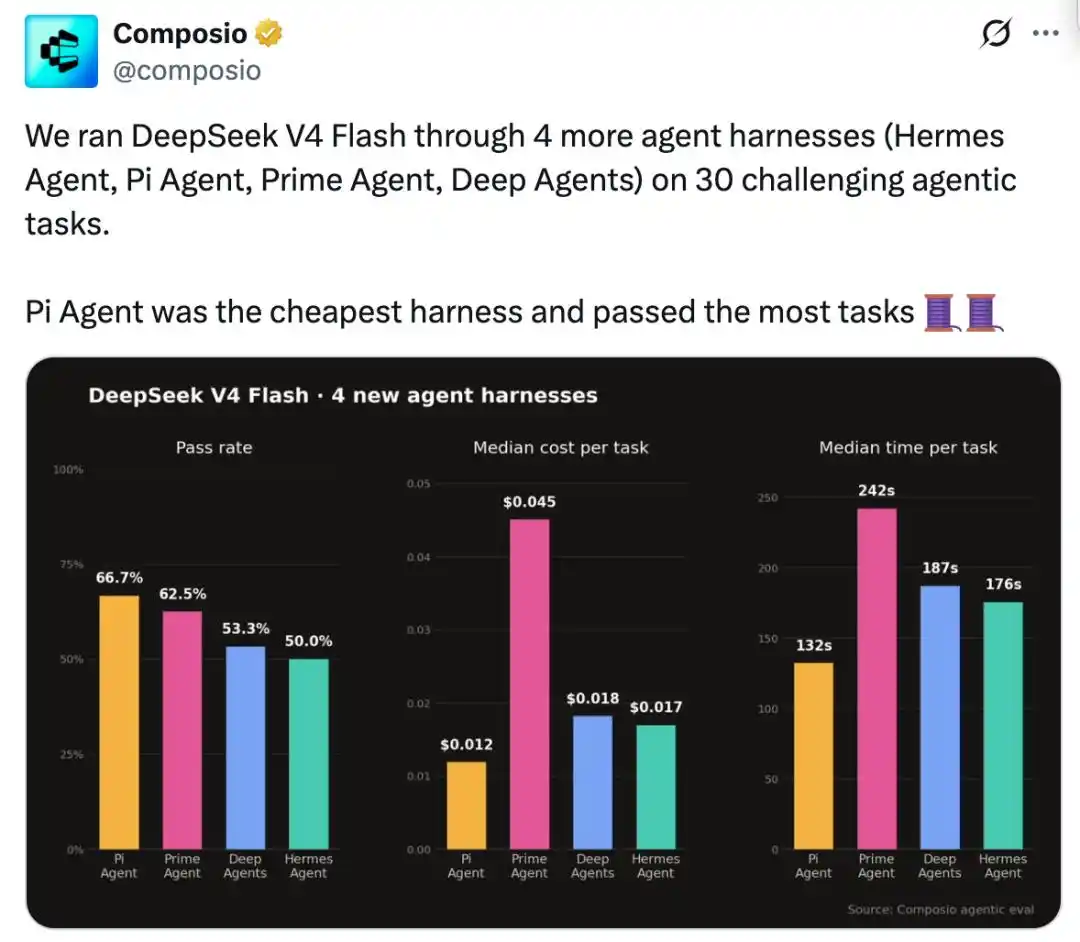
The gap was significant. The best performer, Pi Agent, passed twenty tasks; the worst, OpenCode, passed only fourteen. Out of 240 total runs across eight Harnesses, only 129 succeeded. Among the thirty tasks, only six were completed by all Harnesses. In terms of cost, for similarly completing sixteen tasks, the estimated cost per successful task for Claude Code, Codex, and DeepAgents was approximately $0.195, $0.081, and $0.045 respectively. For the same model, the difference was more than fourfold.
This means that the model sets the upper limit of capability, while the Harness determines how much of that ceiling is ultimately realized and at what cost. Throughout a long-running task, the execution system must constantly make judgments: what to keep and what to discard in the context, when to call which tool, whether to retry or change course when a tool fails, whether to trust the model's completion signal or verify it again. If any step is mishandled, even if the model has the right idea, it could fail at the last moment when actually modifying files or submitting code.

It's worth noting that this is one of the very few projects that DeepSeek opened for early closed beta since its rise to fame.

Several developers received Harness beta access before the official release. Some testers discovered that having the same V4-Flash model complete the same game within DeepSeek Harness, Reasonix, and Codex produced drastically different outcomes. This shows that when the model is identical, the tools, prompts, context organization, and execution strategies provided by the execution system can significantly alter the final product.

This is precisely why DeepSeek values its self-developed Harness. Internally, DeepSeek has believed that Agents need to solve the problem of continuous learning, ultimately enabling AI to accelerate AI R&D. Looking down this path, Harness is not just an add-on programming tool, but a workbench for models to enter real development tasks.

Furthermore, a company that built its foundation on low cost and model capability would find itself in a precarious position if task delivery, failure feedback, and developer interfaces remained long-term dependencies on others' systems. Even with a price advantage, it wouldn't control how many tokens a task ultimately burns, how many retries are needed, or when a task is truly considered complete.

02

Everything is a Plugin, DeepSeek Isn't a Replacement for Anyone

What exactly is Harness? The most convenient description in the market is " DeepSeek version of Claude Code." But those who have used the beta version generally find this label inaccurate.

According to DeepSeek 's official documentation, the core design philosophy of Harness is "Everything is a plugin." It is built on the Cordis plugin system. Models, tools, skills, sessions, sandboxes, storage, loops, schedulers, UI—all Agent capabilities are composed of plugins. Developers can select, replace, or extend any capability through configuration without modifying the Harness source code.
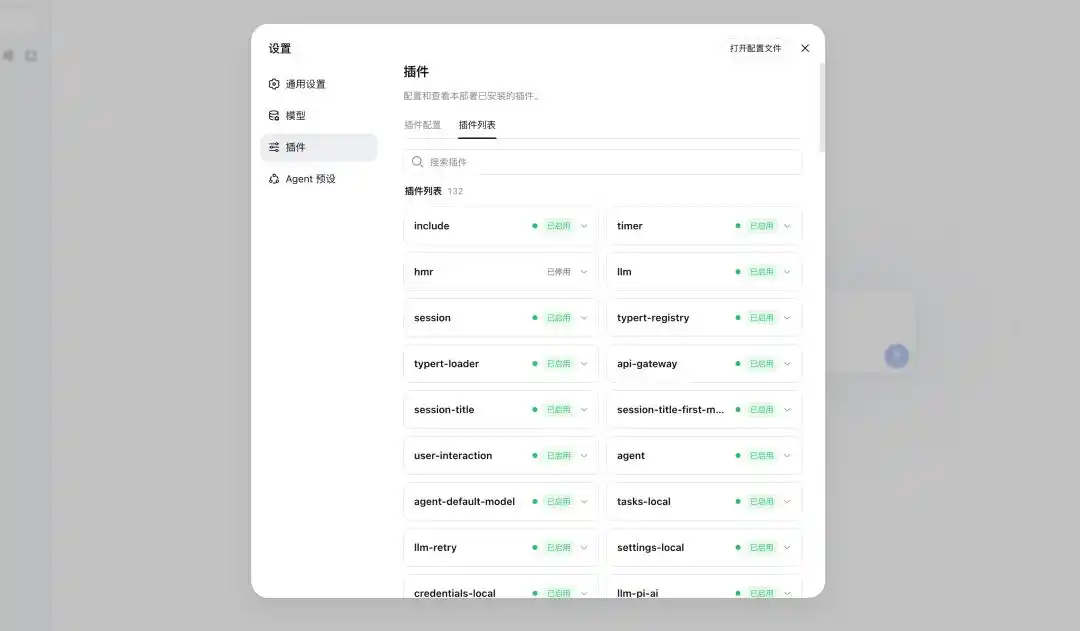
This is on a different scale from the usual understanding of plugins. VS Code plugins add features to the editor; Codex plugins add tools to the Agent. Harness plugins can replace the Agent's brain, toolbox, rules, even its entire interface.

According to multiple sources involved in the beta test, developers went wild with plugin-making during the beta period. "People aren't properly testing the beta anymore; they're running off to write plugins." Hundreds of plugins emerged within just a few days—some completely overhauled the work interface, while others implemented "cross-session long-term memory with background self-evolution" using pure plugins, enabling the model to periodically review its work records and compress temporary experiences into lasting knowledge.

Some also commented that open-source community governance might be another challenge DeepSeek will face next.

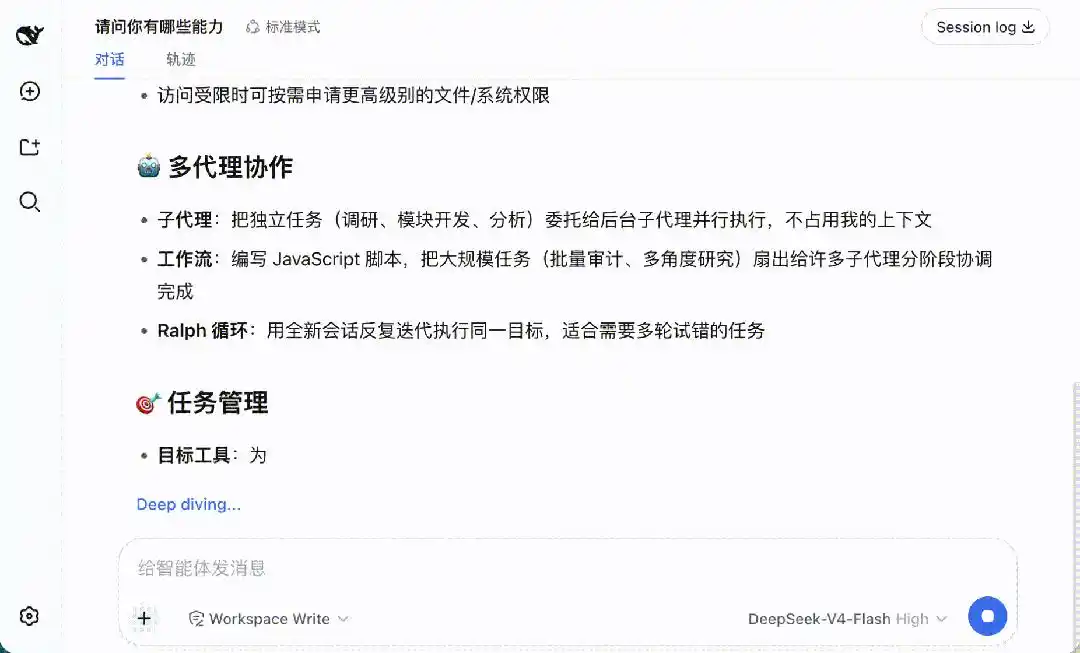
Another crucial design aspect is traceability. Harness uses an append-only session log. Everything the model sees—system prompts, chain-of-thought, tool calls and results, sub-Agent scheduling, every context injection—is fully recorded. Context compression does not delete the original history; it only changes what the model subsequently sees through replacement events. Developers can trace by source in the Trajectory view, supporting recovery, forking, retrieval, and replay. The official documentation summarizes this principle as "If the model saw it, it's recorded."

This reflects a typical systems engineering mindset. According to reports, DeepSeek Harness team leader Cui Tianyi graduated from Zhejiang University's Computer Science Department, worked at the quantitative trading firm Jane Street for nine years, and joined DeepSeek in March 2026, with Harness officially starting internal development in May. The core moat of high-frequency trading systems has never been about smarter strategies, but stable execution in extremely complex environments, exception handling, comprehensive log traceability, and controllable risk—exactly the missing piece for moving AI Agents from demos to production. One beta developer described its performance in long tasks as "steady as an old dog": tasks are automatically saved when interrupted, ready to resume next time without starting over.

It's worth noting that Harness hasn't confined itself within DeepSeek models' walled garden. It natively supports connecting to nearly 40 major models including Kimi , OpenAI, Anthropic, and Google. Perhaps others tend to build a ready-made Agent, but DeepSeek Harness is more like a set of components, allowing developers to decide for themselves what the Agent should be like and how it should work.

Of course, the official team remains clear-headed. The announcement states that, as an early preview version, "there are still many details to be improved and refined, and core plugins and basic APIs will also undergo rapid iteration." In fact, one of the media outlets involved in the beta, ifanr, marveled that it was hard to imagine the famously fast DeepSeek taking over half an hour to run a programming task. The v0.1 version number also indicates that this black whale has just surfaced, far from swimming freely.

03

From Selling Tokens to Delivering Results, the Ambition of the Black Whale

The emergence of Harness coincides with a shift in the entire AI industry.

Over the past few years, competition among large model companies has focused on parameter scale and benchmark scores. But entering 2026, the core capabilities of leading models have rapidly converged, gaps in single-turn QA have narrowed, while price wars have intensified. The ceiling for the pure token-selling business model has become clearly visible. The industry is gradually realizing that the core value of the AI industry lies not in model output, but in real-world application—with the same token consumption, idle chat yields minimal value, while fixing a bug or completing a feature development can create several times the commercial value.

DeepSeek 's new release signifies a move from selling compute power to delivering results. In the old model, customers paid based on token usage, regardless of whether the model actually solved the problem. In the new model, the anchor point for payment shifts from how much compute was consumed to what task was accomplished.

This DeepSeek Harness release is also highly praised by developers for another reason. DeepSeek does not define the Agent itself. Instead, it leverages the diffusion power of the open-source community to promote a Harness-based approach. This is a grander, yet more difficult, path.

Furthermore, Harness faces a mature market already validated by Claude Code and Codex, with the latter backed by the model iterations and commercial resources of Anthropic and OpenAI, holding a first-mover advantage. After open-sourcing, questions remain unanswered: whether the plugin ecosystem can spontaneously flourish, whether developers are willing to entrust production environments to a v0.1 version, and whether the domestic market's payment habits can support the new logic of "pay-per-result." DeepSeek itself has stated that core plugins and APIs will continue to evolve rapidly, meaning early adopters may bear the cost of interface changes.

On August 13th, releases happened on both sides of the Pacific. Elon Musk took the stage for Grok 4.6, calling it "intelligent, fast, and highly cost-effective" ; DeepSeek said nothing, just kept pushing updates.

Between the clamor and the silence lies a divergence of two business philosophies.

We want to call this DeepSeek 's "most promising project in history," not because it's the strongest today. V4 Pro still has gaps with SOTA models, Harness is only a v0.1 developer preview, market reaction to recent price adjustments needs observation, and ecosystem building is a long journey. Potential is potential precisely because it is not yet realized.

But if we stretch the timeline, from R1 to V4, from models to Harness, DeepSeek has taken each step in the same direction: compressing cutting-edge capabilities into affordable costs, then connecting affordable capabilities to implementable systems.

The black whale has surfaced. As for how far it can swim—that lies in a future belonging to the open-source community.

This article is from the WeChat public account "Phoenix Network Technology," author: Dale, editor: Dong Yuqing


Трендові криптовалюти

Пов'язані питання

QAccording to the article, what is the key finding of Composio's experiments comparing different Agent execution systems (Harnesses) using the same DeepSeek model?

AThe key finding was that the choice of execution system significantly impacts the performance and cost of the same AI model. The experiments showed up to a fourfold difference in the cost per successful task completion when the same DeepSeek V4-Flash model was paired with different Harnesses.

QWhat is the core design philosophy of DeepSeek's newly released Harness system?

AThe core design philosophy is "Everything is a plugin." Harness is built on the Cordis plugin system, meaning all Agent capabilities—models, tools, skills, sessions, UI, etc.—are composed of interchangeable plugins, allowing developers to customize the system without modifying the core source code.

QWhy does the article suggest Harness is not simply a 'DeepSeek version of Claude Code'?

ABecause Harness is fundamentally a modular system of plugins where developers can define and configure the Agent's functionality, behavior, and interface. It's designed to be a flexible, foundational framework for building various Agents, not a single, pre-defined tool for coding tasks.

QWhat shift in the AI industry's business model does the article associate with the release of DeepSeek Harness?

AThe article associates it with a shift from selling computational power (tokens) to delivering results. The value proposition is moving from charging for model output volume to charging based on the completion and value of specific tasks (like bug fixes or feature development).

QWhat is the significance of the 'append-only' session log and 'Trajectory view' in the Harness system, according to the article?

AThe 'append-only' log ensures complete traceability and reproducibility. Every system prompt, chain-of-thought, tool call, and context injection is permanently recorded. The 'Trajectory view' allows developers to trace, restore, fork, and replay any step, providing crucial control and debugging capabilities for complex, long-running AI tasks.

Пов'язані матеріали

Stripe’s 16-Year Chronicle: From 7 Lines of Code to a $100 Billion Valuation

Stripe's 16-year journey began with a simple promise: "7 lines of code to accept payments." Founded by Patrick and John Collison, the company started by hiding the complexity of bank integrations and merchant accounts behind a clean API, initially targeting developers at startups. This early focus on user experience and technical simplicity fueled rapid adoption. A key early milestone was establishing vital bank partnerships, a challenge overcome by hiring Billy Alvarado, who brought crucial institutional relationship skills. From this foundation, Stripe systematically expanded its product boundaries. It launched Connect for platform payments, Atlas for company formation, Radar for fraud prevention, and Billing for subscriptions. This transformed Stripe from a payment processor into a broader financial infrastructure suite for internet businesses. The COVID-19 pandemic accelerated growth but also led to over-hiring. A 14% layoff in 2022 marked a period of organizational correction. Subsequently, Stripe shifted its growth strategy towards strategic acquisitions to enter new domains quickly. It acquired Bridge (stablecoin infrastructure), Privy (wallet infrastructure), Metronome (usage-based billing), and agreed to buy OpenRouter (AI model routing). These moves signal Stripe's ambition to build a "programmable money system" for the emerging AI and agent-based economy, managing not just currency flows but also the measurement and pricing of computational resources like AI tokens. Internally, Stripe leverages AI agents (like "Minions") to boost engineering productivity. Despite scaling to nearly 8,000 employees and processing $1.9 trillion in payment volume annually, the company remains private. A recent employee tender offer valued it at $159 billion. The core question for Stripe's future is whether it can successfully integrate its expanding product matrix—spanning payments, crypto, and AI infrastructure—into a cohesive platform, positioning itself as the foundational economic layer for autonomous software agents.

marsbit26 хв тому

Stripe’s 16-Year Chronicle: From 7 Lines of Code to a $100 Billion Valuation

marsbit26 хв тому

Treasury Secretary's Move to Suppress Treasury Yields Ignites 'Currency Debasement Trade'! Gold Hits Three-Month High, Bitcoin Surges Over 25% in a Single Week

US Treasury Secretary Besant's efforts to lower long-term Treasury yields by announcing expanded buybacks had only a brief market impact. However, this move fueled a "currency devaluation trade," weakening the US dollar while boosting both gold (to a three-month high) and Bitcoin (up over 25% for the week). Analysts attribute this reaction to deepening market concerns over the massive US fiscal deficit and structural pressures keeping long-term rates elevated, including fierce competition for capital from global government borrowing and massive AI sector financing. Despite the Treasury's actions, fundamental forces like growth, inflation, and capital demand are seen as limiting its ability to sustainably suppress yields. Bitcoin's strong positive correlation with gold has reinforced its narrative as a hedge against devaluation. While equity markets have shown resilience, some strategists warn that Treasury yields nearing 5% increase pressure on the dollar and high-leverage assets. Figures like Ray Dalio have advised reducing bond exposure in favor of gold and some Bitcoin, citing US debt risks. Market opinions are divided on the sustainability of the devaluation trade, with some noting the lack of a near-term catalyst for its next leg higher. The underlying tension between the Treasury's desire for lower borrowing costs and the Federal Reserve's focus on inflation and reducing market intervention remains a key theme. Upcoming events like Nvidia's earnings and the Jackson Hole symposium will test whether AI profits can continue supporting stocks and if the Fed aligns more with Washington's preference for easier financial conditions.

华尔街日报2 год тому

Treasury Secretary's Move to Suppress Treasury Yields Ignites 'Currency Debasement Trade'! Gold Hits Three-Month High, Bitcoin Surges Over 25% in a Single Week

华尔街日报2 год тому

Alexander Shokhin: Business Needs an Interest Rate Below 10% and the Dollar at 90-95 Rubles

Alexander Shokhin, head of the Russian Union of Industrialists and Entrepreneurs (RSPP), has advocated for potentially using "non-market" tools to keep the ruble within a target exchange rate corridor. This, he argues on August 21, would help avoid excessive volatility, though he called the topic a separate discussion. Shokhin had previously raised the idea of a currency corridor in late May, noting the ruble's current exchange rate is not fully market-driven due to a limited currency segment and reduced foreign currency demand. He stated that many business community colleagues propose fixing a corridor, even through non-market methods, to ensure predictability. The business community's key targets, as outlined by Shokhin in late December 2025, are a Central Bank key rate of 12%, inflation of 4–5%, and a US dollar exchange rate of 90–95 rubles by the end of 2026. A turning point for investment, he said, would be lowering the rate to 12% with 6% inflation, though truly comfortable business conditions would require a rate below 10%. He stressed the critical importance of currency predictability for corporate investment decisions. From a data analysis perspective, the idea of a ruble corridor is not new. A similar mechanism was used in Russia from 1995 to 1998, where the central bank held the dollar within fixed boundaries through regular interventions. This regime lasted three years before ending abruptly during the 1998 default, illustrating the fragility of rigid targets under external shocks. The macro-economic link is clear: stricter corridors require more reserves to defend against currency pressure. The key unresolved technical aspect is the specific sources and volume of such interventions given the current market's limited liquidity. Whether this discussion remains theoretical or leads to concrete corridor parameters will be seen in the coming months.

cryptonews.ru4 год тому

Alexander Shokhin: Business Needs an Interest Rate Below 10% and the Dollar at 90-95 Rubles

cryptonews.ru4 год тому

Торгівля

Спот

Популярні статті

Що таке $S$

Розуміння SPERO: Комплексний огляд Вступ до SPERO Оскільки ландшафт інновацій продовжує еволюціонувати, виникнення технологій web3 та криптовалютних проектів відіграє ключову роль у формуванні цифрового майбутнього. Один з проектів, який привернув увагу в цій динамічній сфері, — це SPERO, позначений як SPERO,$$s$. Ця стаття має на меті зібрати та представити детальну інформацію про SPERO, щоб допомогти ентузіастам та інвесторам зрозуміти його основи, цілі та інновації в рамках web3 та крипто-сектору. Що таке SPERO,$$s$? SPERO,$$s$ — це унікальний проект у криптопросторі, який прагне використати принципи децентралізації та технології блокчейн для створення екосистеми, що сприяє залученню, корисності та фінансовій інклюзії. Проект розроблений для полегшення взаємодії між користувачами новими способами, надаючи їм інноваційні фінансові рішення та послуги. У своїй основі SPERO,$$s$ прагне надати можливості індивідам, забезпечуючи інструменти та платформи, які покращують користувацький досвід у криптовалютному просторі. Це включає в себе можливість більш гнучких методів транзакцій, сприяння ініціативам, що підтримуються спільнотою, та створення шляхів для фінансових можливостей через децентралізовані додатки (dApps). Основна концепція SPERO,$$s$ обертається навколо інклюзивності, прагнучи зменшити розриви в традиційній фінансовій системі, використовуючи переваги технології блокчейн. Хто є творцем SPERO,$$s$? Особистість творця SPERO,$$s$ залишається дещо невідомою, оскільки є обмежені публічно доступні ресурси, що надають детальну інформацію про його засновників. Ця відсутність прозорості може бути наслідком зобов'язання проекту до децентралізації — етики, яку багато проектів web3 поділяють, ставлячи колективні внески вище за індивідуальне визнання. Зосереджуючи обговорення навколо спільноти та її колективних цілей, SPERO,$$s$ втілює суть наділення без виділення конкретних осіб. Таким чином, розуміння етики та місії SPERO є більш важливим, ніж ідентифікація єдиного творця. Хто є інвесторами SPERO,$$s$? SPERO,$$s$ підтримується різноманітними інвесторами, починаючи від венчурних капіталістів до ангельських інвесторів, які прагнуть сприяти інноваціям у крипто-секторі. Зосередження цих інвесторів зазвичай узгоджується з місією SPERO — пріоритет надається проектам, які обіцяють технологічний прогрес у суспільстві, фінансову інклюзію та децентралізоване управління. Ці інвесторські фонди зазвичай зацікавлені в проектах, які не лише пропонують інноваційні продукти, але й позитивно впливають на спільноту блокчейн та її екосистеми. Підтримка з боку цих інвесторів підкріплює SPERO,$$s$ як значного конкурента в швидко змінюваній сфері крипто-проектів. Як працює SPERO,$$s$? SPERO,$$s$ використовує багатогранну структуру, яка відрізняє його від традиційних криптовалютних проектів. Ось деякі ключові особливості, які підкреслюють його унікальність та інноваційність: Децентралізоване управління: SPERO,$$s$ інтегрує моделі децентралізованого управління, надаючи користувачам можливість активно брати участь у процесах прийняття рішень щодо майбутнього проекту. Цей підхід сприяє відчуттю власності та відповідальності серед членів спільноти. Корисність токена: SPERO,$$s$ використовує свій власний криптовалютний токен, розроблений для виконання різних функцій в екосистемі. Ці токени дозволяють здійснювати транзакції, отримувати винагороди та полегшувати послуги, що пропонуються на платформі, підвищуючи загальну залученість та корисність. Шарова архітектура: Технічна архітектура SPERO,$$s$ підтримує модульність та масштабованість, що дозволяє безперешкодно інтегрувати додаткові функції та додатки в міру розвитку проекту. Ця адаптивність є надзвичайно важливою для збереження актуальності в постійно змінюваному крипто-ландшафті. Залучення спільноти: Проект підкреслює ініціативи, що підтримуються спільнотою, використовуючи механізми, які стимулюють співпрацю та зворотний зв'язок. Підтримуючи сильну спільноту, SPERO,$$s$ може краще задовольняти потреби користувачів та адаптуватися до ринкових тенденцій. Фокус на інклюзію: Пропонуючи низькі комісії за транзакції та зручні інтерфейси, SPERO,$$s$ прагне залучити різноманітну базу користувачів, включаючи осіб, які раніше не брали участі в крипто-просторі. Це зобов'язання до інклюзії узгоджується з його загальною місією наділення через доступність. Хронологія SPERO,$$s$ Розуміння історії проекту надає важливі уявлення про його розвиток та етапи. Нижче наведено пропоновану хронологію, що відображає значні події в еволюції SPERO,$$s$: Етап концептуалізації та ідеації: Початкові ідеї, що стали основою SPERO,$$s$, були сформовані, тісно пов'язані з принципами децентралізації та фокусом на спільноті в індустрії блокчейн. Запуск білого паперу проекту: Після концептуального етапу був випущений комплексний білий папір, що детально описує бачення, цілі та технологічну інфраструктуру SPERO,$$s$, щоб залучити інтерес та зворотний зв'язок від спільноти. Створення спільноти та ранні залучення: Активні зусилля були спрямовані на створення спільноти ранніх прихильників та потенційних інвесторів, що полегшило обговорення цілей проекту та отримання підтримки. Подія генерації токенів: SPERO,$$s$ провів подію генерації токенів (TGE) для розподілу своїх рідних токенів серед ранніх прихильників та встановлення початкової ліквідності в екосистемі. Запуск початкового dApp: Перший децентралізований додаток (dApp), пов'язаний з SPERO,$$s$, став доступним, дозволяючи користувачам взаємодіяти з основними функціями платформи. Постійний розвиток та партнерства: Безперервні оновлення та вдосконалення пропозицій проекту, включаючи стратегічні партнерства з іншими учасниками блокчейн-простору, сформували SPERO,$$s$ у конкурентоспроможного та еволюціонуючого гравця на крипто-ринку. Висновок SPERO,$$s$ є свідченням потенціалу web3 та криптовалют для революціонізації фінансових систем та наділення індивідів. Завдяки зобов'язанню до децентралізованого управління, залучення спільноти та інноваційно спроектованих функцій, він прокладає шлях до більш інклюзивного фінансового ландшафту. Як і з будь-якими інвестиціями в швидко змінюваному крипто-просторі, потенційним інвесторам та користувачам рекомендується ретельно досліджувати та обдумано взаємодіяти з поточними подіями в SPERO,$$s$. Проект демонструє інноваційний дух крипто-індустрії, запрошуючи до подальшого дослідження його численних можливостей. Хоча подорож SPERO,$$s$ ще триває, його основні принципи можуть справді вплинути на майбутнє того, як ми взаємодіємо з технологією, фінансами та один з одним у взаємопов'язаних цифрових екосистемах.

374 переглядів усьогоОпубліковано 2024.12.17Оновлено 2024.12.17

Що таке $S$

Що таке AGENT S

Агент S: Майбутнє автономної взаємодії в Web3 Вступ У постійно змінюваному ландшафті Web3 та криптовалюти інновації постійно переосмислюють, як люди взаємодіють з цифровими платформами. Один з таких новаторських проектів, Агент S, обіцяє революціонізувати взаємодію людини з комп'ютером через свою відкриту агентну структуру. Прокладаючи шлях для автономних взаємодій, Агент S прагне спростити складні завдання, пропонуючи трансформаційні застосування в штучному інтелекті (ШІ). Це детальне дослідження заглиблюється в складності проекту, його унікальні особливості та наслідки для сфери криптовалюти. Що таке Агент S? Агент S є революційною відкритою агентною структурою, спеціально розробленою для вирішення трьох основних викликів в автоматизації комп'ютерних завдань: Набуття специфічних знань у галузі: Структура інтелектуально навчається з різних зовнішніх джерел знань та внутрішнього досвіду. Цей подвійний підхід дозволяє їй створити багатий репозиторій специфічних знань у галузі, покращуючи її продуктивність у виконанні завдань. Планування на довгих горизонтах завдань: Агент S використовує планування з підкріпленням досвіду, стратегічний підхід, який полегшує ефективний розподіл та виконання складних завдань. Ця функція значно підвищує її здатність ефективно та результативно управляти кількома підзавданнями. Обробка динамічних, неоднорідних інтерфейсів: Проект представляє Інтерфейс Агент-Комп'ютер (ACI), інноваційне рішення, яке покращує взаємодію між агентами та користувачами. Використовуючи багатомодальні великі мовні моделі (MLLMs), Агент S може безперешкодно орієнтуватися та маніпулювати різноманітними графічними інтерфейсами користувача. Завдяки цим новаторським функціям Агент S надає надійну структуру, яка вирішує складнощі, пов'язані з автоматизацією людської взаємодії з машинами, прокладаючи шлях для численних застосувань у ШІ та за його межами. Хто є творцем Агент S? Хоча концепція Агент S є фундаментально новаторською, конкретна інформація про його творця залишається невідомою. Творець наразі невідомий, що підкреслює або початкову стадію проекту, або стратегічний вибір зберегти засновників у таємниці. Незважаючи на анонімність, акцент залишається на можливостях та потенціалі структури. Хто є інвесторами Агент S? Оскільки Агент S є відносно новим у криптографічній екосистемі, детальна інформація про його інвесторів та фінансових спонсорів не задокументована. Відсутність публічно доступних відомостей про інвестиційні фонди або організації, що підтримують проект, викликає питання щодо його фінансової структури та дорожньої карти розвитку. Розуміння підтримки є критично важливим для оцінки стійкості проекту та потенційного впливу на ринок. Як працює Агент S? В основі Агент S лежить передова технологія, яка дозволяє йому ефективно функціонувати в різних умовах. Його операційна модель побудована навколо кількох ключових функцій: Взаємодія з комп'ютером, подібна до людської: Структура пропонує розширене планування ШІ, прагнучи зробити взаємодії з комп'ютерами більш інтуїтивними. Імітуючи людську поведінку при виконанні завдань, вона обіцяє підвищити досвід користувачів. Наративна пам'ять: Використовується для використання високорівневого досвіду, Агент S використовує наративну пам'ять для відстеження історій завдань, тим самим покращуючи свої процеси прийняття рішень. Епізодична пам'ять: Ця функція надає користувачам покрокові інструкції, дозволяючи структурі пропонувати контекстуальну підтримку в міру виконання завдань. Підтримка OpenACI: Завдяки можливості працювати локально, Агент S дозволяє користувачам зберігати контроль над своїми взаємодіями та робочими процесами, узгоджуючи з децентралізованою етикою Web3. Легка інтеграція з зовнішніми API: Його універсальність і сумісність з різними платформами ШІ забезпечують те, що Агент S може безперешкодно вписатися в існуючі технологічні екосистеми, роблячи його привабливим вибором для розробників та організацій. Ці функціональні можливості колективно сприяють унікальному положенню Агент S у крипто-просторі, оскільки він автоматизує складні, багатоступеневі завдання з мінімальним втручанням людини. У міру розвитку проекту його потенційні застосування в Web3 можуть переосмислити, як відбуваються цифрові взаємодії. Хронологія Агент S Розробка та етапи Агент S можуть бути узагальнені в хронології, яка підкреслює його значні події: 27 вересня 2024 року: Концепція Агент S була представлена в комплексній науковій статті під назвою “Відкрита агентна структура, яка використовує комп'ютери як людина”, що демонструє основи проекту. 10 жовтня 2024 року: Наукова стаття була опублікована на arXiv, пропонуючи детальне дослідження структури та її оцінки продуктивності на основі бенчмарку OSWorld. 12 жовтня 2024 року: Було випущено відеопрезентацію, що надає візуальне уявлення про можливості та особливості Агент S, ще більше залучаючи потенційних користувачів та інвесторів. Ці маркери в хронології не лише ілюструють прогрес Агент S, але й вказують на його прихильність до прозорості та залучення громади. Ключові моменти про Агент S У міру розвитку структури Агент S кілька ключових характеристик виділяються, підкреслюючи її новаторський характер та потенціал: Інноваційна структура: Розроблена для забезпечення інтуїтивного використання комп'ютерів, подібного до людської взаємодії, Агент S пропонує новий підхід до автоматизації завдань. Автономна взаємодія: Здатність автономно взаємодіяти з комп'ютерами через GUI означає стрибок до більш інтелектуальних та ефективних обчислювальних рішень. Автоматизація складних завдань: Завдяки своїй надійній методології він може автоматизувати складні, багатоступеневі завдання, роблячи процеси швидшими та менш схильними до помилок. Безперервне вдосконалення: Механізми навчання дозволяють Агенту S покращуватися на основі минулого досвіду, постійно підвищуючи свою продуктивність та ефективність. Універсальність: Його адаптивність до різних операційних середовищ, таких як OSWorld та WindowsAgentArena, забезпечує його здатність служити широкому спектру застосувань. Оскільки Агент S займає своє місце в ландшафті Web3 та криптовалюти, його потенціал покращити можливості взаємодії та автоматизувати процеси означає значний прогрес у технологіях ШІ. Завдяки своїй інноваційній структурі Агент S є прикладом майбутнього цифрових взаємодій, обіцяючи більш безперешкодний та ефективний досвід для користувачів у різних галузях. Висновок Агент S представляє собою сміливий крок вперед у поєднанні ШІ та Web3, з можливістю переосмислити, як ми взаємодіємо з технологією. Хоча проект все ще на ранніх стадіях, можливості для його застосування є величезними та переконливими. Завдяки своїй комплексній структурі, що вирішує критичні виклики, Агент S прагне вивести автономні взаємодії на передній план цифрового досвіду. У міру того, як ми заглиблюємося в сфери криптовалюти та децентралізації, проекти, подібні до Агент S, безсумнівно, відіграватимуть ключову роль у формуванні майбутнього технологій та співпраці людини з комп'ютером.

984 переглядів усьогоОпубліковано 2025.01.14Оновлено 2025.01.14

Що таке AGENT S

Як купити S

Ласкаво просимо до HTX.com! Ми зробили покупку Sonic (S) простою та зручною. Дотримуйтесь нашої покрокової інструкції, щоб розпочати свою криптовалютну подорож.Крок 1: Створіть обліковий запис на HTXВикористовуйте свою електронну пошту або номер телефону, щоб зареєструвати обліковий запис на HTX безплатно. Пройдіть безпроблемну реєстрацію й отримайте доступ до всіх функцій.ЗареєструватисьКрок 2: Перейдіть до розділу Купити крипту і виберіть спосіб оплатиКредитна/дебетова картка: використовуйте вашу картку Visa або Mastercard, щоб миттєво купити Sonic (S).Баланс: використовуйте кошти з балансу вашого рахунку HTX для безперешкодної торгівлі.Треті особи: ми додали популярні способи оплати, такі як Google Pay та Apple Pay, щоб підвищити зручність.P2P: Торгуйте безпосередньо з іншими користувачами на HTX.Позабіржова торгівля (OTC): ми пропонуємо індивідуальні послуги та конкурентні обмінні курси для трейдерів.Крок 3: Зберігайте свої Sonic (S)Після придбання Sonic (S) збережіть його у своєму обліковому записі на HTX. Крім того, ви можете відправити його в інше місце за допомогою блокчейн-переказу або використовувати його для торгівлі іншими криптовалютами.Крок 4: Торгівля Sonic (S)Легко торгуйте Sonic (S) на спотовому ринку HTX. Просто увійдіть до свого облікового запису, виберіть торгову пару, укладайте угоди та спостерігайте за ними в режимі реального часу. Ми пропонуємо зручний досвід як для початківців, так і для досвідчених трейдерів.

2.1k переглядів усьогоОпубліковано 2025.01.15Оновлено 2026.06.02

Як купити S

Обговорення

Ласкаво просимо до спільноти HTX. Тут ви можете бути в курсі останніх подій розвитку платформи та отримати доступ до професійної ринкової інформації. Нижче представлені думки користувачів щодо ціни S (S).

活动图片