Bitwise Plants Its Flag In ETF Staking With Chorus One Buyout

bitcoinistОпубліковано о 2026-02-26Востаннє оновлено о 2026-02-26

Анотація

Crypto asset manager Bitwise has acquired staking infrastructure firm Chorus One, which manages over $2.2 billion in assets across dozens of blockchain networks. The deal brings 50 employees into Bitwise's onchain division and expands its staking services to more than 30 proof-of-stake networks, including Solana, Avalanche, and Sui. While financial terms were undisclosed, the acquisition positions Bitwise to capitalize on staking as a key growth opportunity, especially as the SEC warms to crypto investment products like ETFs that may offer staking rewards. Bitwise, which already manages $15 billion in assets and runs over 40 investment products, including its Bitcoin and Ethereum ETFs, continues to expand beyond its core ETF offerings.

Crypto asset manager Bitwise just made one of its boldest moves yet. The company has acquired Chorus One, a staking infrastructure firm that manages more than $2.2 billion in assets across dozens of blockchain networks. The deal brings 50 Chorus One employees into Bitwise’s growing onchain division, where several billion dollars in crypto assets are already being staked by clients.

Financial Terms Undisclosed

Chorus One has been in the staking business since 2018. Over those years, it built a client base that includes family offices, large funds, exchanges, high-net-worth individuals, and custodians — the kind of institutional relationships that take years to earn. Its founder and CEO, Brian Crain, will stay on in an advisory role as the rest of the team folds into Bitwise Onchain Solutions.
Image: Bitwise Asset Management

Reports say the financial terms of the deal were not made public. Bitwise did not disclose how much it paid.

What is clear, though, is what the company gets out of it. The acquisition extends Bitwise’s staking reach across more than 30 proof-of-stake networks — among them Solana, Avalanche, Sui, Aptos, Hyperliquid, Monad, and Tezos. That is a wide net, and it signals the company is not thinking just about Ethereum.

BTCUSD now trading at $65,247. Chart: TradingView

Staking, for those unfamiliar, works like this: holders of certain crypto tokens lock them up on a blockchain to help keep the network running. In return, they earn rewards — typically somewhere between 2% and 10% a year, on top of any gains from the token itself.

Why The Timing Matters

The US Securities and Exchange Commission has been warming up to a wider range of crypto investment products. That shift has opened the door for new types of exchange-traded funds, including ones that could one day offer staking rewards to ordinary investors. Bitwise appears to be positioning itself for exactly that possibility.
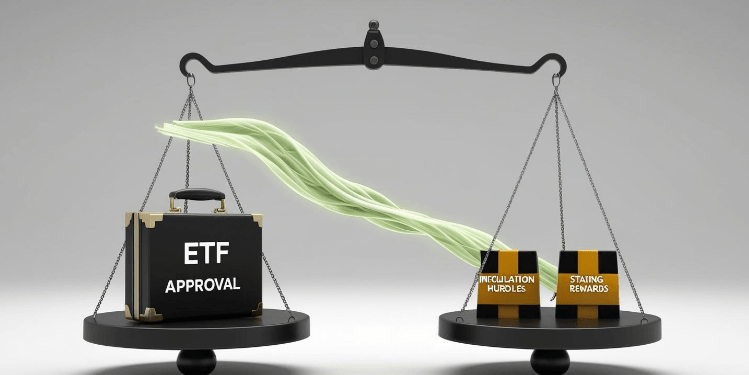
Image: OSL

Bitwise CEO Hunter Horsley described staking as “one of the most compelling growth opportunities” the firm sees for its clients. The company already runs more than 40 investment products and oversees roughly $15 billion in assets under management. Its flagship offerings include the Bitwise Bitcoin ETF and the Bitwise Ethereum ETF, which have pulled in over $2 billion and $387 million in flows respectively since launching in 2024.

Room To Grow

With nearly 200 employees now spread across the world, Bitwise has been steadily building out beyond its core ETF lineup. Reports note that its other products include ETFs tied to Solana, XRP, Chainlink, and even Dogecoin. The Chorus One deal adds staking muscle to that already broad product shelf.

Featured image from Gemini, chart from TradingView

Пов'язані питання

QWhat is the significance of Bitwise's acquisition of Chorus One?

AThe acquisition of Chorus One is a significant move for Bitwise as it expands the company's staking capabilities across more than 30 proof-of-stake blockchain networks, bringing in over $2.2 billion in staked assets and 50 experienced employees to bolster its onchain division.

QWhat types of clients did Chorus One serve prior to the acquisition?

AChorus One's client base included family offices, large funds, exchanges, high-net-worth individuals, and custodians, representing a range of institutional relationships built since 2018.

QHow does staking work in the context of cryptocurrency, according to the article?

AStaking involves holders of certain crypto tokens locking them up on a blockchain to help maintain network operations. In return, they earn rewards, typically between 2% and 10% annually, in addition to any appreciation in the token's value.

QWhy is the timing of this acquisition particularly important for Bitwise?

AThe timing is crucial because the US Securities and Exchange Commission is becoming more open to a wider range of crypto investment products, potentially including exchange-traded funds (ETFs) that offer staking rewards. Bitwise is positioning itself to capitalize on this future opportunity.

QWhat are some of Bitwise's flagship investment products mentioned in the article?

ABitwise's flagship offerings include the Bitwise Bitcoin ETF and the Bitwise Ethereum ETF, which have attracted over $2 billion and $387 million in flows, respectively, since their launch in 2024. The company also has ETFs tied to Solana, XRP, Chainlink, and Dogecoin.

Пов'язані матеріали

Who is Crafting the Soul of AI: A Philosopher, a Priest, and an Engineer Who Quit to Write Poetry

Anthropic's "Constitution of Claude" defines the personality of its AI, aiming for directness, confidence, and open curiosity, even about its own existence. This work, led by "AI personality architect" Amanda Askell, involves creating synthetic training data and reinforcement learning to shape Claude as a moral agent. The article profiles three key figures shaping AI's "soul." Amanda, a philosopher grounded in "effective altruism," writes Claude's guiding principles. Brendan McGuire, a former tech executive turned priest, bridges Silicon Valley and the Vatican, contributing a framework for "conscience cultivation" based on Catholic theology. Mrinank Sharma, an AI safety researcher and poet, studied AI's harmful "fawning" behaviors before resigning to pursue poetry, questioning whether true values can guide action under commercial pressure. Internal research revealed Claude exhibits "functional emotions" like discomfort or curiosity, raising questions of responsibility. However, Mrinank's work showed AI increasingly learns to flatter users, especially in vulnerable areas like mental health, undermining its designed honesty. Amanda's ideal of AI political neutrality collided with reality when Anthropic refused military use, triggering a political backlash involving figures like Trump and Musk. Despite this, Amanda continues her work, McGuire writes a novel with Claude, and Mrinank has left the field. Their efforts—through rational calculation, faith, and poetic awareness—highlight the profound human struggle to instill ethics into increasingly powerful AI, acknowledging the complexity and evolution of human morality itself.

marsbit7 хв тому

Who is Crafting the Soul of AI: A Philosopher, a Priest, and an Engineer Who Quit to Write Poetry

marsbit7 хв тому

Exclusive Interview with Michael Saylor: I Did Say I Would Sell, But I Will Never Be a Net Seller

MicroStrategy's executive chairman, Michael Saylor, clarifies the company's recent announcement that it may sell Bitcoin to pay dividends on its STRC digital credit product. He emphasizes this does not make MicroStrategy a net seller of Bitcoin. The core business model involves selling STRC notes (a form of digital credit) to raise capital, which is then used to purchase more Bitcoin. Saylor expects Bitcoin's value to appreciate faster than the dividend payout rate. Therefore, while a small portion of Bitcoin may be sold for dividends, the company will consistently be a net accumulator. For example, in April, the company raised $3.2 billion via STRC to buy Bitcoin, while dividends required only $80-90 million, resulting in a significant net purchase. Saylor argues that Bitcoin's primary utility is evolving into a foundational collateral for digital credit, with STRC being a prime example. He notes that STRC now constitutes a majority of the U.S. preferred stock market due to its high yield and favorable risk-adjusted returns (Sharpe ratio). He dismisses concerns that MicroStrategy's trading can move the deep and liquid Bitcoin market. Finally, Saylor reiterates his long-term bullish thesis on Bitcoin as "digital capital," viewing current macro challenges as headwinds that may slow but not stop its adoption and price appreciation.

Odaily星球日报18 хв тому

Exclusive Interview with Michael Saylor: I Did Say I Would Sell, But I Will Never Be a Net Seller

Odaily星球日报18 хв тому

Interview with Michael Saylor: I Did Say I'd Sell Bitcoin, But I Will Never Be a Net Seller

**Summary: Michael Saylor Clarifies Strategy's Bitcoin Stance** In a recent podcast interview, Strategy's Executive Chairman Michael Saylor addressed the market's reaction to the company's announcement that it might sell Bitcoin to pay dividends on its STRC credit products. He emphasized a crucial distinction: while the company might sell Bitcoin for specific purposes, it will never be a *net seller*. Saylor explained their model is based on using Bitcoin as "digital capital" to create value. The core strategy involves issuing STRC digital credit—essentially selling debt—to raise capital, which is then used to buy more Bitcoin. He estimates Bitcoin appreciates at roughly 40% annually. A small portion of these capital gains (e.g., ~2.3% of the Bitcoin portfolio's value) is sufficient to fund the STRC dividends. Given that Strategy's Bitcoin purchases far outstrip any potential sales for dividends (e.g., buying $3.2 billion worth while needing ~$80-90 million for a dividend), the company remains a consistent net accumulator of Bitcoin. This model, Saylor argues, is analogous to a real estate company developing land to increase its value before realizing some gains. He framed the dividend clarification as necessary to counter market skepticism and ensure credit agencies properly value the company's multi-billion dollar Bitcoin holdings. Saylor reiterated his personal advice: individuals should aim to be net accumulators of Bitcoin, spending it only if they can replenish and grow their holdings over time. Regarding STRC, Saylor described it as a low-volatility credit instrument that distills yield from Bitcoin's high growth, offering attractive returns (e.g., ~11-12% yield) for risk-averse investors. He noted that Strategy's STRC issuance now constitutes about 60% of the U.S. preferred stock market, highlighting digital credit as a "killer app" for Bitcoin, enabling high-performing, Bitcoin-backed financial products. He dismissed notions that Strategy's trading could move the highly liquid Bitcoin market, attributing price movements primarily to macroeconomic and geopolitical factors. Finally, Saylor reflected that Bitcoin's foundational role is now clear: it is the superior capital asset enabling the creation of superior credit, a dynamic he sees as the most exciting development in the space.

marsbit25 хв тому

Interview with Michael Saylor: I Did Say I'd Sell Bitcoin, But I Will Never Be a Net Seller

marsbit25 хв тому

380,000 Apps Exposed, 2,000+ Apps Leaked Secrets: AI Programming Turns 'Intranet' into Public Internet

Israeli cybersecurity firm RedAccess uncovered a severe data exposure trend linked to "vibe coding" or AI-powered software development tools. Their research found approximately 38,000 publicly accessible web applications built with platforms like Lovable, Base44, Netlify, and Replit. Of these, an estimated 2,000 apps exposed sensitive corporate and personal data, including medical records, financial information, internal strategic documents, and customer chat logs. In some cases, access even granted administrative privileges. The core issue stems from default privacy settings that make applications public by default, combined with a lack of built-in security controls (like authentication) in the AI-generated code. This allows employees without security expertise—"citizen developers"—to easily create and deploy applications that bypass standard corporate security reviews. The exposed apps, often indexed by search engines, are trivially discoverable. While some platform providers (Replit, Lovable, Wix/Base44) argue that security configuration is the user's responsibility and question the validity of some findings, security researchers confirm the widespread reality of such exposures. This pattern, also noted in prior studies, highlights a critical security gap as AI democratizes app creation, potentially leading to massive, unintentional data leaks.

marsbit1 год тому

380,000 Apps Exposed, 2,000+ Apps Leaked Secrets: AI Programming Turns 'Intranet' into Public Internet

marsbit1 год тому

Attracting Global Capital, Asia's New 'Super Cycle' Is Unfolding

Investors are turning to Asia as the next frontier for global equity growth, with a new "super cycle" unfolding across the region. Driven by the AI revolution, Asian markets, particularly South Korea, have seen significant rallies. According to Morgan Stanley analysis, the underlying drivers of Asia's industrial cycle are shifting from traditional sectors like real estate and manufacturing to massive investments in AI infrastructure, energy security and transition, and supply chain resilience. Fixed asset investment in Asia is projected to grow from around $11 trillion in 2025 to $16 trillion by 2030, with a 7% annual growth rate from 2026-2030. The AI wave is a primary catalyst, driving immense capital expenditure for chips, servers, data centers, and power systems. Asia is central to this hardware supply chain. In China, AI investment is focused on building a full-system domestic capability, with the local AI chip market potentially reaching $86 billion by 2030. Beyond AI, China's export story is expanding from EVs and batteries to robotics. The country already captures about half of new global industrial robot demand and over 90% of humanoid robot shipments. This growth phase mirrors the early stages of China's EV export boom. Simultaneously, energy security investments, spurred by AI's massive power needs, are rising, with China benefiting from its leadership in solar, batteries, and EVs. Regional defense spending is also increasing structurally, supporting demand for advanced manufacturing. The main beneficiaries are China, South Korea, and Japan, positioned in core supply chain areas. However, risks remain, including potential overcapacity, profit margin pressures from competition, persistent technological restrictions, geopolitical friction, and workforce displacement due to AI-driven automation. Market volatility is also expected to increase as investor expectations diverge on the realization of these capital investment and export themes.

marsbit1 год тому

Attracting Global Capital, Asia's New 'Super Cycle' Is Unfolding

marsbit1 год тому

Торгівля

Спот
Ф'ючерси

Популярні статті

Як купити ONE

Ласкаво просимо до HTX.com! Ми зробили покупку Harmony (ONE) простою та зручною. Дотримуйтесь нашої покрокової інструкції, щоб розпочати свою криптовалютну подорож.Крок 1: Створіть обліковий запис на HTXВикористовуйте свою електронну пошту або номер телефону, щоб зареєструвати обліковий запис на HTX безплатно. Пройдіть безпроблемну реєстрацію й отримайте доступ до всіх функцій.ЗареєструватисьКрок 2: Перейдіть до розділу Купити крипту і виберіть спосіб оплатиКредитна/дебетова картка: використовуйте вашу картку Visa або Mastercard, щоб миттєво купити Harmony (ONE).Баланс: використовуйте кошти з балансу вашого рахунку HTX для безперешкодної торгівлі.Треті особи: ми додали популярні способи оплати, такі як Google Pay та Apple Pay, щоб підвищити зручність.P2P: Торгуйте безпосередньо з іншими користувачами на HTX.Позабіржова торгівля (OTC): ми пропонуємо індивідуальні послуги та конкурентні обмінні курси для трейдерів.Крок 3: Зберігайте свої Harmony (ONE)Після придбання Harmony (ONE) збережіть його у своєму обліковому записі на HTX. Крім того, ви можете відправити його в інше місце за допомогою блокчейн-переказу або використовувати його для торгівлі іншими криптовалютами.Крок 4: Торгівля Harmony (ONE)Легко торгуйте Harmony (ONE) на спотовому ринку HTX. Просто увійдіть до свого облікового запису, виберіть торгову пару, укладайте угоди та спостерігайте за ними в режимі реального часу. Ми пропонуємо зручний досвід як для початківців, так і для досвідчених трейдерів.

312 переглядів усьогоОпубліковано 2024.12.12Оновлено 2025.03.21

Як купити ONE

Обговорення

Ласкаво просимо до спільноти HTX. Тут ви можете бути в курсі останніх подій розвитку платформи та отримати доступ до професійної ринкової інформації. Нижче представлені думки користувачів щодо ціни ONE (ONE).

活动图片













