Bitwise Plants Its Flag In ETF Staking With Chorus One Buyout

bitcoinistОпубліковано о 2026-02-26Востаннє оновлено о 2026-02-26

Анотація

Crypto asset manager Bitwise has acquired staking infrastructure firm Chorus One, which manages over $2.2 billion in assets across dozens of blockchain networks. The deal brings 50 employees into Bitwise's onchain division and expands its staking services to more than 30 proof-of-stake networks, including Solana, Avalanche, and Sui. While financial terms were undisclosed, the acquisition positions Bitwise to capitalize on staking as a key growth opportunity, especially as the SEC warms to crypto investment products like ETFs that may offer staking rewards. Bitwise, which already manages $15 billion in assets and runs over 40 investment products, including its Bitcoin and Ethereum ETFs, continues to expand beyond its core ETF offerings.

Crypto asset manager Bitwise just made one of its boldest moves yet. The company has acquired Chorus One, a staking infrastructure firm that manages more than $2.2 billion in assets across dozens of blockchain networks. The deal brings 50 Chorus One employees into Bitwise’s growing onchain division, where several billion dollars in crypto assets are already being staked by clients.

Financial Terms Undisclosed

Chorus One has been in the staking business since 2018. Over those years, it built a client base that includes family offices, large funds, exchanges, high-net-worth individuals, and custodians — the kind of institutional relationships that take years to earn. Its founder and CEO, Brian Crain, will stay on in an advisory role as the rest of the team folds into Bitwise Onchain Solutions.
Image: Bitwise Asset Management

Reports say the financial terms of the deal were not made public. Bitwise did not disclose how much it paid.

What is clear, though, is what the company gets out of it. The acquisition extends Bitwise’s staking reach across more than 30 proof-of-stake networks — among them Solana, Avalanche, Sui, Aptos, Hyperliquid, Monad, and Tezos. That is a wide net, and it signals the company is not thinking just about Ethereum.

BTCUSD now trading at $65,247. Chart: TradingView

Staking, for those unfamiliar, works like this: holders of certain crypto tokens lock them up on a blockchain to help keep the network running. In return, they earn rewards — typically somewhere between 2% and 10% a year, on top of any gains from the token itself.

Why The Timing Matters

The US Securities and Exchange Commission has been warming up to a wider range of crypto investment products. That shift has opened the door for new types of exchange-traded funds, including ones that could one day offer staking rewards to ordinary investors. Bitwise appears to be positioning itself for exactly that possibility.
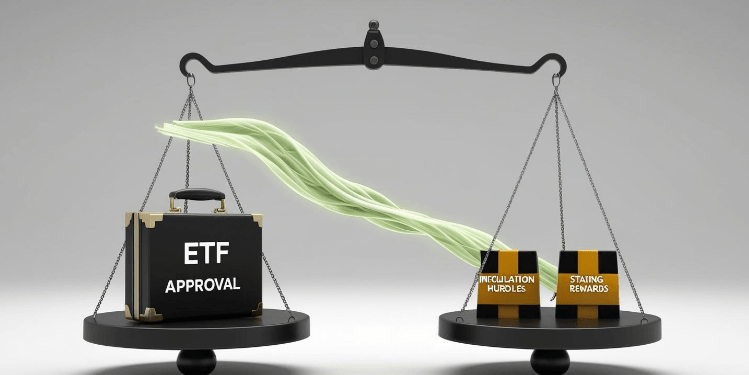
Image: OSL

Bitwise CEO Hunter Horsley described staking as “one of the most compelling growth opportunities” the firm sees for its clients. The company already runs more than 40 investment products and oversees roughly $15 billion in assets under management. Its flagship offerings include the Bitwise Bitcoin ETF and the Bitwise Ethereum ETF, which have pulled in over $2 billion and $387 million in flows respectively since launching in 2024.

Room To Grow

With nearly 200 employees now spread across the world, Bitwise has been steadily building out beyond its core ETF lineup. Reports note that its other products include ETFs tied to Solana, XRP, Chainlink, and even Dogecoin. The Chorus One deal adds staking muscle to that already broad product shelf.

Featured image from Gemini, chart from TradingView

Пов'язані питання

QWhat is the significance of Bitwise's acquisition of Chorus One?

AThe acquisition of Chorus One is a significant move for Bitwise as it expands the company's staking capabilities across more than 30 proof-of-stake blockchain networks, bringing in over $2.2 billion in staked assets and 50 experienced employees to bolster its onchain division.

QWhat types of clients did Chorus One serve prior to the acquisition?

AChorus One's client base included family offices, large funds, exchanges, high-net-worth individuals, and custodians, representing a range of institutional relationships built since 2018.

QHow does staking work in the context of cryptocurrency, according to the article?

AStaking involves holders of certain crypto tokens locking them up on a blockchain to help maintain network operations. In return, they earn rewards, typically between 2% and 10% annually, in addition to any appreciation in the token's value.

QWhy is the timing of this acquisition particularly important for Bitwise?

AThe timing is crucial because the US Securities and Exchange Commission is becoming more open to a wider range of crypto investment products, potentially including exchange-traded funds (ETFs) that offer staking rewards. Bitwise is positioning itself to capitalize on this future opportunity.

QWhat are some of Bitwise's flagship investment products mentioned in the article?

ABitwise's flagship offerings include the Bitwise Bitcoin ETF and the Bitwise Ethereum ETF, which have attracted over $2 billion and $387 million in flows, respectively, since their launch in 2024. The company also has ETFs tied to Solana, XRP, Chainlink, and Dogecoin.

Пов'язані матеріали

Has the 'Digital Gold' Narrative for BTC Failed?

**Title: Has the "Digital Gold" Narrative for Bitcoin Failed?** The article argues that Bitcoin's "digital gold" narrative remains valid despite a recent sharp price decline (from a peak near $126k in Oct 2025 to briefly under $61k in Feb 2026). It presents a long-term investment framework based on three core points: **1. Viewing Bitcoin as an Asset:** Bitcoin is presented as a superior potential store of value compared to gold. Key arguments are its absolute scarcity (21 million cap), superior portability, and transparent auditability via its public ledger. While acknowledging its current use in early, volatile stages (~3-4% global adoption), the author draws parallels to the early, disruptive phases of the internet and e-commerce. **2. Understanding the Recent Downturn:** The current ~50% correction is framed as a predictable, consensus-driven cycle following its post-halving peak (the 2024 halving preceded the Oct 2025 high). A crucial factor is a historic "changing of hands": the influx of new institutional buyers via ETFs allowed early, low-cost holders (miners, OG believers) to take profits. The author notes that while severe, Bitcoin's historical drawdowns (e.g., 93% in 2011, 77% in 2021-22) have been progressively smaller, suggesting maturing holder structure and decreasing volatility over time. **3. The Long-Term Perspective:** The long-term thesis hinges on Bitcoin capturing a portion of gold's market value. With Bitcoin's market cap at ~$1.4 trillion (at $70k) versus gold's ~$20 trillion, significant upside potential exists if the "digital gold" narrative is partially realized. However, the author strongly cautions that short-term risks remain, the bottom is unpredictable, and high volatility is inherent. The real risk is not Bitcoin failing but poor personal position management (over-leverage, wrong capital) and a lack of deep understanding, which can force investors out during severe downturns. The conclusion uses Amazon's 95% crash post-2000 dot-com bubble and subsequent 42x recovery as an analogy. The ultimate question is not if Bitcoin's price will rise, but if an investor's strategy and conviction can withstand the volatility to see the long-term play out. The recent divergence (gold up, Bitcoin down) is posed not as a narrative failure, but as potential evidence of this ongoing, painful transition from a speculative asset to a mainstream allocation.

marsbit7 год тому

Has the 'Digital Gold' Narrative for BTC Failed?

marsbit7 год тому

Has BTC's 'Digital Gold' Narrative Failed?

The article discusses Bitcoin's "digital gold" narrative, its recent price drop, and long-term outlook through the perspective of "Jason". It argues the narrative is not a failure but that Bitcoin represents a superior, new asset class due to its fixed supply (21 million), portability, and auditability. The piece compares its current ~3-4% global adoption rate to early internet/e-commerce, suggesting significant growth potential. Regarding the 2025-2026 price decline (from ~$126k to briefly under $61k), the author views it as a predictable, consensus-driven sell-off within Bitcoin's ~4-year cycle post-halving, exacerbated by a major "handover" from early, low-cost holders to new institutional buyers via ETFs. A key observation is that historical peak-to-trough drawdowns have lessened over time (e.g., 93% in 2011 to ~50% in 2026), indicating maturing volatility as holder structure changes. For the long term, the author uses a simple framework: Bitcoin's total market cap (~$1.4T at $70k) is only about 7% of gold's (~$20T). Even capturing 30-50% of gold's value would imply substantial upside. However, the article strongly cautions against viewing this as investment advice, emphasizing extreme volatility and the critical importance of risk management, position sizing, and deep fundamental understanding to survive severe drawdowns. It concludes by drawing a parallel to Amazon's 95% crash in 2000 and subsequent 42x recovery, stressing that the key is surviving market cycles to realize long-term potential.

链捕手7 год тому

Has BTC's 'Digital Gold' Narrative Failed?

链捕手7 год тому

From Code to Cognition: A Ten-Thousand-Word Guide to the Evolution of the Robot Brain

"From Code to Cognition: The Evolution of Robot Brains" The journey of robotic intelligence has shifted dramatically from manually coded systems to AI-driven brains. For decades, robots relied on layered software stacks—perception, state estimation, planning, control—each handcrafted. While predictable, they lacked adaptability. The 2010s saw deep learning revolutionize perception (e.g., object detection) and control (via reinforcement learning), but learned skills remained narrow. The arrival of Large Language Models (LLMs) marked a turning point. LLMs acted as high-level planners, interpreting natural language instructions and generating sequences of actions for traditional robotic systems to execute. However, true integration came with Visual-Language-Action (VLA) models, which fused vision, language, and motion prediction into a single network. Pioneered by models like RT-2 and open-source projects like OpenVLA, VLAs enable robots to reason and act directly from visual input and commands. The most advanced humanoid robots now employ a "dual-brain" architecture: a slow-thinking, large VLA (System 2) for reasoning and planning, and a fast-reacting, small network (System 1) for high-frequency motion control, sometimes with an even lower-level System 0 for balance. This split balances cognition with the physics of real-time movement. Computation is split between onboard hardware (e.g., NVIDIA Jetson) for safety-critical control loops and cloud/edge servers for non-critical tasks like learning and interfaces. A crucial driver is the open-source ecosystem—models like GR00T and OpenVLA allow startups to build upon pre-trained brains and fine-tune them with their own data, accelerating development. Despite progress, current systems struggle with recovery from errors, sample inefficiency, and long-horizon tasks. This has spurred the rise of **World Models**—neural networks that predict the consequences of actions. By simulating possible futures before acting (like NVIDIA Cosmos or Meta V-JEPA), robots can plan, recover, and generalize better. This represents the next frontier: shifting intelligence from learned reactions to an internal model of physics and cause-and-effect. The field is rapidly evolving. While not yet at its "ChatGPT moment," the convergence of cheaper hardware, scalable simulation, and world models points toward robots that are increasingly capable, adaptive, and useful. The question is shifting from "what can robots do?" to "what *should* they do?"

marsbit8 год тому

From Code to Cognition: A Ten-Thousand-Word Guide to the Evolution of the Robot Brain

marsbit8 год тому

Торгівля

Спот
Ф'ючерси

Популярні статті

Як купити ONE

Ласкаво просимо до HTX.com! Ми зробили покупку Harmony (ONE) простою та зручною. Дотримуйтесь нашої покрокової інструкції, щоб розпочати свою криптовалютну подорож.Крок 1: Створіть обліковий запис на HTXВикористовуйте свою електронну пошту або номер телефону, щоб зареєструвати обліковий запис на HTX безплатно. Пройдіть безпроблемну реєстрацію й отримайте доступ до всіх функцій.ЗареєструватисьКрок 2: Перейдіть до розділу Купити крипту і виберіть спосіб оплатиКредитна/дебетова картка: використовуйте вашу картку Visa або Mastercard, щоб миттєво купити Harmony (ONE).Баланс: використовуйте кошти з балансу вашого рахунку HTX для безперешкодної торгівлі.Треті особи: ми додали популярні способи оплати, такі як Google Pay та Apple Pay, щоб підвищити зручність.P2P: Торгуйте безпосередньо з іншими користувачами на HTX.Позабіржова торгівля (OTC): ми пропонуємо індивідуальні послуги та конкурентні обмінні курси для трейдерів.Крок 3: Зберігайте свої Harmony (ONE)Після придбання Harmony (ONE) збережіть його у своєму обліковому записі на HTX. Крім того, ви можете відправити його в інше місце за допомогою блокчейн-переказу або використовувати його для торгівлі іншими криптовалютами.Крок 4: Торгівля Harmony (ONE)Легко торгуйте Harmony (ONE) на спотовому ринку HTX. Просто увійдіть до свого облікового запису, виберіть торгову пару, укладайте угоди та спостерігайте за ними в режимі реального часу. Ми пропонуємо зручний досвід як для початківців, так і для досвідчених трейдерів.

350 переглядів усьогоОпубліковано 2024.12.12Оновлено 2026.06.02

Як купити ONE

Обговорення

Ласкаво просимо до спільноти HTX. Тут ви можете бути в курсі останніх подій розвитку платформи та отримати доступ до професійної ринкової інформації. Нижче представлені думки користувачів щодо ціни ONE (ONE).

活动图片













