Bitwise Files With SEC to Launch First Uniswap ETF in U.S. Markets

TheNewsCryptoОпубліковано о 2026-02-06Востаннє оновлено о 2026-02-06

Анотація

Bitwise Asset Management has filed with the SEC to launch the first U.S. ETF focused solely on Uniswap’s UNI token. The proposed fund aims to provide regulated exposure to UNI through a conventional investment vehicle, without staking the tokens. Coinbase Custody is set to serve as the custodian. This filing follows the SEC’s recent conclusion of its investigation into Uniswap Labs, easing regulatory concerns. If approved, the ETF would mark a significant step in offering institutional and retail investors traditional access to a DeFi governance token, reflecting growing demand for regulated crypto investment products.

Bitwise Asset Management has filed a registration statement with the U.S. Securities and Exchange Commission to launch an exchange-traded fund focused on Uniswap. The offering would give investors regulated exposure to the governing UNI token via a traditional investment vehicle. If approved, it will become the first ETF to focus on a DeFi protocol token in the United States.
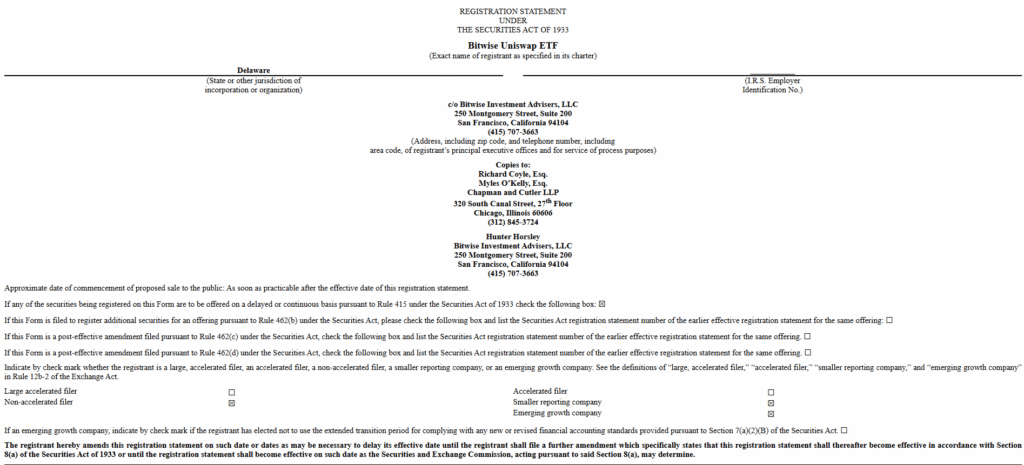
The Bitwise Uniswap ETF would have the UNI token as its main asset for tracking investor exposure. “The Trust’s investment objective is to provide exposure to the value of UNI, less the Trust’s expenses”. If approved, Coinbase Custody Trust Company will serve as the ETF custodian. Meanwhile, Bitwise has confirmed there will be no staking of UNI tokens associated with the proposed ETF at the time of its inception.
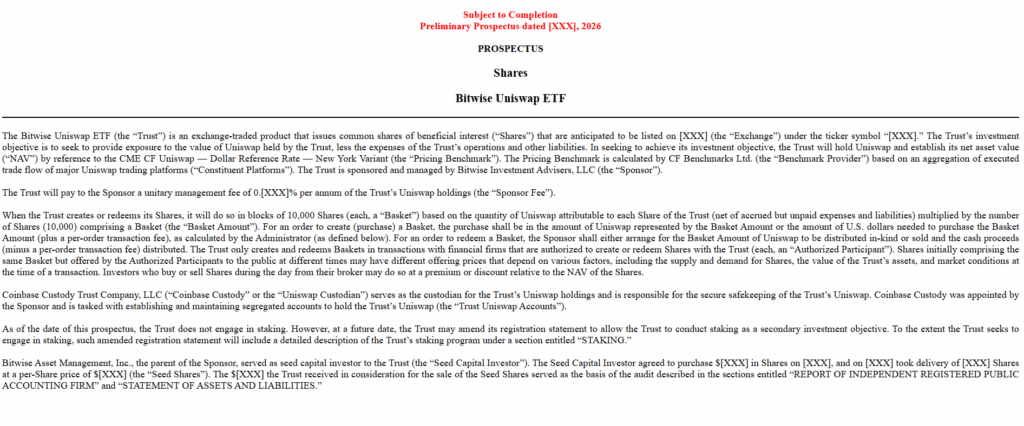
On Thursday, the SEC officially made the filing, bringing the product a step closer to the general financial markets. Indeed, access to DeFi coins via traditional applications has been a major focus for the firm, as stated, as an emerging trend with institutional investment demand. Brokerage accounts could potentially facilitate the ETF, opening more avenues for the UNI asset class. This filing will be part of a trend in crypto ETF filings in the U.S., which started in 2021 with the change in regulations.

Regulatory and Market Context

This comes when the SEC concluded its investigation into the case involving Uniswap Labs last year, which eased regulation issues facing the decentralized finance protocols. Delaware statutory trust filings were the foundation before submitting to the SEC for its approval. Trust filings are technical processes before an actual filing is made to the SEC.

An actual filing of the S-1 form signifies their readiness to start the regulatory process for their Uniswap ETF product. Analysts have revealed that it remains to be seen when the ETF will complete the review and approval process when it is sent to the SEC for processing. The ETF’s standard to trade on the US stock exchange will be determined by the SEC.

Bitwise filing for a Uniswap ETF with the SEC marks a new milestone for bringing a DeFi governance token into a regulated investment product. The new fund would be designed to give investors traditional exposure to UNI without token staking, pending regulatory approval. This action underscores ongoing institutional appetite for regulated crypto-investment vehicles linked to decentralized finance protocols.

Highlighted Crypto News:

Public Retirement Funds Hit by Sharp Decline Amid Bitcoin Slump

TagsBitwiseBlockchainDeFiETFSECUniswapUniswap (UNI)

Пов'язані питання

QWhat is the main asset that the Bitwise Uniswap ETF will use to track investor exposure?

AThe UNI token.

QWhich company will serve as the custodian for the proposed Bitwise Uniswap ETF?

ACoinbase Custody Trust Company.

QWhat significant regulatory event involving Uniswap Labs occurred last year, as mentioned in the article?

AThe SEC concluded its investigation into the case involving Uniswap Labs.

QWhat type of filing with the SEC signifies Bitwise's readiness to start the regulatory process for the Uniswap ETF?

AThe filing of an S-1 form.

QAccording to the article, what will the proposed ETF NOT involve at the time of its inception?

AStaking of UNI tokens.

Пов'язані матеріали

Bitcoin Withdrawals Continue: 8 Years of Storage in a Coldcard Cold Wallet Ended in Zero

Coldcard Hardware Wallet Hacked: Losses Mount Due to Vulnerable Seed Generation A critical vulnerability in Coldcard hardware wallets has led to a continued wave of fund thefts. According to Galaxy Research, the total stolen has reached 1,367.05 BTC (approx. $88.6 million) from 4,585 addresses, a significant increase from the initial 594.5 BTC reported on July 30, 2026. Most of the stolen funds remain on the attackers' addresses. The issue is not with the current firmware, which Coinkite has updated, but with seed phrases generated on vulnerable devices between March 2021 and the release of fixed firmware versions. Due to a programmer error, devices switched from using a hardware random number generator to the software-based Yasmarang generator, which was initialized with publicly accessible data like the chip's serial number. This made the seed phrases predictable through offline brute-force attacks, meaning wallets remain at risk until funds are moved to a new wallet generated with the patched firmware. Affected devices include Mk2/Mk3 with firmware 4.0.1–4.1.9 (and up to 5.0.3), Mk4/Mk5 up to version 5.6.0, and Q models up to 1.5.0Q. The only exceptions are seeds created with a high-entropy method like at least 50 independent dice rolls or a strong unique BIP-39 passphrase. All other owners must generate a new seed on the fixed firmware and transfer their assets. A case highlighting the human impact involves a 39-year-old long-term investor who lost 2 BTC (approx. $130,000) in minutes. He had accumulated the Bitcoin over eight years through physical labor, viewing it as a financial lifeline and a retirement plan in a country suffering from hyperinflation. His story underscores that even conservative "buy and hold in cold storage" strategies can be compromised by such underlying technical flaws. From a technical perspective, this incident echoes historical failures where weak random number generators undermined cryptographic security, challenging the assumption that offline storage is automatically foolproof.

cryptonews.ru3 год тому

Bitcoin Withdrawals Continue: 8 Years of Storage in a Coldcard Cold Wallet Ended in Zero

cryptonews.ru3 год тому

Торгівля

Спот
活动图片





