Bitwise Files With SEC to Launch First Uniswap ETF in U.S. Markets

TheNewsCryptoОпубліковано о 2026-02-06Востаннє оновлено о 2026-02-06

Анотація

Bitwise Asset Management has filed with the SEC to launch the first U.S. ETF focused solely on Uniswap’s UNI token. The proposed fund aims to provide regulated exposure to UNI through a conventional investment vehicle, without staking the tokens. Coinbase Custody is set to serve as the custodian. This filing follows the SEC’s recent conclusion of its investigation into Uniswap Labs, easing regulatory concerns. If approved, the ETF would mark a significant step in offering institutional and retail investors traditional access to a DeFi governance token, reflecting growing demand for regulated crypto investment products.

Bitwise Asset Management has filed a registration statement with the U.S. Securities and Exchange Commission to launch an exchange-traded fund focused on Uniswap. The offering would give investors regulated exposure to the governing UNI token via a traditional investment vehicle. If approved, it will become the first ETF to focus on a DeFi protocol token in the United States.
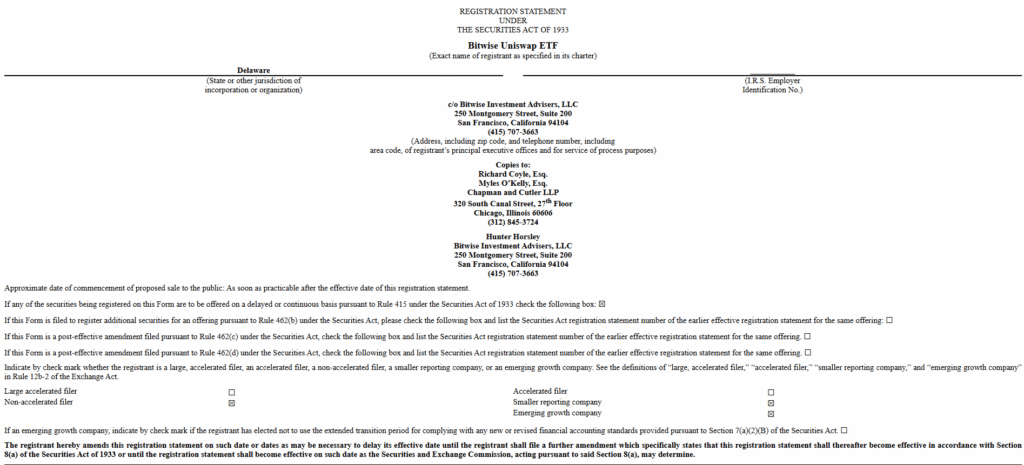
The Bitwise Uniswap ETF would have the UNI token as its main asset for tracking investor exposure. “The Trust’s investment objective is to provide exposure to the value of UNI, less the Trust’s expenses”. If approved, Coinbase Custody Trust Company will serve as the ETF custodian. Meanwhile, Bitwise has confirmed there will be no staking of UNI tokens associated with the proposed ETF at the time of its inception.
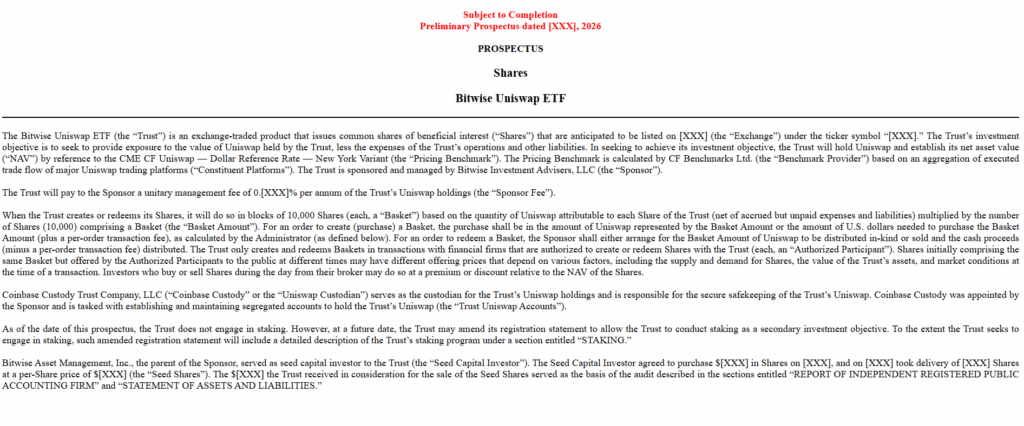
On Thursday, the SEC officially made the filing, bringing the product a step closer to the general financial markets. Indeed, access to DeFi coins via traditional applications has been a major focus for the firm, as stated, as an emerging trend with institutional investment demand. Brokerage accounts could potentially facilitate the ETF, opening more avenues for the UNI asset class. This filing will be part of a trend in crypto ETF filings in the U.S., which started in 2021 with the change in regulations.

Regulatory and Market Context

This comes when the SEC concluded its investigation into the case involving Uniswap Labs last year, which eased regulation issues facing the decentralized finance protocols. Delaware statutory trust filings were the foundation before submitting to the SEC for its approval. Trust filings are technical processes before an actual filing is made to the SEC.

An actual filing of the S-1 form signifies their readiness to start the regulatory process for their Uniswap ETF product. Analysts have revealed that it remains to be seen when the ETF will complete the review and approval process when it is sent to the SEC for processing. The ETF’s standard to trade on the US stock exchange will be determined by the SEC.

Bitwise filing for a Uniswap ETF with the SEC marks a new milestone for bringing a DeFi governance token into a regulated investment product. The new fund would be designed to give investors traditional exposure to UNI without token staking, pending regulatory approval. This action underscores ongoing institutional appetite for regulated crypto-investment vehicles linked to decentralized finance protocols.

Highlighted Crypto News:

Public Retirement Funds Hit by Sharp Decline Amid Bitcoin Slump

TagsBitwiseBlockchainDeFiETFSECUniswapUniswap (UNI)

Пов'язані питання

QWhat is the main asset that the Bitwise Uniswap ETF will use to track investor exposure?

AThe UNI token.

QWhich company will serve as the custodian for the proposed Bitwise Uniswap ETF?

ACoinbase Custody Trust Company.

QWhat significant regulatory event involving Uniswap Labs occurred last year, as mentioned in the article?

AThe SEC concluded its investigation into the case involving Uniswap Labs.

QWhat type of filing with the SEC signifies Bitwise's readiness to start the regulatory process for the Uniswap ETF?

AThe filing of an S-1 form.

QAccording to the article, what will the proposed ETF NOT involve at the time of its inception?

AStaking of UNI tokens.

Пов'язані матеріали

Podcast Notes | Conversation with GSR Asset Management Head: To Determine if This Crypto Rally is Real, Just Watch the Lending Rates on Aave

Podcast Summary: Dialogue with GSR's Head of Asset Management: To Determine if This Crypto Rally is Real, Just Check Lending Rates on Aave Andy Baehr, Managing Director of Asset Management at GSR, discusses the current crypto market, characterizing it as stuck in a state of "ambivalence" with short-lived, unsustainable rallies. He outlines a simple framework: the market moves between "ambivalence" and "conviction" (sustained upward momentum). Currently, every rally resembles a single-stage rocket booster that quickly fizzles out. Baehr identifies three key signals to watch: 1) DeFi lending rates, 2) the potential passage of the CLARITY Act, and 3) the market forming a consensus on the "Fed hawkish peak." He emphasizes that the most immediate indicator for the sustainability of the recent CPI-triggered rally is the USDC borrowing rate on Aave, currently around 3.75%—close to U.S. Treasury yields. The absence of a credit spread indicates low leverage demand and a lack of market energy. He explains that a healthy, sustained rally requires layered buying pressure. Last year's rally progressed from an ETH short squeeze to crypto-native trader influx and finally to ETF inflows. Currently, this structure is missing. Other potential structural buyers like Digital Asset Treasury (DAT) companies are absent, and ETF flows have proven transient. Baehr notes that while small-cap crypto tokens outperformed large caps in Q2—a potential sign of capitation in major assets—capital is also flowing to more exciting opportunities like AI stocks and tech IPOs, leaving crypto sidelined. Regarding DeFi, he highlights that platforms like Aave provide a clear, real-time signal of leverage demand through their supply/demand-driven interest rates. A significant, sustained rate increase would signal genuine market conviction. He also observes the quiet emergence of fixed-income-like products and vaults in DeFi. On regulation, the probability of the CLARITY Act passing before the August 7th deadline has dropped linearly from 75% to below 40% on Polymarket. Baehr suggests its passage would be treated as a bullish surprise, a potent driver for price movement. However, political hurdles, including ethical clause debates and disclosures about the First Family's crypto profits, remain significant obstacles. Ultimately, the market awaits clarity on the Fed's terminal rate under Chair Warsh. Until the "Fed Solstice"—the point where the market collectively understands the peak of hawkish policy—sustained conviction will be difficult to achieve.

marsbit32 хв тому

Podcast Notes | Conversation with GSR Asset Management Head: To Determine if This Crypto Rally is Real, Just Watch the Lending Rates on Aave

marsbit32 хв тому

7 Months After the Collapse of Huiwang, Southeast Asia's Escrow Platforms Undergo a Major Reshuffle

Following the collapse of Huione Pay—dubbed the "Alipay of Southeast Asia"—seven months ago, the region's underground financial guarantee platform sector is undergoing a significant reshuffle. This power vacuum has been swiftly filled by emerging platforms such as XinBi, Tiger/Navigator, JinBei (renamed JinBo), Dali/Tiancheng, and FullyLight. These platforms, operating largely via Telegram and offering services like escrow for illicit transactions, have absorbed the vast user base and markets left behind by Huione. While positioning themselves as "trust intermediaries," their primary clientele consists of networks involved in online scams, money laundering, illegal gambling, and even human trafficking. For instance, the Tiger/Navigator platform explicitly provides "escrow" services for kidnapping-for-ransom operations ("强押车交易"). Data underscores the immense scale: Huione alone processed over $103 billion in cryptocurrency payments and facilitated over $31 billion through its escrow market before its downfall, linking it to Cambodia's notorious Prince Group. Since its collapse, competitors have seen explosive growth. For example, the XinBi platform has accumulated over $1.6 billion in total USDT revenue, while platforms like NewPay, OkPay (under Dali), and FullyLight Wallet collectively processed over $4.8 billion in USDT in a single year. This ecosystem thrives in regions like Cambodia and Myanmar, where regulatory gaps allow these platforms to act as critical financial infrastructure for sprawling cybercrime industries, from scam compounds to online casinos. The article concludes that the moniker "Southeast Asian Alipay" is a misnomer, obscuring the platforms' fundamental role in enabling serious criminal enterprises rather than representing legitimate financial innovation.

Odaily星球日报1 год тому

7 Months After the Collapse of Huiwang, Southeast Asia's Escrow Platforms Undergo a Major Reshuffle

Odaily星球日报1 год тому

Торгівля

Спот
活动图片





