Bitwise crypto index fund moves from over-the-counter to NYSE Arca for trading

cointelegraphОпубліковано о 2025-12-09Востаннє оновлено о 2025-12-09

Анотація

Bitwise Asset Management's 10 Crypto Index Fund (BITW) is transitioning from the over-the-counter market to NYSE Arca, marking a significant step toward mainstream adoption. The fund, which offers diversified exposure to the top 10 cryptocurrencies like Bitcoin and Ethereum, will now trade as an exchange-traded product on a major regulated securities exchange. This move is expected to reduce investment friction and provide a safer, more accessible entry point for investors hesitant about direct crypto exposure. Bitwise, an early issuer of a spot Bitcoin ETF, has seen growing institutional interest amid regulatory developments and market volatility, including recent large liquidations and subsequent inflows into crypto ETPs.

Bitwise Asset Management’s 10 Crypto Index Fund (BITW) is moving from the over-the-counter market to NYSE Arca, a shift that brings crypto exposure further into mainstream trading infrastructure.

Beginning Tuesday, BITW is officially uplisted to NYSE Arca — one of the New York Stock Exchange’s electronic markets for exchange-traded products — where it will trade as an exchange-traded product, the company announced.

Launched in 2017, BITW offers diversified exposure to the 10 largest cryptocurrencies by market capitalization, including Bitcoin (BTC), Ether (ETH), Solana (SOL) and XRP (XRP). The fund rebalances monthly to reflect changes in the broader crypto market.

Listing on NYSE Arca places a crypto-linked product on a major regulated securities exchange, the same type of venue where traditional exchange-traded funds (ETFs) trade. The move is expected to reduce friction for investors who may be hesitant to navigate crypto exchanges.

“Most investors we meet are convinced crypto is here to stay, but they don't know who the winners will be or how many will succeed," said Bitwise CIO Matt Hougan. “The index approach is a way for people to invest in the thesis without having to predict the future.”
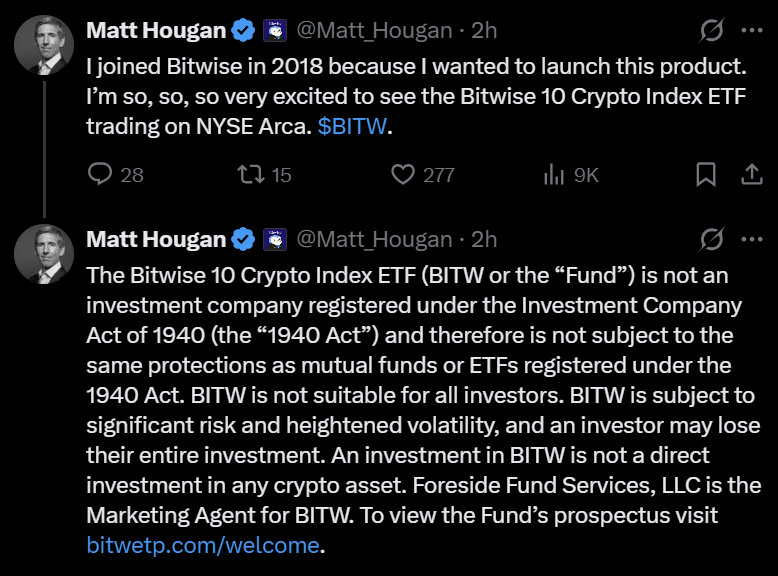
Source: Matt Hougan

Bitwise was among the first issuers to receive approval for a spot Bitcoin ETF in January 2024. Its Bitwise Bitcoin ETF Trust (BITB) was one of the fastest 25 exchange-traded products to reach $1 billion in assets, hitting the milestone roughly a month after launch.

Related: Bitwise files for stablecoin, tokenization ETF with US SEC

Institutional adoption and market volatility

Institutional interest in digital assets has expanded rapidly since the approval of US spot Bitcoin ETFs in early 2024. The arrival of the more crypto-friendly Trump administration has further accelerated adoption through increased regulatory attention, new legislation and a federal mandate to support the industry’s development.

At the same time, institutional investors have been reminded of the sector’s inherent volatility, which remains elevated even as larger and more established participants enter the market.

Crypto markets saw their largest-ever liquidation event on Oct. 10, when roughly $19 billion in positions were wiped out. The resulting turbulence over the following month triggered sharp withdrawals and significant outflows from crypto exchange-traded products.

However, inflows have resumed in the last two weeks, with ETP inflows exceeding $1.7 billion over that period, according to CoinShares data.
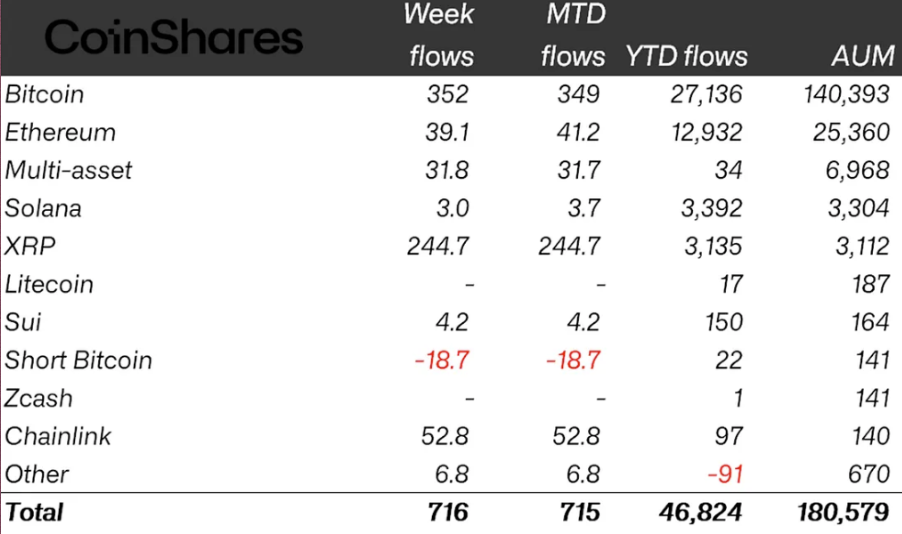
Inflows into crypto ETPs flip positive for two consecutive weeks. Source: CoinShares


Magazine: Decade after Ethereum ICO: Blockchain forensics end double-spending debate
Пов'язані матеріали

Robinhood CEO named three benefits of tokenized stocks for American investors

Robinhood CEO Vlad Tenev advocates for the U.S. to allow trading of tokenized stocks domestically. He argues this model could modernize the financial system through three key benefits: **faster, near real-time settlements** reducing counterparty risk and broker capital requirements; **24/7 trading** enabling reaction to market events anytime; and **greater asset portability**, allowing tokens to be moved between platforms and held in self-custody wallets, increasing competition among services. Tenev emphasized tokenization is about rebuilding asset ownership infrastructure for freer movement, similar to information online. He highlighted potential integration with DeFi, where tokenized stocks could be used for lending or as collateral. Currently, Robinhood's stock tokens are not direct ownership of the underlying securities but are backed by them and provide access to economic value like dividends; their structure may evolve with future regulations. Tenev identified outdated securities laws and market infrastructure, developed over a century, as the main U.S. obstacle, urging regulators to adapt rules for blockchain while preserving investor protections. He warned it would be strange if the rest of the world could build the future of ownership around U.S. assets while Americans are left behind, suggesting tokenization could later expand to private company shares and other illiquid assets.

cryptonews.ru19 хв тому

Robinhood CEO named three benefits of tokenized stocks for American investors

cryptonews.ru19 хв тому

Web3 Wallets in a 'Turbulent Autumn': In the AI Era, How to Understand the Evolution of 'Spear and Shield' in Crypto Security?

The recent spate of incidents involving Coldcard, Trezor, and SafePal highlights a critical evolution in cryptocurrency wallet security, moving the focus beyond simple private key protection to a holistic, multi-layered attack surface. These events—spanning a random number generator flaw, supply chain data leaks, and plugin permission issues—underscore that vulnerabilities now exist across the entire wallet lifecycle: from secure element and code generation to logistics, user data, and daily interactions with dApps. This broadening threat landscape is accelerating with the advent of AI. Attackers are leveraging AI to automate and scale previously labor-intensive tasks like vulnerability discovery, sophisticated social engineering, and targeted phishing campaigns. This effectively lowers the cost of attacks, eroding the security margin once provided by the high effort required to find and exploit flaws. In response, defense strategies must also evolve by integrating AI. The future of wallet security lies not just in static rules and blacklists, but in proactive, AI-powered risk assessment. This includes pre-transaction simulation, behavioral analysis to detect anomalies (like sudden large approvals), and contextual awareness of dApps and counterparties. The goal is to transform wallets from passive signing tools into active guardians that can understand intent, predict outcomes, and clearly communicate risks to users—all while preserving user sovereignty and control through minimal permissions and human confirmation for critical actions. Ultimately, self-custody does not guarantee inherent safety; it returns absolute control to the user. Protecting that control requires a dynamic, evolving security posture where AI becomes a essential tool on both sides of an ongoing "spear and shield" arms race in the Web3 ecosystem.

marsbit29 хв тому

Web3 Wallets in a 'Turbulent Autumn': In the AI Era, How to Understand the Evolution of 'Spear and Shield' in Crypto Security?

marsbit29 хв тому

Торгівля

Спот
活动图片