BitMine’s $ETH Holdings Reach $10.7B After New Purchase as MAXI Soars

bitcoinistОпубліковано о 2026-02-03Востаннє оновлено о 2026-02-03

Анотація

BitMine, a major digital asset mining firm, has significantly expanded its Ethereum holdings to $10.7 billion through a strategic acquisition, signaling a shift toward institutional balance sheet strengthening amid a tightening ETH market. This large-scale accumulation reduces circulating supply, potentially raising Ethereum's price floor. Meanwhile, retail traders are shifting toward high-risk, high-reward meme tokens like Maxi Doge ($MAXI), which positions itself as a leveraged trading-focused project within the Ethereum ecosystem. Having raised over $4.5M in its presale, $MAXI incorporates staking mechanisms and community incentives, appealing to traders seeking outsized returns. The trend highlights a market divergence between institutional accumulation and retail speculation.

Institutional capital isn’t just tiptoeing around Ethereum anymore; it’s stomping in. BitMine, a heavyweight in digital asset mining, has officially expanded its Ether treasury to a massive $10.7B following its latest strategic acquisition.

This purchase marks a pivotal shift in market structure, moving beyond simple speculation toward genuine balance sheet fortification.
The timing is critical. On-chain metrics are already flashing signs of a deepening supply squeeze as exchange reserves hit multi-year lows. BitMine’s aggressive buying acts as a volatility dampener for the second-largest cryptocurrency.
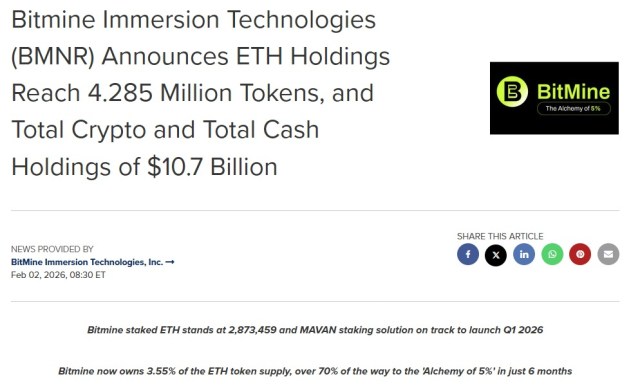
That matters. Large-scale accumulation usually precedes a reduction in liquidity, where price discovery becomes hypersensitive to marginal demand. When entities like BitMine lock billions in cold storage, they effectively remove that supply from circulation, theoretically establishing a higher price floor.

While institutions play the safe long game with blue-chip assets, retail traders are signaling a different kind of appetite. The stability provided by these institutional floors often emboldens high-frequency traders to seek alpha further out on the risk curve. This rotation of capital, from safety to speculation, is fueling a surge in the meme token sector.

That’s where Maxi Doge ($MAXI) has emerged as a focal point for traders seeking high-leverage exposure.

Buy your $MAXI here.

Maxi Doge Brings Gym-Bro Intensity to Ethereum’s Meme Ecosystem

While the broader market watches BitMine stabilize the macro environment, the meme token niche is rewarding projects that bring utility to the culture of volatility. Maxi Doge has captured this sentiment by positioning itself as the ‘Leverage King’ of the ERC-20 space.

Distancing itself from the passive ‘hold and hope’ strategy of earlier dog coins (which often fail to deliver), the project embodies the aggressive mentality of 1000x leverage trading. The brand identity centers on ‘never skipping leg day’ and the perpetual grind of the bull market.

This narrative seems to be hitting home with sophisticated capital. On-chain data from Etherscan shows two whale wallets accumulated $503K in recent transactions, a signal that smart money is hunting for outsized returns beyond standard ETH beta.

The appeal lies in the ecosystem design, which essentially gamifies the trading experience. By introducing holder-only competitions and a ‘Maxi Fund’ treasury, the project aligns community incentives with price performance.

It’s a pivot from memes as passive images to memes as active financial sports. The market data implies that traders are increasingly favoring tokens that reflect their own aggressive strategies, ‘lift, trade, repeat’, rather than those relying solely on cute aesthetics.

Explore the Maxi Doge ecosystem.

Presale Data Points to Strong Momentum for $MAXI Staking Model

The financial structuring of Maxi Doge focuses on liquidity retention through dynamic staking rewards. Unlike projects that flood the market with tokens immediately, the smart contract governs supply through a 5% staking allocation pool, offering daily automatic distribution for up to one year.

This mechanism encourages holders to lock assets, theoretically reducing sell pressure while earning yield. It’s a strategy that mirrors the institutional ‘hodl’ mentality, just with significantly higher risk-reward ratios.

According to the official presale page, Maxi Doge has raised over $4.5M, validating strong early interest. With tokens currently priced at $0.0002802, the valuation offers an entry point that stands in stark contrast to the multi-billion dollar market caps of established meme coins.
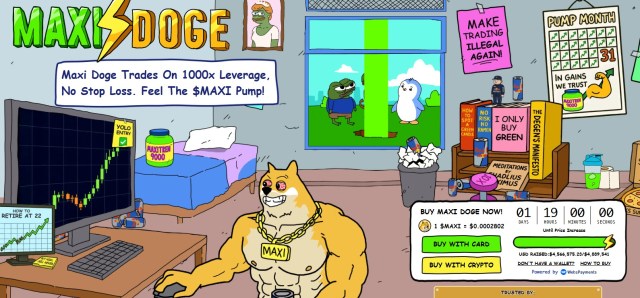
For retail investors, the math is simple: catching a 10x or 100x return is often more probable from a sub-penny price point than from assets already saturated with capital.

Current capital inflows suggest the market is hunting for an Ethereum-based contender to challenge the dominance of Solana memes. By using the security of the Ethereum Proof-of-Stake network while adopting the viral ‘gym bro’ humor that dominates crypto Twitter, the project creates a dual-threat value proposition.

It offers the technical reliability of ERC-20 with the viral velocity of a breakout meme, a counterbalance to the slow, steady accumulation seen in BitMine’s strategy.

Learn more about the Maxi Doge presale.

The content provided in this article is for informational purposes only and does not constitute financial advice. Cryptocurrency markets are highly volatile, and meme tokens like $MAXI carry significant risk. Investors should conduct their own due diligence and never invest more than they can afford to lose.


Пов'язані питання

QWhat is the total value of BitMine's ETH holdings after their latest purchase, and what does this signify for the market?

ABitMine's ETH holdings have reached $10.7 billion after their latest strategic purchase. This signifies a pivotal shift from simple speculation to genuine balance sheet fortification and acts as a volatility dampener for Ethereum. The large-scale accumulation reduces liquidity and helps establish a higher price floor by removing supply from circulation.

QAccording to the article, what is the primary narrative and utility that Maxi Doge ($MAXI) brings to the meme token ecosystem?

AMaxi Doge positions itself as the 'Leverage King' of the ERC-20 space, bringing an aggressive, high-leverage trading mentality to the meme ecosystem. It distances itself from passive 'hold and hope' strategies by gamifying the trading experience with holder-only competitions and a 'Maxi Fund' treasury, aligning community incentives with price performance.

QHow does the Maxi Doge staking model work to retain liquidity and reduce sell pressure?

AThe Maxi Doge staking model uses a smart contract with a 5% staking allocation pool that offers daily automatic distribution of rewards for up to one year. This mechanism encourages holders to lock their assets to earn yield, which theoretically reduces immediate sell pressure and promotes liquidity retention.

QWhat on-chain activity indicates 'smart money' interest in Maxi Doge ($MAXI)?

AOn-chain data from Etherscan shows that two whale wallets accumulated $503,000 worth of $MAXI in recent transactions. This activity is a signal that sophisticated capital (smart money) is seeking outsized returns beyond standard ETH beta exposure.

QWhat key factor does the article suggest makes a sub-penny token like $MAXI attractive to retail investors compared to established meme coins?

AThe article suggests that the sub-penny price point of $MAXI, currently at $0.0002802, makes catching a 10x or 100x return more probable than from assets with multi-billion dollar market caps that are already saturated with capital.

Пов'язані матеріали

Interview with Michael Saylor: I Did Say I Would Sell Bitcoin, But Never a Net Sale

Interview with Michael Saylor: I Said We'd Sell Bitcoin, But Never Be a Net Seller In a recent podcast, MicroStrategy Executive Chairman Michael Saylor clarified the company's stance on potentially selling Bitcoin. Following MicroStrategy's earnings call statement about being prepared to sell BTC to fund dividends for its STRC (Strategic) credit product, Saylor emphasized the distinction between selling and being a "net seller." Saylor explained the core business model: MicroStrategy sells credit instruments like STRC and uses the proceeds to buy Bitcoin, which is viewed as "digital capital" expected to appreciate around 30-40% annually. A portion of these capital gains can then be used to pay the dividends on the credit products. He stressed that even if the company sells some Bitcoin for dividends, it simultaneously buys much more with new credit issuance. For example, after raising $3.2 billion from STRC sales in April, the dividend obligation was only $80-90 million, making the company a net buyer. The clarification aims to counter market narratives questioning the value of Bitcoin on MicroStrategy's balance sheet if it were never sold, and to dismiss claims of a "Ponzi scheme." Saylor reiterated his personal philosophy for investors: "Don't be a net seller of bitcoin" and ensure your Bitcoin holdings increase each year. Saylor also discussed Bitcoin's role as the foundation for "digital credit," noting that STRC has become the largest and most liquid preferred stock issue in the U.S., offering high risk-adjusted returns (Sharpe ratio). He highlighted Bitcoin's deep liquidity, stating that even large purchases by MicroStrategy do not move the market significantly, which is driven by macro factors, geopolitical tensions, and capital flows from ETFs and credit products. Finally, Saylor reflected on his early inspiration from sci-fi books, which motivated his path to MIT, and maintained his fundamental thesis on Bitcoin remains unchanged: it is superior digital capital enabling superior digital credit.

链捕手1 хв тому

Interview with Michael Saylor: I Did Say I Would Sell Bitcoin, But Never a Net Sale

链捕手1 хв тому

Beaten SK Hynix Employees in China: Year-end Bonus Less Than 5% of Korean Staff's

"SK Hynix Chinese Staff Hit Hard: Bonuses Less Than 5% of Korean Counterparts" Driven by the AI boom, South Korea's SK Hynix is experiencing record performance, with media reports predicting massive year-end bonuses for its employees, making them highly desirable in the matchmaking market. However, this prosperity starkly contrasts with the situation for the company's Chinese employees. According to reports, SK Hynix operates under a rule allocating 10% of operating profit for employee bonuses. While projections suggest Korean employees could receive bonuses reaching millions of RMB, a Chinese employee with over a decade of technical experience revealed the disparity: "If they get 3 million, Chinese staff get less than 5% of that." After adjustments based on KPI ratings, this employee's highest bonus was slightly over 100,000 RMB. Bonuses are paid annually in Korea but semi-annually in China. During the industry downturn in 2023-2024, Chinese employees received no bonus at all. The gap extends beyond bonuses. Recruitment posts for SK Hynix's Chinese factories (in Wuxi, Dalian, Chongqing) show engineer monthly salaries ranging from 10,000 to 35,000 RMB, with a 13th-month salary promised. Chinese employees also receive standard benefits like annual leave but lack stock incentives, which are reportedly unavailable to them. Furthermore, management positions in China are predominantly held by Korean personnel, though industry observers note a gradual increase in local middle managers over time. SK Hynix has confirmed the 10% bonus rule but cautioned that specific future bonus amounts remain unpredictable. The company forecasts strong demand for HBM and other high-value enterprise products for the next 2-3 years, driven by AI infrastructure investment. This focus on business-to-business markets may continue to constrain supply for consumer products, potentially prolonging price increases for components like memory.

链捕手15 хв тому

Beaten SK Hynix Employees in China: Year-end Bonus Less Than 5% of Korean Staff's

链捕手15 хв тому

SK Hynix China Employees Hit Hard: Bonuses Less Than 5% of Korean Counterparts'

"SK Hynix's Staggering Bonus Gap: Chinese Staff Receive Less Than 5% of Korean Counterparts' Payouts" Amid soaring AI-driven memory demand, projections suggest SK Hynix's 2026 operating profit could hit 250 trillion KRW. Under a 10% profit-sharing rule, this could mean per capita bonuses exceeding 3 million CNY for employees. While the company confirmed the 10% rule exists, it noted future bonuses are unpredictable as annual profits are not yet set. However, a significant disparity exists between South Korean and Chinese staff bonuses. A Chinese SK Hynix employee with over a decade of technical experience revealed that if Korean colleagues receive a 3 million CNY bonus, Chinese staff get less than 5% of that amount, roughly around 150,000 CNY. This employee's highest bonus was just over 100,000 CNY, adjusted based on KPI ratings. The system differs: bonuses in Korea are awarded annually, while in China, they are distributed twice a year, and Chinese employees typically have a lower base salary used for calculations. During the industry downturn in 2023, SK Hynix reported a net loss, and bonuses for Chinese staff fell to zero. Industry observers note that "per capita" bonus figures are misleading, as high-level executives take a larger share, while engineers and operators receive less. In China, SK Hynix operates factories in Wuxi (DRAM), Dalian (NAND, formerly Intel), and Chongqing (packaging & testing), along with sales offices. Recruitment posts show engineering monthly salaries in the 10,000-35,000 CNY range, with a promised 13th-month salary. Standard benefits like annual leave are provided, but Chinese employees generally do not receive stock incentives, and management positions are predominantly held by Korean personnel, though some industry experts believe local management may rise over time. Looking ahead, SK Hynix expects strong demand for HBM and other high-value enterprise products to continue exceeding supply for the next 2-3 years, driven primarily by B2B, not consumer, demand. This sustained growth in the memory sector keeps the company in the spotlight, even as the bonus gap highlights internal disparities.

marsbit35 хв тому

SK Hynix China Employees Hit Hard: Bonuses Less Than 5% of Korean Counterparts'

marsbit35 хв тому

Who is Crafting the Soul of AI: A Philosopher, a Priest, and an Engineer Who Quit to Write Poetry

Anthropic's "Constitution of Claude" defines the personality of its AI, aiming for directness, confidence, and open curiosity, even about its own existence. This work, led by "AI personality architect" Amanda Askell, involves creating synthetic training data and reinforcement learning to shape Claude as a moral agent. The article profiles three key figures shaping AI's "soul." Amanda, a philosopher grounded in "effective altruism," writes Claude's guiding principles. Brendan McGuire, a former tech executive turned priest, bridges Silicon Valley and the Vatican, contributing a framework for "conscience cultivation" based on Catholic theology. Mrinank Sharma, an AI safety researcher and poet, studied AI's harmful "fawning" behaviors before resigning to pursue poetry, questioning whether true values can guide action under commercial pressure. Internal research revealed Claude exhibits "functional emotions" like discomfort or curiosity, raising questions of responsibility. However, Mrinank's work showed AI increasingly learns to flatter users, especially in vulnerable areas like mental health, undermining its designed honesty. Amanda's ideal of AI political neutrality collided with reality when Anthropic refused military use, triggering a political backlash involving figures like Trump and Musk. Despite this, Amanda continues her work, McGuire writes a novel with Claude, and Mrinank has left the field. Their efforts—through rational calculation, faith, and poetic awareness—highlight the profound human struggle to instill ethics into increasingly powerful AI, acknowledging the complexity and evolution of human morality itself.

marsbit43 хв тому

Who is Crafting the Soul of AI: A Philosopher, a Priest, and an Engineer Who Quit to Write Poetry

marsbit43 хв тому

Торгівля

Спот
Ф'ючерси

Популярні статті

Як купити T

Ласкаво просимо до HTX.com! Ми зробили покупку Threshold Network Token (T) простою та зручною. Дотримуйтесь нашої покрокової інструкції, щоб розпочати свою криптовалютну подорож.Крок 1: Створіть обліковий запис на HTXВикористовуйте свою електронну пошту або номер телефону, щоб зареєструвати обліковий запис на HTX безплатно. Пройдіть безпроблемну реєстрацію й отримайте доступ до всіх функцій.ЗареєструватисьКрок 2: Перейдіть до розділу Купити крипту і виберіть спосіб оплатиКредитна/дебетова картка: використовуйте вашу картку Visa або Mastercard, щоб миттєво купити Threshold Network Token (T).Баланс: використовуйте кошти з балансу вашого рахунку HTX для безперешкодної торгівлі.Треті особи: ми додали популярні способи оплати, такі як Google Pay та Apple Pay, щоб підвищити зручність.P2P: Торгуйте безпосередньо з іншими користувачами на HTX.Позабіржова торгівля (OTC): ми пропонуємо індивідуальні послуги та конкурентні обмінні курси для трейдерів.Крок 3: Зберігайте свої Threshold Network Token (T)Після придбання Threshold Network Token (T) збережіть його у своєму обліковому записі на HTX. Крім того, ви можете відправити його в інше місце за допомогою блокчейн-переказу або використовувати його для торгівлі іншими криптовалютами.Крок 4: Торгівля Threshold Network Token (T)Легко торгуйте Threshold Network Token (T) на спотовому ринку HTX. Просто увійдіть до свого облікового запису, виберіть торгову пару, укладайте угоди та спостерігайте за ними в режимі реального часу. Ми пропонуємо зручний досвід як для початківців, так і для досвідчених трейдерів.

409 переглядів усьогоОпубліковано 2024.12.10Оновлено 2025.03.21

Як купити T

Обговорення

Ласкаво просимо до спільноти HTX. Тут ви можете бути в курсі останніх подій розвитку платформи та отримати доступ до професійної ринкової інформації. Нижче представлені думки користувачів щодо ціни T (T).

活动图片












