BitMart Research Institute's Weekly Hotspot Analysis: U.S.-Iran Détente Coupled with Fed's Hawkish Pivot, Crypto Market Follows Suit in Rebound and Bottoming

marsbitОпубліковано о 2026-04-14Востаннє оновлено о 2026-04-14

Анотація

BitMart Research Weekly Analysis: U.S.-Iran De-escalation and Fed’s Hawkish Turn Drive Crypto Market Rebound and Bottom-Building Macro Overview: Geopolitical tensions between the U.S. and Iran show signs of easing, supporting a rebound in risk assets including equities and oil. U.S. stocks, particularly in AI-related sectors, rebounded strongly. The latest FOMC minutes revealed a more hawkish tone, with “rate hikes” entering discussions, though the majority of members remain focused on labor market conditions. March CPI rose due to energy prices, but core CPI was softer. Sustained high oil prices may push supercore inflation higher in the coming months, potentially influencing Fed policy. Crypto Market Performance: BTC and ETH followed the upward trend in equities, supported by improved risk sentiment and expectations around crypto regulatory clarity (e.g., Clarity Act). However, some long-term indicators suggest the market may still be in a bear phase or experiencing bottom consolidation. The $60,000 level is seen as a key support for BTC. Altcoins lack fundamental drivers and remain highly volatile with strong manipulative tendencies, making BTC and ETH more reliable for strategic allocation. Trading and Fund Flows: Spot trading volume remains low, but active buying interest is noticeable. Perpetual swap funding rates are negative, indicating short dominance, while options markets show no significant rise in fear. Bitcoin ETFs recorded net inflows, including a sing...

I. Macro Level (Macro)

Geopolitics and U.S. Stock Market Performance

Signs of easing emerged in the U.S.-Iran conflict, with the differences in negotiations being smaller than market expectations, prompting a rapid recovery in the prices of risk assets, including crude oil. Against this backdrop, coupled with the pressure from the U.S. election and the potential for easing Sino-U.S. trade relations, U.S. stocks, particularly those in the AI upstream supply chain and individual stocks like Oracle, experienced a strong oversold rebound. Currently, upward repair remains the path of least resistance. However, geopolitical tail risks remain high, and trading is still challenging.

Federal Reserve Monetary Policy (FOMC)

The latest FOMC meeting minutes revealed that internal divisions within the Fed have widened compared to the past, with the "interest rate hike" option explicitly included in the discussions, indicating a somewhat hawkish pivot in the overall stance. Nevertheless, most members still prioritize the fragile balance in the labor market, and the market generally expects the actual probability of a rate hike this year to remain low.

Inflation Data (CPI) and Potential Inflation Risks

The overall CPI for March rose significantly driven by energy prices, but the core CPI was slightly lower than expected, indicating that the transmission of energy prices to core goods and services is not yet significant for the time being. However, if oil prices remain persistently high above $80, they are likely to gradually transmit to supercore inflation over the next 3 to 6 months. This could not only lead to upside risks in inflation data in the coming months but also prompt a further hawkish shift in the Fed's stance. Additionally, due to base effects from the same period last year, next month's housing rent data might show an abnormal jump.

II. Cryptocurrency Level (Crypto)

Market Trend and Overall Expectations

In the recent rebound, although BTC and ETH did not stand out as prominently as during the previous phase of resilience, they still followed the rebound in U.S. stocks. Benefiting from the overall recovery in risk appetite in U.S. stocks and continued strengthening of policy positives such as the expected passage of the crypto bill (Clarity Act), the overall expectations for the Crypto market this year remain optimistic. However, some long-term macro indicators (such as Glassnode-related data) suggest that the current market may still be in a bear market phase or in a range of repeated fluctuations at the bottom of a bear market, which aligns with Glassnode strategists' judgment of the market cycle.

Divergence Between BTC, ETH, and Altcoins

There is still some divergence in the market regarding the bottom position of Bitcoin, but the support level near $60,000 is relatively solid—this level was quickly reached due to fund liquidations, thus holding certain reference value. It is expected to become the阶段性 (staged) bottom for a new round of upward trends and is closely watched by various market participants. In contrast, the altcoin market overall lacks fundamental support, exhibiting more characteristics of "strong manipulation," primarily relying on contract liquidations and funding rate arbitrage for profits, with highly volatile prices, placing retail investors at a clear disadvantage. Therefore, the meeting建议 (suggests) shifting the allocation focus more towards BTC and ETH at this stage to enhance the robustness of the strategy.

Trading Micro Data and Capital Flows

Spot and Futures: Overall spot trading volume remains low, but the active buying volume (CVD) remains high, reflecting that some "smart money" is actively participating in the rebound. Meanwhile, catalyzed by factors such as geopolitics, trading热度 (heat) in the futures market has increased, with overall funding rates偏向负 (leaning negative) (i.e., shorts paying funding to longs), while the options market shows that panic sentiment has not further expanded.

Institutional Funds: Bitcoin ETFs overall showed net inflows last week, for example, with a single-day net inflow reaching $421 million. Looking at the recent Bitcoin ETF行情 (performance), they have maintained a trend of震荡净流入 (oscillating net inflows), reflecting institutions' willingness for long-term布局 (layout) in crypto assets;同时 (At the same time), MicroStrategy's recent pace of increasing holdings has明显加快 (significantly accelerated), purchasing nearly 14,000 Bitcoins in the recent phase, further increasing its cumulative holding scale, continuing its strategy of long-term Bitcoin accumulation.

This article is for market trend analysis only and does not constitute investment advice. Digital asset investment carries high risks; investors should make prudent choices and bear the relevant risks themselves.

Пов'язані питання

QWhat are the main factors driving the recent rebound in the crypto market according to the article?

AThe rebound is driven by easing US-Iran tensions, a potential improvement in US-China trade relations, and increased risk appetite in US stocks, particularly in the AI upstream industry chain and stocks like Oracle. Additionally, expectations for the Clarity Act and institutional inflows into Bitcoin ETFs have supported the market.

QHow did the latest FOMC meeting minutes reflect the Federal Reserve's stance on monetary policy?

AThe FOMC meeting minutes showed an expanded internal divergence among Fed members, with the 'interest rate hike' option explicitly included in discussions, indicating a hawkish shift. However, most members still prioritize the fragile balance of the labor market, and the actual probability of a rate hike this year remains low.

QWhat potential risks to inflation does the article highlight for the coming months?

AThe article highlights that if oil prices remain above $80 per barrel, it could gradually transmit to supercore inflation over the next 3 to 6 months, posing upside risks to future inflation data. Additionally, next month's housing rent data might show an abnormal jump due to base effects from the same period last year.

QWhat is the suggested investment strategy for cryptocurrencies based on the current market conditions?

AThe article suggests shifting the allocation focus more towards BTC and ETH to enhance strategy robustness, as altcoins lack fundamental support and are characterized by high volatility and strong market manipulation, putting retail investors at a disadvantage.

QHow did institutional investors behave in the crypto market recently, as mentioned in the article?

AInstitutional investors showed increased participation, with Bitcoin ETFs experiencing net inflows, such as a single-day net inflow of $421 million. MicroStrategy also accelerated its buying pace, purchasing nearly 14,000 BTC recently, further expanding its cumulative holdings and continuing its long-term Bitcoin accumulation.

Пов'язані матеріали

MSX US Stock Daily Insight: Amazon 2026 Q2 Earnings: AWS Records Fastest Growth in Five Years

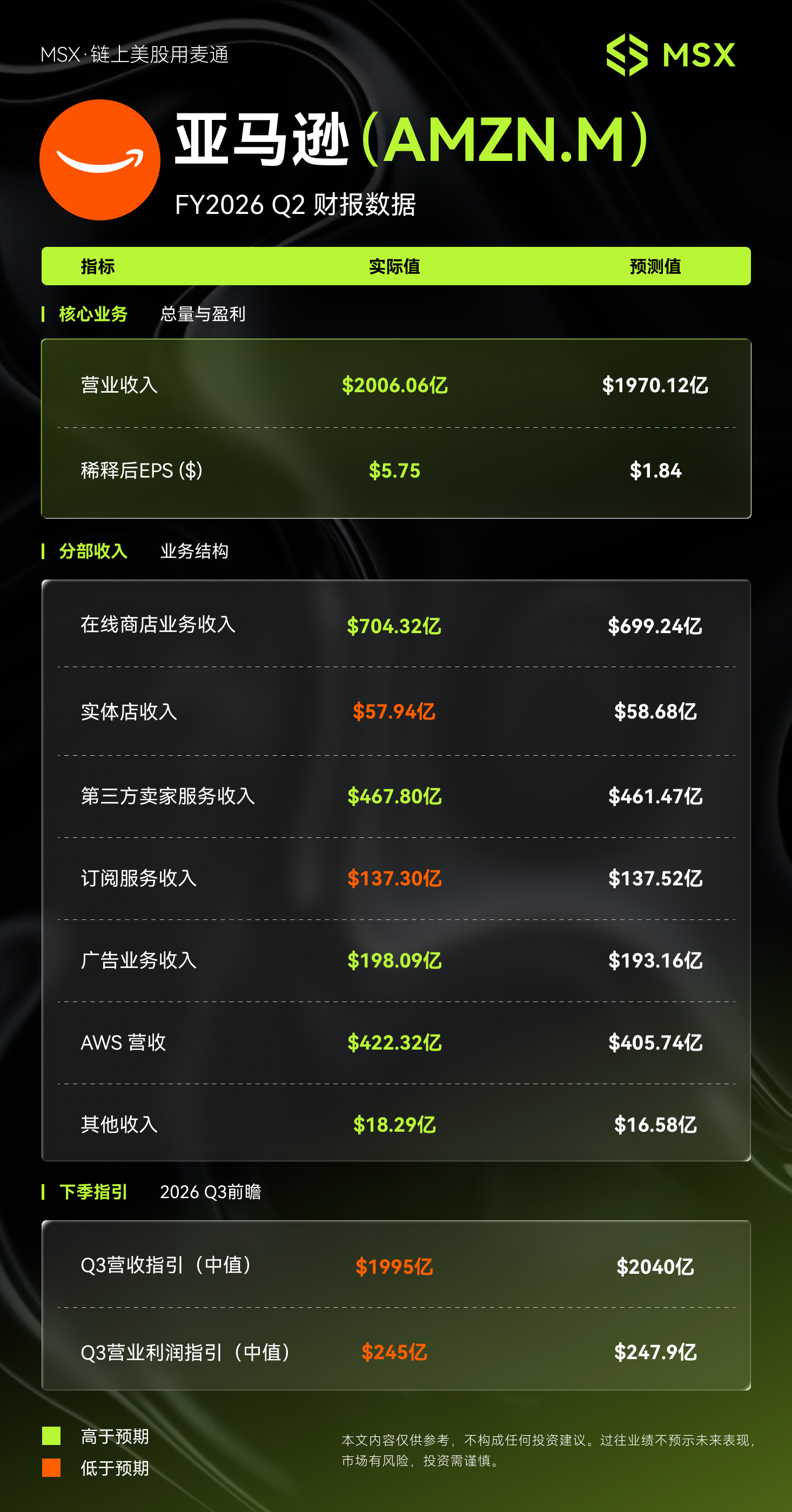
**MSX Daily US Stock Observation: Amazon's Q2 2026 Earnings: AWS Achieves Fastest Growth in Five Years** Amazon's latest quarterly results exceeded expectations, driven by a strong performance from its cloud computing unit. The company reported revenue of $200.66 billion, surpassing estimates of approximately $197 billion. The key highlight was Amazon Web Services (AWS), which generated $42.232 billion in revenue, surging 37% year-over-year. This marked the segment's fastest growth pace in 18 quarters, indicating robust demand for cloud services. Reported Earnings Per Share (EPS) of $5.75 significantly exceeded the $1.84 forecast. However, this figure included a substantial one-time, non-operating gain of $53.4 billion, primarily from the revaluation of Amazon's investment in AI company Anthropic. Excluding this item, core operating profit was $27.461 billion, a strong increase of 43% compared to the same period last year. Despite the positive results, Amazon provided guidance for the upcoming third quarter that fell short of market expectations. The company's revenue guidance midpoint is $199.5 billion, below the consensus estimate of around $204 billion. Operating profit guidance of $24.5 billion also slightly missed expectations of approximately $247.9 billion. Furthermore, Amazon raised its forecast for full-year capital expenditures to $220 billion, citing rising memory chip costs, which weighed on investor sentiment regarding future profitability. In summary, Amazon's quarter showcased accelerating momentum in its core AWS business. The underlying operational profit growth remains solid. However, cautious forward guidance and increased investment spending present key areas for monitoring in the coming quarters, as the market assesses whether the current growth phase will translate into sustained profit margin expansion.

Odaily星球日报9 хв тому

MSX US Stock Daily Insight: Amazon 2026 Q2 Earnings: AWS Records Fastest Growth in Five Years

Odaily星球日报9 хв тому

Cyclical Stock or Growth Stock? Coinbase's Q2 Earnings Report Reveals 'Valuation Disagreement'

Coinbase's Q2 2026 financial results revealed a mixed performance, reigniting debate over whether the company should be valued as a cyclical stock tied to crypto markets or a growth stock with future potential. Total revenue missed expectations at $1.22 billion, down 19% year-over-year. Transaction revenue fell to $599 million, with retail crypto spot trading revenue dropping 30% to $452 million, back to 2023 levels. The company reported a net loss of $359 million, marking its third consecutive quarterly loss. Despite CEO Brian Armstrong's positive commentary on metrics like a 10.3% overall crypto trading market share and 106% growth in prediction markets, the market reacted negatively, with shares dropping over 5% after-hours. A key issue is the decline in core retail trading. While Coinbase touted record market share, this figure includes derivatives and new products. Its traditional crypto spot trading share is likely shrinking. New ventures like prediction markets, while growing, contributed less than $30 million, insufficient to offset the core revenue decline. The valuation debate hinges on perspective. As a cyclical stock, Coinbase remains deeply tied to the crypto bear market, with user attrition and competitive pressures justifying a lower valuation. The company's strategy appears focused on surviving until the next bull cycle. Viewed as a growth stock, however, Coinbase shows promising diversification. Subscription and service revenue reached $555 million, nearly matching transaction revenue. Stablecoin revenue, its second-largest source at $292 million, remains strong through its partnership with Circle. Critically, Coinbase is positioning itself as a leader in the emerging on-chain "agent economy." Over 90% of agent-based stablecoin transactions occur on its Base network, which it believes could handle trillions in future agent transactions. The recent acquisition of Deribit also aims to boost its international derivatives offering. In summary, Coinbase's present struggles are clear, but its future hinges on whether its investments in revenue diversification, stablecoins, and the agent economy can ultimately transform its business model and justify a growth premium.

Odaily星球日报29 хв тому

Cyclical Stock or Growth Stock? Coinbase's Q2 Earnings Report Reveals 'Valuation Disagreement'

Odaily星球日报29 хв тому

Global Market Share Survey: Japanese Firms Lead in Semiconductor Materials

Global Market Share Survey: Japanese Firms Lead in Semiconductor Materials According to the 2025 "Major Goods and Services Market Share Survey" by Nikkei, Japanese companies maintain strong positions in semiconductor-related materials. In silicon wafers, Shin-Etsu Chemical ranks first with a 26.3% share, followed by SUMCO at 17.8%. Together, they hold 44.1% of the market, widening their lead over competitors from Taiwan, Germany, and South Korea. In photoresists, Tokyo Ohka Kogyo, JSR, and Shin-Etsu Chemical occupy the top three spots, with a combined share of 60.5%. Despite their strength in materials, Japanese firms have a weaker presence in core semiconductor segments like DRAM and NAND flash memory, where South Korean and U.S. companies dominate. For instance, SK Hynix and Samsung lead in DRAM, while China’s CXMT doubled its share to 6% in 2025. The semiconductor market is projected to grow rapidly, with WSTS forecasting a 90% increase to $1.5112 trillion by 2026. Major players like Samsung, SK Hynix, and Micron are making massive investments to expand capacity. To maintain their edge in materials, Japanese companies must similarly commit to large-scale, risk-taking investments. In contrast, Japan’s automotive sector shows stagnation. Toyota remains the global leader but with only a slight share increase to 12.3%, while Japanese brands are absent from the top five in the EV market. In shipbuilding, Imabari Shipbuilding rose to third place globally with a 7.2% share, benefiting from large container ship deliveries. However, Chinese and South Korean firms dominate the sector, holding the top two positions. Japan aims to revitalize its shipbuilding industry through government and corporate efforts, targeting a near doubling of output by 2035. Addressing labor shortages and adopting advanced technologies like physical AI will be critical for competitiveness.

marsbit54 хв тому

Global Market Share Survey: Japanese Firms Lead in Semiconductor Materials

marsbit54 хв тому

Торгівля

Спот
活动图片