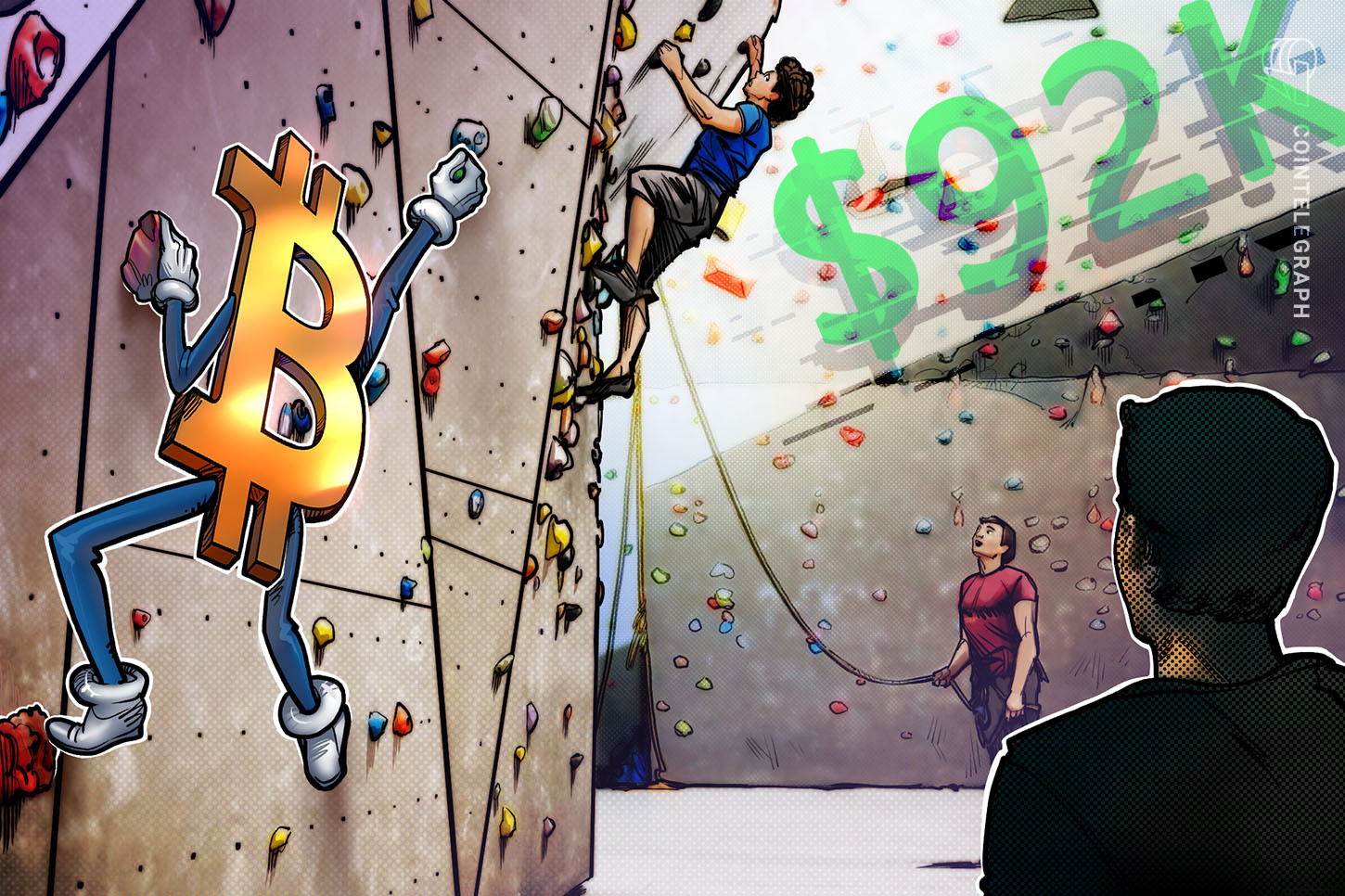
Bitcoin’s price ‘fails’ twice, but here’s why a crypto-winter is still unlikely

ambcryptoОпубліковано о 2025-12-12Востаннє оновлено о 2025-12-12

Анотація

Bitcoin's price has failed twice to break the $94k resistance level, maintaining a bearish higher timeframe trend despite recent gains. Analysts attribute this to a significant drop in stablecoin inflows to exchanges—down 50% since August—indicating weakened buying demand. On-chain data reveals short-term holders are experiencing their deepest losses of 2025, adopting a "sell-the-bounce" mentality that further suppresses upward momentum. Each price increase is met with profit-taking, reflecting fearful market sentiment. However, the current phase is viewed as stabilization rather than a full bear market, making a severe crypto winter unlikely.

Bitcoin’s [BTC] recovery efforts haven’t been totally successful lately. In the last 8 days, Bitcoin has tested the $94k local resistance twice.

Both times, it failed to break through. As things stand, the higher timeframe trend remains bearish for the world’s largest cryptocurrency, despite the uptick from $84k over the last three weeks.

In a post on X, analyst Darkfost explained that the lack of incoming liquidity might be the biggest issue holding BTC back. Stablecoin inflows to exchanges have fallen by 50% since August. It meant that there has been a lack of steady demand for Bitcoin to drive the prices higher.

Other on-chain metrics showed that short-term holders have been suffering and may be in no position to drive a market recovery.

Short-term BTC holders are still in the real pain zone

A post on CryptoQuant Insights explained how the short-term holder cohort may be experiencing its deepest loss regime of 2025. They have been holding losses, which suggested that each Bitcoin price bounce offered an opportunity to sell.

Underwater holders willing to sell the bounce, combined with the dwindling demand, could be tough obstacles for the bulls.

The 24-hour sum of STH holdings sent to exchanges is another way to keep track of trends. During an uptrend, losses from STH will be minimal. During a downtrend, holdings tend to be at a loss in greater numbers.

Over the past month, the lack of an upward trend shift combined with strong profit-taking activity. The price bounce in mid-October saw fewer BTC sent at a profit to exchanges – A sign that there was confidence of further gains.

Since 27 November, the spikes in STH profit-taking have underlined the statement made earlier. Market sentiment is fearful, and each price bounce is for selling.

There may be an argument that the current market phase is stabilization, and not outrightly bearish. Thus, the developments of this cycle mean that a full-blown winter is unlikely.


Final Thoughts

  • The lifeblood of crypto markets, stablecoins saw reduced inflows to exchanges to reflect a fall in demand.
  • Metrics revealed that short-term holder behavior has shifted into a “sell-the-bounce” mentality.
Пов'язані матеріали

2025 Airdrop Survival Rules: From Gold Rush to Holding These Two Aces

In 2025, the airdrop farming landscape shifted dramatically, moving from a "gold rush" to a challenging environment with significantly reduced returns. The absence of an "altcoin season" and Bitcoin's market dominance led to lower valuations for airdropped tokens, with many projects launching at lower fully diluted valuations (FDVs) and experiencing immediate sell-offs. This resulted in smaller airdrops, often not even covering gas fees, causing many farming studios to shut down or pivot to other ventures. Despite the downturn, new farming methods emerged. "InfoFi" or "talk-to-earn" platforms like Kaito, Cookie Snaps, and Galxe’s Starboard allowed users to earn tokens by creating quality content and analysis on social media, lowering entry barriers and offering faster returns compared to traditional on-chain interactions. Binance Alpha also became a key income source for many, though its rewards diminished over time due to increased competition and lower token values. The two most reliable strategies for sustaining profits were: 1) Participating in high-profile token launches (e.g., on BuidlPad, Kaito, or Legion), focusing on projects with strong community hype and oversubscribed sales, which often provided quick, substantial gains at TGE. 2) Stablecoin farming through platforms like Binance’s Web3 Wallet, which offered low-risk, high-yield opportunities (e.g., Plasma’s collaboration with Binance offered over 70% APY for USDT depositors). These methods provided steady returns with minimal capital erosion. The author concludes that while airdrop farming is no longer a path to instant wealth, it remains a viable way to accumulate assets steadily. Success depends on adaptability, research, and discipline—focusing on quality over quantity, leveraging stablecoin yields, and capitalizing on high-potential launches. The key is to survive market downturns and capitalize when conditions improve.

marsbit28 хв тому

2025 Airdrop Survival Rules: From Gold Rush to Holding These Two Aces

marsbit28 хв тому

Торгівля

Спот
Ф'ючерси
活动图片