Author: Gino Matos
Translation: TechFlow DeepTide
DeepTide Guide: Bitcoin has fallen for two consecutive days into the $78,000 support zone after failing to break above $82,000. With the US 10-year Treasury yield approaching 4.6%, the 30-year yield breaking above 5.13%, coupled with April CPI accelerating to 3.8% and oil prices rising above $105, the macro environment is extremely unfriendly to risk assets. ETF flows have also turned to net outflows at a critical moment. Can $78,000 hold? If not, the next stop is $75,000.
$78,000: If This Level Fails, It's $75,000 Next
Bitcoin hit an intraday low of $77,711 before rebounding slightly to around $78,225. This marks the second consecutive trading day under macro pressure.
The US 10-year Treasury yield rose to 4.599%, and the 30-year yield jumped 11.8 basis points to 5.131%, hitting a new high since May 2025. BTC has fallen 3.9% from its opening price above $81,000 on May 15, with US stocks and bonds weakening simultaneously.
When BTC lost the $82,000 level, the $77,700-$78,000 range became the next key support. Now, this support is bearing the full weight of macro pressure.
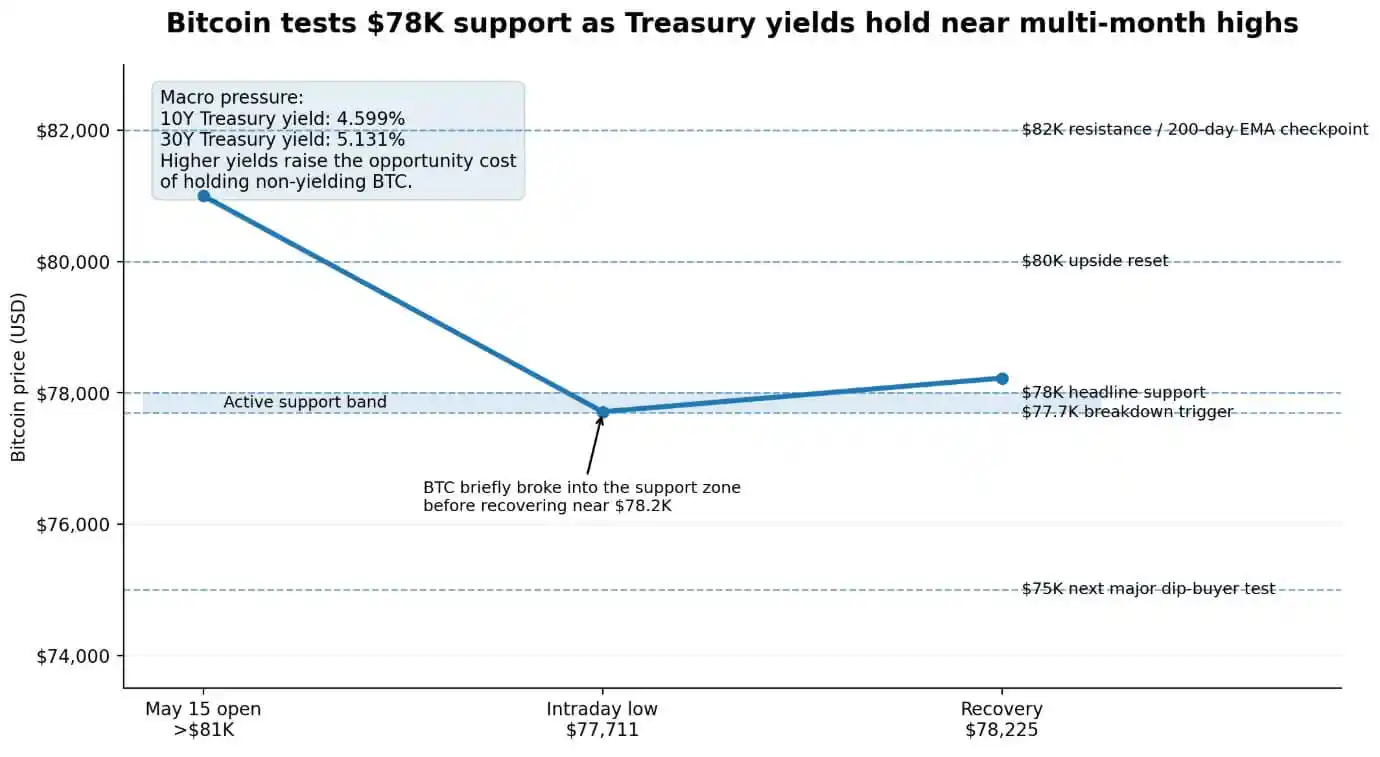
Caption: Bitcoin fell from above $81,000 at the May 15 open to an intraday low of $77,711 before rebounding to $78,225, testing the $77,700-$78,000 support band.
The Weight of Macroeconomics
BTC is a zero-yield asset, now competing against US Treasuries offering yields of 4.5%-5.1%. With the interest rate floor raised to this level, the opportunity cost of holding BTC has increased sharply.
K33 data shows Bitcoin's 30-day correlation with Nasdaq futures exceeds 0.7. During sharp Nasdaq declines, BTC's beta value amplifies. Both transmission channels are active in this sell-off, and the macro environment leaves almost no room for Fed easing.
April CPI accelerated year-on-year to 3.8%, up from 3.3% in March. Core CPI remained at 2.8%, while the energy component rose 17.9% over 12 months.
WTI crude oil closed at $105.42 on May 15, up 4.2% for the day and 11.33% for the month. Brent crude touched $109.26, up 3.35%. Trading Economics models predict Brent to reach $111.28 by the quarter's end, while HSBC raised its 2026 Brent forecast to an average of $95, potentially reaching $110 if supply agreements are delayed until late summer.
University of Michigan May data shows one-year inflation expectations rising to 4.5%. The Fed's April FOMC statement indicated a need to assess inflation before considering easing. The bar for policy relief is high.
ETF Flows Drop the Ball at a Critical Moment
CoinShares data shows that as of the week ending May 11, Bitcoin investment products attracted net inflows of $706.1 million, indicating strong institutional buying interest.
However, daily data from Farside Investors shows a sharp reversal thereafter: net outflows of $630.4 million on May 13, a small inflow of $131.3 million on May 14, and another outflow of $290.4 million on May 15.
Outflows on two out of three days. The ETF flow buffer disappeared at the very moment the $78,000 support needed defense most. This buffer had been absorbing macro headwinds in previous weeks.
Support Map
The intraday low of $77,716.09 already fell within the support range. If the daily close can reclaim territory above $78,000, this pullback would still be technically contained.
Once $77,700 is effectively broken, the downward path opens: $76,500 is the first follow-up target. After bears confirm the breakdown, $75,000 is the key psychological round number where dip-buying capital historically needs to step in with real money.
If the decline extends further, the $73,000-$74,000 range comes into view. At that point, the market narrative would shift from 'pullback' to 'macro-driven deleveraging of risk assets.'
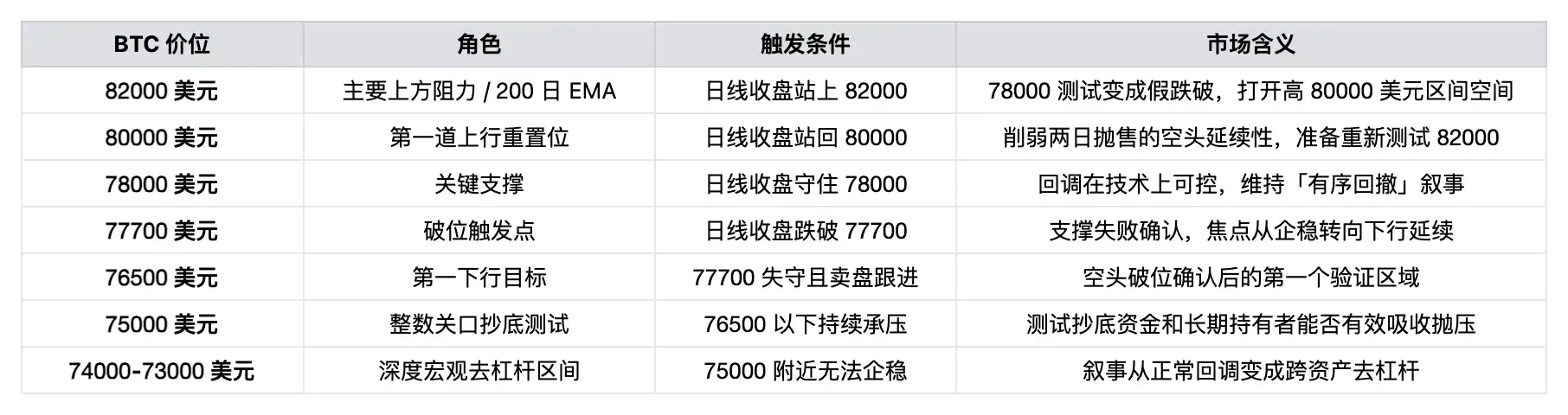
Recapturing $80,000 is the first step to reversing the bearish structure—a daily close above that level would break the sequence of lower lows over the past two trading days, giving bulls a technically clean reset.
The tougher hurdle is at $82,000. On May 13, BTC already broke below its 200-day moving average (around $82,000), meaning $82,000 serves as both a round-number resistance and a technical barrier. A daily close above $82,000 would turn the $78,000 test into a false breakdown.
Four Scenarios

What to Watch Next
If the 10-year yield retreats below 4.50%, oil prices cool from above $105, and ETF flows turn positive, Bitcoin could reclaim $80,000. That would break the pattern of lower lows over the past two days, setting the stage for a retest of $82,000—the level of the 200-day moving average that BTC broke below on May 13.
A daily close above $82,000 would turn the yield-driven retreat into a false breakdown, opening the door to the high $80,000s. The past week's decline would then be viewed as a shakeout-style correction, with the underlying accumulation logic remaining intact.
Conversely, if BTC closes below $77,700 on a daily basis while Treasury yields remain around 4.60% and ETFs see sustained outflows, the support test is confirmed to have failed. $76,500 becomes the first downside target, with a new leg lower beginning once bears confirm the breakdown. $75,000 is the key round-number level where dip-buying forces historically need to demonstrate real demand.
Continued weakness below $75,000 would target the $74,000-$73,000 range. At that point, the narrative would no longer be 'crypto market pullback,' but 'cross-asset macro deleveraging'—with stocks and bonds being repriced, and BTC simply following along.
For Bitcoin's short-term direction, the key macro variables need to stabilize first to form a rebound anchor. With the 10-year at 4.599% and the 30-year at 5.131%, they offer holders a yield floor of 4.5%-5.1%. BTC, as a zero-yield asset, is at a natural disadvantage in terms of carry. With one-year inflation expectations at 4.5% and the Fed still in an 'assessment phase,' rapid easing is far from market reality pricing.
The $78,000 zone faces a structural test: Can ETF buyers and long-term holders absorb selling pressure quickly enough amid an interest rate cost shock to stabilize the price before the support board is broken?