Bitcoin Reclaims $94,000: A New Bull Market Beginning or a Bull Trap?

marsbitОпубліковано о 2025-12-10Востаннє оновлено о 2025-12-10

Анотація

Bitcoin has surged back to the $94,000 level, sparking debate over whether this marks the beginning of a new bull run or a short-term bullish trap. Despite the strong price performance, trading volume has not fully supported the upward move. Key resistance levels and the upcoming FOMC meeting have influenced market sentiment. After a brief period of consolidation, Bitcoin broke through $93,500, reestablishing a short-term bullish trend. Technical analysis indicates the formation of bullish patterns such as the "cup and handle" and "inverse head and shoulders," suggesting a potential rise to $104,000 if $96,000 is breached. However, failure to hold above $96,000 could trigger a pullback toward $88,000–$89,000 or even lower. Market liquidity presents mixed signals. The buy-sell ratio remains low, and retail participation—especially from South Korea—has cooled, though U.S. institutional demand appears stronger. On-chain data shows increased activity from large holders, indicating accumulation by "smart money." Macro factors include potential Fed rate cuts and supportive U.S. policy developments, such as proposed Bitcoin strategic reserves and stablecoin legislation. Bitcoin ETF approvals are also anticipated by mid-May, with traditional firms like Vanguard gradually opening access to crypto ETFs. Risks include overbought conditions, high leverage (with $120M in long liquidations possible below $87,000), and regulatory uncertainties outside the U.S. Investors should monitor t...

Last night, Bitcoin once again became the center of attention as its price strongly rebounded to the $94,000 mark. This breakthrough move has sparked widespread discussion in the market: does this mark the start of a new bull market, or is it just a brief technical rebound?

Despite the strong price performance, trading volume data did not fully support the upward trend.

Battle at Key Resistance and Market Sentiment Ahead of FOMC Meeting

After experiencing brief structural weakness on December 3rd, Bitcoin once struggled to secure a daily close above $93,000.

As the important macroeconomic event—the Federal Open Market Committee (FOMC) meeting—approached, most market participants chose to wait and see, leading to several days of sideways consolidation.

This stalemate was broken on December 5th when Bitcoin's price successfully broke through $93,500, forming the higher high needed to restore the short-term bullish trend.
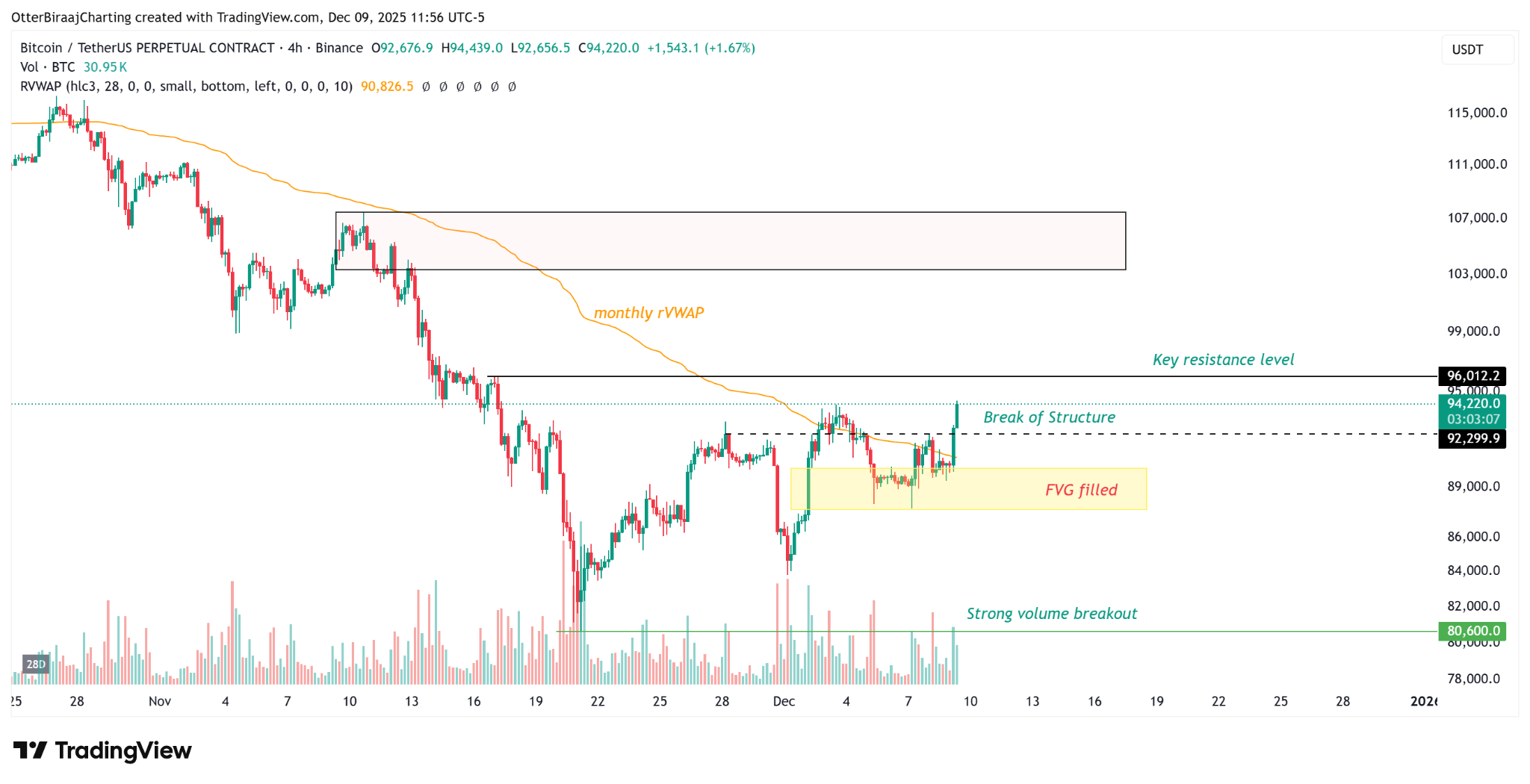
From a technical analysis perspective, on the four-hour chart, Bitcoin not only completely filled the fair value gap between $87,500 and $90,000 but also showed firm buying intent. The effectiveness of this breakthrough is particularly significant against the backdrop of potential volatility from upcoming macro events.


Technical Patterns and Key Level Analysis

Multiple bullish technical patterns have recently formed. A confirmed 'cup and handle pattern' is observed on the four-hour chart, suggesting that if Bitcoin can break above $96,000, the next target could be $104,000. Simultaneously, an 'inverse head and shoulders pattern' has also largely taken shape. These two bullish patterns together strengthen confidence among the bulls.

Market analysts generally view $94,000 as a key psychological level, coinciding with a descending trendline resistance. The criteria for judging trend sustainability are clear: if Bitcoin's daily closing price can stabilize above $96,000, it will be seen as a strong bullish reversal signal; conversely, failure at this resistance could lead to a rapid pullback to the $88,000-$89,000 range.

More broadly, the $95,000 area is seen as the 'main battlefield' between bulls and bears. A successful breakout above this area could open the door for the price to test the $99,000 to $107,000 range; whereas a failure to break through could result in a deeper correction, potentially retesting the $85,000 support, or even plunging further to $76,000 in extreme cases.


Contradictory Signals from Liquidity Conditions and Market Participation
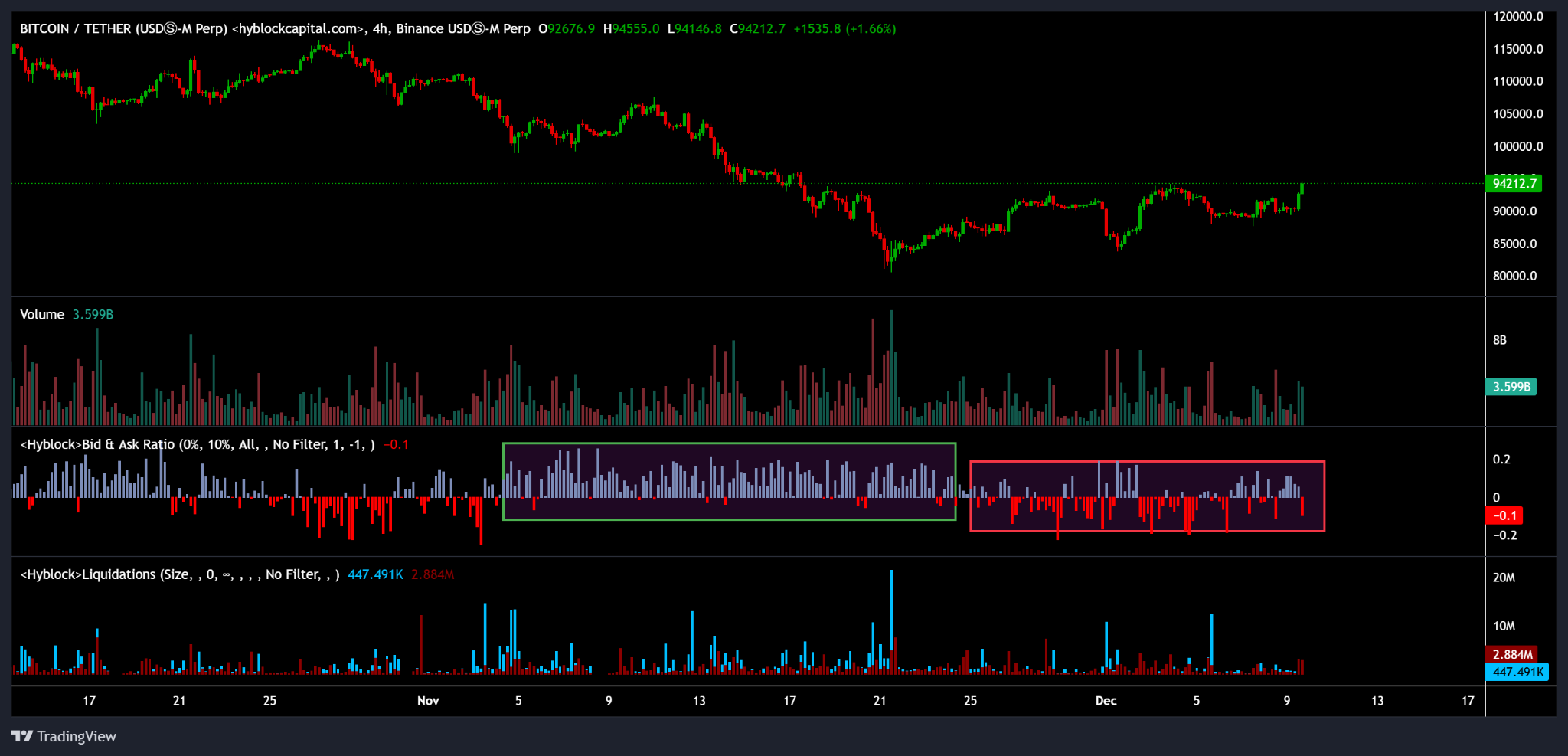
Analysis of Bitcoin's Preference-Sell Ratio and Liquidation Data. Source: Hyblock

Although the price action is encouraging, market liquidity indicators do not fully validate the upward trend. Bitcoin's buy-sell ratio remains at a relatively low and unstable level.

Unlike the aggressive buying seen during November's plunge from $100,000 to $80,000, the current rebound lacks the same intensity of buying support. This suggests that the recent rise is primarily driven by price movement rather than solid new demand. Exchange premium data also paints a complex picture.

The Kimchi Premium (a key indicator of retail sentiment in South Korea) has significantly cooled. Previously, the Korean market often traded at a premium during rallies, but this enthusiasm has now waned, approaching parity or slightly negative, indicating that retail speculators have not yet entered the market en masse.
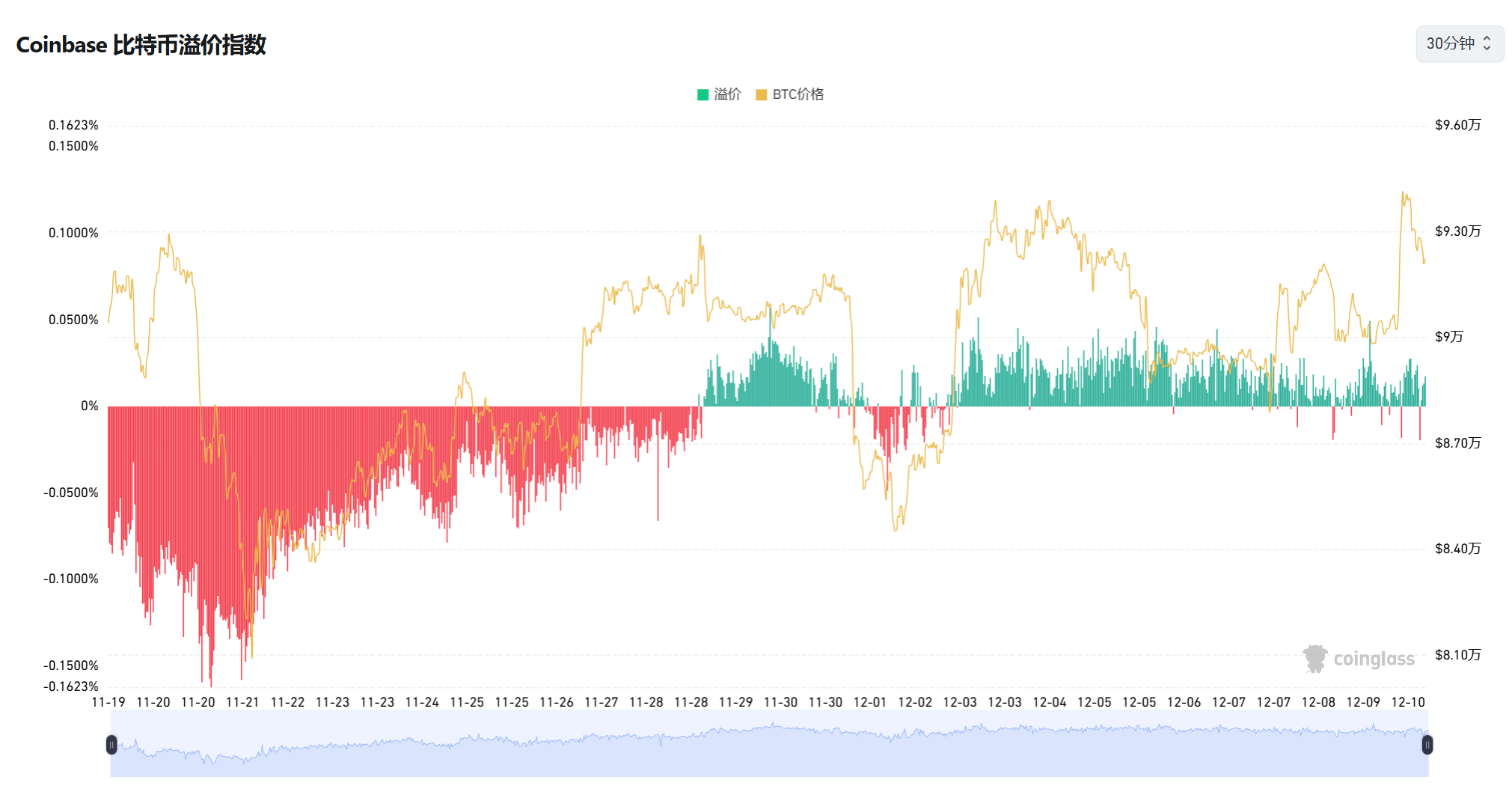
Meanwhile, the Coinbase Premium Index (representing U.S. institutional demand) has turned positive again.

Historical data shows that moderate positive readings often appear during early trend reversals and spot accumulation phases. This regional divergence makes the market outlook more complex.

On-chain data provides further insight. The number of 'whale' addresses holding at least 100 BTC has hit a new high for 2025, and large transfers have reached a three-month peak. This typically indicates that 'smart money' is building positions, rather than the market being dominated by short-term speculators. The average cost basis for short-term holders is now near $90,000, forming a psychological support level.


Macro Backdrop and Policy Catalysts

The Federal Reserve's monetary policy moves remain a key macro factor influencing Bitcoin's trajectory. Ahead of the FOMC meeting, the market widely anticipates a potential 25 basis point rate cut. Historical data shows that five out of the six FOMC meetings this year coincided with Bitcoin price pullbacks.

Furthermore, policy expectations have also become a major market driver. The Trump administration's proposed concept of a 'Bitcoin Strategic Reserve' and the advancement of U.S. stablecoin legislation have injected optimism into the market.

More crucially, the approval process for Bitcoin spot ETFs is entering its final stages, with Bloomberg analysts expecting a result by mid-May. Applications from institutions like BlackRock and Fidelity are queued awaiting approval.

Participation from traditional financial institutions is also deepening. Global asset management giant Vanguard has opened cryptocurrency ETF access to specific clients, including Bitcoin and Ethereum-related products. This widening of traditional financial channels removes another barrier for large-scale institutional capital inflows into the crypto market.


Market Risks and Potential Challenges

Despite the seemingly optimistic outlook, several risk factors cannot be ignored. From a technical indicator perspective, Bitcoin's Relative Strength Index (RSI) has entered overbought territory (>70), and the 200-day moving average around $96,216 poses strong resistance.

Leverage risk is particularly prominent. Data from Bybit and OKX shows that long positions account for 58%. If the price falls below $87,000, it could trigger a cascade of liquidations exceeding $120 million.

This high-leverage environment makes the market more prone to violent fluctuations. Regulatory uncertainty persists.

Although U.S. policy winds are warming, the EU's MiCA framework is just beginning to be implemented, and regulatory attitudes remain strict in some Asian countries. This global lack of regulatory synchronization could continue to affect market stability.


Conclusion

Bitcoin's climb back above $94,000 has undoubtedly injected new optimism into the market, but whether the bull market has truly restarted requires more evidence. The current market is at a resonance point of bullish technical signals and macro tailwinds, yet constrained by key resistance levels and liquidity concerns.

Investors should closely watch the situation around the $96,000 breakout and the Federal Reserve's policy moves, as these factors are more important than any single candlestick pattern. In an environment where volatility may intensify, position management and risk control are more crucial than chasing short-term gains.

The Bitcoin market has entered a new era of complex dynamics driven by ETF flows, leverage cycles, stablecoin liquidity, holder structure, and macro liquidity. Understanding the interrelationships of these signals will be key to navigating future markets.



Пов'язані питання

QWhat are the two main bullish technical patterns mentioned in the article that have formed on Bitcoin's price chart?

AThe two main bullish technical patterns are a confirmed 'cup and handle pattern' and a nearly completed 'inverse head and shoulders pattern'.

QAccording to the article, what is the critical resistance level that Bitcoin needs to close above on a daily basis to signal a strong bullish reversal?

AA daily close above $96,000 is considered a strong bullish reversal signal.

QWhat contradictory signal does the market liquidity data show despite the encouraging price action?

AThe market liquidity data shows that the buy-to-sell ratio remains relatively low and unstable, indicating the recent rally is driven more by price movement than by solid new demand, unlike the aggressive buying seen during the November crash.

QWhich macroeconomic event is highlighted as a key catalyst and potential source of volatility for Bitcoin's price?

AThe Federal Open Market Committee (FOMC) meeting is highlighted as a key macroeconomic event and potential source of volatility, with markets widely anticipating a potential 25 basis point rate cut.

QWhat does the article identify as a significant risk due to the current high leverage in the market?

AA significant risk identified is the potential for a cascade of liquidations exceeding $120 million if the price were to drop below $87,000, due to the high proportion of long positions (58%) on exchanges like Bybit and OKX.

Пов'язані матеріали

IOSG Founder: Web3 Is 'Losing Blood,' How Can Practitioners Survive Better?

IOSG Founder: Web3 Is "Bleeding Out" – How Can Practitioners Survive Better? In a candid reflection, the founder of IOSG Ventures voices deep concerns about the current state of Web3, describing an ecosystem experiencing severe "blood loss." Despite the recent MuShanghai event showcasing a successful pivot towards a more diverse, global community, a somber reality persists: many crypto-native attendees were there exploring exits or new labels in biotech, AI, and robotics. The core issue is identified as a breakdown in the ecosystem's positive feedback loop. Alarmingly, underestimated "low-probability bad events" are occurring simultaneously: a significant brain drain of Chinese developers to AI, a lack of breakout applications despite massive funding, and a widening credibility gap for practitioners globally, often stigmatized as scam artists. This has created a dire接班人 (successor) problem, with the next generation seeing little professional prestige or financial upside in crypto compared to fields like AI. A significant portion of the critique focuses on Ethereum and Vitalik Buterin. While not pessimistic about Ethereum's technology, the founder worries that critical development windows were missed by focusing on niche technical narratives like ZK and L2 instead of mass-market applications. A more urgent concern is that Vitalik may be isolated in an "information bubble," shielded from the grassroots community's hardships by layers of intermediaries, preventing crucial feedback from reaching him. The call is for Vitalik to return to a founder's mindset, re-engage directly with the community, and rally efforts for the next decade. The divergence between U.S. and Chinese OG (Original Gangster) ecosystems is stark. While many U.S. builders reinvest their wealth into the ecosystem, the Chinese scene suffers from a severe lack of "造血能力" (blood-making ability), with most market-driven funds struggling and many early success stories cashing out entirely. This threatens the entire Asian Web3 ecosystem's survival. For individual practitioners, survival advice is pragmatic: find your core "why," maintain life balance beyond token prices, continuously learn new skills (like AI), form small, trusted alliances for mutual support, and practice self-compassion. The industry's greatest need is not money or tech, but lighthouses—individuals at all levels who offer mentorship, grants, referrals, and honest reflection to guide others. The piece concludes with a direct appeal: OGs must pay forward the opportunities the industry gave them; founders must not struggle alone; and builders must continue their work, ensuring it remains a viable profession. The survival of Web3's "cathedral" depends not on any single leader but on the collective responsibility of everyone who remains.

marsbit26 хв тому

IOSG Founder: Web3 Is 'Losing Blood,' How Can Practitioners Survive Better?

marsbit26 хв тому

Deficits, Inflation, and the New Fed: The Deep Logic Behind US Bond Yields Breaking 5% and the Market Reset

In the week of May 15-19, 2026, U.S. long-term Treasury yields surged to multi-year highs, with the 30-year yield hitting 5.2%, a level unseen since 2007, and the 10-year yield climbing to 4.687%. Equity markets declined in response. Four primary factors are driving the rise in yields. First, stubborn inflation persists, with April wholesale prices rising 6% year-over-year, fueling expectations of potential future Fed rate hikes instead of cuts. Second, newly confirmed Fed Chair Kevin Warsh inherits a complex inflation battle, with markets closely awaiting his first FOMC meeting. Third, deteriorating U.S. fiscal health, marked by large deficits and rising debt servicing costs, is eroding the traditional "safe-haven" premium for Treasuries. Fourth, the "One Big Beautiful Bill" tax cuts are projected to add trillions to the national debt, contributing to Moody's recent credit rating downgrade. Rising yields pressure stocks through several channels: a higher discount rate reduces the present value of future earnings (especially for growth stocks); rising risk-free rates compress equity risk premiums, making bonds relatively more attractive; higher borrowing costs impact consumers and corporations; and a stronger dollar affects multinational earnings. For investors, the environment favors value and financial stocks over long-duration growth stocks. Bond investors find attractive yields in short to intermediate maturities, while income investors see the best fixed-income opportunities in over a decade. Key developments to watch include Chair Warsh's first FOMC meeting, upcoming inflation data, Treasury auction demand, and whether the 30-year yield approaches 6%, a level that could trigger a more sustained equity valuation reset. The bond market's message is clear: the era of cheap government borrowing is over, posing a central challenge for markets in late 2026.

marsbit28 хв тому

Deficits, Inflation, and the New Fed: The Deep Logic Behind US Bond Yields Breaking 5% and the Market Reset

marsbit28 хв тому

Is MicroStrategy Selling Bitcoin Not a Bearish Signal? Deconstructing the 5 Financial Logics Behind Corporate Bitcoin Divestment

The article "Is Strategy Selling Bitcoin Not a Bearish Signal? Decoding 5 Financial Logics Behind Corporate Bitcoin Divestment" analyzes why companies might sell their bitcoin holdings, arguing it's not necessarily negative. It begins by noting the market's surprise at Strategy's potential sale, contrasting its previous "never sell" stance. The core argument is that corporate decisions prioritize shareholder value, and selling bitcoin can be a rational strategic choice. The article outlines five key financial reasons for such sales: 1. **Increase Bitcoin Holdings Per Share:** Companies can use proceeds from bitcoin sales to repurchase shares when the stock price is undervalued relative to its bitcoin assets. This reduces the outstanding share count, potentially increasing the bitcoin amount backing each remaining share. 2. **Optimize Capital Structure & Reduce Financing Costs:** Building cash reserves through bitcoin sales can improve credit ratings (as favored by agencies like S&P), leading to lower future borrowing costs. Repaying debt with sale proceeds also reduces financial leverage. 3. **Legitimate Tax Planning:** In the absence of wash-sale rules for bitcoin in the US, companies can sell to realize capital losses, then repurchase, lowering the tax basis of their holdings and creating tax offsets. 4. **Counter Negative Market Narratives:** A controlled, non-disruptive sale could demonstrate market resilience and disprove fears that corporate selling would crash the market, thereby normalizing bitcoin as a corporate treasury asset. 5. **Repurchase Preferred Stock at a Discount:** If a company's preferred stock trades significantly below its face value, using bitcoin sale proceeds to repurchase it can retire expensive liabilities at a profit, saving on future dividend payments. The conclusion emphasizes that bitcoin's monetary properties offer flexibility. Strategic sales can protect corporate and shareholder interests, making asset utilization more important than rigid "hold" mandates.

marsbit57 хв тому

Is MicroStrategy Selling Bitcoin Not a Bearish Signal? Deconstructing the 5 Financial Logics Behind Corporate Bitcoin Divestment

marsbit57 хв тому

Why Did Zhipu Surge Nearly 30% in a Single Day?

"Global AI Model Unicorn" Zhipu's stock surged nearly 30% in a single day, reaching a new market cap high. The catalyst was the launch of its GLM-5.1-highspeed API, boasting a generation speed of **400 tokens per second**, setting a new global benchmark. This speed, roughly 3-5 times faster than industry leaders like OpenAI's GPT-4o and Anthropic's Claude, is achieved **without compromising the full-scale model's capabilities**. In the era of AI Agents requiring dozens of self-calls, such latency reduction is critical, transforming speed from a system metric into a determinant of intelligence limits. The breakthrough stems from a three-layer technical overhaul: 1. **TileRT Inference Engine**: Compiles the entire model into a continuous, always-on computation pipeline using "Warp Specialization," minimizing GPU idle time by having different processor groups handle data loading, computation, and communication in parallel. 2. **Heterogeneous Parallelism for MLA**: To efficiently run the GLM-5.1 model using the MLA attention mechanism, TileRT employs a heterogeneous strategy. One GPU handles sparse indexing/routing, while the others perform dense computation, optimizing for MLA's unique workflow. 3. **ZCube Network Architecture**: Replaces the standard Spine-Leaf (ROFT) network topology with a flat, dual-group interconnect. This design creates a single optimal path between any two GPUs, eliminating network congestion at scale and reducing latency. The business impact is significant: a 15% increase in cluster throughput (free extra capacity), a 40.6% reduction in tail latency (improved stability), and a one-third cut in networking hardware costs. Long-term, this innovation challenges the dominance of NVIDIA's integrated hardware-software stack (GPU+NVLink+InfiniBand), potentially benefiting manufacturers of high-density Leaf switches and optical modules while lowering the software barrier for domestic AI chips like Huawei's Ascend. The innovation proves that more can be achieved with the same compute, reshaping the infrastructure beyond just GPUs.

marsbit2 год тому

Why Did Zhipu Surge Nearly 30% in a Single Day?

marsbit2 год тому

Торгівля

Спот
Ф'ючерси

Популярні статті

Що таке GENIUS

I. Вступ до проектуGenius Terminal - це перший приватний і фінальний onchain термінал. Це те, що йде після агрегаторів, мостів намірів та розширень гаманців — спеціально створена торгова ОС для професійних користувачів, які хочуть DeFi без DeFi UX.II. Інформація про токен1) Основна інформаціяНазва токена: GENIUS (Genius)III. Пов'язані посиланняВебсайт:https://www.tradegenius.com/homeЕксплорери:https://bscscan.com/address/0x1f12b85aac097e43aa1555b2881e98a51090e9a6Соціальні мережі:https://x.com/GeniusTerminal Примітка: Вступ до проекту взято з матеріалів, опублікованих або наданих офіційною командою проекту, які є лише для довідки і не є інвестиційною порадою. HTX не несе відповідальності за будь-які прямі або непрямі збитки, що виникають внаслідок цього.

204 переглядів усьогоОпубліковано 2026.04.29Оновлено 2026.04.29

Що таке GENIUS

Як купити GENIUS

Ласкаво просимо до HTX.com! Ми зробили покупку Genius (GENIUS) простою та зручною. Дотримуйтесь нашої покрокової інструкції, щоб розпочати свою криптовалютну подорож.Крок 1: Створіть обліковий запис на HTXВикористовуйте свою електронну пошту або номер телефону, щоб зареєструвати обліковий запис на HTX безплатно. Пройдіть безпроблемну реєстрацію й отримайте доступ до всіх функцій.ЗареєструватисьКрок 2: Перейдіть до розділу Купити крипту і виберіть спосіб оплатиКредитна/дебетова картка: використовуйте вашу картку Visa або Mastercard, щоб миттєво купити Genius (GENIUS).Баланс: використовуйте кошти з балансу вашого рахунку HTX для безперешкодної торгівлі.Треті особи: ми додали популярні способи оплати, такі як Google Pay та Apple Pay, щоб підвищити зручність.P2P: Торгуйте безпосередньо з іншими користувачами на HTX.Позабіржова торгівля (OTC): ми пропонуємо індивідуальні послуги та конкурентні обмінні курси для трейдерів.Крок 3: Зберігайте свої Genius (GENIUS)Після придбання Genius (GENIUS) збережіть його у своєму обліковому записі на HTX. Крім того, ви можете відправити його в інше місце за допомогою блокчейн-переказу або використовувати його для торгівлі іншими криптовалютами.Крок 4: Торгівля Genius (GENIUS)Легко торгуйте Genius (GENIUS) на спотовому ринку HTX. Просто увійдіть до свого облікового запису, виберіть торгову пару, укладайте угоди та спостерігайте за ними в режимі реального часу. Ми пропонуємо зручний досвід як для початківців, так і для досвідчених трейдерів.

177 переглядів усьогоОпубліковано 2026.04.29Оновлено 2026.04.29

Як купити GENIUS

Як купити MEGA

Ласкаво просимо до HTX.com! Ми зробили покупку MegaETH (MEGA) простою та зручною. Дотримуйтесь нашої покрокової інструкції, щоб розпочати свою криптовалютну подорож.Крок 1: Створіть обліковий запис на HTXВикористовуйте свою електронну пошту або номер телефону, щоб зареєструвати обліковий запис на HTX безплатно. Пройдіть безпроблемну реєстрацію й отримайте доступ до всіх функцій.ЗареєструватисьКрок 2: Перейдіть до розділу Купити крипту і виберіть спосіб оплатиКредитна/дебетова картка: використовуйте вашу картку Visa або Mastercard, щоб миттєво купити MegaETH (MEGA).Баланс: використовуйте кошти з балансу вашого рахунку HTX для безперешкодної торгівлі.Треті особи: ми додали популярні способи оплати, такі як Google Pay та Apple Pay, щоб підвищити зручність.P2P: Торгуйте безпосередньо з іншими користувачами на HTX.Позабіржова торгівля (OTC): ми пропонуємо індивідуальні послуги та конкурентні обмінні курси для трейдерів.Крок 3: Зберігайте свої MegaETH (MEGA)Після придбання MegaETH (MEGA) збережіть його у своєму обліковому записі на HTX. Крім того, ви можете відправити його в інше місце за допомогою блокчейн-переказу або використовувати його для торгівлі іншими криптовалютами.Крок 4: Торгівля MegaETH (MEGA)Легко торгуйте MegaETH (MEGA) на спотовому ринку HTX. Просто увійдіть до свого облікового запису, виберіть торгову пару, укладайте угоди та спостерігайте за ними в режимі реального часу. Ми пропонуємо зручний досвід як для початківців, так і для досвідчених трейдерів.

196 переглядів усьогоОпубліковано 2026.04.30Оновлено 2026.04.30

Як купити MEGA

Обговорення

Ласкаво просимо до спільноти HTX. Тут ви можете бути в курсі останніх подій розвитку платформи та отримати доступ до професійної ринкової інформації. Нижче представлені думки користувачів щодо ціни A (A).

活动图片