Bitcoin Institutional Demand Overtakes BTC Mining Output – Here Are The Figures

bitcoinistОпубліковано о 2026-04-04Востаннє оновлено о 2026-04-04

Анотація

A recent report highlights a significant shift in the Bitcoin market: institutional demand for BTC is now substantially outpacing the supply of newly mined coins. Despite ongoing macroeconomic uncertainty, public companies acquired over 47,000 BTC in March alone—valued at approximately $3.14 billion—nearly doubling the previous month's accumulation. In contrast, only 13,950 BTC were mined during the same period, intensifying Bitcoin’s scarcity narrative. Leading the institutional charge is Michael Saylor’s MicroStrategy, which accounted for 44,377 of the net acquired BTC. This growing demand is further reflected in declining exchange balances, with BTC supply on exchanges dropping to a multi-year low of 14.6% by April 2026. A similar trend is observed in Ethereum, suggesting a broader institutional accumulation pattern. This supply-demand imbalance may serve as a catalyst for Bitcoin’s future price movement.

Bitcoin demand is taking a crucial turn in a market hampered by ongoing negative macroeconomic and political events across the globe. A recent report has outlined an increasing interest and demand for the leading cryptocurrency asset among large companies, which has now significantly exceeded those produced by miners in the market.

More Bitcoin Is Absorbed Than Being Mined

While price direction has been uncertain and unstable for the past few weeks, a growing imbalance is starting to take shape in the Bitcoin market. This imbalance focuses on institutions’ interests in BTC compared to new coins being mined.

On the X platform, a crypto investor known as AltCryptoGems has shared that institutional demand for BTC is rising at a substantial rate despite current unfavorable market conditions. Currently, public companies are scooping up more BTC faster than the rate at which miners are producing new coins.

As it continues to expand, this dynamic is strengthening the scarcity narrative of the flagship asset and reducing the amount of liquidity that is available. Such an imbalance could play a crucial role or act as a catalyst for the asset’s next price move. When large institutions accumulate, it is typically a clear sign of conviction in the asset’s long-term prospects.
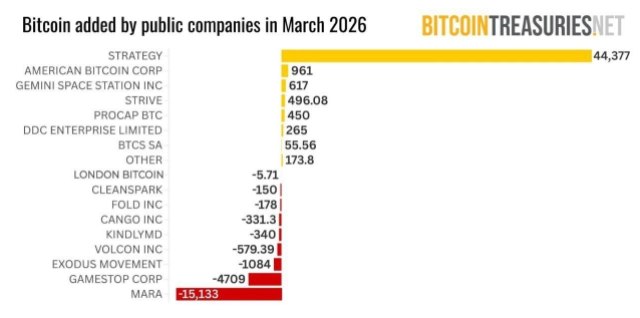
Source: Chart from AltCryptoGems on X

The recently concluded month of March saw a wave of accumulation from these big public firms. In the month alone, the expert revealed that these companies collectively added over 47,000 BTC valued at approximately $3.14 billion at current price levels, to their balance sheets. Leading the charge is Michael Saylor’s Strategy, amassing over 44,377 BTC out of the net acquisition.

When compared to the prior month, this is significantly higher, as it saw over 29,590 BTC being scooped up by public institutions. This shows that institutional interest and demand in BTC nearly doubled within a monthly period. As for Bitcoin mining, only 13,950 BTC were mined during the same period, indicating that demand is currently clouding new supply into the market.

BTC Exchange Balance Is Drying Up Pretty Fast

Despite persistent sideways price action and ongoing volatility, the underlying sentiment toward Bitcoin is turning quite bullish. Investors on cryptocurrency exchanges are steadily taking out their BTC from these platforms. Market expert Leon Waidmann reported that BTC balance on cryptocurrency exchanges is not sitting at its lowest level since 2018.

After a period of steady withdrawals, the total supply of BTC left on exchanges is only 14.6%. From 2019 to 2022, the balance dropped to the 16% to 18% range, and then gradually continued bleeding throughout 2022. Now, 8 years later, the percentage has dropped to 14.6% as of April 2026.

Ethereum, the second-largest cryptocurrency asset, has also witnessed a similar trend, with balances on exchanges now sitting at 11%, its lowest level in years. Both leading assets are at historic lows at the same time, making this period a crucial one for the market as it could notably shift sentiment.

BTC trading at $67,159 on the 1D chart | Source: BTCUSDT on Tradingview.com

Пов'язані питання

QAccording to the article, how much Bitcoin did public companies collectively add to their balance sheets in March, and what was its approximate value?

AIn March, public companies collectively added over 47,000 BTC to their balance sheets, valued at approximately $3.14 billion at current price levels.

QWhat does the article state is the significance of large institutions accumulating Bitcoin?

AWhen large institutions accumulate Bitcoin, it is typically a clear sign of conviction in the asset's long-term prospects and can act as a catalyst for its next price move.

QHow does the institutional demand for Bitcoin compare to the new supply from mining, as reported for March?

AInstitutional demand significantly exceeded mining output. While public companies acquired over 47,000 BTC, only 13,950 BTC were mined during the same period.

QWhat trend is reported regarding the balance of Bitcoin on cryptocurrency exchanges?

AThe balance of Bitcoin on cryptocurrency exchanges is at its lowest level since 2018, with only 14.6% of the total supply remaining on exchanges as of April 2026.

QWhich company was highlighted as the largest accumulator of Bitcoin in the recent wave of institutional buying?

AMichael Saylor's company, MicroStrategy, led the charge by amassing over 44,377 BTC out of the net acquisition.

Пов'язані матеріали

War Trade Unwinding | TradeXYZ Weekend Observations

Weekend markets saw a clear return of risk appetite. Major indices rose broadly, with significant gains in tech and precious metals, while energy sectors fell sharply on the "end of war" narrative. On June 14, oil prices initially rose on reports Iran had not yet finalized a memorandum of understanding. Later, YNET reported Trump might immediately lift the maritime blockade on Iran and the Strait of Hormuz. At 21:30, Trump confirmed on Truth Terminal that a deal with Iran was done, authorizing an immediate end to the US blockade and toll-free opening of the Strait. Iran's deputy foreign minister simultaneously announced an immediate and permanent halt to military actions on multiple fronts. Oil prices had already fallen to weekend boundaries, pre-pricing the news. The S&P 500 subsequently touched 7530. Markets will likely remain in a waiting period until the formal peace deal signing on June 19. At the moment of the deal announcement, gold jumped from ~4,221 to a high of 4,337, and silver from ~67.85 to 70.83, before stabilizing at higher levels. Individual stocks and ETFs like NBIS, RKLB, and LITE performed strongly. NBIS, added to the Nasdaq index, saw a target price increase due to strong AI cloud growth. RKLB, also added to the index, benefited from positive SpaceX valuation sentiment. LITE received a $1,130 target from JPMorgan. SPCX rose quickly after Musk tweeted SpaceX could potentially reach ~$1 trillion in revenue by 2030. In summary, the market shock from the multi-month war is beginning to dissipate. Israel's actions remain the key variable before the June 19 signing. Upcoming events like Fed Chair Warsh's debut and BoJ rate hike expectations will also significantly impact markets this week.

marsbit21 хв тому

War Trade Unwinding | TradeXYZ Weekend Observations

marsbit21 хв тому

Will the Next Crypto Bull Run Start with On-Chain Trading of SpaceX?

This article presents a scenario-based forecast for the crypto industry from 2026 to 2029, arguing that the next major cycle will be driven not by technological narratives but by legal access to real-world assets. The author predicts that by mid-2026, pre-IPO perpetual contracts for top private companies like SpaceX, OpenAI, and Anthropic on platforms like Hyperliquid will become the primary gateway for accessing quality assets, as most crypto-native tokens fail to capture real value. The much-hyped AI x Crypto intersection largely fails except for prediction markets, which thrive on betting on AI model supremacy. By 2027, public blockchain foundations are forced to choose between catering to retail speculation or building compliant infrastructure for institutions, with many opting for the latter. Growth in stablecoins and tokenized private credit/equity hits a "triple ceiling" due to regulatory and political uncertainty rather than market demand. The pivotal shift is forecast for 2028. A major liquidation event in pre-IPO perpetuals exposes the structural flaw of synthetic markets lacking a real underlying asset anchor. In response, regulatory changes finally allow the public solicitation of private securities resales to verified accredited investors. This creates a legitimate secondary market for real company equity, which then becomes the core asset class of the new bull market, relegating synthetic perps to a niche role. By 2029, the industry becomes "boring" but foundational. Tokens without claims on real cash flows or assets cease trading. Stablecoin growth is steady but politically capped. Crypto infrastructure fades from view as it gets absorbed into traditional finance backends. The article's central thesis is that the key bottleneck for crypto's next phase is legal and regulatory channels for real asset ownership, not technology.

marsbit1 год тому

Will the Next Crypto Bull Run Start with On-Chain Trading of SpaceX?

marsbit1 год тому

The Value Distribution of Stablecoins

**Summary: The Value Distribution of Stablecoins** The article argues that stablecoins are evolving from mere trading tools into broader channels for dollar access. It divides the stablecoin ecosystem into four layers to analyze how value is distributed: 1. **Issuance Layer:** Mints stablecoins, holds reserve assets, and captures the spread between reserve yield and user costs (e.g., Tether, Circle). This layer currently earns the largest profit margin. 2. **Infrastructure Layer:** Connects stablecoins to the traditional financial system, handling fiat on/off-ramps, banking integration, compliance (KYC/AML), and asset management (e.g., Bridge, BVNK). This is the "unglamorous" but critical work, building the essential bridges between crypto and real-world finance. 3. **Acquiring/Distribution Layer:** Integrates stablecoins into merchant systems, manages payment flows, and provides enterprise financial software (e.g., Stripe, Coinbase). They act as the access point for businesses. 4. **Application Layer:** The end-users and businesses that ultimately use stablecoins for payments, settlements, or as a store of value. They benefit from convenience but have little pricing power. The core thesis is that while the issuance layer currently dominates profits, the often-overlooked **infrastructure layer holds significant long-term potential**. The real challenge and barrier to mass adoption is not the on-chain transfer of stablecoins (which is simple), but the complex "last mile" integration into existing business workflows, banking systems, and regulatory frameworks across different countries. Companies in this layer are currently in a "land grab" phase, investing heavily to build networks, secure bank partnerships, and establish compliance pathways. While their position is currently pressured by the profitable issuers above and distribution platforms below, the article suggests that if stablecoins become a default financial rail for businesses, the infrastructure providers who have done the hard work of integration will ultimately gain strong pricing power and become entrenched, essential players.

marsbit8 год тому

The Value Distribution of Stablecoins

marsbit8 год тому

Торгівля

Спот
Ф'ючерси
活动图片