BIP-110 Proceeds to Mandatory Signaling with Less Than 3% Miner Support

cryptonews.ruОпубліковано о 2026-08-08Востаннє оновлено о 2026-08-08

Анотація

At block 961,632, BIP-110 transitioned to mandatory signaling after receiving support in only 51 of the previous 2,016 blocks (2.53%), far below the 55% threshold for early activation. Nodes implementing BIP-110 now reject blocks without version bit 4, while standard Bitcoin nodes continue to accept all blocks. A minority BIP-110 chain briefly emerged but quickly fell behind the main chain. The low hashrate support makes a sustained competing chain unlikely without significantly more miner backing. The proposal, authored by Dathon Ohm, aims to impose temporary consensus restrictions for roughly one year. It limits the size of most new output scripts to 34 bytes, caps OP_RETURN outputs at 83 bytes, and restricts certain data carriers and witness elements to 256 bytes, with some Taproot functions also temporarily limited. The goal is to curb non-monetary data like inscriptions, which increase costs for node operators. Critics, including Michael Saylor and Adam Back, warn it could split the Bitcoin network by causing nodes to reject transactions currently permitted by network rules. The mandatory signaling window lasts from block 961,632 to 963,647. If locked in by block 963,648, the transaction restrictions would activate at block 965,664. Proponents have also discussed a more extensive contingency plan. On August 1st, developer Chris Guida rebased preliminary code for a proof-of-work change, originally by Luke Dashjr, describing it as a backup option should miners oppose BIP...

On Saturday at block 961,632, BIP-110 proceeded to mandatory signaling: miners had supported it in only 51 of the previous 2,016 blocks—2.53%. This is significantly below the 55% required for early activation, according to the BIP-110 monitor.

From block 961,632, nodes with BIP-110 started rejecting blocks without version bit 4, while regular Bitcoin nodes continued to accept both signaling and non-signaling blocks. A minority BIP-110 chain later emerged but quickly fell behind the main chain.

The low level of signaling makes a sustainable competing chain unlikely without significantly greater miner support. With weak miner participation, the BIP-110 chain may grow slowly or even stop producing blocks altogether.

This phase will show whether proponents can carry out a controversial consensus change without broad miner support. It could separate BIP- nodes from the main chain and intensify the debate over Bitcoin's block space usage.

BIP-110 to Temporarily Restrict Data in Bitcoin

A developer using the pseudonym Dathon Ohm prepared BIP-110—a proposal for additional consensus restrictions lasting approximately one year.

It will limit the size of most new output scripts to 34 bytes, the maximum size of OP_RETURN outputs to 83 bytes, and individual data carries and witness elements to 256 bytes. Several Taproot features will also be temporarily restricted. Unspent transaction outputs created before activation will be exempt from these rules.

Supporters believe the restrictions will curb inscriptions and other non-monetary data that increase the storage and bandwidth costs for node operators.

Critics of the proposal, including Strategy executive chairman Michael Saylor and Blockstream CEO Adam Back, argue that BIP- could split Bitcoin and lead to nodes rejecting transactions permitted by the network's current rules.

Related: Number of Bitcoin Nodes with BIP-110 Exceeds 2% Amid Escalating Spam Wars

Miners signal support via version bit 4. The period from block 961,632 to 963,647 is the mandatory signaling window: nodes with BIP-110 reject blocks without this signal.

The specification provides for the start of the locked-in phase at block 963,648, with transaction restrictions taking effect at block 965,664.

BIP-110 proponents are also discussing a more extensive contingency plan. On August 1, Bitcoin developer Chris Guida rebased preliminary proof-of-work change code originally written by Bitcoin Knots maintainer Luke Dashjr.

Guida described this code as a contingency plan in case miners oppose BIP- and clarified that no activation date is set. Journal: 110

The Strangest Things Ever Tokenized... Including Fart.10 dek

end-content

Пов'язані питання

QWhat is the key threshold for miner support required for BIP-110 to activate early, and what was the actual support level?

AThe key threshold for early activation of BIP-110 is 55% support from miners. The actual support level was only 2.53% (51 out of 2,016 blocks).

QWhat specific transaction limitations does BIP-110 propose to impose?

ABIP-110 proposes to limit most new output scripts to 34 bytes, cap the size of new OP_RETURN outputs at 83 bytes, restrict individual data pushes and witness elements to 256 bytes, and temporarily restrict some Taproot functions.

QWhat was the consequence for BIP-110 nodes regarding blocks without version bit 4 starting from block 961,632?

AStarting from block 961,632, nodes implementing BIP-110 began rejecting blocks that did not signal support via version bit 4.

QWhat is the primary concern of critics of BIP-110, as mentioned in the article?

ACritics, including Michael Saylor and Adam Back, are concerned that BIP-110 could split the Bitcoin network and cause nodes to reject transactions that are currently permitted under the network's existing rules.

QWhat is the 'backstop option' discussed by BIP-110 supporters, as mentioned near the end of the article?

AThe 'backstop option' is a change to Bitcoin's proof-of-work algorithm, originally drafted by Bitcoin Knots maintainer Luke Dashjr and rebased by developer Chris Guida on August 1st. It is considered a contingency plan if miners oppose BIP-110.

Пов'язані матеріали

Bitcoin's ECX Hard Fork to Introduce Three New Versions Throughout October

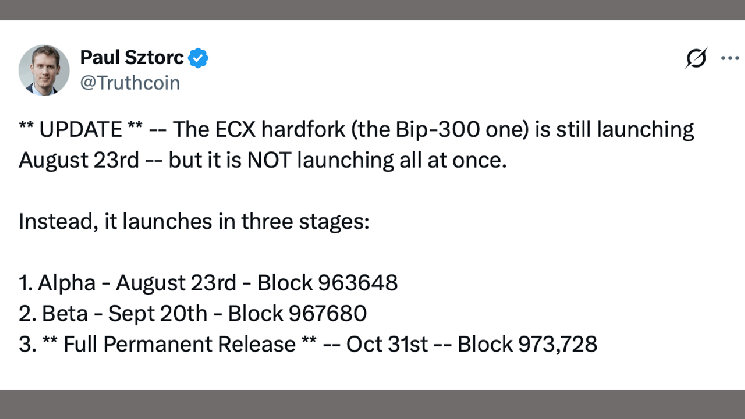
Bitcoin developer Paul Stortz, behind the Drivechain and BIP 300 proposals, has announced a hardfork for a new blockchain called ECX. Scheduled for October 31st (the 18th anniversary of the Bitcoin whitepaper), ECX will copy Bitcoin's full transaction history at a specific block height, crediting nearly all Bitcoin holders with an equal amount of ECX coins without altering the Bitcoin network itself. The launch will be executed in three phases. An "alpha" version is set for August 23rd (block 963,648), followed by a "beta" version on September 20th (block 967,680). The final mainnet launch is planned for October 31st (block 973,728). Coins accumulated during the alpha and beta phases can later be burned or swapped for real ECX. Stortz cites several reasons for the phased rollout: to address potential software bugs (including those possibly found by AI), allow an early market price to form for ECX before mining difficulty stabilizes, and let traders test and speculate. He described it as a "safety net" to manage any major issues and to demonstrate the chain's functionality. A key detail is that replay protection—a mechanism to prevent a transaction from being valid on both the Bitcoin and ECX chains—will remain optional, not automatic. The official ECX wallet software will apply this protection and warn users; Stortz warned that transactions ignoring this warning will be replayed on ECX, effectively tracking a user's spent bitcoins to their new owner unless a deliberate split is made. Stortz has given holders and exchanges 12 weeks from the alpha launch to prepare, during which they must decide on practical matters like running the wallet software to split their BTC and ECX holdings and how exchanges will credit the new asset to clients. The announcement comes as Bitcoin also faces another potential fork related to BIP-110.

cryptonews.ru1 год тому

Bitcoin's ECX Hard Fork to Introduce Three New Versions Throughout October

cryptonews.ru1 год тому

Торгівля

Спот
活动图片