BIP-110 Could Split Bitcoin In New Soft Fork Fight, Jameson Lopp Warns

bitcoinistОпубліковано о 2026-02-25Востаннє оновлено о 2026-02-25

Jameson Lopp is escalating his criticism of BIP-110, arguing the proposal could trigger a disruptive Bitcoin chain split while failing to stop the behavior it is meant to curb. In a Feb. 23 post, Lopp frames the plan as a consensus-layer response to a policy and cultural dispute around transaction “spam,” with risks that extend well beyond mempool debates.

BIP-110 is pitched as a soft fork led by Luke Dashjr that would temporarily restrict arbitrary data in transactions. Lopp summarizes it as adding seven new transaction-validity restrictions, including limits on where data can be placed and constraints on certain script behavior, but says the tradeoffs are far more severe than supporters admit. He calls the proposal “reckless and doomed to fail,” setting the tone for a post that is less a technical explainer than a warning about governance and coordination risk.

Why Lopp Thinks The Activation Path Is Dangerous For Bitcoin

The core of Lopp’s argument is not just what BIP-110 changes, but how it tries to activate. He points to the proposal’s 55% miner-signaling threshold for a user-activated soft fork and says that low bar materially increases the probability of two competing chains if the ecosystem is not aligned.

He also stresses that BIP-110 nodes would reject non-compliant blocks outright, which raises coordination risk compared with soft forks that old nodes can continue to follow without enforcement conflicts.

Lopp is especially pointed on the mandatory activation posture at block height 961,632. In one of the sharpest passages, he writes: “This is not a neutral, low-drama deployment posture. It’s dogmatic bullying. [...] you cannot pretend it’s low-risk.” He ties that warning to a broader point: even if one views UASF tactics as legitimate, the proposal’s design increases the odds of a messy failure mode if miners, exchanges, wallets, and infrastructure providers do not converge in time.

He also pushes back on comparisons to 2017, noting that the UASF many people cite in the SegWit era never actually had to run to the edge because SegWit activated via miner signaling instead. That distinction matters in Lopp’s framing, because BIP-110 proponents are, in his view, leaning on a historical precedent that did not test the exact scenario they now describe as manageable.

Another major section of Lopp’s post targets the claim that BIP-110 has meaningful grassroots momentum. He argues that raw node counts (roughly 20% run Knots) are a weak proxy for consensus because signaling is cheap, node operation can be low-cost, and Tor addresses are “effectively zero” cost to create at scale. He publishes a breakdown of reachable nodes and highlights the higher Tor-to-IPv4 ratio among Knots and BIP-110 signaling nodes as a reason to treat node-count narratives cautiously.

On mining support, Lopp says the gap is more straightforward. At the time of publication, he writes miner signaling was “precisely [...] zero,” and he cites public opposition from F2Pool while arguing miners have limited incentive to back a proposal that could reduce fee revenue. That point reinforces his broader thesis that BIP-110 supporters are overestimating social signaling and underestimating the role of economically significant actors in Bitcoin upgrade politics.

Lopp’s post ultimately reads as a warning that the immediate issue is not simply whether BIP-110 activates, but what the campaign reveals about where Bitcoin’s internal dispute over neutrality, censorship resistance, and block-space usage is heading. Even a failed fork push, in his framing, can still impose real costs by forcing operators and businesses to plan around low-probability but high-impact coordination failure.

At press time, Bitcoin traded at $62,791.
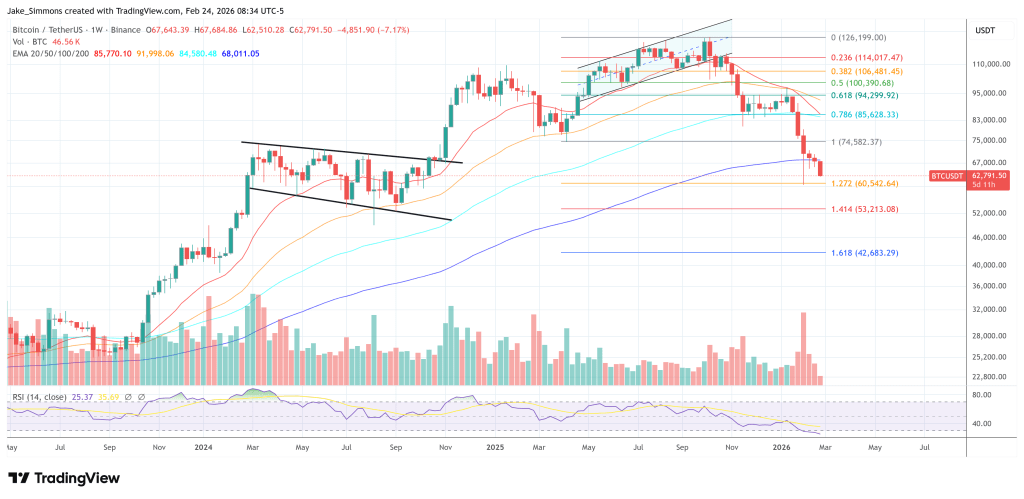
Bitcoin falls below $63,000, 1-week chart | Source: BTCUSDT on TradingView.com

Пов'язані питання

QWhat is the main concern Jameson Lopp raises about BIP-110?

AJameson Lopp's main concern is that BIP-110 could trigger a disruptive Bitcoin chain split due to its low 55% miner-signaling threshold for activation and its design that increases coordination risks, while failing to effectively stop the 'spam' behavior it aims to curb.

QHow does BIP-110 propose to activate, and why does Lopp find this dangerous?

ABIP-110 proposes a user-activated soft fork (UASF) with a 55% miner-signaling threshold. Lopp finds this dangerous because the low activation threshold and the node's policy of outright rejecting non-compliant blocks significantly increase the probability of creating two competing chains if the broader Bitcoin ecosystem is not fully aligned.

QWhat does Jameson Lopp say about the grassroots support for BIP-110?

ALopp argues that the raw node count signaling support for BIP-110 is a weak proxy for consensus. He highlights that a high percentage of these nodes are on the Tor network, which are cheap to create at scale, and cautions against overestimating this form of social signaling, especially since miner support was precisely zero at the time of his writing.

QAccording to Lopp, why is the comparison to the 2017 SegWit UASF flawed?

ALopp states the comparison is flawed because the 2017 SegWit UASF never actually had to run to its full extent; SegWit activated via miner signaling before the UASF was triggered. This means the historical precedent did not test the high-risk scenario of a contentious chain split that BIP-110 proponents are now describing as manageable.

QWhat is the broader implication of the BIP-110 debate, beyond the proposal itself?

AThe broader implication is that the debate reveals a deepening internal conflict within Bitcoin over core principles like neutrality, censorship resistance, and block-space usage. Even if BIP-110 fails, the campaign forces operators and businesses to incur real costs by having to plan for a low-probability but high-impact coordination failure.

Пов'язані матеріали

In Jinjiang, Fujian, a Storage Super Unicorn Lies Quiet

In Fujian's Jinjiang, a city known for sportswear, lies a quiet semiconductor giant: Fujian Jinhua Integrated Circuit Co. (JHICC). Once a promising domestic DRAM manufacturer alongside Yangtze Memory and ChangXin Memory Technologies (CXMT), its journey was derailed in 2018 when the U.S. placed it on an Entity List and filed criminal charges for alleged trade secret theft. This halted production for years. A turning point came in February 2024 when a U.S. federal court found JHICC not guilty. However, it had lost crucial time. While CXMT soared to become a top-valued A-share company in 2024, JHICC, with an estimated valuation of 80 billion RMB, was just restarting. Its current output is primarily customized DDR4 chips, not the advanced DDR5/HBM demanded for AI, but it still benefits from the broader memory chip upcycle. JHICC's story is tied to Chen Zhengkun, a veteran engineer who left Micron to lead the venture. Founded in 2016 with state-backed funding, JHICC partnered with Taiwan's UMC to develop DRAM technology. Rapid progress was cut short by the U.S. actions, which Micron initiated, partly due to its heavy reliance on the Chinese market. Post-sanctions, Chen's team worked to rebuild the production line with reduced reliance on U.S. technology. According to its records, JHICC achieved small-scale production and revenue growth under immense pressure. It now focuses on the stable "niche" DRAM market (e.g., TVs, routers) with a monthly capacity of ~40,000 wafers, aiming for 60,000 by 2026. It holds over 1,000 patents but remains on the Entity List. For Jinjiang, investing in JHICC was a bold industrial leap. The local government provided unwavering financial and logistical support during the crisis, helping the company survive. JHICC has become the anchor for a growing local semiconductor cluster. Though its scale lags behind domestic peers, JHICC's persistence symbolizes a hard-won foothold in a global market long dominated by Samsung, SK Hynix, and Micron. Having missed one boom, it seeks a place in the new AI-driven memory supercycle.

marsbit27 хв тому

In Jinjiang, Fujian, a Storage Super Unicorn Lies Quiet

marsbit27 хв тому

Must-Watch Events Next Week|CLARITY Act Could Face Senate Vote; SpaceX, Circle to Report Earnings (8.3-8.9)

**Summary: Key Events and Developments to Watch (August 3-9)** The upcoming week is marked by significant financial disclosures, key legislative deadlines, and notable product updates. **Major Financial Events:** Several companies are scheduled to release their Q2 2026 earnings. American Bitcoin (ABTC) will report on August 3, followed by SpaceX and Hut 8 Mining Corp. on August 4, and Circle on August 5. Notably, a significant portion of SpaceX shares (up to 12% of total shares) will be unlocked on August 6 following their earnings release. **Key Legislative Deadline:** The U.S. Senate faces an August 7 deadline to secure 60 votes for the CLARITY Act, a bipartisan bill aiming to establish a federal regulatory framework for cryptocurrencies. The Senate may hold a full vote on the bill during the week. **Economic Data:** The U.S. July Non-Farm Payrolls report will be released on August 7, providing crucial labor market data. **Technology & Product Updates:** * **Shutdowns:** DeFi portfolio tracker Zapper and wallet app Ctrl Wallet will cease operations on August 3. * **Upgrades:** LayerZero will deprecate its v1 relayers on August 3. XRP Ledger's new version 3.3.0, featuring five new functions, is expected next week. * **AI:** Elon Musk announced that the advanced Grok 4.6 AI model is set for release around August 7. * **Bitcoin:** The BIP-110 forced signaling for a potential Bitcoin network change is scheduled to begin around August 8. **Other Notable Events:** Chinese robotics firm Unitree Tech has set its preliminary price inquiry for its IPO for August 5. South Korean exchange Upbit will delist AQT and AERGO tokens on August 3.

marsbit2 год тому

Must-Watch Events Next Week|CLARITY Act Could Face Senate Vote; SpaceX, Circle to Report Earnings (8.3-8.9)

marsbit2 год тому

Торгівля

Спот
活动图片





