Binance XRP Reserves Fall To 2024 Low — Recovery Soon?

bitcoinistОпубліковано о 2025-12-15Востаннє оновлено о 2025-12-15

Анотація

XRP's exchange reserves on Binance have fallen to approximately 2.6 billion, the lowest level recorded in 2024, according to an on-chain analysis by Arab Chain. This decline suggests a shift in investor behavior, with more tokens being moved from exchanges into personal wallets, indicating reduced selling pressure and potential accumulation. Historically, such outflows can signal easing bearish momentum and lower the risk of large-scale sell-offs. Meanwhile, XRP's price has been trading between $2.000 and $2.123 for most of December. Analysts note that holding above the $2.0 support level is crucial; a break below could lead to a decline toward $1.20. At the time of writing, XRP is trading around $2.02.

While the XRP price displays a clear bearish structure, momentum pushing the price downwards appears to be cooling. A recent analysis into underlying on-chain activity has revealed a shift in investor behavior, providing context to the recently slowed momentum seen.

XRP Holdings Decline To 2024 Low Of 2.6 Billion

In a QuickTake post on CryptoQuant, the on-chain analytics group Arab Chain explains how the XRP market is experiencing certain shifts in liquidity dynamics. The analysis revolved around data obtained from the XRP Ledger: Exchange Reserve metric, which tracks the total amount of XRP held in wallets associated with centralized cryptocurrency exchanges (in this case, Binance).

According to Arab Chain, XRP’s exchange reserves on the Binance platform have declined, reaching an approximate 2.6 billion reading, the lowest level seen since 2024. Typically, a fall in exchange reserve numbers indicates the tokens’ movement out of centralized platforms into personal wallets for long-term holding or merely transferred out for other on-chain uses.
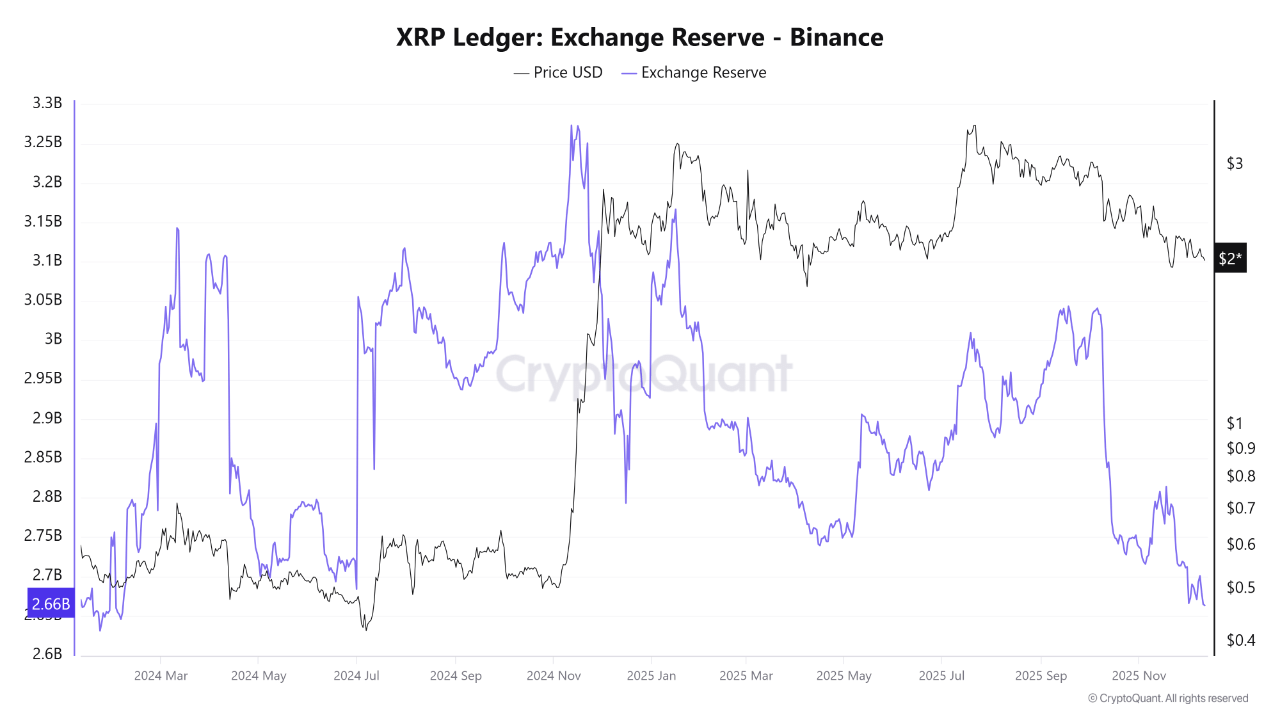
Source: CryptoQuant

Notably, the steady contraction of Binance’s XRP reserves points out that market participants might be more inclined towards holding, as opposed to having a growing selling appetite. Arab Chain cites historical data, explaining that increased outflows from exchanges can be interpreted as a sign of easing bearish pressure. This is because coins outside exchanges are less prone to rapid liquidation events. Also, such a decline during periods where prices remain stable could signal growing accumulation tendencies among investors.

The analytics group further revealed a unique trait of current data. The present decline in reserves came after previous sharp growths in the XRP exchange reserves. It then becomes clear that the market may simply be “rebalancing its supply structure, with a reduced amount of XRP available for day-to-day trading.”

It’s worth noting that the contraction in reserves puts the market in a delicately bullish position. In this scenario, the re-entry of buyers into the XRP market could translate into a faster and sharper bullish momentum. On the other hand, a sustained absence of growing reserves dampens the chances of any large-scale sell-off in the short term.

XRP Price Overview

For most of December, XRP has traded within the $2.123–$2.000 price levels. Popular market analyst, Ali Martinez, however, recently took to X to report that $XRP has to prevail above $2.0, for any hopes of a price recovery to be realistic. In the scenario where $2.0 fails to hold, the altcoin could spiral downwards to as low as $1.20.

As of this writing, XRP trades at approximately $2.02, with CoinMarketCap data reporting a % 0.64% growth over the last 24 hours.

XRP trading at $2.0153 on the daily chart | Source: Tradingview.com

Трендові криптовалюти

Пов'язані матеріали

Unlocking $100 Million in Liquidity? Pump.fun's New Policy Tests the 5-Minute Pump Technique

Pump.fun, a popular meme coin launchpad, has introduced a new standard mechanism called BOOST. It aims to address a significant capital efficiency issue: when a newly launched token graduates from its initial bonding curve to a liquidity pool (LP), roughly 20% of its liquidity becomes permanently locked as "dead liquidity," estimated to waste over $100 million annually. Instead of locking these funds permanently, BOOST repurposes them. Upon a token's migration, approximately 20% of the settlement funds (e.g., 17.6 SOL or ~$2516 USDC) are used to buy back the token on the open market over a 5-minute period via a Time-Weighted Average Price (TWAP) mechanism. All purchased tokens are immediately burned. This creates a brief, systematic buy pressure immediately after migration, potentially generating a short-term price surge ("pump") while permanently reducing the token's circulating supply. The goal is to enhance the immediate post-launch trading experience, potentially increasing trader retention and sustainable protocol revenue, which funds ongoing token buybacks. However, concerns exist that this artificial 5-minute boost could lower the barrier for launching low-quality tokens and lead to steeper price crashes once the buy pressure stops, if followed by large sell-offs. The feature automatically applies to tokens migrating after July 21, 2024, but not to previously migrated tokens or those launched via the Mayhem AI Agent lab.

marsbit5 хв тому

Unlocking $100 Million in Liquidity? Pump.fun's New Policy Tests the 5-Minute Pump Technique

marsbit5 хв тому

Podcast Notes | Conversation with GSR Asset Management Head: To Determine if This Crypto Rally is Real, Just Watch the Lending Rates on Aave

Podcast Summary: Dialogue with GSR's Head of Asset Management: To Determine if This Crypto Rally is Real, Just Check Lending Rates on Aave Andy Baehr, Managing Director of Asset Management at GSR, discusses the current crypto market, characterizing it as stuck in a state of "ambivalence" with short-lived, unsustainable rallies. He outlines a simple framework: the market moves between "ambivalence" and "conviction" (sustained upward momentum). Currently, every rally resembles a single-stage rocket booster that quickly fizzles out. Baehr identifies three key signals to watch: 1) DeFi lending rates, 2) the potential passage of the CLARITY Act, and 3) the market forming a consensus on the "Fed hawkish peak." He emphasizes that the most immediate indicator for the sustainability of the recent CPI-triggered rally is the USDC borrowing rate on Aave, currently around 3.75%—close to U.S. Treasury yields. The absence of a credit spread indicates low leverage demand and a lack of market energy. He explains that a healthy, sustained rally requires layered buying pressure. Last year's rally progressed from an ETH short squeeze to crypto-native trader influx and finally to ETF inflows. Currently, this structure is missing. Other potential structural buyers like Digital Asset Treasury (DAT) companies are absent, and ETF flows have proven transient. Baehr notes that while small-cap crypto tokens outperformed large caps in Q2—a potential sign of capitation in major assets—capital is also flowing to more exciting opportunities like AI stocks and tech IPOs, leaving crypto sidelined. Regarding DeFi, he highlights that platforms like Aave provide a clear, real-time signal of leverage demand through their supply/demand-driven interest rates. A significant, sustained rate increase would signal genuine market conviction. He also observes the quiet emergence of fixed-income-like products and vaults in DeFi. On regulation, the probability of the CLARITY Act passing before the August 7th deadline has dropped linearly from 75% to below 40% on Polymarket. Baehr suggests its passage would be treated as a bullish surprise, a potent driver for price movement. However, political hurdles, including ethical clause debates and disclosures about the First Family's crypto profits, remain significant obstacles. Ultimately, the market awaits clarity on the Fed's terminal rate under Chair Warsh. Until the "Fed Solstice"—the point where the market collectively understands the peak of hawkish policy—sustained conviction will be difficult to achieve.

marsbit36 хв тому

Podcast Notes | Conversation with GSR Asset Management Head: To Determine if This Crypto Rally is Real, Just Watch the Lending Rates on Aave

marsbit36 хв тому

Торгівля

Спот

Популярні статті

Як купити SOON

Ласкаво просимо до HTX.com! Ми зробили покупку SOON (SOON) простою та зручною. Дотримуйтесь нашої покрокової інструкції, щоб розпочати свою криптовалютну подорож.Крок 1: Створіть обліковий запис на HTXВикористовуйте свою електронну пошту або номер телефону, щоб зареєструвати обліковий запис на HTX безплатно. Пройдіть безпроблемну реєстрацію й отримайте доступ до всіх функцій.ЗареєструватисьКрок 2: Перейдіть до розділу Купити крипту і виберіть спосіб оплатиКредитна/дебетова картка: використовуйте вашу картку Visa або Mastercard, щоб миттєво купити SOON (SOON).Баланс: використовуйте кошти з балансу вашого рахунку HTX для безперешкодної торгівлі.Треті особи: ми додали популярні способи оплати, такі як Google Pay та Apple Pay, щоб підвищити зручність.P2P: Торгуйте безпосередньо з іншими користувачами на HTX.Позабіржова торгівля (OTC): ми пропонуємо індивідуальні послуги та конкурентні обмінні курси для трейдерів.Крок 3: Зберігайте свої SOON (SOON)Після придбання SOON (SOON) збережіть його у своєму обліковому записі на HTX. Крім того, ви можете відправити його в інше місце за допомогою блокчейн-переказу або використовувати його для торгівлі іншими криптовалютами.Крок 4: Торгівля SOON (SOON)Легко торгуйте SOON (SOON) на спотовому ринку HTX. Просто увійдіть до свого облікового запису, виберіть торгову пару, укладайте угоди та спостерігайте за ними в режимі реального часу. Ми пропонуємо зручний досвід як для початківців, так і для досвідчених трейдерів.

199 переглядів усьогоОпубліковано 2025.05.23Оновлено 2026.06.02

Як купити SOON

Обговорення

Ласкаво просимо до спільноти HTX. Тут ви можете бути в курсі останніх подій розвитку платформи та отримати доступ до професійної ринкової інформації. Нижче представлені думки користувачів щодо ціни SOON (SOON).

活动图片













