Binance secures global ADGM licenses to operate international platform

cointelegraphОпубліковано о 2025-12-08Востаннє оновлено о 2025-12-08

Анотація

Binance has secured three licenses from Abu Dhabi's Financial Services Regulatory Authority (FSRA), allowing it to operate its exchange, clearing house, and broker-dealer services under the ADGM regulatory framework. The approval grants Binance regulatory clarity and legitimacy for its international operations, which will be supervised from Abu Dhabi starting January 5, 2026. Co-CEO Richard Teng emphasized that the move provides users with enhanced consumer protections under a globally recognized framework. Binance already holds a virtual asset service provider license in Dubai and received a $2 billion investment from Abu Dhabi-based MGX earlier this year.

Crypto giant Binance has been granted three separate licenses from Abu Dhabi’s financial regulator, providing a green light to operate its exchange, clearing house and broker-dealer services under the Financial Services Regulatory Authority’s (FSRA) regulatory framework.

The FSRA, an independent financial regulator of the Abu Dhabi Global Market (ADGM), a financial free zone in Abu Dhabi, has approved licenses for Binance’s Nest Exchange Limited, Nest Clearing and Custody Limited, and Nest Trading Limited, according to a press release and announcement from Binance on Monday.

Richard Teng, the co-CEO of Binance, said in a statement the licenses provide regulatory clarity and legitimacy, enabling Binance to support its global operations from ADGM.

“While our global operations remain distributed, leveraging talent and innovation worldwide, this regulatory foundation offers our users peace of mind knowing Binance operates under a globally recognised, gold standard framework,” he said

“We are grateful for the FSRA’s forward-thinking approach, which safeguards users while fostering innovation.”
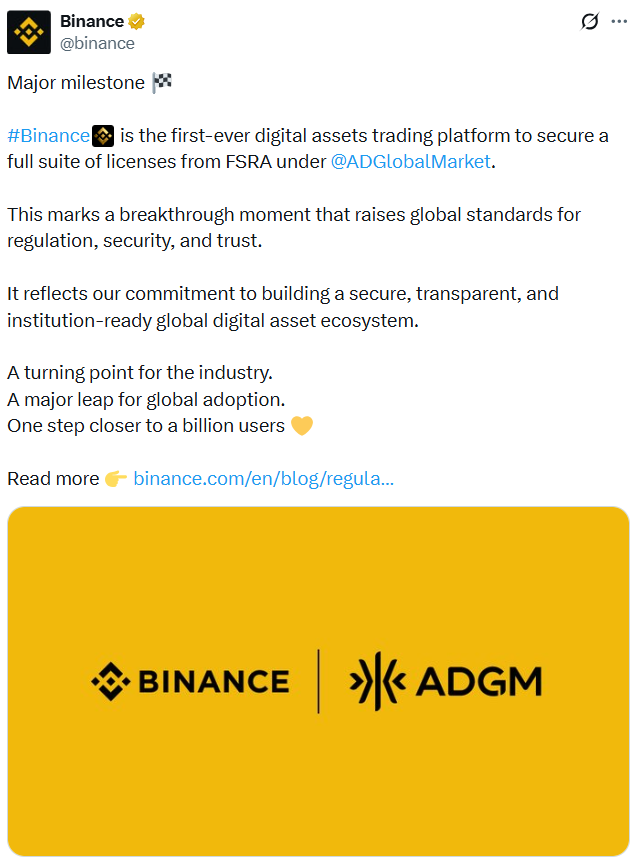
Source: Binance

Binance could set up shop in Abu Dhabi

Binance doesn’t have an official corporate headquarters, which can dictate tax obligations and the regulations a company must follow.

Cointelegraph has contacted Binance for additional comment.

Related: Former Binance US CEO launches stablecoin platform ahead of L1 network

Under a February 2020 guidance, the FSRA outlines that authorised entities conducting regulated activities within the ADGM need to have “mind and management” operating out of the zone, which includes devoting resources to commercial, governance, compliance, surveillance, operations, technical, IT and HR functions.

Operating under the ADGM’s financial services regime provides Binance users with additional consumer protections, along with enhanced oversight from regulators, according to Binance. The exchange plans to start operating its “regulated activities” starting Jan. 5, 2026.

Teng said in an X post on Monday that it’s an “important milestone for Binance,” because it’s become the first global exchange to secure regulatory approval from a respected regulator, and will now have its international operations and liquidity supervised end-to-end.
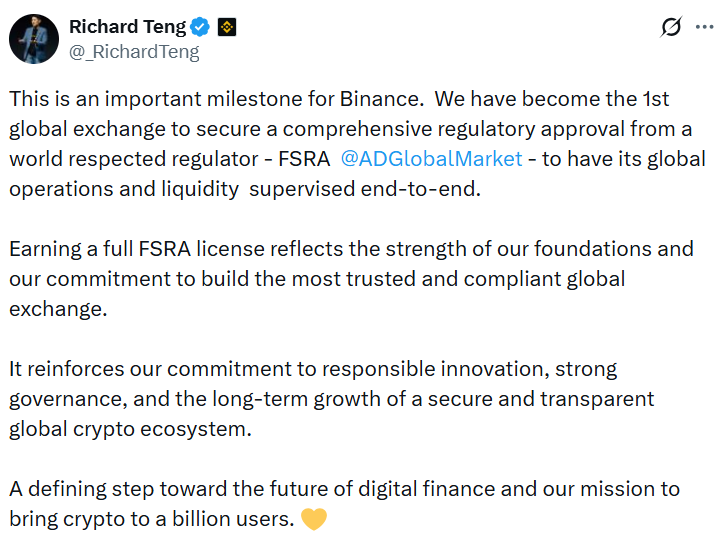
Source: Richard Teng

Binance already has a foothold in the United Arab Emirates, with its virtual asset service provider license in Dubai, which it obtained in April 2024, and a $2 billion investment from MGX, an Abu Dhabi-based artificial and technology venture firm, in March.

Magazine: When privacy and AML laws conflict: Crypto projects’ impossible choice

Пов'язані матеріали

Polymarket Revival: The Mainstreaming of Crypto Prediction Markets and Future Prospects

Polymarket, a crypto-based prediction market platform, has made a significant comeback in 2025 by re-entering the U.S. market through regulatory-compliant means, including the acquisition of regulated trading and清算 entities. This resurgence is further supported by institutional capital investment and integration with mainstream platforms like the MetaMask wallet, allowing users to trade directly without leaving their wallets. Mainstream financial data platforms have also begun displaying prediction market data, increasing market visibility. Once viewed primarily as a gambling or speculative platform, Polymarket is increasingly recognized as a mechanism for information pricing in financial markets. Widespread participation from both retail and institutional users has made its probability assessments of future events more representative and liquid. Prediction market data is now being incorporated by traditional financial media and data platforms, highlighting its growing potential. However, challenges remain. Prediction markets are not always accurate, with studies showing limited predictive reliability in certain contexts. Questions about platform neutrality and business models have emerged, such as the employment of internal market makers, which could undermine trust. Information asymmetry and insider risks are inherent, potentially disadvantaging ordinary users when some participants access information early. Regulatory, tax, and disclosure requirements also present ongoing uncertainties. The revival and transformation of Polymarket signify a broader shift of prediction markets from niche experiments toward mainstream financial infrastructure. By converting public expectations into tradable probabilities, these markets may complement traditional analysis and polling, providing real-time, decentralized signals in areas like macroeconomics, policy, technology, and geopolitics. As traditional financial institutions invest in compliance and structured products, DeFi is evolving beyond an alternative asset pool to resemble traditional financial infrastructure. Prediction market applications are expanding beyond crypto to potentially include stocks, macroeconomic indicators, sports events, and tech product launches, tightening the link between crypto and the real world. If platforms like Polymarket continue on a path of compliance, stable operation, and integration with mainstream financial services, they could become next-generation market infrastructures—event-driven financial tools alongside stocks, bonds, and options. Key factors for development include platform neutrality, prediction accuracy, regulatory environment, participant diversity, and the maturity of related financial products. In summary, Polymarket’s comeback represents a move of prediction markets from the fringe into the core of financial systems, reflecting deeper changes in how information is priced and how financial infrastructure is rebuilt. This shift brings not only new trading methods but also potential changes in how investors perceive and engage with future events and asset valuation.

cointelegraph_中文35 хв тому

Polymarket Revival: The Mainstreaming of Crypto Prediction Markets and Future Prospects

cointelegraph_中文35 хв тому

Торгівля

Спот
Ф'ючерси
活动图片