Betting Big On XRP: Billion-Dollar Asset Manager Confirms What Smart Money Has Been Doing

bitcoinistОпубліковано о 2025-12-09Востаннє оновлено о 2025-12-09

Анотація

A billion-dollar asset manager, WisdomTree, confirms that institutional investors are driving significant capital inflows into XRP globally, far surpassing most other altcoins. In Europe, XRP attracted over $549 million this year—more than triple Ethereum's inflows. Outside the U.S., it drew $252 million. Despite Bitcoin products being much larger, institutions allocated nearly 25 times more new capital to XRP relative to size. A new U.S. synthetic XRP product also garnered $241 million, exceeding Solana and other altcoins. This institutional accumulation, viewed as strategic rather than speculative, positions XRP as a settlement-grade asset for regulated digital finance, even amid recent price declines and market volatility.

Institutional investors are quietly reshaping the narrative around XRP, with the latest analysis report from the billion-dollar asset manager WisdomTree confirming what insiders have long suspected. According to the report, XRP is garnering institutional interest and demand on a global scale. While retail traders debate short-term price movements, smart money capital inflows into XRP are surpassing those of almost every other altcoin.

XRP Dominates Institutional Inflows Across Europe And The Globe

According to an X post by crypto expert Stern Drew, the latest WisdomTree report shows that XRP is the only digital asset attracting consistent institutional demand worldwide. In Europe, XRP has attracted over $549 million in new institutional capital this year, more than three times the inflows into Ethereum. This figure surpasses the total for every altcoin in the market and multi-asset products except Bitcoin.

In a continent traditionally known for conservative investment strategies, these flows into XRP represent a decisive vote of confidence from European institutional investors. Drew has revealed that the demand for XRP has also extended beyond Europe. Outside the United States, XRP has captured roughly $252 million in fresh institutional capital just this year.
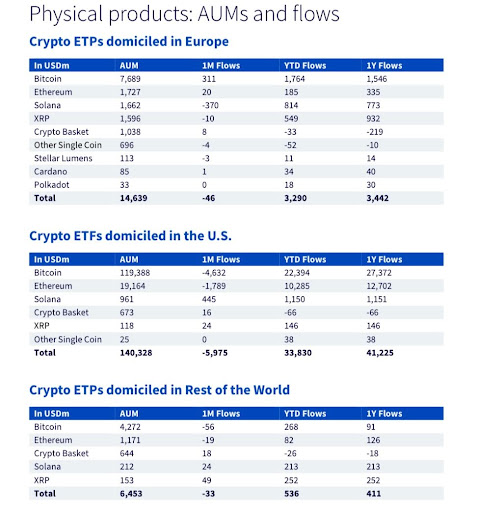
Source: Chart from Stern Drew on X

By comparison, Bitcoin products absorbed only $268 million in smart money capital. Given that BTC products are more than 25 times the size of XRP products, this suggests that institutions have directed nearly 25 times more new capital into XRP than into Bitcoin. Drew has suggested that this increase in flows indicates careful, deliberate positioning rather than short-term speculative activity, which highlights the market’s growing preference for XRP.

US Adoption Signals Broader Shift

In his post, Drew also revealed the growing institutional interest in XRP within the US. This year, a new synthetic XRP product attracted $241 million, surpassing flows into Solana and all other altcoin products in the same category. This surge came at a time when the two largest cryptocurrencies, Bitcoin and Ethereum, collectively saw $6.4 billion exit their ETF structures.

Drew revealed that the dramatic outflows from BTC and ETH signaled that institutional investors were diversifying from established assets while selectively accumulating XRP. The WisdomTree report also showed that, excluding Europe and the US, regions such as Asia and other global markets are increasing their exposure to XRP.

Surprisingly, this surge in global institutional demand is occurring during periods of market stress rather than euphoric rallies. The XRP price is currently down by more than 15% this year and trading at just $2.1. The cryptocurrency has also been experiencing significant choppy action over the past few months, failing to reclaim former highs above $3.

Despite this structural weakness, institutions continue to accumulate XRP in large quantities, indicating a clear bias toward the cryptocurrency. Drew has also revealed that smart money views XRP as a settlement-grade asset, well-suited for integration into the future architecture of regulated digital finance. He highlights that, as global institutional preference increasingly concentrates on XRP, price movements might follow later.


XRP trading at $2.09 on the 1D chart | Source: XRPUSDT on Tradingview.com

Пов'язані матеріали

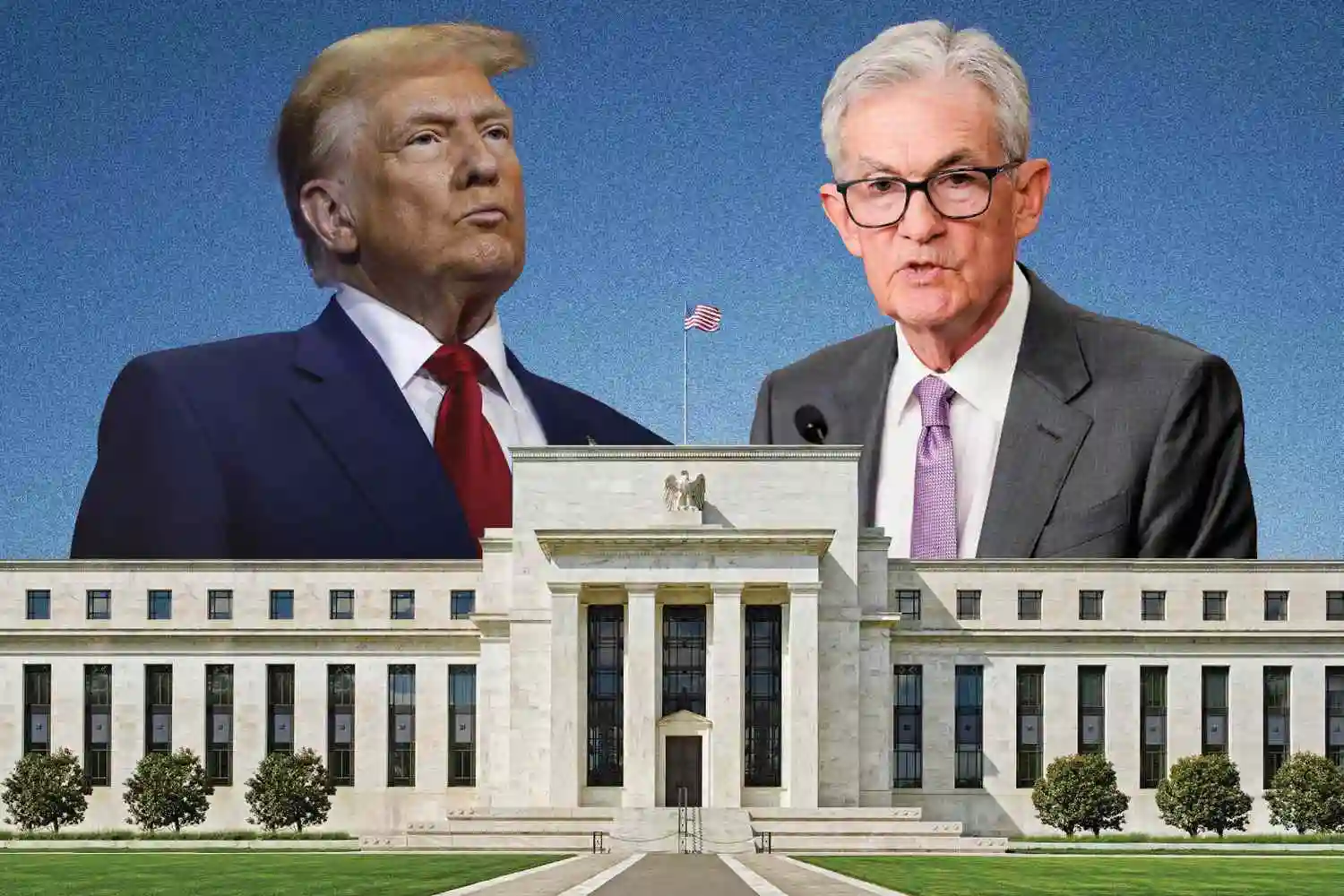
On the Night of the Fed Rate Cut, the Real Game Is Trump's 'Monetary Power Grab'

Tonight marks the Federal Reserve's most anticipated interest rate decision of the year. While a 25-basis-point cut is widely expected, the key variable for risk assets is whether the Fed will restart liquidity injections, potentially through a $45 billion monthly short-term debt purchase program starting in January. This signals a stealth return to quantitative easing. The larger tension stems from an unprecedented shift in monetary power. President Trump is rapidly reshaping the Federal Reserve, not just by replacing its chair but by redrawing the boundaries of monetary authority. The long-held principle of central bank independence is being eroded as the Treasury Department seeks to reclaim control over long-term interest rates, liquidity, and the balance sheet. This transition to a "fiscally dominated monetary era" is the underlying logic connecting recent market events. Despite a 40 billion outflow from Bitcoin ETFs, analysis suggests this was not panic selling but the unwinding of leveraged basis trades, leaving a healthier, less leveraged market. Meanwhile, led by Michael Saylor, made its largest Bitcoin purchase in months ($963 million), and Tom Lee's BitMine significantly increased its Ethereum holdings, signaling strong institutional conviction during the downturn. The macro shift implies higher market volatility as the old order fractures. While improved liquidity may provide a floor for Bitcoin, its longer-term trajectory awaits clarity within this new monetary framework, where Treasury, not the Fed, may ultimately dictate key financial conditions.

marsbit11 хв тому

On the Night of the Fed Rate Cut, the Real Game Is Trump's 'Monetary Power Grab'

marsbit11 хв тому

The Dark Side of Altcoins

The article "The Dark Side of Altcoins" argues that most cryptocurrency tokens inevitably fail due to a fundamental structural conflict between company equity and token holders. Most crypto projects are essentially traditional companies with equity-held founders, VC investors, and profit motives, which later issue a token. This creates irreconcilable incentives: equity seeks to capture value (revenue, profit, control) for the company and shareholders, while tokens need value (fees, buybacks, governance) to accrue to the protocol and holders. Equity almost always wins, leading to token value drainage. The piece highlights Hyperliquid as a rare success because it avoided VC equity financing entirely. Without a board or pressure to deliver value to shareholders, it could direct all economic value to its protocol and token. Legally, tokens cannot function like stocks without being deemed unregistered securities (if they offer dividends, ownership, etc.), which would trigger severe regulatory crackdowns. The optimal structure is one where the company holds no equity, captures no revenue, and all value flows to token holders via protocol mechanisms, with a DAO governing economic decisions. However, the only way to eliminate all conflict is to become a fully decentralized protocol like Bitcoin or Ethereum, with no company, no equity, and neutral, autonomously running infrastructure. The core issue is structural, not market conditions. Tokens are mathematically destined to fail if the project had VC rounds, private token sales, investor unlock schedules, or allows the company to capture revenue. Success requires value directed to the protocol, no VC equity, aligned founder/tokenholder incentives, and an economically irrelevant company. The solution is for investors to stop funding poorly designed projects. The future of the industry depends on capital flowing to projects with sound tokenomics, like those pioneered by Hyperliquid, MetaDAO, and Street.

深潮16 хв тому

The Dark Side of Altcoins

深潮16 хв тому

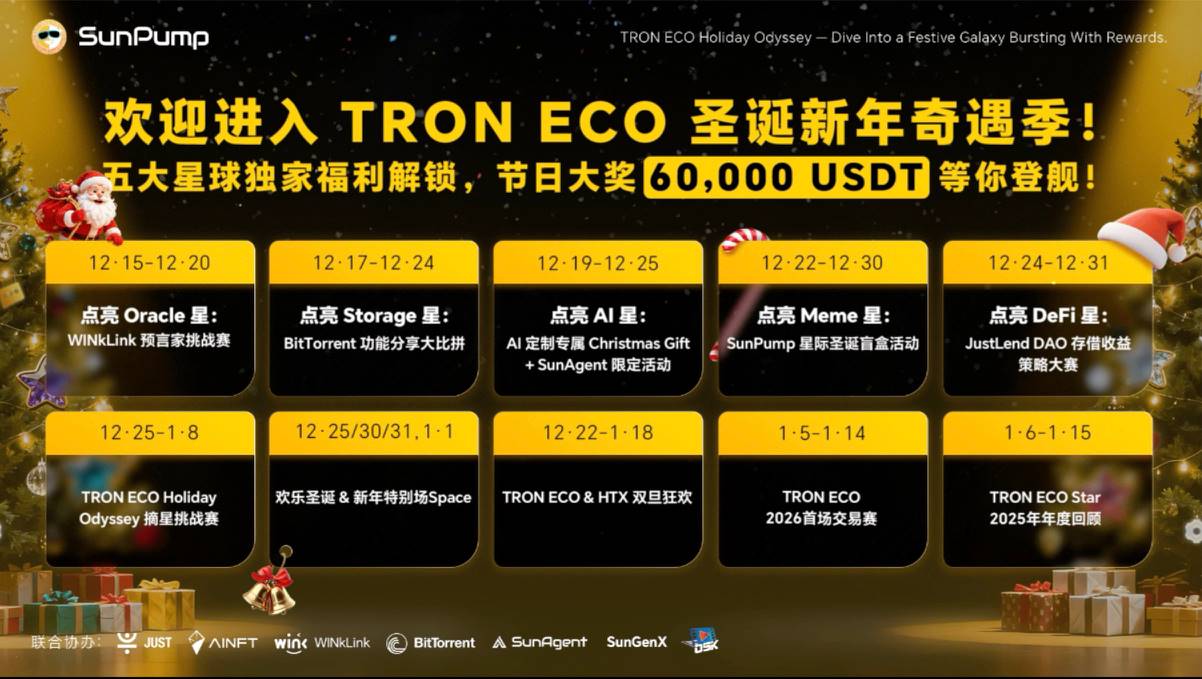
Prize Pool 60,000 USDT: "TRON ECO Holiday Odyssey" Annual Ecological Exploration Gala Set to Begin

TRON ECO launches its "Holiday Odyssey" event, a large-scale year-end celebration from December 10, 2025, to January 18, 2026, featuring a total prize pool of 60,000 USDT. The event centers around five core ecosystem projects—SunPump, JUST, AINFT, BitTorrent, and WINkLink—each representing a "holiday planet" with unique interactive tasks. Participants can complete missions to earn rewards, including limited edition TRON ECO merchandise. Key activities include planet-specific tasks such as price prediction with WINkLink, engagement with BitTorrent’s decentralized storage, AI-themed meme creation via SunGenX, a Christmas blind box event with SunPump, and a DeFi strategy competition with JUST. A major "Star Challenge" from December 25 to January 8 offers a 10,000 USDT prize pool supported by sponsors including OSK, Biconomy, and PepeOnTron. Additional features include holiday-themed Twitter Spaces sessions and a joint campaign with HTX exchange boasting over 40,000 USDT in rewards. The event highlights TRON's growing ecosystem, which recently surpassed 250 million accounts and continues to expand across DeFi, AI, and storage sectors. Recent upgrades in AI infrastructure, tokenomics, and user experience tools like SunAgent aim to strengthen TRON’s position as a leading smart contract platform. "Holiday Odyssey" invites the global community to explore TRON’s ecosystem and participate in its end-of-year festivities.

深潮28 хв тому

Prize Pool 60,000 USDT: "TRON ECO Holiday Odyssey" Annual Ecological Exploration Gala Set to Begin

深潮28 хв тому

Торгівля

Спот
Ф'ючерси
活动图片