Bessent Urges Senate to Fast-Track Warsh Nomination as Institutional Liquidity Pivot Favors LiquidChain

bitcoinistОпубліковано о 2026-02-09Востаннє оновлено о 2026-02-09

Анотація

Treasury Secretary Scott Bessent is urging the Senate to fast-track the confirmation of Kevin Warsh to the Federal Reserve Board, signaling a potential shift toward pro-growth monetary policies and reduced regulatory uncertainty. This move is seen as a precursor to a more disciplined economic environment, which could slash uncertainty premiums and push institutional capital toward risk assets. Concurrently, institutional investors are seeking unified infrastructure to manage liquidity across fragmented blockchain ecosystems. LiquidChain ($LIQUID) emerges as a key solution, offering a Layer 3 infrastructure that merges Bitcoin, Ethereum, and Solana into a single execution layer. Its 'Deploy-Once' architecture and Cross-Chain Virtual Machine eliminate the need for complex bridges and multiple gas tokens, addressing critical friction points for capital efficiency. The protocol has raised over $532K in its ongoing presale, indicating smart money is positioning for a liquidity rotation. As macro conditions improve and federal policy evolves, interoperability layers like LiquidChain are poised to capture the volume from traditional finance entering the digital asset space.

Trusted Editorial content, reviewed by leading industry experts and seasoned editors. Ad Disclosure

Quick Facts:

  • ➡️ Treasury Secretary Bessent’s push for Kevin Warsh’s confirmation signals a potential shift toward pro-growth monetary policies and reduced regulatory uncertainty.
  • ➡️ Institutional investors are seeking a unified infrastructure to manage liquidity across fragmented blockchains as macro conditions improve.
  • ➡️ LiquidChain ($LIQUID) merges Bitcoin, Ethereum, and Solana into a single execution layer, solving critical friction points for capital efficiency.
  • ➡️ Capital rotation into risk assets historically accelerates following major shifts in Federal Reserve leadership and policy direction.

In an interview with Fox News, U.S. Treasury Secretary Scott Bessent indicated he wants the Senate to move fast on Kevin Warsh’s confirmation to the Federal Reserve Board. That’s not just procedural housekeeping. It signals a coordinated push to reshape the Fed’s doctrinal approach before the next tightening cycle can even take hold.

Wall Street sees the Warsh nomination as a precursor to a more disciplined, pro-growth environment. Historically, clarity at the central bank slashes uncertainty premiums, pushing capital further out on the risk curve. That matters. Institutional allocators are currently sitting on record levels of dry powder, just waiting for a signal that the headwinds are finally abating.

If confirmed, Warsh, a former Morgan Stanley banker, will likely champion capital formation over aggressive interventionism. For digital assets? The implications are massive. While the Treasury pushes for leadership that understands modern financial plumbing, the infrastructure underneath is evolving rapidly. (The timing here isn’t exactly coincidental.)

Smart money is prepping for a liquidity rotation, shifting focus from accumulation to efficiency. This macro setup creates a perfect storm for interoperability layers like LiquidChain ($LIQUID), designed to capture the volume traditional rails are about to unleash.

Unified Execution Environments Solve the Fragmentation Crisis

While the Treasury streamlines federal policy, crypto faces its own bureaucracy: liquidity silos that trap capital. Institutional investors entering the space are finding that managing positions across Bitcoin, Ethereum, and Solana requires a messy web of bridges and distinct wallets. Frankly, it’s a friction point that kills true institutional adoption.

LiquidChain tackles this by establishing a Layer 3 (L3) infrastructure that fuses these major ecosystems into one execution environment. Using a ‘Deploy-Once’ architecture, the protocol allows developers to write code interacting simultaneously with $BTC, $ETH, and $SOL liquidity. That’s a game-changer. It eliminates the security risks of traditional bridges (often the weak link in DeFi) while providing the unified experience Wall Street desks demand.
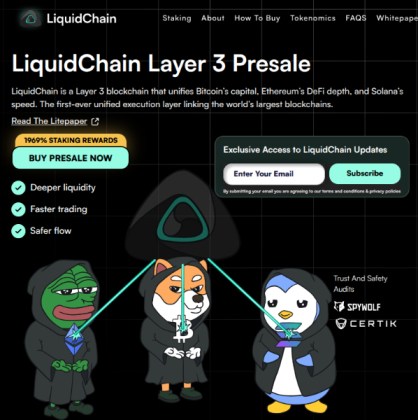
The protocol’s Cross-Chain Virtual Machine acts as a universal translator for value. Instead of forcing users to juggle different gas tokens, LiquidChain abstracts the complexity for single-step execution. For an asset manager looking to stake Bitcoin while accessing Solana’s high-velocity markets, this isn’t just convenient; it’s an operational necessity.

LEARN MORE ON THE OFFICIAL LIQUIDCHAIN WEBSITE

Presale Data Suggests Smart Money is Front-Running the Pivot

The appetite for infrastructure plays is already showing up in the data. LiquidChain has raised over $532K in its ongoing presale, a figure pointing to specific accumulation patterns rather than broad retail speculation. With tokens currently priced at $0.0136, the valuation implies significant room for growth relative to interoperability competitors trading at multi-billion dollar caps.

This traction validates a core thesis: the next cycle will be defined by utility, not just meme-driven hype. Funds are bolstering the Unified Liquidity Layer to ensure the pipes are wide enough when the macro floodgates open. Unlike governance-only tokens, $LIQUID functions as transaction fuel, creating a direct link between network usage and token demand.

The risk here, of course, is execution. Building a secure L3 that interoperates with Bitcoin’s rigid scripting and Solana’s speed is technically demanding. But the market’s willingness to fund this vision early suggests high conviction that fragmentation is a problem worth solving.

As the Treasury works to unclog the regulatory gears in D.C., LiquidChain is quietly building the machinery to unclog the flow of value on-chain.

BUY YOUR $LIQUID HERE

This article is for informational purposes only and does not constitute financial advice. Cryptocurrency investments carry inherent risks, and readers should perform their own due diligence before making any investment decisions.

Editorial Process for bitcoinist is centered on delivering thoroughly researched, accurate, and unbiased content. We uphold strict sourcing standards, and each page undergoes diligent review by our team of top technology experts and seasoned editors. This process ensures the integrity, relevance, and value of our content for our readers.

Ben Wallis

Follow

Ben is a freelance writer, and AI editor specializing in crypto developments (mainly altcoins) and the intricate ways global economics shape the digital asset space. His B.Ed. in Education provides a unique foundation for his writing, enabling him to distill complex crypto concepts and market shifts into clear, digestible insights. This skill is key to helping readers adapt and apply their understanding to the ever-evolving world of crypto investment. Passionate about making crypto accessible, Ben crafts content designed to educate a broad audience, from current market events to the essential foundational knowledge that underpins them. His goal is to empower readers through understanding. When he’s not immersed in crypto analysis and breaking down complex topics, Ben is an avid Pokémon fan and enjoys all things Disney.

Full Profile

Related Posts

South Korea’s FSS To Probe Whale Manipulation: How SUBBD Is Built For Fair And Transparent Trading

Infini Exploiter Hackers Resurface to Buy the $ETH Dip: How $BMIC Adds Security for the Future

Turkey & Tether Freeze $544M: Why $BMIC Is The Safe Haven

Tether’s $23B Gold Hoard Rivals Nation States As Smart Money Pivots To $HYPER

Story Co-Founder Defends Token Unlock Delays; Why Long-Term Scaling Matters For $MAXI

Takaichi’s Victory Sends Nikkei to Records as Bitcoin Reclaims $72K; What this Means for $HYPER

Пов'язані питання

QWhat is the significance of Treasury Secretary Scott Bessent urging the Senate to fast-track Kevin Warsh's nomination to the Federal Reserve Board?

AIt signals a coordinated push to reshape the Fed's doctrinal approach toward a more disciplined, pro-growth monetary policy and reduced regulatory uncertainty, which is seen as a precursor to slashing uncertainty premiums and encouraging capital to move further out on the risk curve.

QWhat problem does LiquidChain ($LIQUID) aim to solve in the cryptocurrency space?

ALiquidChain aims to solve the liquidity fragmentation crisis by creating a unified Layer 3 (L3) infrastructure that merges Bitcoin, Ethereum, and Solana into a single execution layer, eliminating the friction and security risks of managing capital across multiple, distinct blockchains and bridges.

QHow does LiquidChain's 'Deploy-Once' architecture function?

ALiquidChain's 'Deploy-Once' architecture allows developers to write code that can interact simultaneously with $BTC, $ETH, and $SOL liquidity, creating a unified execution environment that abstracts away the complexity of using different gas tokens and separate wallets.

QWhat does the presale data for LiquidChain ($LIQUID) indicate about investor sentiment?

AThe presale raising over $532K indicates smart money is accumulating and front-running a potential macro pivot, showing high conviction that solving blockchain fragmentation is a critical utility play for the next market cycle, rather than mere retail speculation.

QHow is the potential confirmation of Kevin Warsh linked to the thesis for investing in infrastructure like LiquidChain?

AA Warsh-led Fed is expected to create a pro-growth, clarity-driven environment that reduces uncertainty. This macro shift is anticipated to unleash a wave of institutional capital into risk assets, making high-efficiency infrastructure like LiquidChain essential for capturing and managing that incoming liquidity.

Пов'язані матеріали

U.S. Government Bans Foreign Nationals from Using Fable 5, Anthropic Issues Rebuttal

U.S. Government Bans Foreign Access to Fable 5, Anthropic Issues Rebuttal On June 12th, the U.S. government ordered AI company Anthropic to immediately suspend all foreign access—including foreign nationals within the U.S. and Anthropic's own foreign employees—to its newly released Fable 5 and Mythos 5 AI models, citing national security concerns. This forced Anthropic to temporarily disable access to both models for all users globally, as it cannot technically differentiate user nationality at scale. The models, released just three days prior, represent Anthropic's highest public capability tier. Fable 5 is the first publicly available model from the advanced "Mythos" family, while Mythos 5 is a less-restricted version for approved cybersecurity and critical infrastructure partners. The government's directive was reportedly triggered by claims from another company that it could "jailbreak" Mythos 5, raising alarm within the Trump administration. Anthropic, in a detailed public statement, strongly challenged this rationale. The company argues the demonstrated "jailbreak" is a narrow, non-generalized technique that merely involves identifying minor, known software vulnerabilities—a capability common to other publicly available models like OpenAI's GPT-5.5 and routinely used by cybersecurity defenders. Anthropic stated it has complied with the order but disagrees with the government's standard, warning that applying it industry-wide would halt all new frontier model deployments. The company criticized the lack of a transparent, fact-based legal process and expressed confidence the situation stems from a misunderstanding. It is working to restore access and will release more technical details within 24 hours. Other Anthropic models remain unaffected.

链捕手18 хв тому

U.S. Government Bans Foreign Nationals from Using Fable 5, Anthropic Issues Rebuttal

链捕手18 хв тому

The Revelation from the Raydium Theft Incident: New DeFi Vulnerabilities Lurking in Forgotten Old Contracts

**Raydium Exploit Reveals DeFi's Hidden Risk: Forgotten "Zombie" Contracts** A recent attack on Raydium's deprecated V3 AMM pools resulted in a loss of approximately $1.34 million. The hacker exploited pools that were no longer supported by Raydium's current UI or SDK but remained fully functional and accessible on-chain. This incident highlights a critical, often overlooked category of risk in DeFi: inactive or legacy smart contracts that projects fail to properly decommission. Since March 2025, there have been at least 8 publicly reported attacks targeting such abandoned contracts, with total losses around $10.8 million. Including older pools and deprecated features, the count rises to 10 incidents with roughly $22.5 million in losses. These "zombie contracts" represent a lifecycle management failure rather than a code vulnerability, yet they are typically misclassified under general "code bug" categories in security reports, masking the true scale of the problem. The root cause is that projects often merely document a contract as "deprecated" without taking essential technical steps to secure it: withdrawing remaining assets, disabling external call functions, and implementing ongoing monitoring. These forgotten, under-monitored components become prime targets for attackers. To address this, the industry needs to recognize "zombie contracts" as a distinct risk category and establish standardized decommissioning protocols. Essential steps should include: 1) a formal retirement announcement, 2) removal of all front-end integrations, 3) withdrawal of locked assets, 4) disabling key contract functions, 5) ongoing security monitoring, 6) clear user communication, and 7) a post-mortem analysis. The value of a DeFi project lies not only in its current TVL but also in the security of its historical codebase, which has now become a new attack surface.

Foresight News2 год тому

The Revelation from the Raydium Theft Incident: New DeFi Vulnerabilities Lurking in Forgotten Old Contracts

Foresight News2 год тому

Robots Begin to 'Consume Data': The Hidden Production Chain from Indian Data Factories to Billion-Dollar Humanoid Robots

Robots have started to 'consume data,' driving the formation of a new industrial supply chain focused on producing training data for embodied AI. Unlike large language models, which are trained on vast internet text corpora, embodied AI models face a 'data desert' in the physical world. This has created a massive demand for first-person perspective video data (Ego Data), captured by workers wearing cameras in places like Indian garment factories. Companies like Neocambrian AI are establishing 'data factories' where workers perform standardized tasks (e.g., sorting clothes, kitchen organization) to generate thousands of hours of video. Research, such as NVIDIA's EgoScale, demonstrates that scaling this human demonstration data predictably improves robot performance, particularly for dexterous manipulation. This has validated a training path combining large-scale human data for pre-training with smaller amounts of robot-specific data for fine-tuning. The value of different data types varies significantly, forming a 'data pyramid.' The base consists of low-cost, large-scale internet and Ego Data. Higher layers include more expensive motion-capture data (e.g., from data gloves), simulation/synthetic data, and the most costly and scarce layer: real robot teleoperation data. This demand has spawned a layered ecosystem of data suppliers: low-cost data factories, motion capture and alignment specialists, robot-native teleoperation service providers, simulation data companies, and platforms aiming for data standardization. Robot companies themselves are adopting a 'layered procurement' strategy: outsourcing generic Ego Data while building in-house capabilities for robot-specific adaptation data and the critical deployment/failure data generated in real-world applications. The industry is shifting focus from hardware and basic mobility to the data pipelines required for general-purpose capability. While parallels exist to data labeling companies like Scale AI in the LLM boom, the physical complexity of robot data—involving action success ambiguity and sim-to-real gaps—requires more integrated solutions for data collection, annotation, and a continuous feedback loop. The race is on to build the data engines that will teach robots to operate reliably in the unstructured real world.

marsbit4 год тому

Robots Begin to 'Consume Data': The Hidden Production Chain from Indian Data Factories to Billion-Dollar Humanoid Robots

marsbit4 год тому

Торгівля

Спот
Ф'ючерси
活动图片