Bernstein Interprets SpaceX's First Quarterly Report Since IPO: How Does the $239 Target Price Hold Up?

marsbitОпубліковано о 2026-08-06Востаннє оновлено о 2026-08-06

Анотація

Bernstein maintains its "Outperform" rating and $239 price target for SpaceX following its first earnings report as a public company. The Q2 2026 results showed strong growth, with revenue reaching $7.814B, a 92% year-over-year increase, beating expectations. The Starlink Connectivity business remained the profit driver, generating $1.656B in operating income. The AI segment saw revenue surge 247% to $2.561B, though it required massive capital expenditures of $15.828B. The $239 target is based on a sum-of-the-parts valuation projecting 2031 revenue of $554B, significantly below CEO Elon Musk's accelerated goal of $1 trillion by 2030. Bernstein's model assumes AI computing prices will eventually fall to around $10/watt, not the $30-$50/watt range cited by management. The valuation hinges on three key pillars: continued profit growth from Connectivity, the AI business converting its heavy investment into scalable revenue, and the Starship achieving full and rapid reusability to enable low-cost expansion. While quarterly performance was strong, post-IPO stock lock-up expirations and execution risks around Starship and AI returns contributed to a subsequent share price decline.

SpaceX's first quarterly earnings since going public have presented the market with an even more aggressive growth story: the Connectivity business continues to contribute profits, AI computing revenue is growing rapidly, and Musk has moved forward the target year for reaching $1 trillion in annual revenue from 2031 to 2030, suggesting it could be achieved as early as 2029.

According to the company's SEC filing, Space Exploration Technologies Corp. Class A common stock has begun trading on Nasdaq and Nasdaq Texas under the ticker SPCX. Following the release of its Q2 results for the period ending June 30 on August 4, Bernstein maintained its 'Outperform' rating and a $239 price target. Based on the closing price of $125.33 on August 4 as cited in the report, this implies an approximate 91% upside potential.

However, the $239 target price is not predicated on the full realization of the $1 trillion revenue goal. Bernstein's own revenue forecast for SpaceX in 2031 is $554 billion, significantly lower than management's vision; its AI computing price model also still assumes a long-term decline to approximately $10 per watt. In other words, higher computing prices and more aggressive revenue targets represent potential upside beyond the current valuation.

On August 5, SpaceX's stock price fell further to $108.27, a single-day drop of 13.6%. This indicates the market is not solely focused on this quarter's performance but is simultaneously weighing AI capital expenditures, potential stock supply pressure from the post-IPO lock-up period expiration, and whether Starship can enter a phase of high-frequency, low-cost launches.

Revenue Growth of 92%, Connectivity Remains the Profit Pillar

SpaceX's Q2 revenue reached $7.814 billion, a year-on-year increase of 92%. The consensus cited by Axios from S&P Visible Alpha was $6.9 billion, while Bernstein's report used a market consensus of $6.546 billion. Despite differing methodologies, both point to the same conclusion: revenue this quarter significantly exceeded expectations.

The company's Q2 diluted loss per share was $0.09, also better than the market expectation of a $0.24 loss per share. The three business segments combined posted an operating loss of $143 million, far better than the $1.73 billion market expectation used by Bernstein, primarily due to a narrower AI segment loss and Connectivity margins higher than expected.

Looking at the segments, the most stable currently remains the Connectivity business centered on Starlink. Starlink user count reached 12 million by the end of Q2, an increase of 1.7 million from Q1, with average monthly revenue per user remaining stable at $66.

Connectivity's quarterly revenue was $4.291 billion, with operating profit of $1.656 billion, corresponding to an operating margin of approximately 38.6%, higher than the 37% market expectation used by Bernstein. It is also SpaceX's only currently profitable business segment at the operating level, providing crucial support for the company's continued investments in AI and Starship.

The Space business completed 38 launches in Q2, comprising 10 customer launches and 28 internal launches, delivering a total mass to orbit (MTO) of 485 tons. This segment's revenue was $962 million, higher than the market expectation of $874 million, but operating losses still reached $542 million due to increased Starship R&D investment.

The AI business possesses both the greatest revenue elasticity and funding requirements. By the end of Q2, SpaceX's nominal compute capacity reached 1.4 GW, up from 1.0 GW in Q1, with expectations to exceed 2 GW by the end of 2026. The AI segment's quarterly revenue was $2.561 billion, a year-on-year increase of 247%, with AI solutions and infrastructure revenue reaching $2.194 billion.

The AI business's operating loss was $1.257 billion, corresponding to an operating margin of approximately -49.1%, but this is a significant improvement from the Q1 operating loss of $2.469 billion; segment adjusted EBITDA turned positive to $1.146 billion from a Q1 loss of $609 million.

Meanwhile, the AI business's quarterly capital expenditure in Q2 reached $15.828 billion, higher than Q1's $7.723 billion. SpaceX's total Q2 capital expenditure reached $18.369 billion. Whether this massive investment can translate into sustained revenue and cash returns remains one of the market's key concerns.
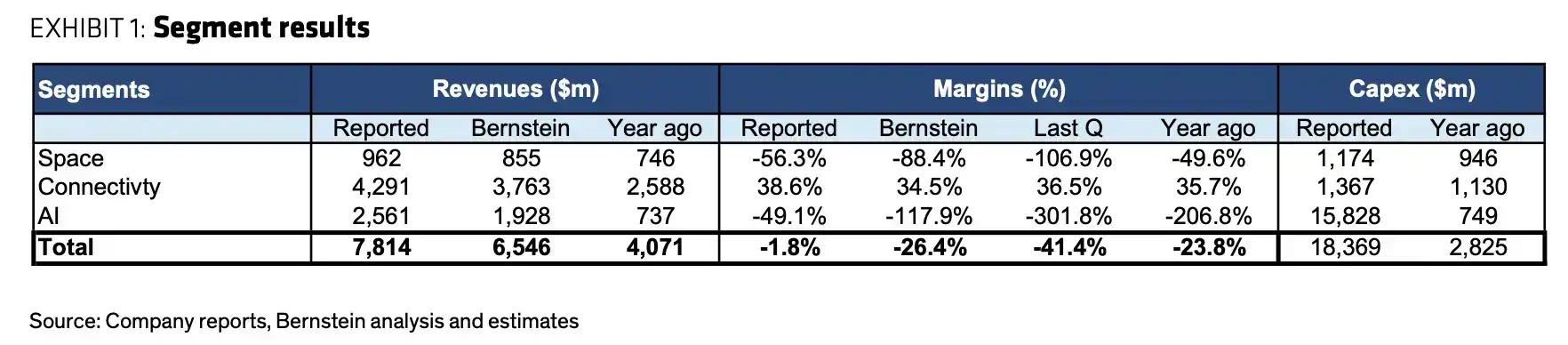
Table of SpaceX's Q2 performance by its three business segments. Connectivity contributes the main profit, while AI segment capital expenditure reached $15.828 billion. Source: Bernstein

AI Compute Opens Revenue Potential; A Trillion in Revenue Can't Rely Solely on Satellite Internet

The most notable change from the earnings call was Musk moving the target year for reaching $1 trillion in annual revenue from 2031 to 2030, suggesting it could be achieved as early as 2029. Management also presented expectations for an annualized revenue run rate of at least $100 billion, though this Bernstein report summary does not explicitly state the corresponding timeframe.

To approach this target, SpaceX clearly cannot rely solely on Starlink user growth. Connectivity needs to continue expanding its consumer, enterprise, and government customer base; the AI business needs to convert massive compute capacity into long-term contracts and stable revenue; and Starship needs to reduce the costs of satellite deployment and orbital data center construction.

Among these, AI compute pricing is the most sensitive variable.

Musk stated that compute service pricing could remain in the range of $30 to $50 per watt, noting this assessment aligns with prices agreed upon in deals with Anthropic and Google. In contrast, Bernstein's current model still assumes compute prices will eventually revert to approximately $10 per watt.

This means that the $30 to $50 per watt range is not the base assumption already incorporated into Bernstein's $239 target price, but rather potential model upside. If SpaceX can maintain higher prices while expanding capacity, its long-term revenue and EBITDA could significantly exceed Bernstein's current forecasts.

However, the sustainability of this price range remains uncertain. Customer contract terms and cancellation clauses, AI compute supply and demand dynamics, semiconductor supply, and competitor expansion could all impact actual realized prices.

Capacity expansion targets are similarly aggressive. SpaceX's nominal compute capacity was 1.4 GW at the end of Q2. The company expects to exceed 2 GW by the end of 2026, approach 10 GW by the end of 2027, and move toward 20 GW in 2028. If this pace is realized, SpaceX's business structure will evolve beyond just rocket launches and satellite internet, extending further into large-scale AI infrastructure.

Key financial and valuation projection table. Bernstein forecasts SpaceX's revenue for 2025-2027 to be $18.674 billion, $40.236 billion, and $84.990 billion respectively, with the EV/Adjusted EBITDA multiple decreasing from 245.7x to 37.2x.

The Prerequisite for High-Frequency Launches is Full Reusability for Starship

In SpaceX's valuation framework, Connectivity answers the question "Is there a current profit foundation?", AI compute answers "How much faster can revenue grow?", and Starship answers "Can future scale be achieved at a sufficiently low cost?"

If SpaceX is to approach $1 trillion in annual revenue around 2030, relying solely on Starlink user growth is insufficient. Starship's launch frequency, payload capacity, and degree of full reusability will directly impact the costs of next-generation Starlink satellite deployment, orbital data center construction, and the expansion of other space businesses.

Management has still presented a very aggressive timeline. The company plans to continue advancing Starship orbital flights and V3 satellite deployment, while attempting more complex booster and upper stage recovery maneuvers. Its long-term goal is to approach a daily launch rate by the end of 2027, operating five launch pads, with two in Texas and three in Florida.

Achieving this frequency requires SpaceX not only to reuse the booster but also to solve the upper stage recovery problem for Starship. Bernstein believes a durable heat shield is key to full upper stage reusability. Musk indicated that flight number 13 may have addressed the heat shield issue, but analysis is not yet complete and will require further flights for validation.

Regulatory approvals, launch pad construction, flight anomalies, and iteration cycles could also affect the pace at which Starship transitions from high-frequency testing to industrialized operations. Therefore, full reusability remains the most critical, yet also the most uncertain, component in Bernstein's valuation model.

The $239 Target Price Relies on Three Pillars Being Realized in Tandem

Bernstein's $239 12-month target price is derived by calculating the 2030 enterprise value based on projected 2031 EBITDA for each business, using sum-of-the-parts valuation and forward EV/EBITDA multiples, then discounting each segment's valuation back to mid-2027. Connectivity and AI are discounted using late-stage venture capital discount rates of 25% and 35%, respectively.

Notably, Bernstein's model projects SpaceX's 2031 revenue at $554 billion, significantly lower than management's $1 trillion target. Its long-term compute price assumption also remains a reversion to approximately $10 per watt, not the $30 to $50 per watt suggested by Musk.

Therefore, the $239 target price does not require SpaceX to fully achieve all of management's vision but still incorporates strong business expansion assumptions. It requires at least three elements to be realized in tandem: continued profit growth from Connectivity, AI compute translating high capital expenditure into scaled revenue, and Starship achieving its planned full reusability milestones.

SpaceX's stock price has declined noticeably since its IPO, yet Bernstein maintains its $239 price target and Outperform rating. Source: Bernstein

This also explains why SpaceX's stock price fell significantly after the earnings release despite Q2 revenue and earnings per share exceeding expectations. Quarterly performance can only demonstrate that current growth remains strong; it cannot directly alleviate market concerns about AI investment returns, post-lock-up stock supply, and Starship execution risk.

If AI compute pricing can be maintained in the $30 to $50 per watt range for a longer duration, Starship's full reusability progresses as planned, and Starlink consumer and enterprise customer growth continues, Bernstein's current model still has room for upward revision. Conversely, if compute contract fulfillment, semiconductor supply, or Starship development progress falls short of expectations, the $239 target price itself will face pressure.


Трендові криптовалюти

Пов'язані питання

QWhat is Bernstein's target price for SpaceX and what is the implied upside based on the August 4th closing price?

ABernstein maintains a target price of $239 for SpaceX. Based on the August 4th closing price of $125.33, this represents an implied upside of approximately 91%.

QAccording to the article, what are the three key elements Bernstein's $239 target price relies on being fulfilled?

ABernstein's $239 target price relies on three key elements: 1) Continued profit growth from the Connectivity (Starlink) business, 2) AI computing transforming high capital expenditures into scaled revenue, and 3) Starship successfully achieving full and rapid reusability as planned.

QWhat was SpaceX's Q2 revenue and how did it compare to market expectations?

ASpaceX's Q2 revenue was $7.814 billion, representing 92% year-over-year growth. This significantly exceeded market expectations, which Bernstein cited as $6.546 billion and another consensus at $6.9 billion.

QWhat is the critical difference between Bernstein's and SpaceX management's assumptions regarding the long-term price of AI computing power?

AThe critical difference is the assumed long-term price per watt for AI computing. SpaceX management (Musk) suggests prices could remain in the $30-$50/watt range based on recent deals. In contrast, Bernstein's valuation model still assumes the price will eventually fall to around $10/watt.

QWhy did SpaceX's stock price fall sharply after the release of its strong Q2 earnings, according to the article?

AThe stock price fell because the market was looking beyond the strong quarterly results. Investors were simultaneously weighing concerns about the return on massive AI capital expenditures, potential selling pressure from the post-IPO lockup expiration, and the execution risk of Starship achieving high-frequency, low-cost launch capability.

Пов'язані матеріали

Writing Censorship Resistance into the Protocol: Who Decides If an Ethereum Transaction Can Be On-Chained?

Building censorship resistance into the protocol: who decides if an Ethereum transaction gets into a block? In Ethereum, censorship resistance is a technical capability, not a political stance. A key challenge emerges from the current Proposer-Builder Separation (PBS) model, where specialized Builders construct most blocks. This centralizes the power to include transactions, creating risks, as Builders can exclude certain transactions under external pressure. The core problem is ensuring any transaction following protocol rules gets a fair chance to enter a block. To address Builder dominance, Ethereum researchers are exploring Inclusion Lists—mechanisms allowing validators to specify transactions that must be included if valid and space permits. Two primary proposals are detailed: 1. **FOCIL (Fork-Choice Enforced Inclusion Lists)**: Distributes the power to create an inclusion list from a single Proposer to a randomly selected committee of validators. If a Builder ignores the committee's aggregated list, the network's consensus rules will reject the block, making censorship costly. 2. **FairFIL (Fair Forward Inclusion Lists)**: Focuses on accountability and economic disincentives. Builders must publicly list valid transactions they exclude, creating a verifiable record. Persistently censoring transactions by omitting them from this list can lead to escalating penalties, including loss of block rewards. For users, these mechanisms aim to improve transaction inclusion certainty without changing how they interact with wallets. Valid, fee-paying transactions should no longer be indefinitely delayed by a Builder's choice. While Builders retain control over transaction ordering for MEV extraction, their gatekeeping power over *who gets in* is constrained. Current status: FOCIL is advancing in Ethereum's development pipeline, while FairFIL is an earlier-stage research proposal. Ultimately, Ethereum's approach acknowledges that not all participants will remain neutral. The goal is to make censorship observable, expensive, and unsustainable through protocol-level rules, moving the network's credible neutrality from a social promise to a technically enforced property.

marsbitЩойно

Writing Censorship Resistance into the Protocol: Who Decides If an Ethereum Transaction Can Be On-Chained?

marsbitЩойно

Dice vs. Hackers: Why South Korean Bitcoiners Escaped the Coldcard Hack Unscathed

South Korea's Bitcoin community suffered minimal direct losses from the recent Coldcard hardware wallet hack, despite the device's popularity among its most experienced users. An error in random number generation in certain Coldcard models allowed attackers to access vulnerable seed phrases, leading to the theft of over 1,596 BTC (approx. $130M) from thousands of addresses globally. Analyst Koji Higashi attributes Korea's resilience not to luck, but to a long-standing community culture of self-custody and caution. Local leaders have long promoted generating seed phrases independently from any device, relying on offline, analog methods like dice rolls or coin flips to create true randomness, followed by offline BIP39 phrase creation and verification. In contrast, English-speaking self-custody communities, despite high technical literacy, experienced more significant losses. Higashi links this to greater reliance on influencers, some with ties to the manufacturer (Coinkite), creating an echo chamber of trust in the device's security without independent verification. Korean leaders, lacking commercial ties, provided more neutral risk assessments that their followers heeded. The incident underscores applying Bitcoin's "don't trust, verify" principle not just to code, but to information sources. The key takeaway is to create seed phrases using independent physical methods where possible and to default to distrusting any device's built-in random number generator.

cryptonews.ru4 хв тому

Dice vs. Hackers: Why South Korean Bitcoiners Escaped the Coldcard Hack Unscathed

cryptonews.ru4 хв тому

Senate to Vote on CLARITY Act Before August Recess, Lummis Says

U.S. Senator Cynthia Lummis (R-WY), chair of the Senate's digital assets subcommittee, stated the Senate may work past Friday and through the weekend to secure a vote on the CLARITY Act before the August recess. This vote would force senators to take a public position on the bill. Over 300 pages of amendments, requested by Democrats, have been prepared after 11 months of negotiations, with final discussions ongoing regarding CFTC jurisdiction, law enforcement provisions, and ethics rules for senior federal officials. Key unresolved issues, per Democratic staff, include securities protection, illicit finance, national security, and presidential conflicts of interest. A bipartisan counterproposal, allowing state attorneys general to enforce federal crypto ethics rules, has been sent to President Trump, who reportedly agreed to broader restrictions than those applied to previous presidents. Lummis asserted that if the bill fails, it will be due to Democratic opposition. Regulators have expressed support. CFTC Chairman Michael S. Selig endorsed congressional action for clearer digital asset rules, while SEC Chairman Paul Atkins expressed optimism about the bill's passage. The CLARITY Act aims to divide oversight between the CFTC and SEC, providing distinct regulatory frameworks for cryptocurrencies and securities. Proponents argue this clarity will help retain crypto companies, capital, and innovation within the United States, preventing an exodus to jurisdictions like Switzerland or Singapore. The approaching recess deadline increases pressure to secure the 60 votes typically needed. With Republicans holding 53 seats, Democratic support is crucial. A Senate vote would lock in each legislator's stance before negotiations with the House on a final bill text.

cryptonews.ru15 хв тому

Senate to Vote on CLARITY Act Before August Recess, Lummis Says

cryptonews.ru15 хв тому

Торгівля

Спот

Популярні статті

Що таке $S$

Розуміння SPERO: Комплексний огляд Вступ до SPERO Оскільки ландшафт інновацій продовжує еволюціонувати, виникнення технологій web3 та криптовалютних проектів відіграє ключову роль у формуванні цифрового майбутнього. Один з проектів, який привернув увагу в цій динамічній сфері, — це SPERO, позначений як SPERO,$$s$. Ця стаття має на меті зібрати та представити детальну інформацію про SPERO, щоб допомогти ентузіастам та інвесторам зрозуміти його основи, цілі та інновації в рамках web3 та крипто-сектору. Що таке SPERO,$$s$? SPERO,$$s$ — це унікальний проект у криптопросторі, який прагне використати принципи децентралізації та технології блокчейн для створення екосистеми, що сприяє залученню, корисності та фінансовій інклюзії. Проект розроблений для полегшення взаємодії між користувачами новими способами, надаючи їм інноваційні фінансові рішення та послуги. У своїй основі SPERO,$$s$ прагне надати можливості індивідам, забезпечуючи інструменти та платформи, які покращують користувацький досвід у криптовалютному просторі. Це включає в себе можливість більш гнучких методів транзакцій, сприяння ініціативам, що підтримуються спільнотою, та створення шляхів для фінансових можливостей через децентралізовані додатки (dApps). Основна концепція SPERO,$$s$ обертається навколо інклюзивності, прагнучи зменшити розриви в традиційній фінансовій системі, використовуючи переваги технології блокчейн. Хто є творцем SPERO,$$s$? Особистість творця SPERO,$$s$ залишається дещо невідомою, оскільки є обмежені публічно доступні ресурси, що надають детальну інформацію про його засновників. Ця відсутність прозорості може бути наслідком зобов'язання проекту до децентралізації — етики, яку багато проектів web3 поділяють, ставлячи колективні внески вище за індивідуальне визнання. Зосереджуючи обговорення навколо спільноти та її колективних цілей, SPERO,$$s$ втілює суть наділення без виділення конкретних осіб. Таким чином, розуміння етики та місії SPERO є більш важливим, ніж ідентифікація єдиного творця. Хто є інвесторами SPERO,$$s$? SPERO,$$s$ підтримується різноманітними інвесторами, починаючи від венчурних капіталістів до ангельських інвесторів, які прагнуть сприяти інноваціям у крипто-секторі. Зосередження цих інвесторів зазвичай узгоджується з місією SPERO — пріоритет надається проектам, які обіцяють технологічний прогрес у суспільстві, фінансову інклюзію та децентралізоване управління. Ці інвесторські фонди зазвичай зацікавлені в проектах, які не лише пропонують інноваційні продукти, але й позитивно впливають на спільноту блокчейн та її екосистеми. Підтримка з боку цих інвесторів підкріплює SPERO,$$s$ як значного конкурента в швидко змінюваній сфері крипто-проектів. Як працює SPERO,$$s$? SPERO,$$s$ використовує багатогранну структуру, яка відрізняє його від традиційних криптовалютних проектів. Ось деякі ключові особливості, які підкреслюють його унікальність та інноваційність: Децентралізоване управління: SPERO,$$s$ інтегрує моделі децентралізованого управління, надаючи користувачам можливість активно брати участь у процесах прийняття рішень щодо майбутнього проекту. Цей підхід сприяє відчуттю власності та відповідальності серед членів спільноти. Корисність токена: SPERO,$$s$ використовує свій власний криптовалютний токен, розроблений для виконання різних функцій в екосистемі. Ці токени дозволяють здійснювати транзакції, отримувати винагороди та полегшувати послуги, що пропонуються на платформі, підвищуючи загальну залученість та корисність. Шарова архітектура: Технічна архітектура SPERO,$$s$ підтримує модульність та масштабованість, що дозволяє безперешкодно інтегрувати додаткові функції та додатки в міру розвитку проекту. Ця адаптивність є надзвичайно важливою для збереження актуальності в постійно змінюваному крипто-ландшафті. Залучення спільноти: Проект підкреслює ініціативи, що підтримуються спільнотою, використовуючи механізми, які стимулюють співпрацю та зворотний зв'язок. Підтримуючи сильну спільноту, SPERO,$$s$ може краще задовольняти потреби користувачів та адаптуватися до ринкових тенденцій. Фокус на інклюзію: Пропонуючи низькі комісії за транзакції та зручні інтерфейси, SPERO,$$s$ прагне залучити різноманітну базу користувачів, включаючи осіб, які раніше не брали участі в крипто-просторі. Це зобов'язання до інклюзії узгоджується з його загальною місією наділення через доступність. Хронологія SPERO,$$s$ Розуміння історії проекту надає важливі уявлення про його розвиток та етапи. Нижче наведено пропоновану хронологію, що відображає значні події в еволюції SPERO,$$s$: Етап концептуалізації та ідеації: Початкові ідеї, що стали основою SPERO,$$s$, були сформовані, тісно пов'язані з принципами децентралізації та фокусом на спільноті в індустрії блокчейн. Запуск білого паперу проекту: Після концептуального етапу був випущений комплексний білий папір, що детально описує бачення, цілі та технологічну інфраструктуру SPERO,$$s$, щоб залучити інтерес та зворотний зв'язок від спільноти. Створення спільноти та ранні залучення: Активні зусилля були спрямовані на створення спільноти ранніх прихильників та потенційних інвесторів, що полегшило обговорення цілей проекту та отримання підтримки. Подія генерації токенів: SPERO,$$s$ провів подію генерації токенів (TGE) для розподілу своїх рідних токенів серед ранніх прихильників та встановлення початкової ліквідності в екосистемі. Запуск початкового dApp: Перший децентралізований додаток (dApp), пов'язаний з SPERO,$$s$, став доступним, дозволяючи користувачам взаємодіяти з основними функціями платформи. Постійний розвиток та партнерства: Безперервні оновлення та вдосконалення пропозицій проекту, включаючи стратегічні партнерства з іншими учасниками блокчейн-простору, сформували SPERO,$$s$ у конкурентоспроможного та еволюціонуючого гравця на крипто-ринку. Висновок SPERO,$$s$ є свідченням потенціалу web3 та криптовалют для революціонізації фінансових систем та наділення індивідів. Завдяки зобов'язанню до децентралізованого управління, залучення спільноти та інноваційно спроектованих функцій, він прокладає шлях до більш інклюзивного фінансового ландшафту. Як і з будь-якими інвестиціями в швидко змінюваному крипто-просторі, потенційним інвесторам та користувачам рекомендується ретельно досліджувати та обдумано взаємодіяти з поточними подіями в SPERO,$$s$. Проект демонструє інноваційний дух крипто-індустрії, запрошуючи до подальшого дослідження його численних можливостей. Хоча подорож SPERO,$$s$ ще триває, його основні принципи можуть справді вплинути на майбутнє того, як ми взаємодіємо з технологією, фінансами та один з одним у взаємопов'язаних цифрових екосистемах.

257 переглядів усьогоОпубліковано 2024.12.17Оновлено 2024.12.17

Що таке $S$

Що таке AGENT S

Агент S: Майбутнє автономної взаємодії в Web3 Вступ У постійно змінюваному ландшафті Web3 та криптовалюти інновації постійно переосмислюють, як люди взаємодіють з цифровими платформами. Один з таких новаторських проектів, Агент S, обіцяє революціонізувати взаємодію людини з комп'ютером через свою відкриту агентну структуру. Прокладаючи шлях для автономних взаємодій, Агент S прагне спростити складні завдання, пропонуючи трансформаційні застосування в штучному інтелекті (ШІ). Це детальне дослідження заглиблюється в складності проекту, його унікальні особливості та наслідки для сфери криптовалюти. Що таке Агент S? Агент S є революційною відкритою агентною структурою, спеціально розробленою для вирішення трьох основних викликів в автоматизації комп'ютерних завдань: Набуття специфічних знань у галузі: Структура інтелектуально навчається з різних зовнішніх джерел знань та внутрішнього досвіду. Цей подвійний підхід дозволяє їй створити багатий репозиторій специфічних знань у галузі, покращуючи її продуктивність у виконанні завдань. Планування на довгих горизонтах завдань: Агент S використовує планування з підкріпленням досвіду, стратегічний підхід, який полегшує ефективний розподіл та виконання складних завдань. Ця функція значно підвищує її здатність ефективно та результативно управляти кількома підзавданнями. Обробка динамічних, неоднорідних інтерфейсів: Проект представляє Інтерфейс Агент-Комп'ютер (ACI), інноваційне рішення, яке покращує взаємодію між агентами та користувачами. Використовуючи багатомодальні великі мовні моделі (MLLMs), Агент S може безперешкодно орієнтуватися та маніпулювати різноманітними графічними інтерфейсами користувача. Завдяки цим новаторським функціям Агент S надає надійну структуру, яка вирішує складнощі, пов'язані з автоматизацією людської взаємодії з машинами, прокладаючи шлях для численних застосувань у ШІ та за його межами. Хто є творцем Агент S? Хоча концепція Агент S є фундаментально новаторською, конкретна інформація про його творця залишається невідомою. Творець наразі невідомий, що підкреслює або початкову стадію проекту, або стратегічний вибір зберегти засновників у таємниці. Незважаючи на анонімність, акцент залишається на можливостях та потенціалі структури. Хто є інвесторами Агент S? Оскільки Агент S є відносно новим у криптографічній екосистемі, детальна інформація про його інвесторів та фінансових спонсорів не задокументована. Відсутність публічно доступних відомостей про інвестиційні фонди або організації, що підтримують проект, викликає питання щодо його фінансової структури та дорожньої карти розвитку. Розуміння підтримки є критично важливим для оцінки стійкості проекту та потенційного впливу на ринок. Як працює Агент S? В основі Агент S лежить передова технологія, яка дозволяє йому ефективно функціонувати в різних умовах. Його операційна модель побудована навколо кількох ключових функцій: Взаємодія з комп'ютером, подібна до людської: Структура пропонує розширене планування ШІ, прагнучи зробити взаємодії з комп'ютерами більш інтуїтивними. Імітуючи людську поведінку при виконанні завдань, вона обіцяє підвищити досвід користувачів. Наративна пам'ять: Використовується для використання високорівневого досвіду, Агент S використовує наративну пам'ять для відстеження історій завдань, тим самим покращуючи свої процеси прийняття рішень. Епізодична пам'ять: Ця функція надає користувачам покрокові інструкції, дозволяючи структурі пропонувати контекстуальну підтримку в міру виконання завдань. Підтримка OpenACI: Завдяки можливості працювати локально, Агент S дозволяє користувачам зберігати контроль над своїми взаємодіями та робочими процесами, узгоджуючи з децентралізованою етикою Web3. Легка інтеграція з зовнішніми API: Його універсальність і сумісність з різними платформами ШІ забезпечують те, що Агент S може безперешкодно вписатися в існуючі технологічні екосистеми, роблячи його привабливим вибором для розробників та організацій. Ці функціональні можливості колективно сприяють унікальному положенню Агент S у крипто-просторі, оскільки він автоматизує складні, багатоступеневі завдання з мінімальним втручанням людини. У міру розвитку проекту його потенційні застосування в Web3 можуть переосмислити, як відбуваються цифрові взаємодії. Хронологія Агент S Розробка та етапи Агент S можуть бути узагальнені в хронології, яка підкреслює його значні події: 27 вересня 2024 року: Концепція Агент S була представлена в комплексній науковій статті під назвою “Відкрита агентна структура, яка використовує комп'ютери як людина”, що демонструє основи проекту. 10 жовтня 2024 року: Наукова стаття була опублікована на arXiv, пропонуючи детальне дослідження структури та її оцінки продуктивності на основі бенчмарку OSWorld. 12 жовтня 2024 року: Було випущено відеопрезентацію, що надає візуальне уявлення про можливості та особливості Агент S, ще більше залучаючи потенційних користувачів та інвесторів. Ці маркери в хронології не лише ілюструють прогрес Агент S, але й вказують на його прихильність до прозорості та залучення громади. Ключові моменти про Агент S У міру розвитку структури Агент S кілька ключових характеристик виділяються, підкреслюючи її новаторський характер та потенціал: Інноваційна структура: Розроблена для забезпечення інтуїтивного використання комп'ютерів, подібного до людської взаємодії, Агент S пропонує новий підхід до автоматизації завдань. Автономна взаємодія: Здатність автономно взаємодіяти з комп'ютерами через GUI означає стрибок до більш інтелектуальних та ефективних обчислювальних рішень. Автоматизація складних завдань: Завдяки своїй надійній методології він може автоматизувати складні, багатоступеневі завдання, роблячи процеси швидшими та менш схильними до помилок. Безперервне вдосконалення: Механізми навчання дозволяють Агенту S покращуватися на основі минулого досвіду, постійно підвищуючи свою продуктивність та ефективність. Універсальність: Його адаптивність до різних операційних середовищ, таких як OSWorld та WindowsAgentArena, забезпечує його здатність служити широкому спектру застосувань. Оскільки Агент S займає своє місце в ландшафті Web3 та криптовалюти, його потенціал покращити можливості взаємодії та автоматизувати процеси означає значний прогрес у технологіях ШІ. Завдяки своїй інноваційній структурі Агент S є прикладом майбутнього цифрових взаємодій, обіцяючи більш безперешкодний та ефективний досвід для користувачів у різних галузях. Висновок Агент S представляє собою сміливий крок вперед у поєднанні ШІ та Web3, з можливістю переосмислити, як ми взаємодіємо з технологією. Хоча проект все ще на ранніх стадіях, можливості для його застосування є величезними та переконливими. Завдяки своїй комплексній структурі, що вирішує критичні виклики, Агент S прагне вивести автономні взаємодії на передній план цифрового досвіду. У міру того, як ми заглиблюємося в сфери криптовалюти та децентралізації, проекти, подібні до Агент S, безсумнівно, відіграватимуть ключову роль у формуванні майбутнього технологій та співпраці людини з комп'ютером.

875 переглядів усьогоОпубліковано 2025.01.14Оновлено 2025.01.14

Що таке AGENT S

Як купити S

Ласкаво просимо до HTX.com! Ми зробили покупку Sonic (S) простою та зручною. Дотримуйтесь нашої покрокової інструкції, щоб розпочати свою криптовалютну подорож.Крок 1: Створіть обліковий запис на HTXВикористовуйте свою електронну пошту або номер телефону, щоб зареєструвати обліковий запис на HTX безплатно. Пройдіть безпроблемну реєстрацію й отримайте доступ до всіх функцій.ЗареєструватисьКрок 2: Перейдіть до розділу Купити крипту і виберіть спосіб оплатиКредитна/дебетова картка: використовуйте вашу картку Visa або Mastercard, щоб миттєво купити Sonic (S).Баланс: використовуйте кошти з балансу вашого рахунку HTX для безперешкодної торгівлі.Треті особи: ми додали популярні способи оплати, такі як Google Pay та Apple Pay, щоб підвищити зручність.P2P: Торгуйте безпосередньо з іншими користувачами на HTX.Позабіржова торгівля (OTC): ми пропонуємо індивідуальні послуги та конкурентні обмінні курси для трейдерів.Крок 3: Зберігайте свої Sonic (S)Після придбання Sonic (S) збережіть його у своєму обліковому записі на HTX. Крім того, ви можете відправити його в інше місце за допомогою блокчейн-переказу або використовувати його для торгівлі іншими криптовалютами.Крок 4: Торгівля Sonic (S)Легко торгуйте Sonic (S) на спотовому ринку HTX. Просто увійдіть до свого облікового запису, виберіть торгову пару, укладайте угоди та спостерігайте за ними в режимі реального часу. Ми пропонуємо зручний досвід як для початківців, так і для досвідчених трейдерів.

1.9k переглядів усьогоОпубліковано 2025.01.15Оновлено 2026.06.02

Як купити S

Обговорення

Ласкаво просимо до спільноти HTX. Тут ви можете бути в курсі останніх подій розвитку платформи та отримати доступ до професійної ринкової інформації. Нижче представлені думки користувачів щодо ціни S (S).

活动图片