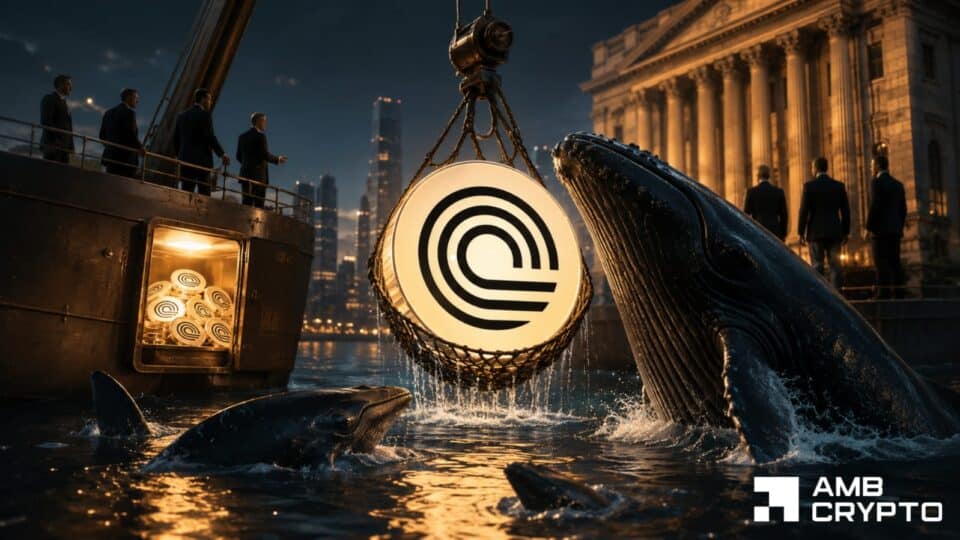
Berkshire Hathaway and SoftBank: One Must Die

marsbitОпубліковано о 2026-05-08Востаннє оновлено о 2026-05-08

Анотація

"Berkshire Hathaway vs. SoftBank: One Must 'Die'" In May 2026, with half-empty seats at its annual meeting, Berkshire Hathaway, under new CEO Greg Abel, faces investor pressure over its massive $397.4 billion cash pile—nearly 40% of its market cap. This hoard, largely in US Treasuries, resulted from 14 consecutive quarters of net equity sales, including massive Apple divestments. Abel inherits Buffett's "nothing looks attractive" stance in an expensive market likened to "a casino next to a church." However, Berkshire's significant underperformance versus the S&P 500 and a future of sustained high valuations could force a historic choice: returning capital via special dividends or breaking up the conglomerate. Berkshire's "death" would be a slow, existential one—the erosion of its value-investing identity post-Buffett. Conversely, SoftBank, led by Masayoshi Son, is in a frantic race against debt. It has pledged a staggering $64.6 billion for a 13% stake in OpenAI, financed by escalating parent-company debt (over ¥16.3 trillion), a historic $40 billion bridge loan, and the fire-sale of assets like Nvidia, T-Mobile, and Alibaba shares. The plan hinges on a successful OpenAI IPO and the $100 billion listing of its Roze AI unit to refinance. Son's high-wire act faces three correlated triggers for potential collapse: an OpenAI IPO delay or stumble, a sharp de-rating of its key liquid asset Arm (trading at 70x forward P/E), or a failure to refinance the massive 2027 bridge loan at...

Author: Le Ming

May 2, 2026, Omaha. This time, only a little over half of the 18,000 seats were filled—in the past, you had to scramble for tickets and queue up to get into the Berkshire Hathaway annual shareholders meeting, and hotels outside the venue were impossible to book.

This time, the 95-year-old Warren Buffett was not presiding on stage as in previous years. The new CEO, Greg Abel, stood in front of the main screen, fielding investors' tough questions about why Berkshire was sitting on nearly $400 billion in cash.

That same week, six thousand miles away in Tokyo, Masayoshi Son's team was doing something else: bundling SoftBank Group's yet-unprofitable AI assets, preparing to load them into a new company called Roze AI, targeting a $100 billion valuation and planning a U.S. listing in the second half of 2026.

The reason is simple: SoftBank must continue to find money and continue investing for OpenAI's $64.6 billion check, which could ultimately balloon to nearly a trillion dollars.

One is holding $397.4 billion in cash, buying nothing, waiting for the market to crash; the other is carrying over 16.34 trillion yen (over $100 billion) of parent company interest-bearing debt, betting the market won't crash.

Berkshire Hathaway: Too Much Money Is a Disease

What does $397.4 billion mean?

It's nearly 40% of Berkshire's total market capitalization, double Buffett's average cash level over the past two decades.

Of this, $339.3 billion is directly held in U.S. short-term Treasury bonds, making Berkshire one of the U.S. Treasury's largest non-governmental creditors.

This pile of money wasn't passively accumulated; it was actively built.

For the past fourteen quarters, Berkshire has been a net seller of stocks each quarter. Apple, once its largest holding, has been continuously reduced for four quarters starting from Q3 2024, with cumulative sales of nearly 688 million shares, raising over $100 billion.

Buffett's explanation has always been the same: can't find anything cheap.

He wrote one sentence in his 2024 letter to shareholders—"Generally, nothing appears attractive." In a recent off-site interview during the annual meeting, he described the current market as "a church next to a casino," saying that of all the market sentiments he has experienced, this is the most gambling-like.

The problem is, he's been making this judgment for more than a year.

Berkshire's stock performance over the past twelve months has lagged the S&P 500 by about 40 percentage points. This is no small number—it's one of the largest relative drawdowns since Buffett took over Berkshire in 1965. The last time such a degree of underperformance occurred was during the final stages of the dot-com bubble in 1999.

At that time, Buffett said he would only buy in "cutting-edge industries like bricks, carpet, insulation, and paint." Two years later, the Nasdaq fell 78%, and he was proven right.

But this time, investors have waited more than two years. The market rises, Berkshire doesn't move; the market rises again, Berkshire still doesn't move. On January 1 of this year, when Buffett officially stepped down as CEO, Berkshire's stock price fell slightly—the market expressed a measured disappointment in the most restrained manner.

This is the situation Abel inherited. He is a Canadian accountant who worked his way up to Berkshire Vice Chairman, spending his entire career in heavy-asset, regulated, slow-growth businesses like utilities, railroads, and energy.

He is not Buffett, and he knows he is not Buffett. In his first letter to shareholders, he repeatedly emphasized "continuity" and "decentralization." At his first annual meeting, his answer to all suggestions about splitting up the conglomerate was an absolute "impossible."

Abel's dilemma is: he can neither deploy this cash (because the market is too expensive), nor can he continue to pretend this money doesn't exist (because investors are voting with their feet).

If the market continues to rise over the next five to ten years, he will eventually have to face a question that has never been seriously discussed in Berkshire's history—giving the money back. Either returning it to shareholders as a special dividend, or actually breaking up and selling off this behemoth stitched together from over 60 subsidiaries.

Will Berkshire die? Not suddenly. Its holdings are too diversified, its cash too abundant, its debt too low; any external shock would struggle to truly pierce it. But it will slowly, decently, become something else.

SoftBank's Problem: Too Little Money and Still Betting

Masayoshi Son's situation is the opposite mirror image of Abel's.

On February 27, 2026, SoftBank issued an announcement. The most critical sentence translates to: "SoftBank Group's cumulative investment in OpenAI is expected to reach $64.6 billion, representing an ownership stake of approximately 13%."

$64.6 billion, 13%. It's the most expensive single bet of this era.

To understand the madness of this number, one needs to see how SoftBank managed to afford it.

The parent company's interest-bearing debt has skyrocketed from 12.14 trillion yen in March 2025 to 16.34 trillion yen in December 2025. The parent company's so-called cash is only about 3.8 trillion yen, nearly one-third of which is actually unused committed credit lines, not real cash.

Where did this money come from? SoftBank took out $20 billion from pledging its holdings of Arm stock; and scraped together about $7.7 billion from pledging its holdings in the Japanese telecom subsidiary SBKK.

On March 27, 2026, SoftBank also signed an unprecedented $40 billion bridge loan, led by five banks—JPMorgan Chase, Goldman Sachs, Mizuho, SMBC, and MUFG—later expanded to eight. This is one of the largest bridge loans in Asian history. $30 billion of this money is directly used to follow-on invest in OpenAI. The term is 12 months, meaning SoftBank must repay $40 billion by March 2027.

This is why Son has seemed a bit "not himself" this year: He completely offloaded SoftBank's entire Nvidia stake, raising $5.8 billion. This was a one-time sell-off in October 2025. In a Tokyo speech in early December 2025, he admitted: "I didn't want to sell a single share of Nvidia, but I needed more money to invest in OpenAI. I sold Nvidia crying."

To scrape together money for OpenAI, Son has been "selling the family silver." SoftBank sold its T-Mobile holdings—56.9 million shares in the first three quarters of fiscal 2025, raising $12.7 billion; another 12.5 million shares in Q4, raising another $2.3 billion. Deutsche Telekom was completely sold off. Alibaba was completely sold off. At the end of April this year, SoftBank began organizing a $10 billion margin loan secured by OpenAI equity, with an interest rate as high as nearly 8%.

At the same time, SoftBank has been issuing bonds everywhere: In November 2025, SoftBank issued a 500 billion yen bond with a 3.98% coupon; in April 2026, it followed with a 418 billion yen, five-year 4.97% coupon subordinated bond—the most expensive retail bond in SoftBank's history and the highest coupon in the history of Japanese yen retail bonds for non-financial corporations. This shows that the market is already starting to become "suspicious" of SoftBank's debt.

The credit market's reaction is direct: SoftBank's 5-year credit default swap surged to 355 basis points in early March, an 11-month high.

Son's recent "lifeline" is hoping OpenAI can go public as soon as possible. Otherwise, if debt pressure becomes chronic, it could really blow up SoftBank.

However, while OpenAI CEO Sam Altman advocates for a Q4 2026 listing, CFO Sarah Friar advocates for a delay to 2027. The fact that the CEO and CFO are publicly split on this matter itself tells the market: the company internally isn't sure if it's ready.

One Must Die

Berkshire's death will be gentle.

It won't go bankrupt—its subsidiaries are high-quality cash cows, its debt level is extremely low. Even if the AI capital expenditure bubble bursts, even if data center demand is cut in half, even if the S&P 500 falls 50%, Berkshire's cash pile is enough for it to devour any cheap thing like a glutton over a decade.

Its death is the death of identity—the Buffett-style compound interest myth of "buying good businesses at cabbage prices" may no longer hold in a world where valuations are forever above 30 times P/E, in a world where ten-year Treasury yields have shattered all traditional valuation models.

Abel may perform very well as a "rational CEO"—continuing operations, continuing small buybacks, continuing to make some marginal acquisitions—but Berkshire as a narrative of capitalist discipline died the moment Buffett stopped writing letters. Its body remains, but its soul has left the stage.

SoftBank's death, however, could be violent. It has three death triggers; pulling any one could set off a chain reaction:

The first trigger is OpenAI. If its IPO is delayed until 2027 or even 2028, if Amazon's $35 billion commitment tied to the IPO ultimately fails to materialize, if OpenAI's revenue growth stops for a single quarter—even just one quarter—the valuation of that 13% stake on SoftBank's balance sheet will be revalued downward.

The second trigger is Arm. Arm is currently SoftBank's only truly liquid asset that is still highly valued by the market—market cap about $200 billion, with SoftBank holding 87%.

Arm's royalty revenue rose 26% year-on-year in Q3 FY2026, with data center-related royalties doubling, one of the pillars supporting SoftBank's entire valuation story.

But Arm is also currently the most susceptible target for re-pricing—once it returns from its current forward P/E of 70 times to a "normal" semiconductor company valuation, the coverage ratio for SoftBank's $20 billion Arm-collateralized loan will collapse.

The third trigger is the refinancing itself. The $40 billion bridge loan matures in March 2027. Before that, SoftBank must achieve at least one of the following: OpenAI's IPO, Roze AI's IPO, sell another batch of assets, or issue a bond of similar size to roll it over.

But each path is more expensive than the last—SoftBank's retail bond coupon has already risen from 3.98% in 2025 to 4.97% in 2026.

The probability of each of these three triggers individually is not high—OpenAI will likely go public, Arm likely won't crash immediately, and credit markets likely won't shut their doors to SoftBank overnight. But they have one non-negligible characteristic: they are highly correlated, not three independent events.

If the bubble doesn't burst, Son will ultimately be deified: Roze AI lists at a $100 billion valuation, OpenAI successfully IPOs, and in his 70s he will realize his proclaimed ASI (Artificial Superintelligence) narrative.

And Berkshire, under Abel's prudent management, will be gently, persistently, irreversibly marginalized by the market—until one day, a successor is forced to do what Buffett refused to do his entire life


Пов'язані питання

QWhat is the core difference in the current strategies of Berkshire Hathaway and SoftBank as depicted in the article?

AThe core difference lies in their capital allocation and risk posture. Berkshire Hathaway, under the guidance of Warren Buffett and now Greg Abel, is hoarding nearly $400 billion in cash and U.S. Treasury bills, actively selling stocks (like Apple) and waiting for a market downturn to buy undervalued assets. Conversely, SoftBank, led by Masayoshi Son, is aggressively leveraging itself—incurring over $100 billion in parent-level debt and selling core assets (like its holdings in Nvidia, T-Mobile, and Alibaba)—to fund a massive, concentrated $64.6 billion bet on OpenAI and other AI ventures. One is betting the market will crash (by holding cash), while the other is betting it will not crash (by continuing to invest at high valuations).

QWhat are the primary challenges faced by Greg Abel as the new CEO of Berkshire Hathaway, according to the article?

AGreg Abel faces the challenge of managing a vast cash pile of nearly $400 billion that is generating low returns in a market he deems overvalued. He cannot easily deploy this capital without violating Buffett's value investing principles, yet investors are growing impatient as Berkshire's stock performance lags significantly behind the S&P 500. His dilemma is balancing the continuation of Buffett's 'wait-for-a-bargain' philosophy with mounting pressure from shareholders. The article suggests his ultimate challenge may be deciding whether to return capital to shareholders via a special dividend or break up the conglomerate if the market remains expensive for an extended period.

QWhat financial risks does SoftBank face due to its massive investment in OpenAI?

ASoftBank faces severe financial risks stemming from its massive OpenAI investment, which is largely debt-financed. Key risks include: 1) **Liquidity and Refinancing Risk:** It has a $40 billion bridge loan maturing in March 2027 that must be repaid or refinanced, potentially at higher costs as its creditworthiness declines. 2) **Asset Concentration Risk:** Its financial health is heavily tied to the success and timely IPO of OpenAI. Any delay or setback in OpenAI's performance or public listing could trigger a valuation writedown and a liquidity crisis. 3) **Collateral Risk:** The value of key pledged assets, especially its Arm Holdings stake, is critical. A significant drop in Arm's stock price could breach loan covenants and force asset sales. 4) **Rising Debt Costs:** The company is already issuing debt at record-high interest rates (nearly 5% for retail bonds), indicating market skepticism and increasing its interest burden.

QHow does the article characterize the potential 'death' of Berkshire Hathaway and SoftBank?

AThe article characterizes their potential 'deaths' as fundamentally different in nature. **Berkshire Hathaway's 'death' is described as a slow, existential decline of its core identity.** It won't go bankrupt due to its strong subsidiaries and low debt, but the 'Buffett-era' narrative of phenomenal returns through value investing may end. With Buffett gone and the market persistently expensive, Berkshire risks becoming a conservatively managed holding company that is gradually marginalized, its soul gone even if its body survives. **SoftBank's potential 'death' is portrayed as a sudden, catastrophic financial collapse.** It is highly leveraged and dependent on the success of a few high-stakes bets (OpenAI, Arm). A trigger event—like an OpenAI IPO delay, an Arm stock crash, or a failure to refinance its massive bridge loan—could create a deadly domino effect, potentially leading to a liquidity crisis or insolvency.

QWhat are the three main 'triggers' identified in the article that could lead to SoftBank's collapse?

AThe three main interconnected triggers are: 1) **The OpenAI Trigger:** Any significant delay in OpenAI's IPO (beyond 2026), a failure to secure promised funding (like from Amazon), or a slowdown in OpenAI's revenue growth could lead to a downward revaluation of SoftBank's 13% stake, crippling its balance sheet. 2) **The Arm Trigger:** Arm Holdings is SoftBank's most valuable and liquid asset. If Arm's stock price falls significantly from its current high valuation (around 70x forward P/E), it could undermine the collateral for loans secured against it ($20 billion) and destroy a key pillar of SoftBank's valuation story. 3) **The Refinancing Trigger:** The $40 billion bridge loan maturing in March 2027 must be repaid or refinanced. If SoftBank cannot execute a successful IPO (OpenAI or Roze AI) or sell assets in time, it may need to refinance at prohibitively high interest rates, exacerbating its debt burden and potentially causing a credit market shutdown.

Пов'язані матеріали

ByteDance Adopts Arm CPUs, Jensen Huang: So Sad I Didn't Buy Arm

**Summary:** At Computex 2026, Arm CEO Rene Haas announced that ByteDance and Oracle have adopted Arm's self-designed Arm AGI data center CPU. The company expects significant revenue growth from this product, projecting $20 billion in demand for the 2027/2028 fiscal years. Haas noted that restricting AI-capable CPUs from the US to China is nearly impossible due to their widespread applications. Arm's stock has surged dramatically this year, notably rising 16% after NVIDIA's Arm-based Vera CPU and RTX Spark announcements. A highlight was the informal, humorous on-stage conversation between Haas and NVIDIA CEO Jensen Huang. Huang joked about NVIDIA's failed attempt to acquire Arm and playfully lamented selling his Arm shares. Both executives showed a clear sense of camaraderie and shared regret over the missed merger. Key technical topics were discussed: 1. **AI PC Design:** Huang explained NVIDIA's RTX Spark superchip (with a 20-core Arm CPU) is designed for future AI agents that will autonomously run and use tools on PCs, blending local and cloud processing. 2. **Agent vs. OS:** Huang emphasized the operating system remains crucial, as AI agents rely on its APIs and tools to function. 3. **Growth Constraints:** He identified the shift to "useful AI" that generates profitable tokens as a primary driver for immense, almost limitless, computational demand. Haas outlined Arm's strategy across PC and data centers. For PCs, Arm collaborates with partners like NVIDIA and MediaTek, offering its compute subsystem (CSS) for custom SoCs. In data centers, its Arm AGI CPU (built on TSMC's 3nm process) has gained major partners including OpenAI, Meta, and now ByteDance and Oracle. Arm presented a multi-year roadmap for its in-house CPU line. The article concludes that while GPUs dominated the AI training race, the explosion of AI agents is shifting significant focus to CPUs for inference, state management, and tool orchestration. The industry is trending towards vertical integration, with companies like cloud providers designing chips and chip/IP firms offering full solutions, all competing to deliver more efficient computing per watt.

marsbit19 хв тому

ByteDance Adopts Arm CPUs, Jensen Huang: So Sad I Didn't Buy Arm

marsbit19 хв тому

New Wall Street Play: Yen Shorts Still Adding, But Japan Stocks Don't Rely on Carry Trade Unwinding

On June 3rd, USD/JPY hit 160.44, its highest level since July 2024, while the Nikkei 225 surged past 68,000 points. Contrary to popular narratives of an imminent "carry trade unwind" akin to August 2024, data reveals a more complex picture. Speculative net short positions in yen futures have actually increased, reaching -114,667 contracts by late May, suggesting traders are doubling down rather than retreating. Meanwhile, Japan's Finance Ministry conducted its largest-ever single-round FX intervention (11.73 trillion yen) in April-May but failed to hold the 160 yen line. The Nikkei's rally is not driven by carry trade dynamics. Foreign investors are aggressively buying Japanese stocks, with net purchases in 2026 running nearly 16 times higher than 2025 levels. This inflow is concentrated in AI and semiconductor-related stocks like SoftBank and Socionext, fueled by positive sector outlooks, rather than being a flight from unwinding yen shorts. Furthermore, the Nikkei has continued climbing despite the Bank of Japan's (BOJ) rate hikes to 0.75%. This disconnect exists because the current equity boom is fueled by AI-driven foreign investment, not reliant on cheap yen funding. However, this relationship remains fragile. Should the BOJ hike rates further (e.g., to 1.0%) while dollar weakness increases carry trade costs, the trajectories of the yen and Japanese stocks could reconverge, potentially triggering volatility.

marsbit24 хв тому

New Wall Street Play: Yen Shorts Still Adding, But Japan Stocks Don't Rely on Carry Trade Unwinding

marsbit24 хв тому

Broadcom's Q3 Guidance Misses Expectations by $12 Billion, After-Hours Trading Plummets Over 13%, AI Narrative "Cooling"?

On June 3, Broadcom released record Q2 FY26 results with revenue of $22.19B, up 48% YoY, and AI chip sales of $10.8B, up 143%. Adjusted EPS of $2.44 beat estimates. However, its Q3 AI semiconductor revenue guidance of $16B, while up over 200% YoY, fell roughly $1.2B (7%) short of analyst consensus expectations of $17.2B. This miss, coupled with slightly weaker-than-expected software revenue, triggered a severe market reaction. CEO Hock Tan maintained the FY26 AI revenue outlook of over $100B but did not raise it, disappointing investors who had priced in more robust growth. The stock plummeted over 13% in after-hours trading, erasing roughly $270B in market cap. The sell-off extended to peers like Marvell. A key concern for markets, particularly for Chinese optical module suppliers, was Tan's comment that the contribution of AI networking (e.g., Ethernet switches, optical interconnect chips) to AI revenue, currently near 40%, is expected to normalize to around 30% over time, signaling a potential peak in growth for that segment. Despite the guidance shortfall, Tan reiterated that AI demand remains "insatiable" and reaffirmed the long-term target of exceeding $100B in AI revenue by FY27. The reaction highlights the heightened sensitivity and premium valuation placed on AI-exposed stocks, where anything less than stellar guidance can prompt significant profit-taking. The broader question is whether this represents a cooling AI narrative or a correction in overstretched valuations.

marsbit24 хв тому

Broadcom's Q3 Guidance Misses Expectations by $12 Billion, After-Hours Trading Plummets Over 13%, AI Narrative "Cooling"?

marsbit24 хв тому

Торгівля

Спот
Ф'ючерси

Популярні статті

Як купити ONE

Ласкаво просимо до HTX.com! Ми зробили покупку Harmony (ONE) простою та зручною. Дотримуйтесь нашої покрокової інструкції, щоб розпочати свою криптовалютну подорож.Крок 1: Створіть обліковий запис на HTXВикористовуйте свою електронну пошту або номер телефону, щоб зареєструвати обліковий запис на HTX безплатно. Пройдіть безпроблемну реєстрацію й отримайте доступ до всіх функцій.ЗареєструватисьКрок 2: Перейдіть до розділу Купити крипту і виберіть спосіб оплатиКредитна/дебетова картка: використовуйте вашу картку Visa або Mastercard, щоб миттєво купити Harmony (ONE).Баланс: використовуйте кошти з балансу вашого рахунку HTX для безперешкодної торгівлі.Треті особи: ми додали популярні способи оплати, такі як Google Pay та Apple Pay, щоб підвищити зручність.P2P: Торгуйте безпосередньо з іншими користувачами на HTX.Позабіржова торгівля (OTC): ми пропонуємо індивідуальні послуги та конкурентні обмінні курси для трейдерів.Крок 3: Зберігайте свої Harmony (ONE)Після придбання Harmony (ONE) збережіть його у своєму обліковому записі на HTX. Крім того, ви можете відправити його в інше місце за допомогою блокчейн-переказу або використовувати його для торгівлі іншими криптовалютами.Крок 4: Торгівля Harmony (ONE)Легко торгуйте Harmony (ONE) на спотовому ринку HTX. Просто увійдіть до свого облікового запису, виберіть торгову пару, укладайте угоди та спостерігайте за ними в режимі реального часу. Ми пропонуємо зручний досвід як для початківців, так і для досвідчених трейдерів.

346 переглядів усьогоОпубліковано 2024.12.12Оновлено 2026.06.02

Як купити ONE

Обговорення

Ласкаво просимо до спільноти HTX. Тут ви можете бути в курсі останніх подій розвитку платформи та отримати доступ до професійної ринкової інформації. Нижче представлені думки користувачів щодо ціни ONE (ONE).

活动图片