Beneath the Surface Glamour: OpenAI's 'Four Major Dilemmas'

marsbitОпубліковано о 2026-02-24Востаннє оновлено о 2026-02-24

Анотація

Despite its massive user base and substantial funding, OpenAI faces four fundamental strategic challenges according to analysis by tech analyst Benedict Evans. The company lacks a durable technical moat, as multiple competitors now offer models with comparable performance, eliminating any sustained technological advantage. User engagement remains shallow, with only 5% of its 900 million weekly active users paying and 80% sending fewer than 1000 messages in 2025—equivalent to less than three prompts per day—indicating ChatGPT has not become a daily habit for most. Competitors like Google and Meta are closing the gap technologically and leveraging their distribution strengths to capture market share. Meanwhile, OpenAI’s platform strategy, which aims to build a full-stack AI ecosystem, may not create real network effects or lock-in, as users and developers can easily switch between underlying models. Additionally, the company’s product roadmap is heavily influenced by research breakthroughs rather than user-centric design, limiting strategic control. Evans concludes that without true differentiation, network effects, or ecosystem leverage, OpenAI’ position relies on execution rather than a defensible long-term strategy.

Author: Zhao Ying

Source: Wall Street News

Former a16z partner and renowned technology analyst Benedict Evans recently published an in-depth analysis, pointing directly to four fundamental strategic dilemmas faced by OpenAI beneath its apparent prosperity. He argues that despite OpenAI's massive user base and ample capital, it lacks a technological moat, suffers from insufficient user stickiness, faces rapid competition catching up, and has a product strategy constrained by lab R&D directions, all of which threaten its long-term competitiveness.

Evans points out that OpenAI's current business model does not possess a clear competitive advantage. The company has neither unique technology nor has it formed network effects. Only 5% of its 900 million weekly active users are paying, and 80% of users sent fewer than 1000 messages in 2025—equivalent to an average of less than three prompts per day. This "a mile wide, an inch deep" usage pattern indicates that ChatGPT has not yet become a daily habit for users.

Meanwhile, tech giants like Google and Meta have caught up with OpenAI technologically and are leveraging their distribution advantages to capture market share. Evans believes the real value in the AI field will come from new experiences and application scenarios that have yet to be invented, and OpenAI cannot create all these innovations alone. This forces the company to fight on multiple fronts simultaneously, laying out a comprehensive strategy from infrastructure to the application layer.

Evans's analysis reveals a core contradiction: OpenAI is attempting to build competitive barriers through massive capital investment and a full-stack platform strategy, but it remains questionable whether this approach can succeed in the absence of network effects and user lock-in mechanisms. For investors, this means a need to reassess OpenAI's long-term value proposition and its true position in the AI competitive landscape.

Vanishing Technical Advantage: Intensifying Model Homogenization

Evans notes in his analysis that currently about six institutions can launch competitive frontier models, with performance being largely equivalent. Companies leapfrog each other every few weeks, but none has established a technical lead that others cannot match. This stands in stark contrast to platforms like Windows, Google Search, or Instagram—which achieved self-reinforcing market share through network effects, making it difficult for competitors to break the monopoly regardless of investment.

This trend towards technical parity could change due to certain breakthroughs, most obviously the achievement of continuous learning capabilities, but Evans believes OpenAI currently cannot plan for this. Another potential differentiating factor is the scale effect of proprietary data, including user data or vertical industry data, but existing platform companies also have advantages in this regard.

Against the backdrop of converging model performance, competition is shifting towards brand and distribution channels. The rapid market share growth of Gemini and Meta AI confirms this trend—for the average user, these products look very similar, and Google and Meta have strong distribution capabilities. In contrast, Anthropic's Claude model often tops benchmark tests but has near-zero consumer awareness due to its lack of a consumer strategy and product.

Evans draws an analogy between ChatGPT and Netscape, which had an early advantage in the browser market but was ultimately defeated by Microsoft leveraging its distribution advantage. He believes chatbots face the same differentiation problem as browsers: they are essentially just an input box and an output box, with extremely limited room for product innovation.

Fragile User Base: Scale Masks Lack of Stickiness

Although OpenAI has a clear lead with 800 to 900 million weekly active users, Evans points out that this data masks a serious user engagement problem. The vast majority of users who already know about and know how to use ChatGPT have not cultivated it into a daily habit.

Data shows that only 5% of ChatGPT users pay. Even among American teenagers, the proportion using it a few times a week or less is much higher than those using it multiple times daily. OpenAI's "2025 Year in Review" event disclosed that 80% of users sent fewer than 1000 messages in 2025, which at face value equates to an average of less than three prompts per day, and even fewer actual conversations.

This shallow usage means most users do not see the differences in personality and focus between different models, nor do they benefit from stickiness-building features like "Memory." Evans emphasizes that the memory feature can only bring stickiness, not network effects. Meanwhile, usage data from a larger user base could be an advantage, but it's questionable how big this advantage is when 80% of users use it at most a few times a week.
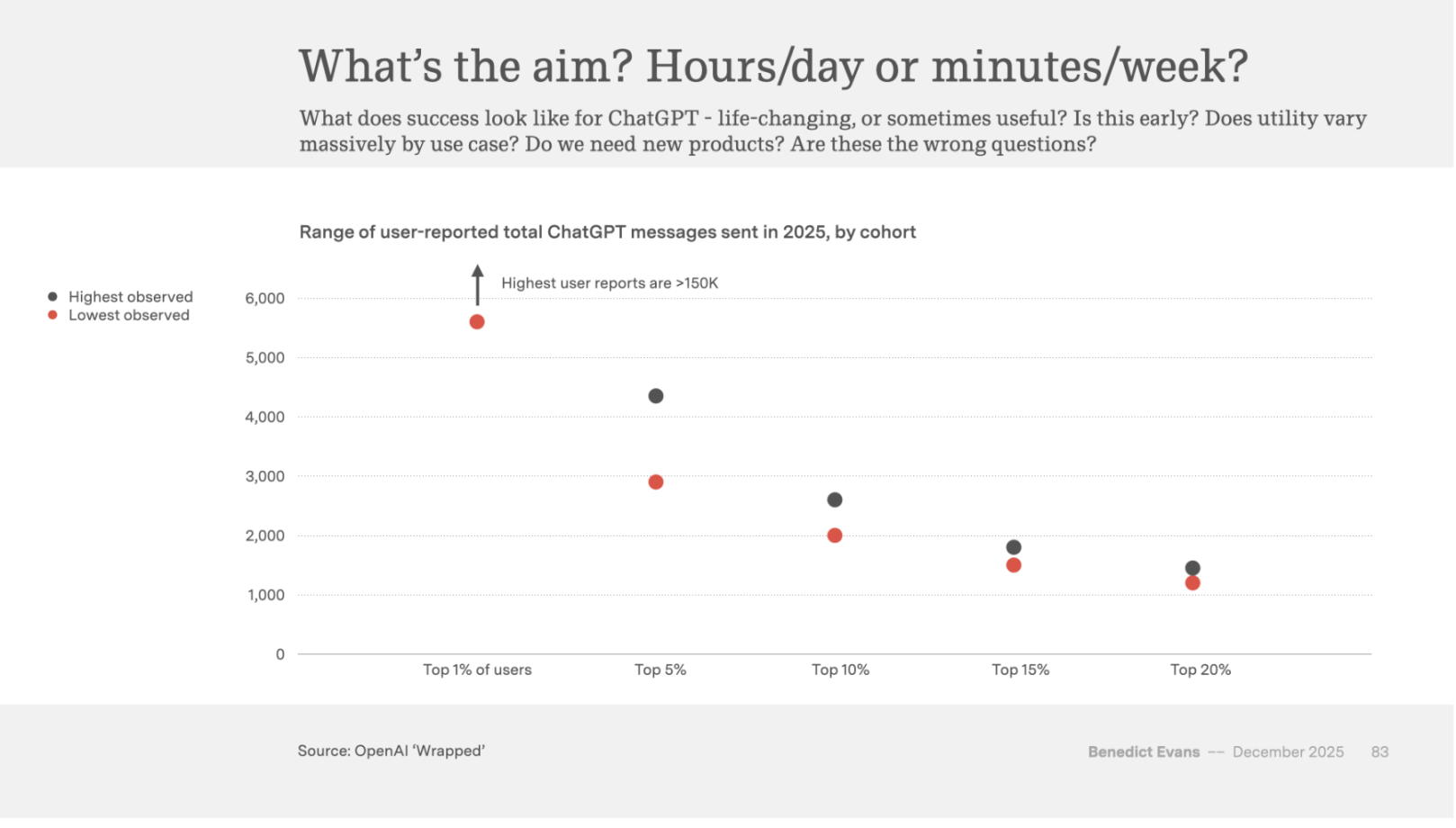
OpenAI itself has acknowledged the issue, proposing a "capability gap" between model capabilities and actual user usage. Evans sees this as sidestepping the fact that product-market fit is unclear. If users can't figure out what to use it for on an ordinary day, it means it hasn't changed their lives.

The company launched an advertising program partly to cover the service costs for the over 90% of non-paying users, but more strategically, this allows the company to offer these users the latest, most powerful (and most expensive) models, hoping to deepen user engagement. However, Evans questions whether giving users a better model will change the situation if they can't think of what to do with ChatGPT today or this week.

Platform Strategy in Question: Lack of a True Flywheel Effect

Last year, OpenAI CEO Sam Altman attempted to integrate the company's various initiatives into a coherent strategy, presenting a chart and quoting Bill Gates: "A platform is when the economic value of everybody that uses it exceeds the value of the company that creates it." Meanwhile, the CFO released another chart showcasing a "flywheel effect."
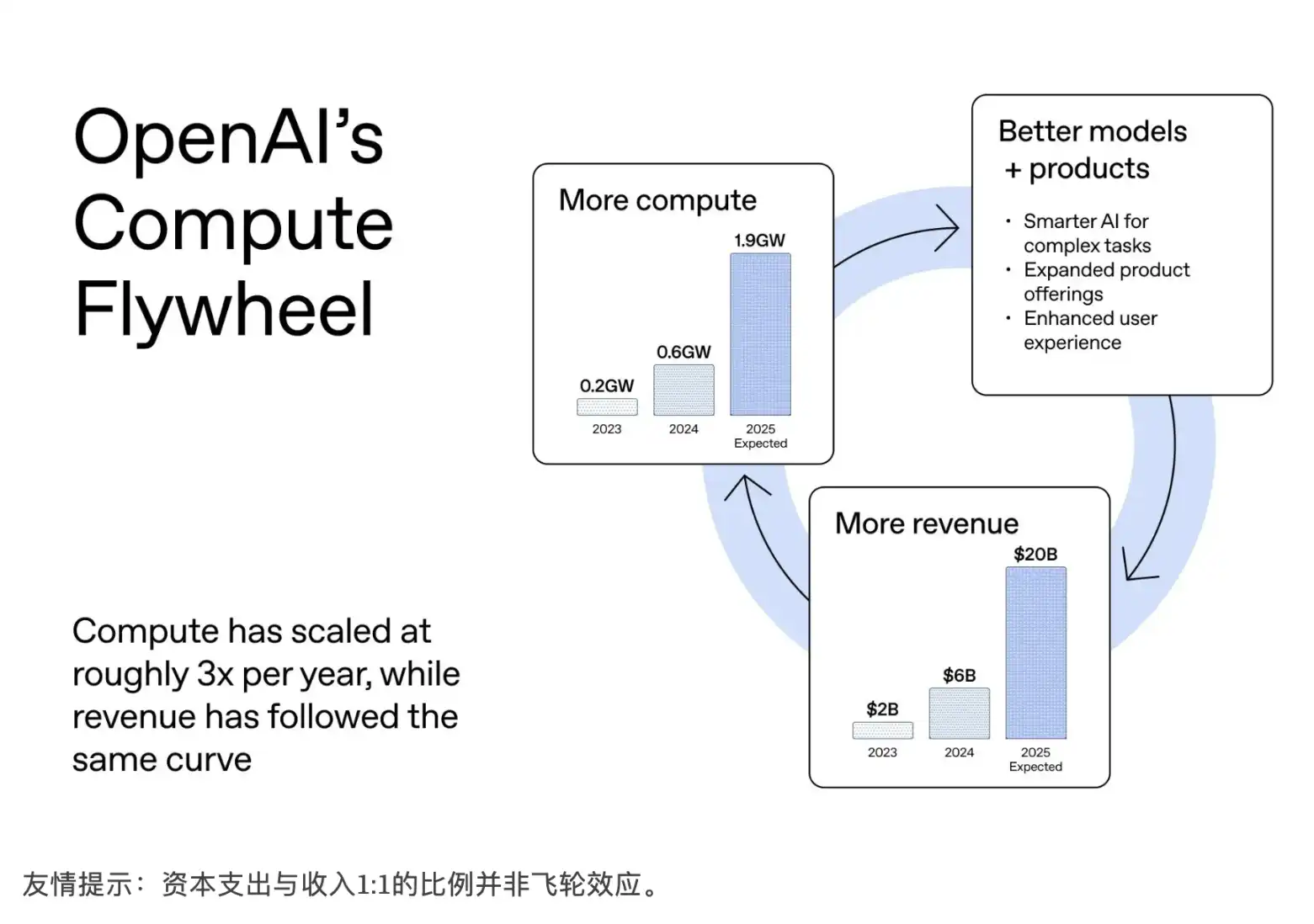
Evans considers the flywheel effect an elegant, coherent strategy: capital expenditure itself forms a virtuous cycle and becomes the foundation for building a full-stack platform company on top of it. Starting with chips and infrastructure, building up each layer of the tech stack; the higher you go, the more you help others use your tools to create their own products. Everyone uses your cloud, chips, and models, and then at higher layers, the layers of the tech stack reinforce each other, forming network effects and an ecosystem.

However, Evans bluntly states that he doesn't believe this is the right analogy, that OpenAI does not possess the platform and ecosystem dynamics that Microsoft or Apple once had, and that flywheel chart does not actually depict a true flywheel effect.

In terms of capital expenditure, the four major cloud computing firms invested about $400 billion in infrastructure last year and announced at least $650 billion for this year. OpenAI claimed a few months ago to have future commitments of $1.4 trillion and 30 gigawatts of computing power (with no clear timeline), while actual usage at the end of 2025 was 1.9 gigawatts. Lacking the large-scale cash flow from an existing business, the company achieves these goals through financing and using others' balance sheets (partly involving "recurring revenue").

Evans believes that massive capital investment might just buy a seat at the table, not a competitive advantage. He draws an analogy between AI infrastructure costs and aircraft manufacturing or the semiconductor industry: no network effects, but the process for each generation of products becomes more difficult and expensive, eventually leaving only a few companies able to sustain the investment required to stay at the frontier. However, while TSMC has a de facto monopoly in cutting-edge chips, this does not give it leverage or value capture ability further up the tech stack.

Evans points out that developers had to build apps for Windows because it had almost all the users, and users had to buy Windows PCs because it had almost all the developers—that's network effects. But if you invent a great new app or product using generative AI, you simply call the base model running in the cloud via an API, and the user doesn't know or care which model you used.

Lack of Product Leadership: Strategy Constrained by the Lab

Evans begins his article by quoting OpenAI product lead Fidji Simo from 2026: "Jakub and Mark set the long-term research direction. After months of work, amazing results emerge, and then the researchers contact me and say: 'I have something cool. How are you going to use it in chat? How for our enterprise products?'"

This stands in stark contrast to Steve Jobs' famous 1997 quote: "You've got to start with the customer experience and work backwards to the technology. You can't start with the technology and try to figure out where to sell it."

Evans argues that when you are the product lead at an AI lab, you cannot control your own roadmap; your ability to set product strategy is very limited. You open your email in the morning to find out what the lab research has produced, and your job is to turn it into a button. Strategy happens elsewhere, but where?

This issue highlights the fundamental challenge facing OpenAI: unlike Google in the 2000s or Apple in the 2010s, OpenAI's smart and ambitious employees do not have a truly effective product that others cannot replicate. Evans suggests that one interpretation of OpenAI's activities over the past 12 months is that Sam Altman is deeply aware of this and is trying to convert the company's valuation into a more lasting strategic position before the music stops.

For most of last year, OpenAI's answer seemed to be 'everything, all at once, immediately.' App platform, browser, social video app, collaboration with Jony Ive, medical research, advertising, etc. Evans believes some of this looks like "throwing everything at the wall," or simply the result of rapidly hiring lots of aggressive people. At times, it also gives the feeling that people are replicating the forms of previously successful platforms without fully understanding their purpose or dynamic mechanisms.

Evans repeatedly uses terms like platform, ecosystem, leverage, and network effects, but he acknowledges these terms are widely used in the tech industry with rather vague meanings. He quotes his university medieval history professor Roger Lovatt: "Power is the ability to make people do what they do not want to do." This, he suggests, is the real question: Does OpenAI have the ability to make consumers, developers, and enterprises use its system more, regardless of what the system actually does? Microsoft, Apple, and Facebook once had this power, as did Amazon.
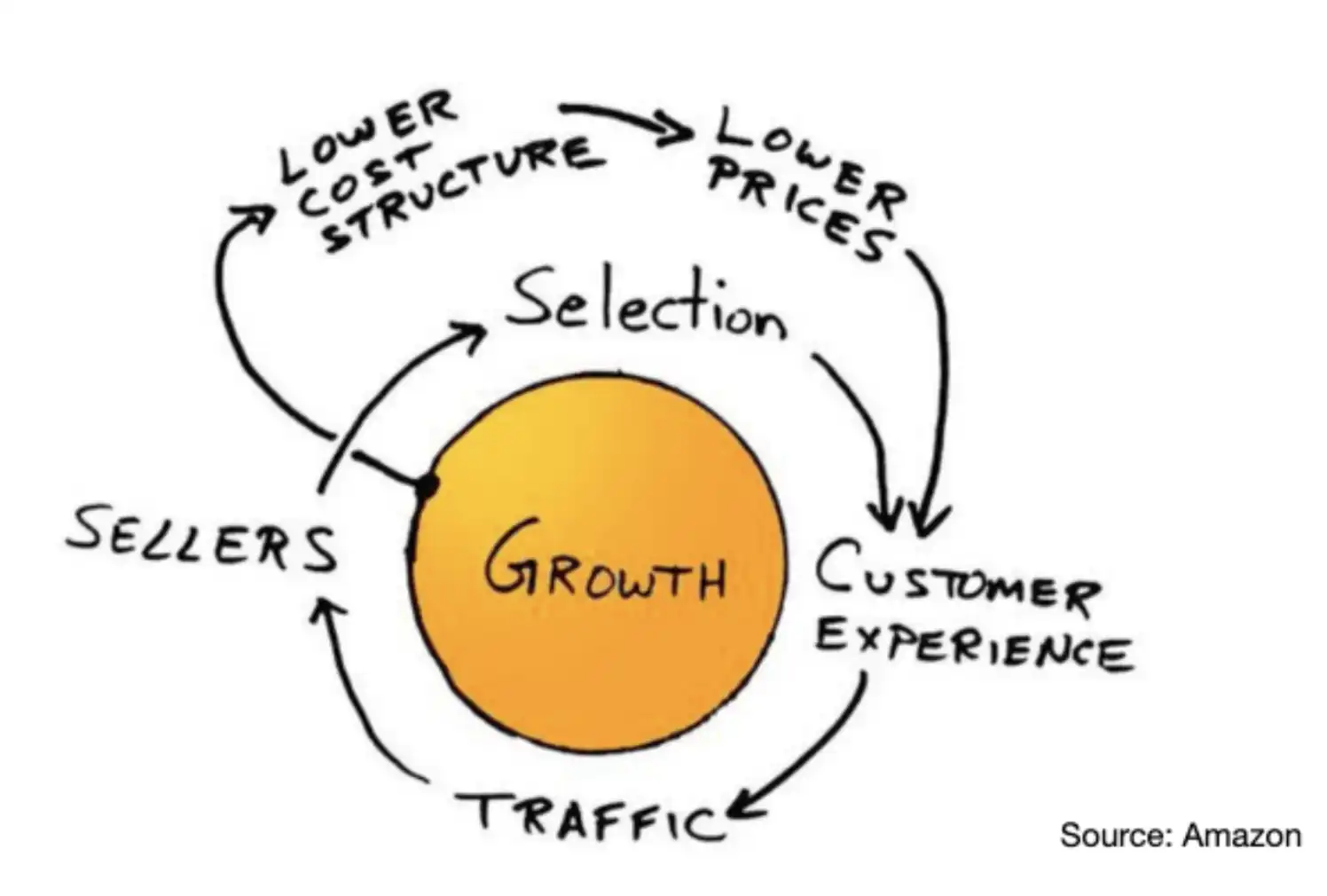
Evans believes a good way to interpret Bill Gates's quote is that what a platform truly achieves is leveraging the creativity of the entire tech industry, so you don't have to invent everything yourself; you can build much more, at scale, but all of it is done on your system, under your control. Foundation models are indeed multipliers; a lot of new things will be built with them. But do you have a reason why everyone must use your product, even if competitors have built the same thing? Is there a reason why your product will always be better than competitors', no matter how much money and effort they invest?

Evans concludes that without these advantages, then all you have is execution, day after day. Executing better than everyone else is certainly an aspiration, and some companies have done it for extended periods, even convincing themselves they've institutionalized it, but it is not a strategy.


Пов'язані питання

QWhat are the four fundamental strategic dilemmas facing OpenAI according to Benedict Evans' analysis?

AAccording to Benedict Evans, OpenAI faces four fundamental strategic dilemmas: 1) Lack of a technological moat, 2) Insufficient user stickiness, 3) Rapid competition catching up, and 4) Product strategy being constrained by the lab's research direction.

QWhy does Evans argue that OpenAI lacks a technological moat despite its large user base?

AEvans argues that OpenAI lacks a technological moat because about six institutions can now produce competitive frontier models with roughly equivalent performance. No company has established an unassailable technical lead, and there is an absence of network effects or user lock-in mechanisms that create self-reinforcing market share like those seen with Windows or Google Search.

QWhat user engagement data does Evans cite to demonstrate ChatGPT's 'shallow' usage pattern?

AEvans cites data showing that only 5% of ChatGPT users are paying subscribers. Furthermore, OpenAI's own '2025 Year in Review' disclosed that 80% of users sent fewer than 1,000 messages in 2025, which averages to less than three prompts per day, indicating it has not become a daily habit for the vast majority of its user base.

QHow does Evans critique OpenAI's 'flywheel' platform strategy and capital expenditure plans?

AEvans critiques the 'flywheel' strategy by arguing that massive capital expenditure (e.g., $1.4T in future compute commitments) may only buy a seat at the table rather than a competitive advantage. He states that OpenAI lacks the true platform dynamics and network effects of companies like Windows, where developers and users are locked into an ecosystem. He compares it to capital-intensive industries like semiconductor manufacturing, where high costs create barriers but do not inherently grant leverage over the rest of the tech stack.

QWhat core contradiction does Evans identify in OpenAI's product development process, as illustrated by a quote from its product head?

AEvans identifies a core contradiction where product strategy is dictated by the research lab, not customer needs. He contrasts a quote from OpenAI's product head—where researchers contact her to find a use for a new discovery—with Steve Jobs' philosophy of starting with the customer experience and working backward to the technology. This indicates that OpenAI's product team has limited control over its roadmap, and strategic direction happens elsewhere, leading to a reactive rather than a market-driven product strategy.

Пов'язані матеріали

STAR 50 Soars 10.73%, Why Did A-Shares Stage a "V-Shaped Reversal"?

After a prolonged decline, the Chinese A-share market staged a strong rally on July 21. The STAR 50 index surged 10.73%, its largest single-day gain in nearly a year, leading a broad-based "V-shaped" reversal. The Shanghai Composite Index rose 1.79%, the Shenzhen Component Index gained 4.81%, and the ChiNext Index jumped 7.05%. Total market turnover reached 2.97 trillion yuan, an increase of 256.1 billion yuan from the previous session, with over 3,100 stocks advancing. The semiconductor sector spearheaded the rebound, with related ETFs posting significant gains. Analysts attribute the surge to three converging factors. First, coordinated capital inflows from "national team" institutions, insurance funds, listed company buybacks, and fund house self-purchases have bolstered market liquidity and confidence. Second, supportive policy signals, including commitments from regulators to ensure stable market operations, provided a favorable backdrop. Third, a stabilization and recovery in overseas markets, notably South Korea, created a positive external environment. Institutions suggest the most severe panic selling phase for the tech sector has likely passed, following a significant digestion of crowded positions and leveraged funds. While short-term volatility may persist, the medium to long-term outlook remains underpinned by enduring trends like AI computing demand expansion and semiconductor localization. The market's focus now shifts to the sustainability of supportive fund flows, earnings reports, and upcoming catalysts from the global AI industry chain.

marsbit19 хв тому

STAR 50 Soars 10.73%, Why Did A-Shares Stage a "V-Shaped Reversal"?

marsbit19 хв тому

U.S. Tech Momentum Stocks Post Largest Single-Day Gain Ever, But Is the Plunge Over?

US tech momentum stocks staged a sharp rebound on Tuesday (July 21st). Morgan Stanley's TMT Momentum Factor surged over 12%, marking its largest single-day gain on record, exceeding even peaks from the 2000 dot-com bubble. Key momentum indices from Goldman Sachs also posted their strongest daily performances in years. The rally was led by semiconductors, with the Philadelphia Semiconductor Index jumping 4.6%. This rebound followed three consecutive down days and a cumulative 33% plunge in momentum stocks, one of the steepest drawdowns since the dot-com era. Analysts attribute the surge largely to a short squeeze. Heavy selling had pushed high-beta momentum stocks into deeply oversold territory, forcing many short sellers, particularly in Asia, to cover their positions, creating a self-reinforcing buying spiral. However, the rebound's internals appear weak. Trading volume was notably low, and advancing stocks still lagged decliners on the S&P 500, indicating a narrow, concentrated rally rather than broad market participation. Diverging views emerge on the outlook. BTIG warns the bounce has hit key resistance and recommends selling into strength, citing extreme volatility and historical parallels to past market tops. Conversely, Goldman Sachs and UBS believe the momentum unwind is nearing its end, suggesting it may be time to gradually add exposure, as positioning has been significantly reduced. They caution, however, that high volatility warrants a measured approach, potentially using defined-risk strategies. The upcoming earnings season, particularly reports from major tech firms like Alphabet, is seen as a critical test for the rally's sustainability. Simultaneously, bond markets flashed a warning, with yields rising partly due to spiking oil prices. Analysts note that if long-term Treasury yields break decisively higher, it could pose a significant headwind for equities, especially growth stocks.

marsbit26 хв тому

U.S. Tech Momentum Stocks Post Largest Single-Day Gain Ever, But Is the Plunge Over?

marsbit26 хв тому

U.S. Tech Momentum Stocks Record Largest Single-Day Gain Ever, but Has the Rout Ended?

U.S. tech momentum stocks staged a dramatic rebound on Tuesday, July 21st. Key momentum indices like the Morgan Stanley TMT Momentum Factor and Goldman Sachs' High Beta Momentum Long Index posted historic or near-historic single-day gains, fueled largely by semiconductor stocks. This sharp rally followed a severe three-day sell-off that saw momentum stocks plunge 33%, marking one of the steepest pullbacks since the dot-com bubble. Analysts attribute the bounce primarily to a short squeeze, as forced covering from over-leveraged traders, particularly in Asia, created a buying spiral. However, the rally's health is questioned due to weak market breadth—overall trading volume was low, and decliners outnumbered advancers in the S&P 500 despite the index's gain—suggesting a narrow, concentrated surge rather than broad recovery. Opinions on the sustainability diverge. BTIG strategists warn the rebound has hit key resistance levels, citing extreme volatility and historic stock dispersion as signs of an ongoing broader correction, and recommend selling into strength. Conversely, Goldman Sachs and UBS view the aggressive momentum unwinding as nearing its end, noting reduced positioning and a lack of new fundamental catalysts. They suggest the sell-off presents a selective opportunity to add exposure, albeit cautiously and gradually using defined-risk strategies. The immediate trajectory hinges on the ongoing earnings season, with market focus on Alphabet's capital expenditure guidance for AI investment clarity. Meanwhile, bond markets present a risk, with rising Treasury yields—potentially heading toward 5.5%—and widening credit spreads for mega-cap tech companies posing a threat to equity valuations. The combination of technical factors, earnings results, and macro conditions leaves the durability of the rebound in doubt.

链捕手29 хв тому

U.S. Tech Momentum Stocks Record Largest Single-Day Gain Ever, but Has the Rout Ended?

链捕手29 хв тому

Long-Divided Must Unite, Long-United Must Divide: When L1 Becomes Its Own Rollup, What Is Ethereum's Endgame?

"The Inevitable Cycle: When L1 Becomes Its Own Rollup – What is Ethereum's Endgame?" For years, the Ethereum community grappled with concerns that L2s were fragmenting the ecosystem and eroding L1's value. While L2s provided cheaper execution, they also splintered liquidity and the unified user experience of a single chain. This has prompted a fundamental reassessment of the relationship between L1 and L2. Ethereum's roadmap is evolving. The "Scale" initiative merges L1 and L2 expansion into a holistic framework. L1 itself is advancing with higher gas limits, statelessness, and zkEVM verification, no longer content to be just a low-throughput settlement layer. Consequently, the primary value proposition of L2s is shifting from merely providing cheap blockspace to offering L1 cannot easily provide: application-specific optimizations, privacy features, and flexible governance models. L2s are becoming a spectrum of execution environments with varying degrees of security inheritance from Ethereum. A critical challenge in this multi-chain future is interoperability. The vision is to make Ethereum "feel like one chain again." This relies on advancements in native account abstraction (like EIP-7702) and intent-based architectures (Open Intents Framework), where users declare desired outcomes, and solvers handle the complex cross-chain execution. Furthermore, shortening Ethereum's finality time from minutes to seconds is crucial, as it underpins trust between chains for bridges, stablecoins, and cross-chain applications. Perhaps the most provocative idea is that Ethereum L1 itself could become a form of "its own Rollup." As zkEVM and proof systems mature, high-performance nodes could execute transactions and generate validity proofs. Regular validators would then verify these proofs instead of re-executing all transactions. This blurs the traditional L1/L2 hierarchy, making "Rollup" more of a general execution-verification architecture. Native Rollup aims to integrate L2 validation more directly into the Ethereum protocol, allowing L2s to inherit L1's security more fully and move away from reliance on security councils. In the end, L2s are not destined to replace L1 or be made obsolete by it. The likely future is a unified system where diverse execution environments—each optimized for specific use cases like DeFi, gaming, or privacy—coexist. They will share a common foundation of security, liquidity, and verifiable state, seamlessly connected to restore a cohesive user experience. The next phase for Ethereum is not just about scaling through separation, but about intelligently reintegrating what was separated back into a coherent whole.

链捕手45 хв тому

Long-Divided Must Unite, Long-United Must Divide: When L1 Becomes Its Own Rollup, What Is Ethereum's Endgame?

链捕手45 хв тому

Торгівля

Спот
活动图片




